









- bhavya gada
- No Comments
If you build a retention or detention basin in Maryland, you will often pay both state permit fees and local review or utility fees. For many projects, the first state fee starts at $1,600 and can reach $9,600, based on disturbed acreage. On top of that, counties or cities may charge for grading, erosion and sediment control review, stormwater plan review, inspections, and yearly stormwater bills.
Here’s the short version:
- State fee: MDE construction permit fee for sites that usually disturb 1 acre or more
- Local upfront fees: grading, ESC review, and stormwater plan review
- Yearly local fees: stormwater utility or remediation charges after the work is done
- Main cost drivers: disturbed area, impervious surface, and project location
- Key timing point: local ESC approval usually must happen before MDE issues permit coverage
If I were budgeting a Maryland basin project, I’d treat the fees in two groups:
- One-time preconstruction costs
- Recurring local charges after construction
That simple split makes the process easier to follow and helps avoid missing a county or city fee that can change the total cost by a lot.
Quick comparison
| Fee type | Who sets it | When I pay it | What affects the cost |
|---|---|---|---|
| MDE construction permit | State | Before construction | Disturbed acreage |
| Grading / ESC review | County or city | Before construction | Local fee schedule, site work |
| SWM plan review | County or city | Before construction | Plan scope, impervious area |
| Stormwater utility fee | County or city | Annual | Impervious surface, ERUs, property class |
Bottom line: the basin itself is only part of the cost. In Maryland, the full fee picture usually depends more on where the site is and how much land the project disturbs than on whether the basin is called retention or detention.
sbb-itb-843f8be
Maryland’s regulatory framework for stormwater fees
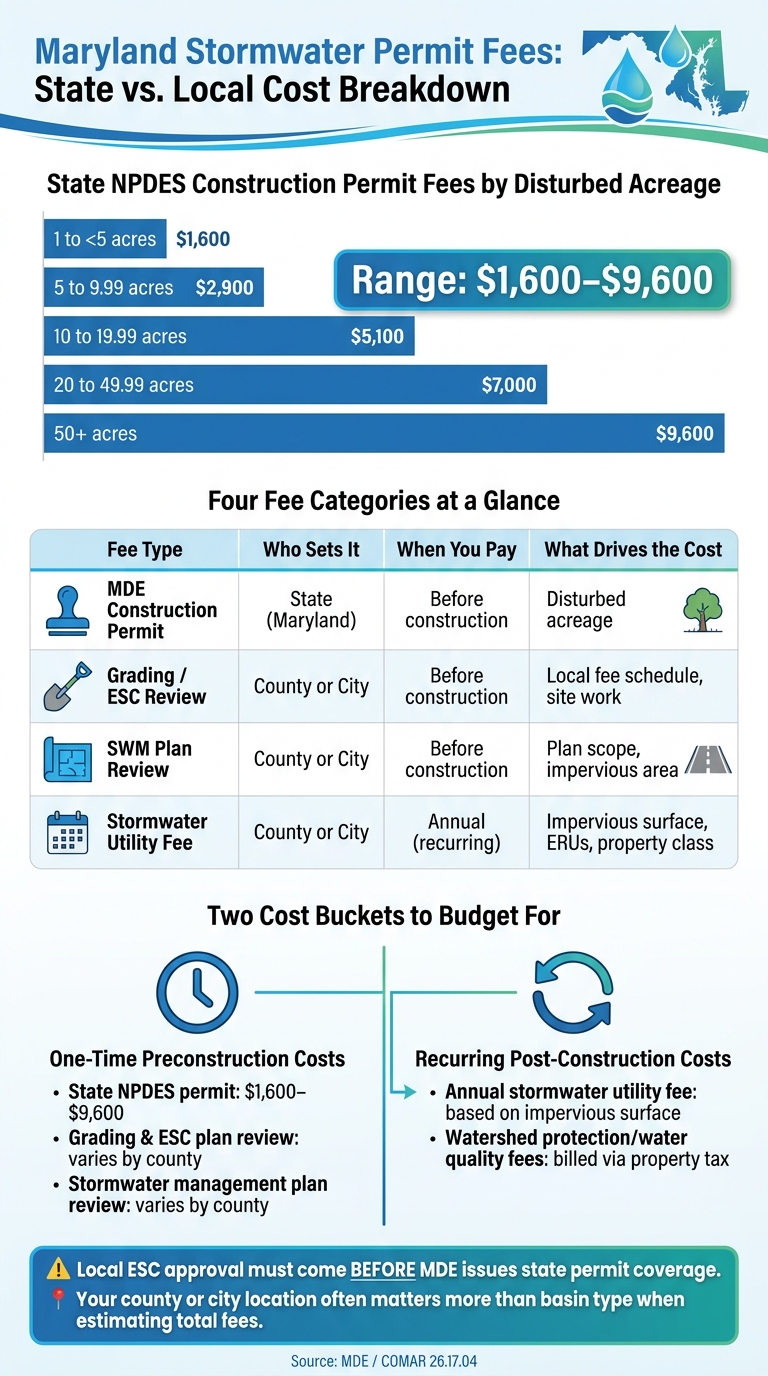
Maryland Stormwater Permit Fees: State vs. Local Cost Breakdown
Maryland stormwater fees work on two levels: state NPDES construction permits and local ESC plan review and inspection fees [1].
State stormwater law and MS4 compliance
This setup begins with the Maryland Stormwater Management Act of 2007 and COMAR 26.17.04 [1]. Post-construction rules for basins come from the 2009 Maryland Stormwater Design Manual, which puts the focus on Environmental Site Design (ESD) so sites behave more like they did before development changed the land [1]. In plain English, that means the design standards affect what gets reviewed, how much detail a jurisdiction has to check, and what approval ends up costing.
MS4 permits require counties and municipalities to pay for ESC review and inspections through local fee schedules. Those schedules help cover the cost of running the program and staying in line with state and federal rules [1]. That’s the mechanism that turns stormwater regulation into project fees.
Permit fees versus stormwater utility charges
Permit fees are one-time project charges. For construction activity, MDE fees range from $1,600 to $9,600 based on disturbed area [1]:
| Total Disturbed Area | MDE Construction Activity Fee |
|---|---|
| 1 to < 5 acres | $1,600 |
| 5 to 9.99 acres | $2,900 |
| 10 to 19.99 acres | $5,100 |
| 20 to 49.99 acres | $7,000 |
| 50+ acres | $9,600 |
Stormwater utility charges are not the same thing. They recur and often show up on property tax bills as watershed protection or water-quality fees [1]. Those charges pay for MS4 compliance over time, including infrastructure maintenance, water quality monitoring, and long-term remediation programs [1].
So the split is pretty simple:
- Permit fees are one-time, preconstruction costs.
- Utility charges continue after the basin is built.
Next: the specific fees that apply to basin projects, including plan review, grading, erosion control, and recurring local charges.
Fee categories that apply to retention and detention basins
Basins usually run into three main fee buckets: local plan review, construction-related permits, and recurring stormwater charges.
Stormwater management plan review and approval fees
Local approving authorities review SWM plans for ESD compliance and may charge a separate plan-review fee [1]. That fee can change a lot from one jurisdiction to the next, which is why county fee schedules matter so much.
Grading, sediment and erosion control, and construction permit fees
Basin work often triggers separate grading and ESC permits, plus state NPDES coverage [1]. There’s one catch that trips people up: local ESC plan approval must come first – MDE will not issue state construction permit coverage until that local sign-off is in hand [1]. In practice, local permit costs vary by county and can end up costing more than the filing fee alone.
Annual stormwater utility and remediation fees
After construction, counties and municipalities may charge recurring stormwater utility or remediation fees to fund MS4 compliance, maintenance, and watershed restoration [1]. These charges are usually tied to impervious area, property class, or ERUs. The next section compares how those local charges differ across central Maryland jurisdictions.
How fee structures differ across central Maryland jurisdictions
In central Maryland, the biggest fee differences usually come from the county or municipality, not the basin type. Each local government sets its own review schedule, so costs can shift from one jurisdiction to the next. And one point matters a lot here: local approval still comes before MDE coverage.
Howard County and Montgomery County fee models
Howard County and Montgomery County mainly split on local review fees. The state fee still ties back to disturbed acreage, but the local piece can change the total by a fair amount. That’s why county-by-county budget checks aren’t just a nice extra – they’re part of the basic math.
Prince George’s County and city-level fee examples

Prince George’s County has its own local approval step and fee schedule. If a site sits inside a municipality, that city may also have a separate approval process and its own fee schedule.
| Jurisdiction / Authority | Fee Type | Calculation Basis | Budget Impact |
|---|---|---|---|
| Central Maryland counties/municipalities | Local grading and ESC plan review | Local fee schedule | One-time local review charge; varies by jurisdiction [1] |
Local fees can add materially to the state fee. Those local differences shape the upfront budget items covered next.
Budget impact and project planning for Maryland property owners
For Maryland property owners, basin work usually comes with two kinds of costs: one-time permit fees and recurring local stormwater charges.
The total price can swing a lot from one project to the next. In most cases, it comes down to three things: the total disturbed area, any changes to impervious surface, and the county or municipality where the site sits. That last part matters a lot. Local governments set their own fee schedules for grading permits, ESC plan review, and stormwater management plan approval, so the same type of project can cost very different amounts depending on location.
Here’s where those costs usually land:
| Fee Category | Frequency | Calculation Basis | Variability |
|---|---|---|---|
| State NPDES construction permit | One-time | Total disturbed acreage ($1,600–$9,600) [1] | Low – fixed by state |
| Grading & ESC Plan Review | One-time | Local fee schedule / disturbed area | High – jurisdiction-dependent |
| Stormwater Management Plan Review | One-time | Project complexity / impervious area | High – jurisdiction-dependent |
| Stormwater Utility Fee | Annual | Post-construction impervious surface | Moderate – local rates vary |
Key takeaways for retention and detention basin projects
Pull the county fee schedule before you lock in your budget.
FAQs
Do I need both state and local approvals?
Yes. In many cases, stormwater projects in Maryland need both state and local approval.
At the state level, the Maryland Department of the Environment handles key requirements. That includes a construction stormwater permit for projects that disturb 1 acre or more.
At the local level, counties and municipalities may have their own stormwater rules, permits, and fees. So before you move ahead, check with your local planning department too.
When does the MDE permit fee apply?
The MDE permit fee applies to construction projects that disturb 1 acre or more of land.
Before work begins, developers need to get a General Permit for Stormwater Associated with Construction Activity and submit the fee along with a Notice of Intent.
The fee depends on the total number of acres disturbed. It ranges from $1,600 for projects that disturb 1–5 acres to $9,600 for projects that disturb 50 acres or more.
How can I estimate my total stormwater fees?
Estimate total stormwater fees by combining annual charges with one-time permit costs.
For homes and business properties, annual fees usually fall between $21 and $264, depending on the county.
Construction permit costs depend on how much land is disturbed:
- $100 for 1 to 10 acres
- $2,500 for more than 20 acres
- Up to $9,600 for larger commercial or industrial projects
That gives you a simple way to size up the total cost before a project starts.
Chat with Us