









- bhavya gada
- No Comments
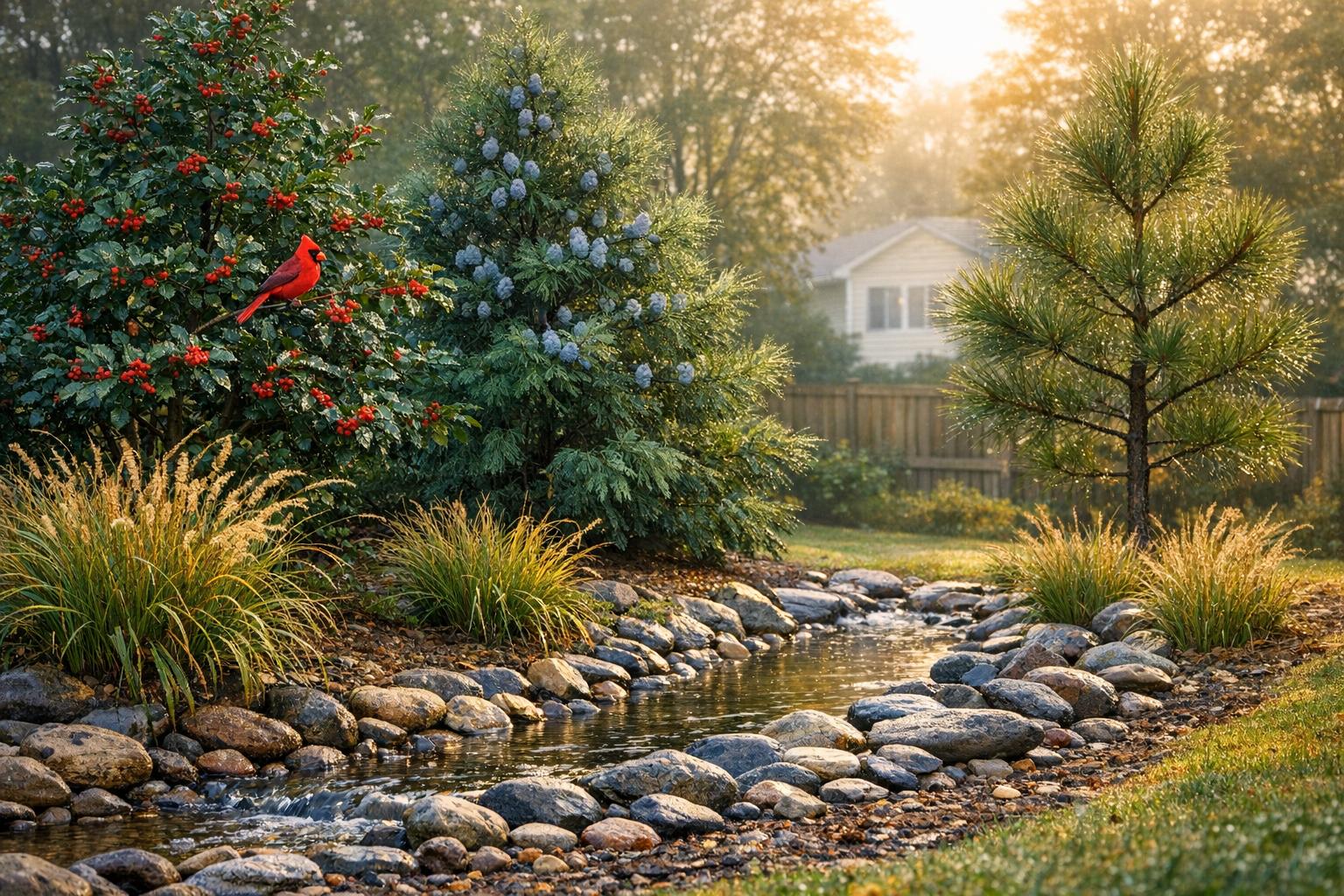
Native evergreens like Eastern red cedar, American holly, and Eastern white pine are ideal for Maryland’s landscapes. They thrive in the region’s climate, improve biodiversity, and help manage stormwater runoff. These trees offer year-round benefits, including erosion control, wildlife support, and privacy screening. Their low maintenance needs and ability to handle varying soil and weather conditions make them a practical choice for residential and commercial properties. Whether for aesthetics or ecological purposes, native evergreens are a smart investment for Maryland homeowners and landscapers.
Key Benefits:
- Erosion Control: Year-round root activity stabilizes soil.
- Wildlife Habitat: Provides food and shelter for birds and insects.
- Stormwater Management: Reduces runoff and improves water quality.
- Low Maintenance: Requires less water and care compared to non-native species.
- Visual Appeal: Adds structure and greenery throughout the year.
- Privacy and Noise Reduction: Dense foliage creates natural screens.
For best results, choose species suited to your soil and sunlight conditions, and plant during early fall or spring. Experts like Pro Landscapes MD can help ensure proper planting and long-term success.
Bay-Wise 2.0: Expanding the Role of Native Plants in Creating Climate-Resilient Maryland Communities
sbb-itb-843f8be
Ecological Benefits of Native Evergreens
Maryland’s native evergreens play a crucial role in maintaining the health of local ecosystems. These plants have adapted to the region’s wildlife, soil, and climate, making them key contributors to the environment. Let’s dive into how they support wildlife, enhance biodiversity, and stabilize soil.
Wildlife Habitat and Food Sources
Native evergreens offer vital shelter and food for wildlife throughout the year. Their dense branches create natural insulation, forming microclimates that are several degrees warmer than surrounding areas. This slight temperature difference can mean the difference between life and death for animals during harsh winters.
Food is just as critical as shelter. For example, American holly (Ilex opaca) retains its berries well into winter, providing sustenance when other food sources are scarce. Eastern red cedar (Juniperus virginiana) produces berry-like cones that feed at least 50 bird species, while Eastern white pine (Pinus strobus) offers seeds enjoyed by finches, crossbills, squirrels, and chipmunks. Additionally, evergreen foliage supports caterpillars and other invertebrates, which are essential for insect-eating birds like chickadees and warblers – especially during late winter and early spring when deciduous trees are bare.
Supporting Biodiversity
Native evergreens have a unique advantage when it comes to biodiversity because they’ve co-evolved with local wildlife over thousands of years. This close relationship means that many native species rely on these plants in ways they cannot rely on non-native alternatives. Research highlighted by the National Wildlife Federation, based on the work of entomologist Douglas Tallamy, reveals that native plants support up to 35 times more species of moths and butterflies (Lepidoptera) than non-native plants. This abundance of insects, in turn, supports a richer variety of birds and other wildlife.
Non-native evergreens, on the other hand, often fail to provide comparable benefits. Some even harm ecosystems by becoming invasive; for instance, English ivy and certain non-native junipers can overrun native plants, reducing habitat diversity. Planting a mix of native evergreens helps create layered habitats that support a wider range of species and ecological roles.
Erosion Control and Soil Stabilization
Native evergreens excel at preventing erosion, thanks to their year-round root activity. Unlike deciduous trees, which go dormant in winter, evergreens continue to anchor soil during the most erosion-prone times – freeze-thaw cycles and early spring storms.
Their roots stabilize soil at various depths, improve water infiltration, and reduce surface runoff. Meanwhile, their canopies soften the impact of rainfall, preventing soil crusting. Over time, fallen needles and leaves form a natural mulch that slows water flow and nourishes soil microbes. Data from the Chesapeake Bay region shows that riparian forest buffers, which often include native evergreens, can reduce sediment loss by 60–90% and cut nitrogen and phosphorus runoff by 40–80%. On steep slopes where turfgrass struggles due to shallow roots, deep-rooted native evergreens provide a long-lasting and effective solution for soil stabilization.
Climate Resilience and Site Adaptability
How Native Evergreens Handle Maryland’s Climate
Maryland’s climate is a tough balancing act – hot, sticky summers, freezing winters, and those unpredictable freeze-thaw cycles in between. While these extremes can wreak havoc on many ornamental plants, native evergreens have spent thousands of years thriving under these conditions. Take the Eastern white pine (Pinus strobus) and American holly (Ilex opaca), for example – they’re well-suited to a range of USDA Hardiness Zones, making them reliable choices for Maryland landscapes.
What makes native evergreens so dependable? Their ability to withstand harsh weather without much help. The Eastern redcedar (Juniperus virginiana) is practically a superhero when it comes to tough environments. It can handle road salt, wind, compacted soil, and even drought, making it perfect for challenging spots like roadsides, driveways, or cramped urban spaces. Meanwhile, the Atlantic white-cedar (Chamaecyparis thyoides) thrives in soggy, acidic soils and can even tolerate occasional flooding, filling a role that few other plants can manage. If you’re planting these evergreens, fall is the ideal time. The warm soil encourages root growth before winter sets in, helping the plants gear up for summer’s heat. Their resilience also plays a key role in managing stormwater and improving air quality.
Stormwater Management and Air Quality
Since Maryland lies entirely within the Chesapeake Bay watershed, how we manage rainfall in our landscapes has ripple effects on water quality for millions of people. Here’s where native evergreens shine. Unlike deciduous trees that lose their leaves, evergreens work year-round, intercepting rainfall during those heavy late-fall and early-spring storms. According to the Chesapeake Bay Program, trees and forests in the watershed can cut stormwater runoff volumes by 40–80% compared to impervious surfaces like pavement.
The benefits don’t stop there. Trees, including evergreens, play a major role in cleaning the air. In Baltimore, for instance, the U.S. Forest Service estimates that the city’s tree canopy removes about 7,000 metric tons of air pollution annually. This includes harmful pollutants like ozone, nitrogen dioxide, sulfur dioxide, and particulate matter, with these services valued in the tens of millions of dollars every year. Evergreens, in particular, are heavy lifters during winter when deciduous trees are dormant. Plus, their canopies help combat the urban heat island effect, providing shade and cooling the air through evapotranspiration. Studies show urban trees can lower surrounding temperatures by 2–9°F, making them not just eco-friendly but people-friendly too.
Low Maintenance and Long-Term Value
One of the best perks of native evergreens? They’re low maintenance. Compared to non-native ornamentals, they need 25–50% less irrigation and fewer resources to stay healthy. Adapted to Maryland’s soils, rainfall, and pests, these evergreens rarely require fertilizer, pesticides, or frequent pruning.
Choosing the right species for the right spot makes all the difference. For example, plant Virginia pine or pitch pine on dry slopes, American holly along woodland edges, and Atlantic white-cedar in wet areas. Once established – usually after one or two growing seasons with regular watering – these plants are largely self-sufficient. That means lower maintenance costs in the long run, a major reason why choose us for municipalities, HOAs, and commercial properties increasingly adopting "Right Tree, Right Place" policies. Native evergreens are becoming the go-to choice for screens, buffers, and streetscapes across Maryland, thanks to their ability to thrive with minimal intervention while delivering year-round ecological benefits.
Aesthetic and Landscape Design Value
In addition to their ecological benefits, native evergreens bring both beauty and functionality to Maryland landscapes.
Year-Round Visual Appeal
Native evergreens are the backbone of Maryland gardens. While perennials fade and deciduous trees lose their leaves during the colder months, evergreens maintain their structure, color, and texture throughout the year. Landscape designers often refer to them as the "bones" of a garden – providing strong, enduring shapes like cones, columns, and rounded mounds that keep outdoor spaces looking polished, even in the depths of winter.
Strategic placement is key. For instance, an American holly (Ilex opaca) near a front entrance or a cluster of inkberry holly (Ilex glabra) along a foundation can keep these focal areas visually appealing regardless of the season. Their subtle seasonal changes – new growth in spring, berries in fall, and snow-dusted branches in winter – add interest without overwhelming the landscape. In commercial settings, evergreen plantings around entrances and signage can influence customer perceptions of care and quality. According to surveys from the National Association of Realtors, strong curb appeal – often supported by evergreens – can contribute to home price premiums of 5–11%.
But their benefits go beyond aesthetics. Native evergreens also provide privacy and help reduce noise.
Screening and Privacy
For year-round privacy, evergreens outperform fences or deciduous hedges. Eastern redcedar (Juniperus virginiana) and Eastern white pine (Pinus strobus) are excellent choices, forming dense, natural screens when planted in staggered rows 8–15 feet apart. In tighter spaces, the naturally narrow shape of some redcedars offers vertical privacy without taking up too much room.
Evergreens also excel at reducing noise. Their dense foliage absorbs sound, making them an effective barrier against road or neighborhood noise. A layered planting approach – tall conifers in the back with shorter shrubs like inkberry or mountain laurel in front – can soften noise from nearby traffic or commercial areas. Research on roadside vegetation shows that evergreen belts can cut near-road particulate pollution by up to 50% on the leeward side, further enhancing environmental quality. Additionally, a grove of evergreens can create a cozy, enclosed feel around patios or outdoor seating areas, making them more enjoyable year-round.
Pairing Evergreens with Mixed Plantings
Beyond privacy, evergreens serve as a versatile backdrop for mixed plantings. They create a steady visual foundation that highlights seasonal accents such as spring-blooming serviceberry, summer coneflowers, fall asters, and ornamental grasses like little bluestem.
A layered design works particularly well: tall evergreens in the back, mid-height shrubs like native hydrangea or fothergilla in the middle, and low-growing perennials or groundcovers in the front. Repeating the same evergreen species or shapes across multiple garden beds creates a sense of rhythm and unity, enhancing the overall visual appeal of the property. For homeowners looking to achieve this cohesive look, working with professionals like Pro Landscapes MD – experts in planting design, hardscaping and drainage solutions – can ensure that evergreen screens, focal points, and mixed borders are perfectly scaled and thoughtfully placed from the outset.
How to Choose and Plant Native Evergreens in Maryland
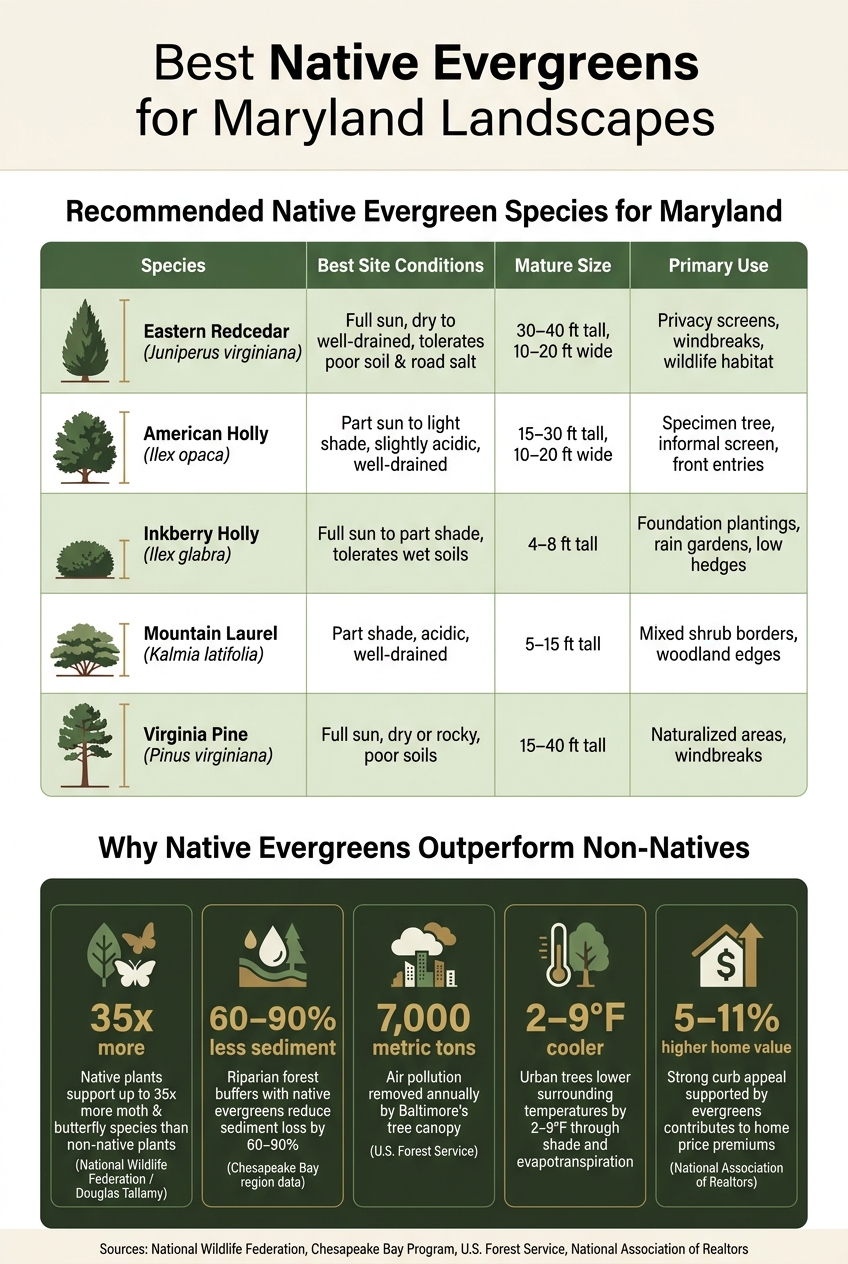
Native Evergreens for Maryland: Species Comparison & Key Benefits
To enjoy the benefits of native evergreens in your Maryland landscape, it’s important to choose the right species and plant them correctly.
Matching Plants to Site Conditions
Start by evaluating your property’s conditions – sunlight, soil type, moisture levels, and exposure. Determine how much sun each area gets: full sun (6+ hours), part shade (3–6 hours), or full shade (less than 3 hours). For soil, grab a moist handful and test its texture: sandy soil falls apart, clay sticks together, and loam crumbles lightly. Also, check for poor drainage by observing if water puddles linger for more than 24 hours after rain.
Exposure is another key factor. Areas near roads or open spaces may face challenges like winter road salt or strong winds, which can harm sensitive plants. Maryland’s diverse ecological regions also play a role. For example, Coastal Plain areas with sandy, acidic soils require different plants than the heavy clay soils found in the Piedmont region, which includes Howard, Montgomery, and Carroll counties. To get precise soil information, consider a soil test through the University of Maryland Extension. This can confirm soil pH and nutrients, helping you select species that will thrive in your specific conditions.
Recommended Native Evergreen Species for Maryland
Here’s a quick guide to some of the best native evergreens for Maryland, tailored to various landscape needs:
| Species | Best Site Conditions | Mature Size | Primary Use |
|---|---|---|---|
| Eastern redcedar (Juniperus virginiana) | Full sun, dry to well-drained, tolerates poor soil and road salt | 30–40 ft tall, 10–20 ft wide | Privacy screens, windbreaks, wildlife habitat |
| American holly (Ilex opaca) | Part sun to light shade, slightly acidic, well-drained | 15–30 ft tall, 10–20 ft wide | Specimen tree, informal screen, front entries |
| Inkberry holly (Ilex glabra) | Full sun to part shade, tolerates wet soils | 4–8 ft tall | Foundation plantings, rain gardens, low hedges |
| Mountain laurel (Kalmia latifolia) | Part shade, acidic, well-drained | 5–15 ft tall | Mixed shrub borders, woodland edges |
| Virginia pine (Pinus virginiana) | Full sun, dry or rocky, poor soils | 15–40 ft tall | Naturalized areas, windbreaks |
For privacy, Eastern redcedar works well when planted in staggered rows 8–15 feet apart. If you’re working with smaller spaces, inkberry holly is a great alternative to boxwood, offering similar structure without the risk of disease.
Working with a Landscape Professional
Even with the right species, proper planting is essential for long-term success. When digging the planting hole, make it 2–3 times as wide as the root ball but no deeper. The root flare – the spot where the trunk widens – should sit at or slightly above ground level. Use the original soil to backfill, then apply 2–3 inches of shredded hardwood mulch in a flat ring around the plant. Keep the mulch 3–6 inches away from the trunk to prevent rot. During the first growing season, water deeply once or twice a week, aiming for about 1 inch of water weekly.
The best times to plant in Maryland are early fall (September–October) and early spring (March–April). Fall is often preferred since the soil stays warm enough for root growth, while cooler air temperatures reduce stress on the plant.
Precision in planting is key. As noted by Pro Landscapes MD, a licensed Maryland forestry and horticulture expert:
"As a college educated horticulturalist, professional landscape designer and a licensed Maryland forester, landscape design and landscape restoration are specialty services offered by our company." – Pro Landscapes MD [4]
For homeowners looking to avoid mistakes with species selection, spacing, or planting techniques, Pro Landscapes MD offers professional help. With expertise in horticulture and forestry, they serve areas like Columbia, Ellicott City, Bethesda, and Towson, ensuring that your native evergreens thrive and add lasting beauty to your landscape.
Conclusion: Why Native Evergreens Matter for Maryland Landscapes
Native evergreens are a smart choice for Maryland property owners, offering long-lasting beauty, practical benefits, and year-round ecological advantages. Backed by research, these plants thrive across seasons and decades, making them a reliable option for sustainable landscaping. [5][6]
Their benefits grow over time. For example, an Eastern red cedar or American holly becomes increasingly effective as a windbreak, privacy screen, or wildlife habitat as it matures. Over the course of 10–20 years, these trees require fewer replacements, reduce erosion issues, and need less chemical maintenance. This makes them a low-maintenance and environmentally friendly solution, as highlighted throughout this article. [1][3]
From a design perspective, native evergreens provide structure and interest all year long. During the stark winter months, they keep properties looking polished, while in spring and summer, they create a backdrop that enhances the colors of native perennials and flowering shrubs.
Choosing regionally adapted native species is essential. Maryland’s diverse conditions, from the clay soils of the Piedmont to the sandy terrain of the Coastal Plain, can be challenging for generic evergreens found at garden centers. In contrast, native species are naturally suited to these environments, thriving with minimal care and ensuring long-term success. [1][2]
For properties with unique challenges like poor drainage, steep slopes, or large-scale planting needs, professional guidance can make a big difference. Experts like Pro Landscapes MD can turn research into practical, beautiful solutions tailored to your landscape. [4]
FAQs
Which native evergreen is best for my yard’s sun and soil?
The best native evergreen for your yard will depend on things like how much sunlight the area gets, the type of soil, and how much space you have available. Pro Landscapes MD offers thorough property evaluations to help you choose plants that will flourish in your unique environment. Give them a call at 410-940-9664 to book a professional site visit and get personalized recommendations for evergreens that will remain lush and green all year long.
How soon will evergreens help with drainage and erosion problems?
The research doesn’t detail exactly how fast native evergreens can tackle drainage and erosion problems. Their effectiveness hinges on establishing strong root systems, which is easier with fall planting. Cooler temperatures and moist soil during this season help minimize stress on the plants. For more urgent or intricate water management challenges, Pro Landscapes MD offers expert drainage solutions like berms, swales, and permeable paving systems. These methods are designed to handle runoff, flooding, and erosion efficiently.
What spacing works best for an evergreen privacy screen?
The right spacing for an evergreen privacy screen varies based on the type of tree and how dense you want the screen to be. Things like soil quality, sunlight, and the mature size of the trees play a big role in determining the best layout. Pro Landscapes MD specializes in creating custom designs and selecting plants that thrive in Maryland’s climate, promoting healthy growth. Reach out to them for a personalized plan that fits your yard’s specific needs.
Chat with Us