









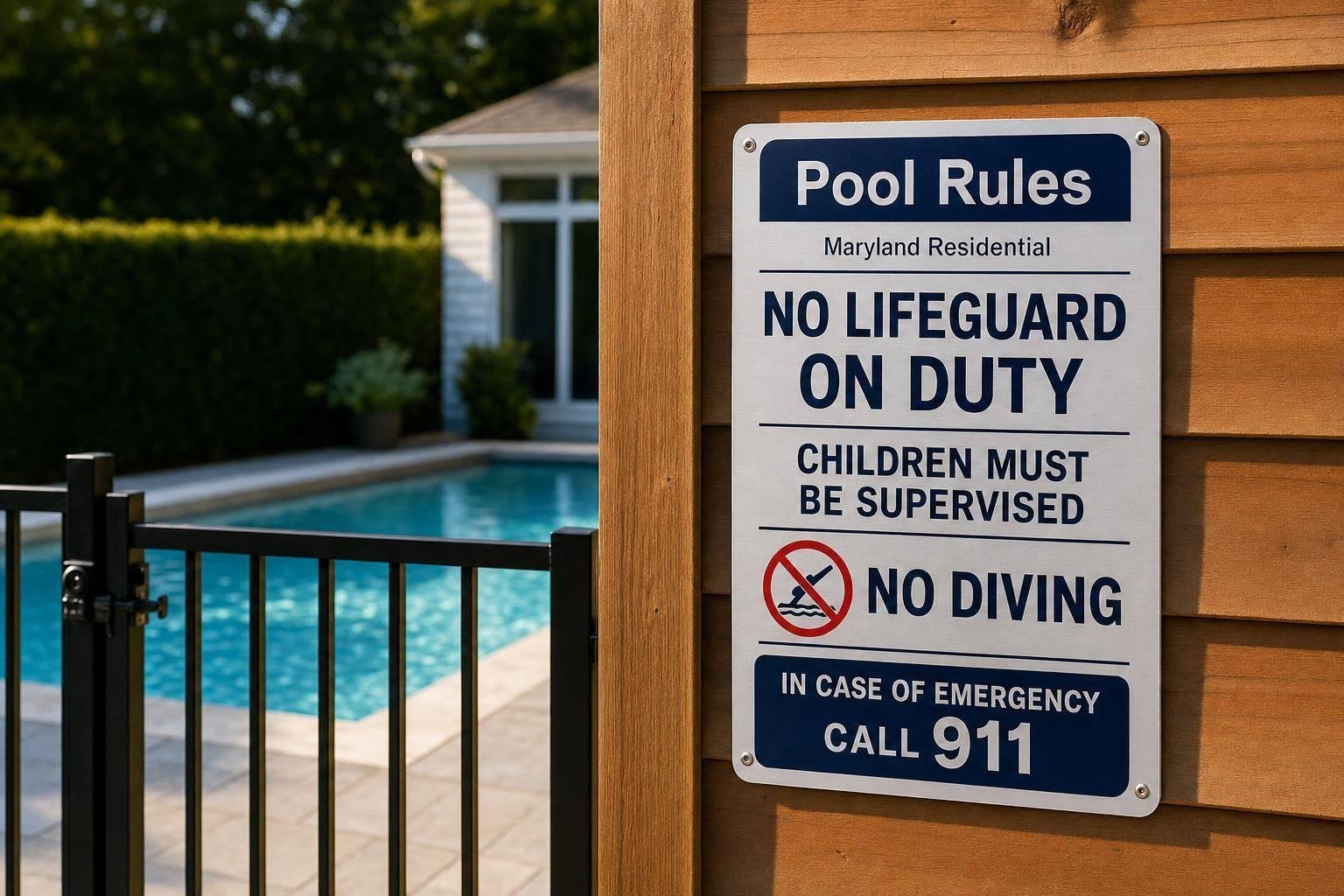
- bhavya gada
- No Comments
Most Maryland backyard pools do not have state sign rules. If your pool is for one home, you usually choose signs based on safety, insurance, local code, and common sense – not a state-required sign list.
Here’s the short version:
- Private home pools: state pool-sign rules usually do not apply
- HOA, condo, club, or rental-use pools: state or local rules may apply
- Best signs for many homes: no diving, adult supervision, swim at your own risk, spa heat warnings, and equipment-area warnings
- Best sign spots: gate, fence, shallow end, spa entry, and equipment area
- Best materials: aluminum, ACP, PVC, ceramic tile, and outdoor vinyl
- Check signs often: at the start of swim season, at the end, and monthly during heavy use
In other words: if you own a private pool in Maryland, you probably don’t need a long compliance board. But you do want signs that warn people before they make a bad call.
A few facts stand out right away:
- Maryland state pool-sign rules mainly target public and semipublic pools
- The article points to 5 main sign decisions: type, wording, placement, material, and upkeep
- Common mounting height is about 5–6 feet
- The article also suggests lettering at least 4 inches high for easy reading
- A common main sign size is 12" × 18" or 18" × 24"
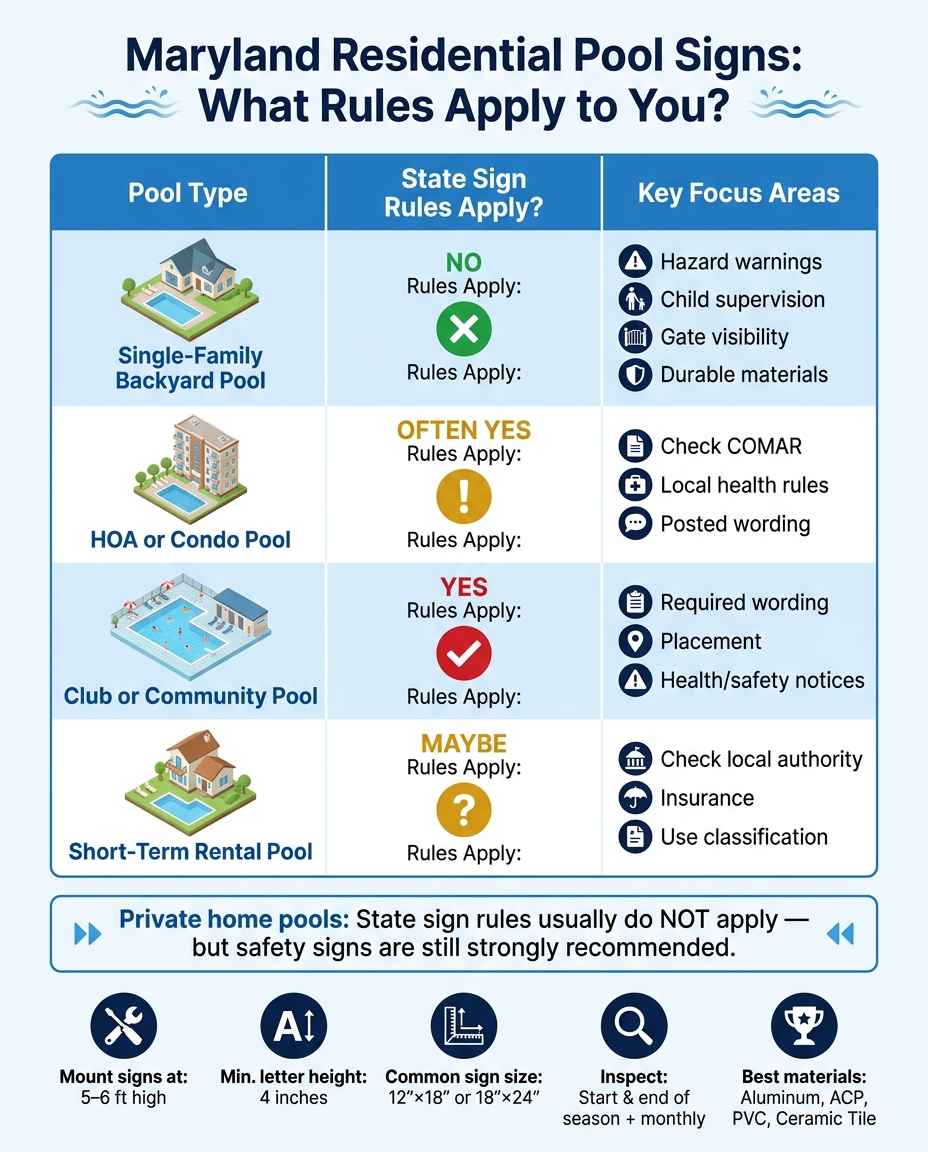
Maryland Pool Sign Rules by Pool Type: Quick Reference Guide
Quick comparison
| Pool type | State sign rules usually apply? | What you should focus on |
|---|---|---|
| Single-family backyard pool | No | Hazard warnings, child supervision, gate visibility, durable materials |
| HOA or condo pool | Often yes | Check COMAR, local health rules, and posted wording |
| Club or community pool | Yes, in many cases | Required wording, placement, and health/safety notices |
| Short-term rental pool | Maybe | Check local authority, insurance, and use classification |
If I were setting up a Maryland home pool sign plan, I’d keep it simple: post only the signs tied to actual risk, place them where people see them first, and replace them when they fade or crack. That’s the core idea behind the full guide below.
sbb-itb-843f8be
Maryland Pool Sign Basics for Residential Properties
For most private backyard pools, COMAR 10.17.01 does not control signage. But local codes, HOA rules, and insurance requirements still can.[6][7][10] So while Maryland does not require signs for most private pools, posting them can still help with safety and liability protection.[5][14] The key issue is how the pool is classified. That decides whether you need set wording or just smart warning signs.
Before you pick any sign, look at:
- county and city building codes
- local health department guidance
- HOA covenants
- homeowner’s insurance requirements
Some counties care more about barrier rules than exact sign wording.[11][12] And if you live in an HOA community, you may need approval before putting signs on a fence or gate.[13] That can affect both placement and design.
Required Rules vs. Recommended Residential Safety Signs
Required signs apply only to public or semipublic pools. If the pool is tied to a community, club, or rental use, COMAR sign rules may apply, and the wording can become mandatory.[6][1] For a standard private home pool used only by residents and invited guests, those rules usually do not apply.[10]
In plain English: a private residential pool uses signs as a safety step, not as part of a state compliance list. Public and semipublic pools, on the other hand, have to follow set wording. If your pool’s use changes, such as with a short-term rental, check with your local authority to see if semipublic rules now apply.[10][7] That one detail can change the sign requirements.
Once you know the pool’s status, choose signs based on the risks that are actually present.
Common Wording Themes for Maryland Pool Signs
Maryland’s public pool rules include phrases that also make sense for home use.[2][14] For most residential pools, the most helpful signs tend to fall into four main groups:
| Sign Theme | Example Wording |
|---|---|
| No lifeguard / supervision | No Lifeguard on Duty – Swim at Your Own Risk |
| Children’s supervision | Children Under 14 Must Be Supervised |
| Diving hazard | Danger! No Diving in Shallow Water |
| Spa health caution | High Heat – Limit Use; Consult Your Doctor if You Have Health Conditions |
| General conduct | No Running – No Glass Containers – No Alcohol |
Carroll County‘s health department pre-opening guidance for semipublic pools lists Danger! No Diving in Shallow Water and a no-lifeguard warning that also includes supervision rules for children under 14.[8] Maryland sign examples based on COMAR 10.17.01.40 also use wording such as No Lifeguard on Duty, Swim at Your Own Risk, and Children Under 15 Should Not Use the Pool Without Adult Supervision.[9][2]
For spas, COMAR points to the American National Standard for Public Spas, which stresses warnings about high water temperature, time limits, and medical conditions like heart disease and pregnancy.[1][3] A residential spa sign does not need to copy every line from a commercial spa placard. But it should clearly cover those main health warnings.
Which Signs to Use and What They Should Say
Start with the risk, then pick the sign. After that, put each sign where people will notice it right away. For a pool or spa, that means matching each sign to a clear hazard and using wording that leaves little room for guesswork.
Warning Signs for Water Depth
Depth signs tell people where the water is shallow and where it drops off. That matters the moment someone walks up to the pool.
Use plain wording like:
- Deep Water
- Shallow Water
- No Diving – Shallow Water
Rule and Informational Signs for Safer Backyard Use
Rule signs work best when they’re short and easy to scan. If someone has to stop and read a mini paragraph, the sign has already lost its punch.
Use short rules such as No Running, No Glass, Children Must Be Supervised, or Swim at Your Own Risk.
Spa Signs for Heat and Health Warnings
Spa signs need to spell out heat limits and health warnings in plain language. Hot water can be hard on the body, so the message should be direct.
Post a sign with: Hot Water – Limit Use, Consult Your Doctor if Pregnant or if You Have Heart, Blood Pressure, or Other Health Conditions, and Keep Children Under Supervision.
Where to Post Pool Signs in Fenced Yards, Patios, and Deck Areas
Once you know which signs you need, the next step is simple: put them where people will see them before they need them.
Gate, Fence, and Main Access Point Placement
For a fenced residential pool, the main entry gate is the top place to post signage. Mount the main rules sign directly on the gate or on the fence panel next to the latch, about 5–6 feet high. People should be able to read it before they step into the pool area.
Secondary gates need signage too, even if it’s smaller. Put reminder signs at the same height and angle them toward the direction people are coming from, whether that’s the house or the yard. In most cases, signs should face the house, patio, or main walkway, because that’s where people first notice the pool. One well-placed 12"×18" or 18"×24" rules sign on the fence section facing the shallow end will usually cover the main line of sight. Keep signs out from behind tall planters, shrubs, or pergola posts that cut off visibility from seating areas.[4]
Deck, Patio, Equipment, and Spa Placement
Once people are inside the pool area, signs should show up at the moments when they need to make a choice.
Depth markers and no-diving warnings belong near the shallow edge, steps, ladder entries, and any place where the floor slope changes. On decks, one combined pool rules sign often works best beside a bench or another spot where people naturally stop for a second on the main walkway.[4]
Equipment areas need their own warning sign. If you have pumps, heaters, or chemical storage nearby, post a clear "Keep out – equipment and chemicals" sign on the gate, door, or fence panel leading into that area. It should face the approach from the deck or yard, not the other way around. Spa signs should go right at the spa entry, mounted at eye level and kept clear of chairs, tables, or plants that block the view.[4]
Mount signs to a visible permanent structure, and use lettering at least 4 inches high.[15]
Fitting Signs Into the Overall Outdoor Layout
It helps to think about signs as part of the yard layout, not as something you tack on at the end. Gate pillars, retaining-wall faces, seat walls, and masonry piers often make the best mounting spots because they’re stable, easy to see, and already part of the space. If the sign material and finish match the hardscape, the area can still look clean while meeting contrast and readability rules.[1][4]
It also makes sense to plan sign locations during the hardscape phase. That way, you can leave room on flat wall sections, fence panels, and gate posts without cramming signs into seating zones or walkways.
Materials, Upkeep, and a Final Planning Checklist
After placement, the next job is simple: make sure your signs last and stay easy to read.
Best Sign Materials for Maryland Weather and Pool Conditions
Maryland weather can be rough on pool signage. Heat, humidity, freeze-thaw cycles, and pool chemicals can wear out cheap materials fast. That’s why outdoor-rated materials matter. You want signs that still look clear next to water, sun, and chlorine.
Aluminum is a solid pick. Powder-coated or anodized aluminum panels resist corrosion and don’t rot or warp. Add a UV-protective laminate, and the sign face stays readable longer.[16][21]
Aluminum composite panels (ACP) are another good option. They offer similar corrosion resistance, and their rigid core stands up well to temperature swings and moisture.[18]
For deck markers, weatherproof PVC or ceramic tile works well. These materials can handle sun, splashing, chlorine, and foot traffic.[17]
If you’re using applied graphics or lettering, go with UV-protected vinyl or laminated decals. They should be waterproof, chlorine-resistant, and made for outdoor use.[17][18]
One detail makes a big difference: UV-stable inks or a clear UV laminate on the finished face. Without that layer, colors can fade within a single season in Maryland sun and humidity.[16] Mounting hardware matters too. Use stainless steel or coated hardware to help stop rust stains and loose fasteners.[16]
Permanent signs usually last better than suction-cup signs, A-frames, or loose banners.[16][18]
How to Inspect and Replace Signs to Keep Them Readable
Inspect signs at the start and end of swim season, then once a month during heavy use.[16] Each time, stand where a person would normally approach the sign, like the gate, patio entry, deck stairs, or spa path, and check whether it’s easy to read.
Look for:
Also check the view. Shrubs, umbrellas, and décor have a way of drifting into the wrong spot over time. A sign might still be in place but no longer easy to see.
If a sign is hard to read from a normal approach distance, replace it. For depth markers, no-diving warnings, and spa cautions, it’s smart to swap them out early instead of waiting until they fail outright. Once the print starts cracking or delaminating, replacement is usually the right move.[16][18][19][20]
Conclusion: Key Points for Residential Pool Signs in Maryland
Use this checklist to make sure your signs still match your pool layout, hazard areas, and normal viewing angles.
| Step | What to Confirm |
|---|---|
| Required sign categories | Warning, rule, informational, and spa signs are all accounted for |
| Clear, concise text | Plain language; high contrast |
| Main hazard points | Main hazard points covered |
| Outdoor-rated, corrosion-resistant materials | Aluminum, ACP, weatherproof PVC, or ceramic tile with corrosion-resistant hardware |
| Readable at approach distance | Legible from normal approach distance in daylight and at dusk |
| Inspection and replacement schedule | Seasonal inspections scheduled; replacement criteria defined |
Private pools still gain a lot from clear, durable signs. The right materials, smart placement, and early replacement can make the pool area safer and simpler to use.
FAQs
How do I know if my pool counts as semipublic?
In Maryland, a residential pool is generally private when it serves only the residents of a single-family home.
It is usually semipublic when people beyond the residents and their guests can use it, such as at community associations, apartment complexes, hotels, or clubs.
Which pool signs matter most for kids and guests?
For children and guests, the most important pool signs are the ones that spell out the rules fast and show people what to do if something goes wrong. Put the most visible signs on No Diving, Adult Supervision, emergency procedures, the pool address for 911, and the nearest phone location.
Clear depth markings matter too. Swimmers should be able to tell at a glance how deep the water is before they step in.
When should I replace faded or damaged pool signs?
Replace residential pool signs as soon as they look faded, cracked, or hard to read. A pool sign only does its job if people can see and understand it right away.
If the surface is damaged or the text isn’t easy to read from a normal distance, the sign is no longer doing its safety job. Swap it out as soon as possible. It also helps to check signs on the pool deck, patio, and fence on a regular basis.
Chat with Us