









- bhavya gada
- No Comments
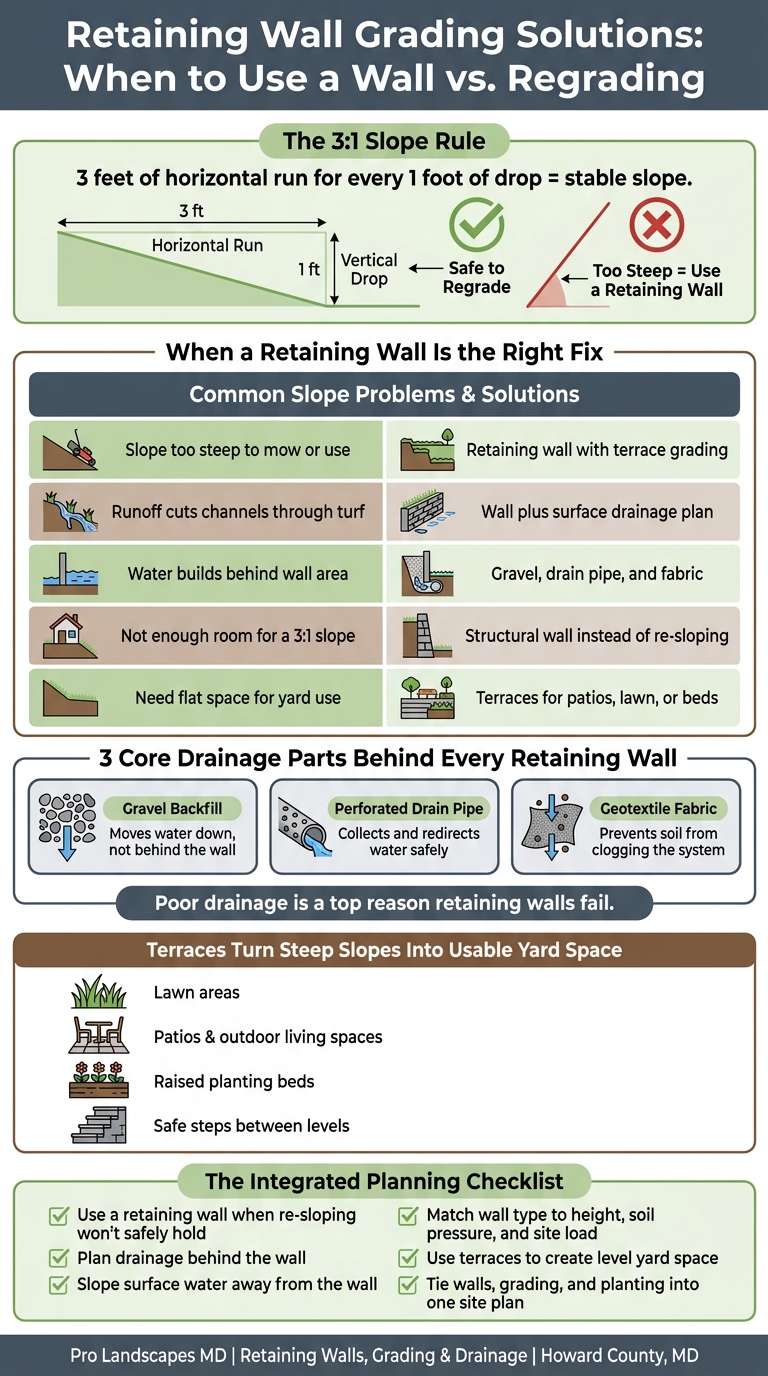
If your yard can’t hold a safe 3:1 slope – that is, 3 feet of horizontal run for every 1 foot of drop – a retaining wall is often the right fix. I’d look at three things first: whether the slope is washing out, whether water is moving toward the house, and whether there is enough room to regrade without running into property lines, septic areas, or existing structures.
In plain terms, retaining walls are used when sloped lots in Howard County need more than simple reshaping. They help hold soil, cut erosion, guide drainage, and carve out flat areas for lawns, patios, steps, and planting beds. But the wall alone is not enough. Drainage behind the wall, surface grading above it, and the finished yard layout all need to work together.
Here’s the short version:
- Use a retaining wall when re-sloping will not safely hold
- Plan for drainage behind the wall
- Slope surface water away from the wall
- Match wall type to height, soil pressure, and site load
- Use terraces to create level yard space
- Tie walls, grading, and planting into one site plan
A few facts matter here:
- A common stable slope target is 3:1 or gentler
- Most residential retaining wall systems rely on 3 core drainage parts:
- Gravel backfill
- Perforated drain pipe
- Geotextile fabric
- Poor drainage is one of the top reasons retaining walls fail on sloped lots
| Issue | What usually works |
|---|---|
| Slope is too steep to mow or use | Retaining wall with terrace grading |
| Runoff cuts channels through turf | Wall plus surface drainage plan |
| Water builds behind wall area | Gravel, drain pipe, and fabric |
| Not enough room for a 3:1 slope | Structural wall instead of re-sloping |
| Need flat space for yard use | Terraces for patios, lawn, or beds |
If I were planning this kind of project, I’d start with the finished grade and water flow first, then fit the wall into that plan.
Retaining Wall vs. Regrading: Howard County Slope Solutions
Correcting a Wild Grade Change With This Retaining Wall
sbb-itb-843f8be
When Retaining Walls Are the Right Grading Solution
When a slope is too steep to grade safely, a retaining wall gives the site the support it’s missing.
On many Howard County residential lots, cutting into a hillside or adding fill to level an area can leave behind a slope that simply won’t hold. The main limit is slope length. A stable graded slope usually needs a 3:1 ratio – 3 feet of horizontal run for every 1 foot of drop – or something gentler. On a lot of Howard County properties, there just isn’t enough room for that. Property lines, septic fields, and existing structures often box the site in.
When a site can’t fit a stable 3:1 slope or gentler, a retaining wall is the practical fix.
Signs a Slope Needs Structural Support Instead of Re-Sloping
A retaining wall makes more sense when regrading would force the slope into property lines, septic fields, or existing structures. It’s also the right move when a homeowner wants to cut into a slope to make level space, but the exposed soil face would be unstable without structural support.
In plain terms, if re-sloping leaves you with a slope that can’t safely stand on its own, a wall is usually the better path.
How Retaining Walls Create Usable Yard Areas
A retaining wall holds soil in place and helps stop slope movement. That alone can make a steep, awkward part of a yard far more usable.
It also helps reduce erosion along the slope and limits surface runoff. And by holding back soil, the wall can create level terraces for:
- Lawns
- Patios
- Planting beds
That support works best when the wall is part of a grading plan that also handles drainage.
Design and Drainage Details That Make Retaining Walls Work
On Howard County slopes, a retaining wall can fail if drainage behind it isn’t handled the right way. On sloped residential lots, drainage is the difference between a wall that just looks good and a wall that actually holds grade.
Drainage Behind the Wall and Surface Water Control
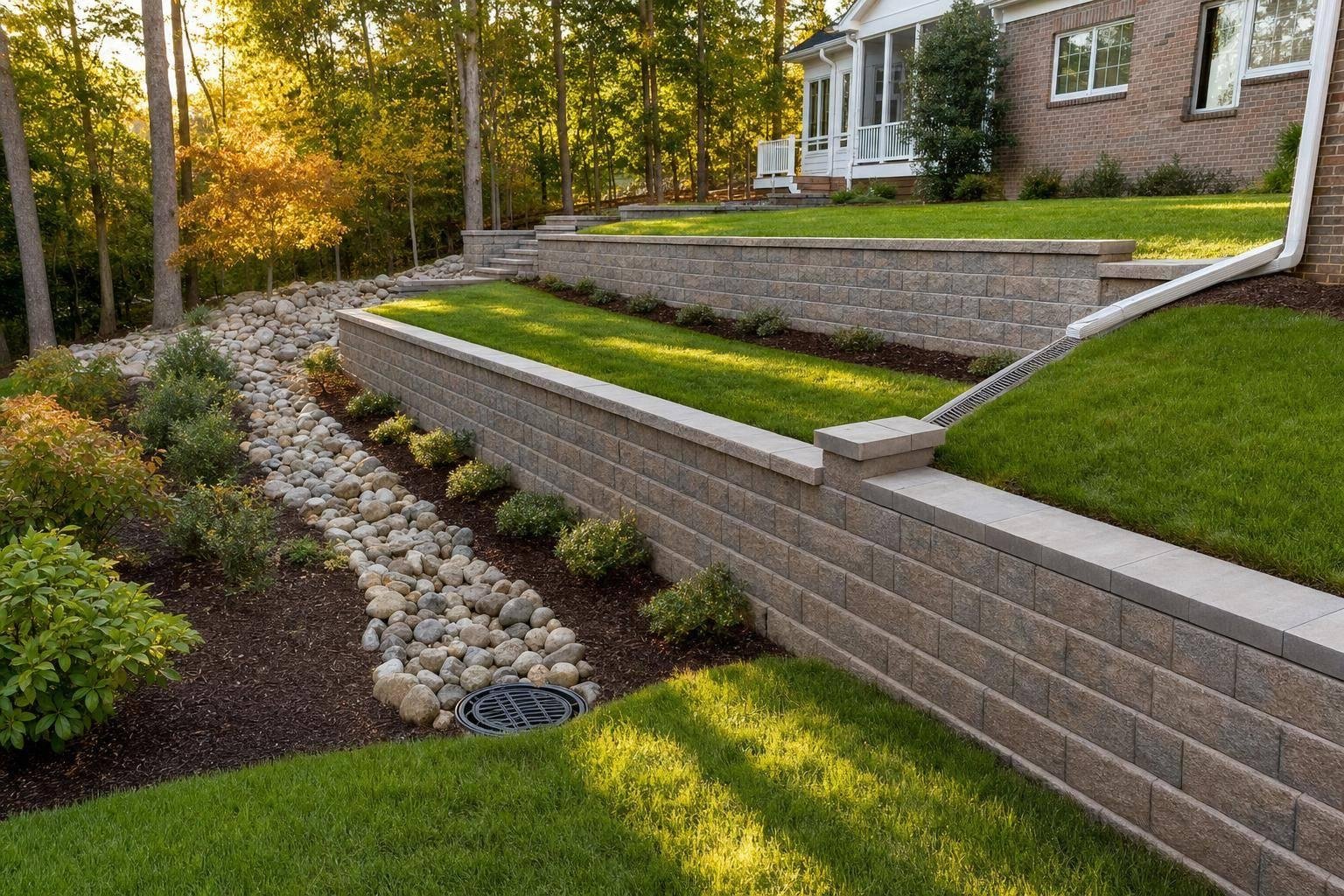
Most residential walls depend on three core parts: gravel backfill, a perforated drain pipe, and geotextile fabric.
- Gravel backfill helps water move down instead of sitting behind the wall.
- The drain pipe at the base collects that water and sends it to a safe discharge point.
- Geotextile fabric keeps fine soil from washing into the stone and clogging the system over time.
Surface grading above the wall matters just as much. The ground should slope away from the wall so runoff doesn’t pour into the drainage zone. That simple detail can make a big difference over time.
The wall also needs to fit the site’s height and load conditions. A short wall on a light-duty slope isn’t the same as a taller wall holding back more soil and water pressure.
Wall Types Used for Residential Grading Projects
Residential grading projects often use segmental block, natural stone, or reinforced concrete walls, based on height, load, and drainage needs.
How Retaining Walls Fit Into a Grading and Permitting Plan
Drainage details work best when they’re built into the full site plan from the start. A retaining wall should be part of the grading plan, with water flow mapped out before construction begins. In plain English: look at how the slope drains now, then make sure the finished layout sends water away from the wall, not toward it.
Pro Landscapes MD integrates grading, retaining walls, and drainage into residential site plans across Howard County and nearby areas.
Using Retaining Walls to Create Better Yard Space and Planting Areas
Once a wall holds the slope in place, it can do more than stop soil from moving. It can turn a hard-to-use yard into a set of flat, usable spaces.
Retaining walls split a steep slope into level terraces for lawns, patios, and planting beds. Each wall forms a stable, level bench behind it. If the yard has a steep grade, you can use more than one terrace to make the space easier to use. One level might hold a patio or outdoor living area, while another gives you room for grass or plants. Steps connect the levels and make movement between them safer.
These terraces can provide space for:
- Lawn areas
- Patios
- Raised planting beds
- Safe steps between levels
Raised Planting Beds and Landscape Design Suited to Slopes
Garden walls and terraced planting areas create stable, level spots for landscaping. On a slope, that kind of setup helps the planting area follow the site’s grade in a clean, practical way.
They work best when drainage and grading are planned together with the terraces, not treated as separate parts of the project.
Integrated Retaining Wall and Grading Solutions in Howard County

Combining Walls, Drainage, and Planting for Long-Term Slope Stability
Terraces tend to last much longer when the wall, grading, drainage, and planting are planned as one system. A retaining wall by itself usually won’t solve a slope problem for good. The best outcome comes from one coordinated plan that ties the wall, grading, drainage, and planting together.
That kind of plan helps cut erosion and moves water away from foundations, patios, walkways, and other hardscapes.
Conclusion: Key Points for Planning Retaining Wall Grading Work
For any retaining wall project in Howard County, the finished grade and drainage plan should shape the design from the start. Begin with a grading plan that lines up the wall, drainage, and planting. If a wall is part of the fix, drainage behind it is critical for stability.
The wall should be designed around the finished grade and how the yard will be used. Pro Landscapes MD provides retaining wall installation, grading, drainage, stormwater management, and landscape construction across Howard County and central Maryland.
FAQs
Do I need a retaining wall or just regrading?
No. Regrading alone can change your yard’s slope so water flows away from your foundation and doesn’t collect in low spots.
You need a retaining wall when the slope is too steep to hold steady with grading alone, or when you want flat, usable space and tighter control over soil movement and hydrostatic pressure.
How do you keep water from building up behind a wall?
Prevent water from building up behind a retaining wall by controlling hydrostatic pressure with a dependable drainage system. A French drain with perforated pipe and gravel is a common fix because it helps move groundwater away from the property instead of letting it collect behind the wall.
Maintenance matters too. Keep weep holes clear, and check that drainage pipes stay free of debris so water can keep moving and help protect the wall over time.
Can a retaining wall create more usable yard space?
Yes. A retaining wall can turn sloped, unstable ground into level space you can actually use by holding back soil on steep grades.
That extra support can open up room for planting beds, outdoor seating, or more flat lawn. It can also help with site grading and keep soil in place.
Chat with Us