









- bhavya gada
- No Comments
Building a retaining wall in Maryland requires understanding the specific permit rules for each county. Here’s a quick breakdown:
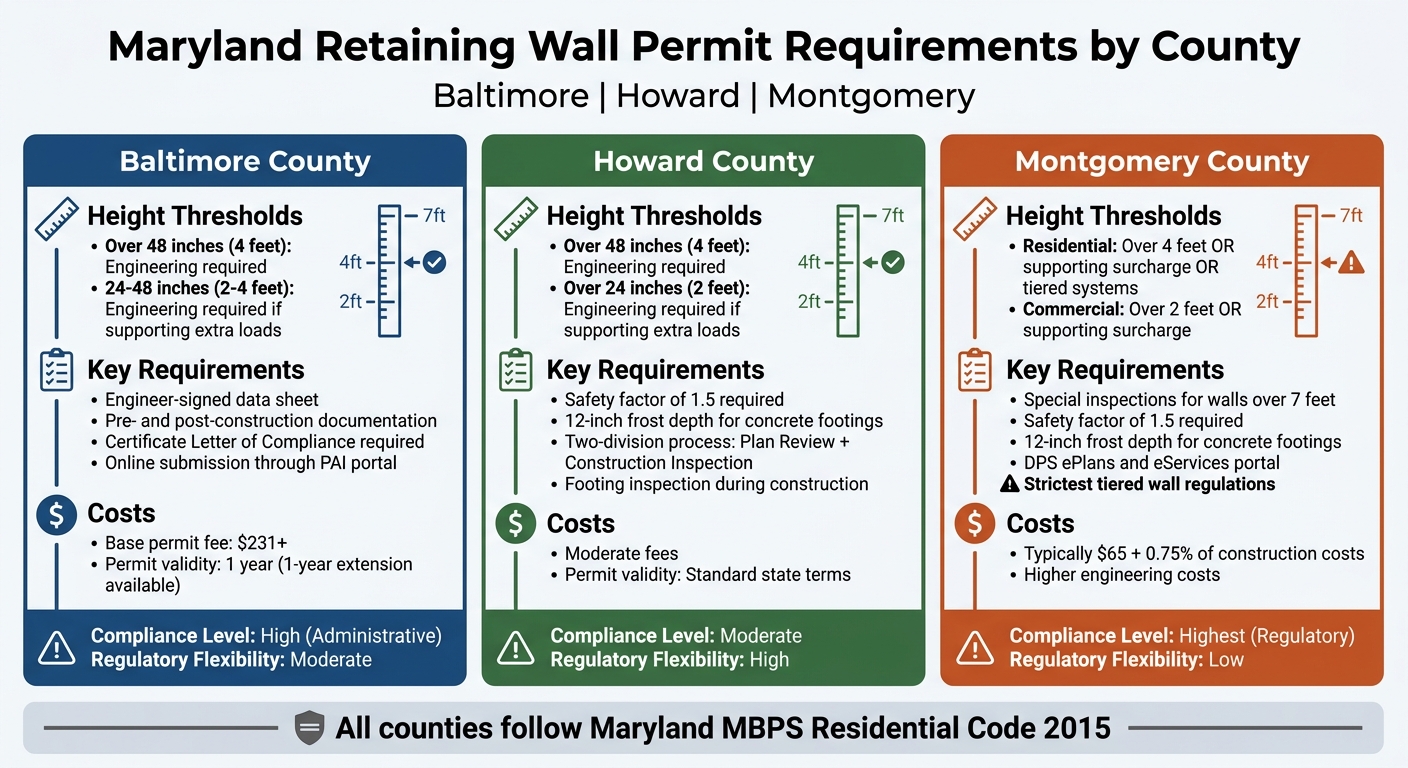
- Baltimore County: Engineering is mandatory for walls over 4 feet or those between 2-4 feet supporting extra loads. Pre- and post-construction documentation is required, with permits starting at $231.
- Howard County: Follows state codes. Walls over 4 feet or over 2 feet with additional loads need engineering. Fewer administrative steps compared to other counties.
- Montgomery County: Strictest rules. Permits are needed for walls over 4 feet, tiered systems, or those supporting surcharges. Special inspections are required for walls over 7 feet.
Permit fees vary but often include a base fee plus a percentage of construction costs. Hiring a professional engineer and understanding local rules can help avoid delays and extra costs.
Maryland Retaining Wall Permit Requirements Comparison by County
Do You Need Permits to Build a Retaining Wall? | Landscaping and Rockery Construction Services
sbb-itb-843f8be
1. Baltimore County
Baltimore County takes retaining wall permits seriously, emphasizing structural integrity and public safety. Managed by the Department of Permits, Approvals and Inspections (PAI), the county handles these permits entirely online. While it follows the Maryland MBPS Residential Code 2015, Baltimore County adds extra documentation requirements that distinguish it from nearby areas.
Here’s what you need to know about height thresholds: if your wall exceeds 48 inches (4 feet), professional engineering is a must. For walls between 24 inches (2 feet) and 48 inches, engineering is also required if the wall needs to handle more than just soil pressure – like support for a driveway, slope, or other surcharge. This is a common oversight by homeowners, so double-check these requirements.
To apply, you’ll need to submit a county-specific engineer-signed data sheet, a checklist, and a property owner acknowledgment letter through the digital portal. The engineer must complete these forms, and all documents must follow the county’s strict file naming conventions. Once submitted, the process moves to compliance verification.
After construction, don’t forget to file a Certificate Letter of Compliance to officially close the permit. Skipping this step leaves the permit incomplete. The base fee for a residential building permit starts at $231, but costs can rise depending on the project’s size and complexity.
Permits are valid for one year, with an option to request a one-year extension when filing. If you’re taking on the construction yourself, you’ll also need to include an Affirmation of Landowner Form, along with construction plans, site plans, and sediment control documents.
2. Howard County
Howard County adheres to the Maryland Building Performance Standards (MBPS) Residential Code 2015, with oversight managed by the Department of Inspections, Licenses & Permits. The permitting process involves multiple divisions to ensure compliance from the design phase through construction.
When it comes to height thresholds, the county follows the state code. Walls taller than 48 inches (4 feet) without lateral support at the top require a professional engineering design. For shorter walls, if they exceed 24 inches (2 feet) and must support extra loads – like a driveway, pool, or steep slope – engineering is also required. Be sure to evaluate whether your wall does more than hold back basic soil to avoid surcharge issues. Like Baltimore County, Howard County enforces strict standards for both load and height.
Engineering documents must address four key stability factors: overturning, sliding, foundation pressure, and water uplift. Designs must incorporate a safety factor of 1.5 to guard against lateral sliding and overturning. For concrete walls with poured footings, Maryland standards require the footing to extend to a 12-inch frost depth.
The permitting process involves two main divisions. First, the Licenses & Permits Division and Plan Review Division check your designs for code compliance before issuing approval. Once construction begins, the Construction Inspection Division, part of the Bureau of Engineering, conducts on-site inspections during critical phases like footing installation.
Make sure to schedule a footing inspection promptly – any delay in approval can bring your project to a standstill.
3. Montgomery County
Montgomery County follows the Maryland Building Performance Standards (MBPS) Residential Code 2015 and is known for having some of the strictest retaining wall permit rules in Maryland. All permits and inspections are handled by the Montgomery County Department of Permitting Services (DPS).
Permit requirements depend on the type of property and wall height. For residential properties, a building permit is required for walls taller than 4 feet, walls supporting a surcharge (like slopes behind the wall), or walls that are part of a tiered system, regardless of the height of individual tiers. For commercial properties, the rules are even stricter: any wall over 2 feet or supporting a surcharge needs a permit. These requirements also determine the necessary documentation and inspection steps.
Engineering plans are required for walls exceeding 4 feet or for walls over 2 feet that support a surcharge. These designs must address critical factors like overturning, sliding, foundation pressure, and water uplift. According to the MBPS Residential Code 2015, a 1.5 safety factor is required to guard against lateral sliding and overturning. For concrete walls, poured footings must meet the 12-inch frost depth standard, though segmental retaining walls may have different embedment requirements. These engineering standards are essential to ensure safety and structural stability.
Montgomery County uses the DPS ePlans and eServices portal for submitting applications, making payments, and scheduling inspections. This system also provides updated information on permit processing times. A key distinction in Montgomery County is the special inspection requirement for retaining walls over 7 feet tall, which involves additional inspections beyond the standard process.
When planning your retaining wall, check if it will support extra loads. Even walls shorter than 4 feet need permits if they back a slope, driveway, or other surcharge. Given the county’s strict enforcement, having your plans signed and sealed by a Maryland Professional Engineer from the start can save you from potential rejections and delays.
Pros and Cons
Looking at the differences between these counties highlights the balance between strict regulations and simpler administrative processes.
Montgomery County’s tighter rules help ensure higher safety standards. On top of that, they offer fast-track services and design consultations to streamline projects[3].
Baltimore County, on the other hand, adds extra administrative steps. According to DIY Retaining Wall:
Baltimore County requires an additional data sheet and checklist signed by an engineer prior to receiving a permit, and an additional Certificate Letter of Compliance submitted to the building inspector when the wall is complete[1].
This means your engineer needs to be involved at both the start and end of your project. While this ensures thorough oversight, it can also extend timelines and increase professional fees, which could impact your overall budget and schedule.
Howard County follows the Maryland MBPS 2015 Residential Code and avoids many county-specific requirements. With fewer administrative steps compared to Montgomery and Baltimore, the permitting process in Howard is more straightforward. While the technical standards are consistent across counties, the way each county handles the process can vary a lot[1].
Here’s a quick breakdown of how these counties compare in terms of compliance challenges, costs, and flexibility:
| County | Compliance Difficulty | Cost Impact | Regulatory Flexibility | Key Challenge |
|---|---|---|---|---|
| Baltimore | High (Administrative) | Moderate to High | Moderate | Pre-permit checklists and post-construction compliance letters[1] |
| Montgomery | Highest (Regulatory) | High | Low | Strict triggers for tiered walls; special inspections for walls over 7 feet[1] |
| Howard | Moderate | Moderate | High | Standard state code requirements with fewer administrative hurdles[1] |
Permit fees also differ. In nearby areas, fees average around $65 plus 0.75% of the total construction cost[2]. When planning your project, it’s important to include these fees and consider the possibility of higher engineering costs in counties with more documentation requirements.
Conclusion
Montgomery County requires permits for all tiered walls, with extra inspections for those over 7 feet. Baltimore County mandates both pre- and post-construction engineering documentation, while Howard County follows state baseline standards closely[1]. These differences highlight how important it is to understand the specific requirements of your project.
Take the time to evaluate your property’s slopes or any surcharges. Even a small, 2-foot wall might need a permit if it’s subject to additional lateral loads[1].
Hiring seasoned contractors who are well-versed in local regulations can help you avoid headaches and expensive errors. Pro Landscapes MD offers expertise in designing and building retaining walls throughout Baltimore County, Howard County, and Montgomery County.
Be sure to include permit fees and engineering costs in your budget from the beginning. For example, in some areas, permit fees are often around $65 plus 0.75% of the construction costs[2]. Working with knowledgeable professionals ensures your project meets all regulations while staying on track and within budget.
FAQs
Does wall height include the buried portion?
Yes, wall height typically includes the portion that is buried. Regulations often define the total height as the measurement from the bottom of the footing or base all the way to the top of the wall. This means the buried section is factored into the overall height.
What counts as a surcharge on a retaining wall?
A surcharge on a retaining wall means any extra weight or pressure the wall has to hold up. This could come from sloped soil, foot traffic, vehicles, or even liquids. In some counties, you might need a permit for the wall, depending on its height and the type of load it’s handling.
How are permit fees calculated for retaining walls?
Permit fees for retaining walls often depend on the construction costs. Some areas calculate these fees by combining a fixed amount with a percentage of the total cost. For example, a jurisdiction might charge $65 plus 0.0075 of the construction cost. In Maryland, retaining walls that exceed specific heights – such as 2 or 4 feet, depending on the county – must meet engineering requirements and obtain permits. The exact fees are listed in local government schedules.
Chat with Us