









- bhavya gada
- No Comments
Retention basin liners are essential for managing stormwater runoff, preventing seepage, and protecting nearby structures. Costs depend on factors like basin size, shape, depth, liner material, and site conditions. Here’s what you need to know:
- Size & Shape: Larger or irregularly shaped basins cost more due to increased material and labor.
- Materials: Common options include HDPE ($0.50–$1.50/sq. ft.), PVC ($0.75–$2.00/sq. ft.), and EPDM ($1.00–$2.50/sq. ft.), with costs varying by durability and flexibility.
- Site Conditions: Rocky terrain, high water tables, or sloped land increase preparation costs.
- Additional Costs: Excavation, permits, and maintenance can add 20–40% to the budget.
Plan for $450–$750 annually for maintenance on a $15,000 project. Choose a material that balances cost, durability, and Maryland’s climate needs. Always get itemized bids and factor in a 10–15% contingency for unexpected expenses.
Key Factors That Drive Retention Basin Liner Costs
The cost of retention basin liners depends on several factors, including the basin’s size, shape, depth, the materials used, and the site’s specific conditions. Knowing how these elements impact pricing can help you make informed decisions and avoid unexpected expenses.
Basin Size, Shape, and Depth
The size of the basin is one of the most straightforward cost influencers. Larger basins require more liner material, which increases both material and labor costs. Deeper basins add another layer of complexity since the liner needs to extend higher along the sides, further raising material usage and installation difficulty.
The basin’s shape is another important consideration. Simple shapes like ovals or rectangles are generally more economical to line than designs with irregular curves, inlets, or multiple sections. Complex shapes often require additional seams and meticulous installation, which drives up costs. If your property has uneven terrain or steep slopes, the basin’s design may need to be adjusted to match the land’s natural contours, adding to the overall expense.
These physical characteristics directly influence the type and cost of liner materials you might choose.
Liner Material Options and Their Costs
The material you select for the liner has a significant impact on your project’s budget. Each option varies in durability, lifespan, and suitability for Maryland’s climate, which features hot, humid summers and freezing winters. Common liner materials include:
- HDPE liners: Known for their durability and chemical resistance, these are well-suited for large basins where long-term performance is a priority.
- PVC liners: A more affordable choice for smaller basins, though they may have a shorter lifespan if not adequately protected.
- EPDM liners: Highly flexible, making them ideal for basins with irregular shapes or unique designs.
- Compacted clay or concrete liners: These alternatives can be effective in specific situations. For instance, compacted clay works best in areas with naturally clay-rich soil, while concrete is often used in municipal or high-traffic applications due to its strength.
Given Maryland’s weather conditions, HDPE and EPDM liners tend to provide the best combination of durability and performance. On the other hand, PVC liners may require more maintenance and could deteriorate faster without proper care [2].
Site Conditions and Preparation Work
Even with the right materials and design, site conditions can significantly affect costs. Factors like rocky terrain, expansive clay soils, and high water tables often require additional steps, such as extra excavation, subgrade preparation, or drainage solutions.
High water tables are particularly challenging. If groundwater is close to the surface, you may need to install French drains or sump systems to stabilize the basin floor before the liner can be placed. For basins located on sloped land, retaining walls might be necessary to prevent soil erosion and maintain the liner’s integrity.
"Retaining walls are crucial for properties with uneven terrain, providing support to prevent soil erosion, flooding, and other landscape issues." – Pro Landscapes MD [2]
"Drainage problems are complex and require a custom approach for each project." – Pro Landscapes MD [1]
These additional structures and preparations can significantly impact your budget. Accounting for such costs early on can save you from unexpected financial surprises later. A clear understanding of these factors is key to effective project planning, as explored in later sections.
sbb-itb-843f8be
Cost Ranges for Common Liner Types
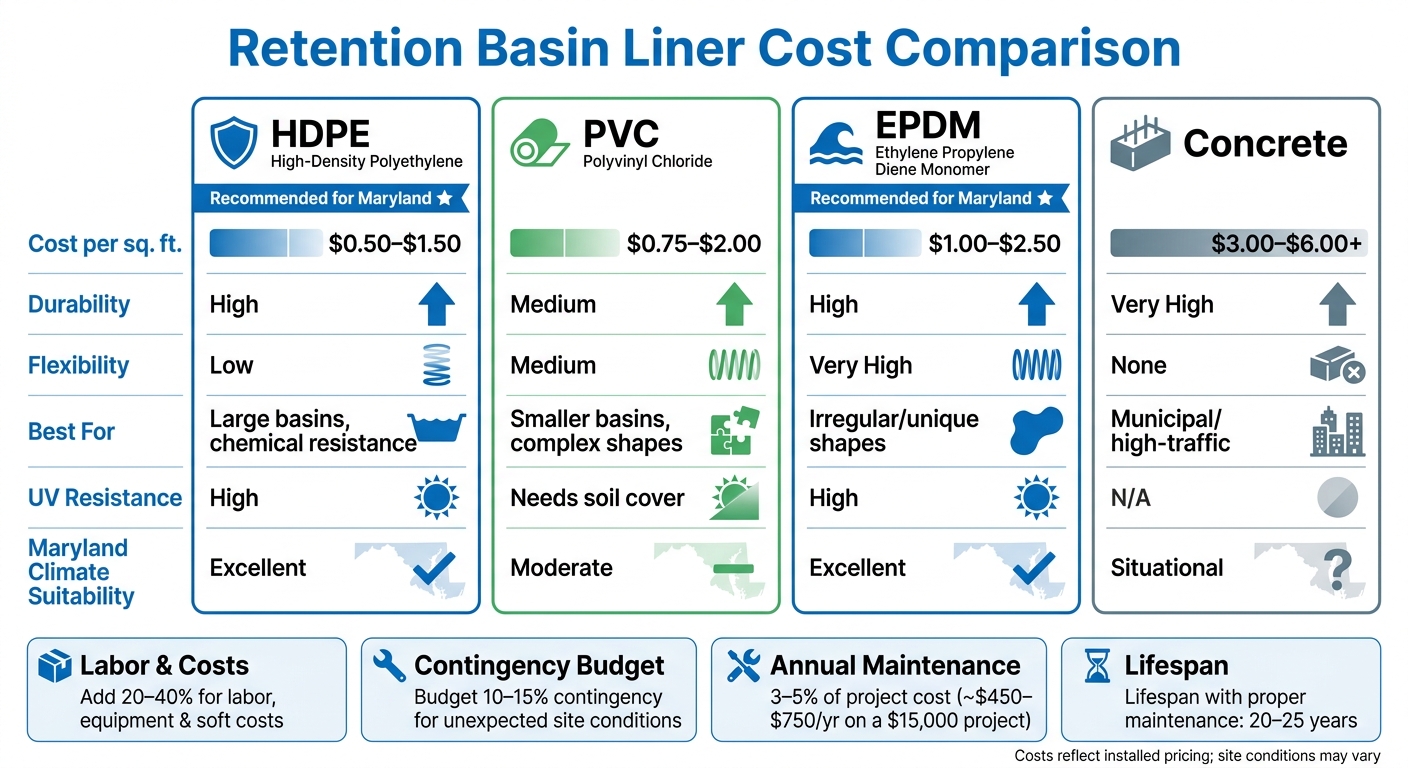
Retention Basin Liner Cost Comparison: HDPE vs PVC vs EPDM vs Concrete
Understanding the costs of different liner materials helps set realistic expectations when evaluating contractor bids. Below, you’ll find a breakdown of common liner types, giving you a clear idea of what to expect based on the size, shape, and site-specific factors discussed earlier.
HDPE, PVC, and EPDM Liners
These synthetic liners are popular choices for residential retention basins, each offering distinct advantages and price ranges.
| Liner Type | Typical Installed Cost (per sq. ft.) | Best For |
|---|---|---|
| HDPE | $0.50 – $1.50 | Large basins needing chemical resistance |
| PVC | $0.75 – $2.00 | Smaller basins with complex shapes |
| EPDM | $1.00 – $2.50 | Irregular or uniquely shaped basins |
- HDPE: Known for being economical on a larger scale, HDPE is a durable choice for basins requiring chemical resistance. However, it requires heat-welding during installation, which can increase labor costs.
- PVC: This mid-range option is easier to work with around curves and intricate designs. Keep in mind, though, that PVC liners need a protective soil cover to shield them from UV damage.
- EPDM: While the most expensive of the three, EPDM’s flexibility makes it ideal for basins with irregular shapes, justifying the higher price for certain projects.
Thickness also impacts costs. For example, a 40-mil HDPE liner is less expensive than an 80-mil version, though the latter provides better durability against sediment loads and freeze-thaw cycles – both crucial factors for Maryland’s climate.
Natural liners, however, follow a completely different pricing structure.
Clay and Concrete Liners
Clay and concrete liners aren’t priced like synthetic options. Here, labor and site preparation play a much larger role in the overall cost.
- Compacted Clay: If your property already has clay-rich soil, compacted clay can be a more affordable option. However, achieving the right density requires specialized equipment and multiple compaction passes, which adds to labor costs. If you need to import clay, expenses can climb significantly.
- Concrete: At $3.00 – $6.00 per square foot or more, concrete liners are the most expensive option. This cost includes forming, pouring, and finishing. Concrete is extremely durable and often used for municipal-scale basins or areas with heavy foot or vehicle traffic. For most residential projects in Maryland, concrete may not be cost-effective unless there’s a specific structural need.
Another important consideration for clay and concrete liners is site regrading. Adjusting the basin floor and surrounding slopes to ensure proper water flow adds both time and expense. Since every project has unique terrain, a custom grading plan is required [1][2].
Budgeting Tips for Maryland Homeowners
How to Estimate Total Project Costs
When planning a retention basin liner project, it’s essential to factor in every component – design, excavation, liner installation, and site preparation. Skipping any of these could lead to unexpected expenses that throw your budget off track.
Engineering and permitting costs alone can easily reach the low thousands for residential-scale projects, particularly since many Maryland counties require stamped stormwater management plans. To stay on the safe side, include a 10–15% contingency to cover surprises, especially given the region’s clay-heavy soils and rolling terrain [1][2]. Site access can also influence costs – tight spaces or wooded lots may require smaller equipment or more manual labor, which can increase expenses.
To estimate costs accurately, measure the basin’s surface area, calculate the liner’s square footage (including side slopes and anchor allowances), and apply the per-square-foot installation rate. Don’t forget to add 20–40% for labor, equipment, and additional soft costs, plus that 10–15% contingency for unexpected conditions. To compare proposals effectively, ask contractors for itemized bids [1].
If you’re tackling other drainage or grading projects, consider bundling them with your basin installation. Combining tasks like yard leveling or French drain installation can save on mobilization costs. For example, Pro Landscapes MD, a contractor specializing in drainage installation, grading, stormwater management, and yard leveling, offers bundled services that eliminate the need for multiple crews, which can help trim expenses.
Once your initial budget is set, don’t forget to factor in ongoing upkeep to protect your investment.
Planning for Long-Term Maintenance Costs
The costs don’t stop after installation. To keep your basin functional, plan to set aside 3–5% of the initial project cost annually for maintenance. For a $15,000 basin, that’s about $450–$750 per year.
Regular maintenance tasks include inspecting the liner, managing vegetation, and clearing debris. One of the bigger expenses is sediment removal – neglecting this can reduce the basin’s capacity and lead to costly dredging. In central Maryland, where heavy rainfall and freeze-thaw cycles are common, post-storm inspections are especially crucial to prevent erosion and liner damage [1].
For long-term planning, it’s worth noting that according to the MDE Stormwater Design Manual, bioretention systems and similar features typically last 20–25 years with proper maintenance before major rehabilitation is needed. Starting a small replacement reserve early can help ease future financial strain. Keep all as-built drawings, liner warranties, and inspection records organized. These documents are often required by Maryland counties during property sales or audits of private stormwater systems.
Conclusion: Picking the Right Liner for Your Budget
Retention basin liner costs hinge on several factors, including material, labor, and the specific conditions of your site. Finding the right liner is about more than just the price tag – it’s a balance between upfront costs, durability over time, and meeting local regulations.
"Drainage problems are complex and require a custom approach for each project. These issues can cause long-term damage to your property if not handled correctly." – Pro Landscapes MD
The liner you select should match your basin’s purpose, the site’s environmental conditions, and your ability to maintain it. While it might be tempting to choose the cheapest option upfront, this can lead to higher repair costs down the line. It’s a decision that benefits from expert advice to avoid potential pitfalls.
Partnering with a licensed and experienced contractor is key. Pro Landscapes MD, operating since 2011 with an A+ Better Business Bureau rating, provides a full range of services. They handle everything from site assessments and permits to liner installation and stormwater compliance. Serving counties like Howard, Montgomery, Carroll, Frederick, Prince George’s, and Baltimore, they ensure every step – from grading to liner selection – is managed seamlessly, reducing the risk of errors that could cost you later.
Before making your final decision, ask for an itemized bid, check that your contractor holds a valid Maryland license (Pro Landscapes MD’s license is 110409), and confirm that all necessary permits are secured. Taking these steps not only protects your investment but also ensures that your project complies with local regulations, giving you peace of mind for years to come.
FAQs
What liner thickness do I need (40-mil vs 60/80-mil)?
The ideal liner thickness for your project hinges on specific factors unique to your site. Pro Landscapes MD takes into account elements like soil composition, basin size, and local regulations to determine the most suitable choice. Whether you’re considering a 40-mil, 60-mil, or 80-mil liner for your retention basin, it’s crucial to consult a professional. They can evaluate your site and offer recommendations tailored to your needs.
Do I need permits or an engineered stormwater plan in Maryland?
Maryland’s stringent runoff regulations and water quality standards often mean you’ll need permits or an engineered stormwater plan for certain projects. These requirements aren’t one-size-fits-all – they depend on your location and the specific conditions of your site.
At Pro Landscapes MD, we carefully assess your property to ensure any drainage installations meet local regulations. If you’re planning a retention basin project, it’s essential to work with an experienced professional who can guide you through the permitting and engineering process tailored to your needs.
How can I tell if my basin has a high water table problem?
A high water table can reveal itself through persistent drainage problems. These might include frequent flooding, water pooling in low areas after rain, or lawns that stay soggy for extended periods. You might also notice increased erosion or more mosquito activity in damp areas. If these issues sound familiar, Pro Landscapes MD can assess your soil and drainage conditions to offer customized solutions for your property.
Chat with Us