










- bhavya gada
- No Comments
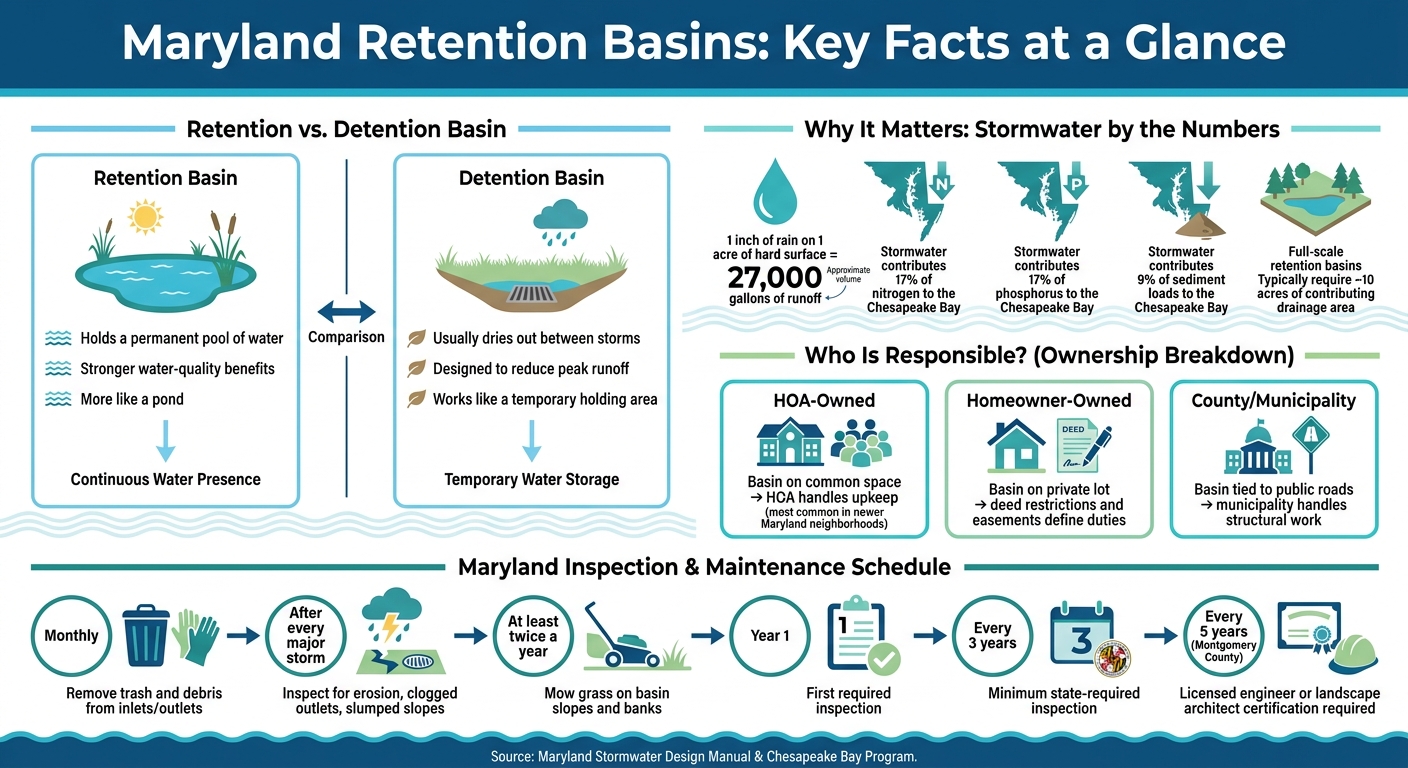
If you live near a subdivision pond in Maryland, it likely needs regular care, clear ownership, and the right design to keep runoff under control. One inch of rain on 1 acre of hard surface can create about 27,000 gallons of runoff, and stormwater adds about 17% of nitrogen and 17% of phosphorus going into the Chesapeake Bay each year.
Here’s the short version:
- A retention basin holds a permanent pool of water.
- A detention basin usually dries out between storms.
- In many Maryland neighborhoods, the basin is owned by the HOA, but sometimes it is tied to a private lot or public land.
- Full-scale retention basins usually make the most sense when drainage from about 10 acres flows to one low area.
- Owners need to watch for sediment buildup, blocked outlets, erosion, algae, and standing-water issues.
- Maryland rules often call for inspections in the first year, then at least every 3 years, with some local counties adding more checks.
- Skipping upkeep can lead to drainage problems, county action, and higher repair costs.
If I were explaining it simply, I’d say this: a retention basin is not just a pond. It is a stormwater system with parts that must keep working together – grading, plants, outlet structures, spillways, and routine inspections. When those parts are ignored, the basin can lose depth, drain poorly, and create trouble for homeowners and HOAs.
| Topic | Quick Answer |
|---|---|
| What it does | Holds runoff and releases it slowly |
| Main difference | Retention stays wet; detention dries out |
| Who maintains it | Usually HOA, sometimes homeowner or county |
| Common issues | Sediment, clogging, slope erosion, algae |
| Why it matters | Less flooding, cleaner local waterways, code compliance |
Below, I break down how these basins work, who is on the hook for maintenance, what Maryland site rules matter, and what problems show up when care slips.
Retention Basin vs. Detention Basin: Benefits, Drawbacks & Maryland Maintenance Requirements
Sligo Creek Stormwater Management Project
sbb-itb-843f8be
How Retention Basins Work on Residential Properties
On a residential property, a retention basin holds stormwater in a permanent pool and lets it out slowly after storms. It usually sits at the lowest part of the site, takes in water through pipes or swales, and releases that water through an outlet or spillway over time. As water stays in the basin, sediment drops to the bottom and plants help filter pollutants.[9][12]
That setup leads to the key difference homeowners should know: retention vs. detention.
In Maryland neighborhoods, these basins often show up as shared subdivision ponds, HOA-managed stormwater ponds, or features on larger private lots where grading and groundwater support a permanent pond.[2][5][11]
Retention Basin vs. Detention Basin
A retention basin keeps a permanent pool of water. A detention basin usually drains dry between storms. Put simply, a retention basin is more like a pond, while a detention basin works more like a temporary holding area.
Retention basins tend to provide stronger water-quality benefits. Detention basins are mostly designed to reduce peak runoff.[9]
Once you know which type you’re looking at, the next step is figuring out who has to take care of it.
Who Owns and Maintains the Basin
Responsibility for a basin depends on the recorded plat, HOA documents, and permit terms.[2][5] In many newer Maryland neighborhoods, the basin sits on HOA-owned common space, which means the association handles upkeep. On some properties, a basin may sit on an individual homeowner’s lot, with deed restrictions and easements spelling out that owner’s duties. In other cases, basins tied to public roads may be on county-owned land, which can make the municipality responsible for the main structural work.
The recorded permit, plat, covenants, and easements usually show who must maintain the basin. If you’re not sure who is responsible for a basin near your home, the fastest way to get an answer is to review your plat, HOA documents, and county stormwater permit.
Those ownership and site conditions shape what can be built next.
Installation and Maryland Design Requirements
Once ownership is clear, the next step is figuring out whether the site can handle a basin at all. In Maryland, retention basins are sized based on drainage area, soil, slope, and how much room the site has.[4][13]
Site Conditions That Make a Retention Basin Practical
Not every lot is a good fit for a retention basin. Under Maryland pond criteria, you generally need a contributing drainage area of about 10 acres before a full-scale retention basin makes sense.[19][9] If water from multiple lots, streets, driveways, and common areas all drains to one low point, a shared basin is often the better choice.[14][16]
Soils play a big part too. Dense clay soils, which are common in parts of central Maryland, don’t absorb water well. In those cases, designers often use a permanent-pool basin with a controlled outlet.[4][15][9] Other site issues can point in the same direction, including:
- Steep upstream slopes
- High impervious cover
- Existing flooding or erosion problems
On smaller lots, Maryland guidance usually steers homeowners toward rain gardens, bioretention cells, or swales instead.[3][9]
Grading, Planting, and Professional Installation
If the site clears those basic hurdles, the design details do the heavy lifting. Basin side slopes should generally be no steeper than 3H:1V and should end at a safety bench that allows mowing and access for upkeep.[19][17] Around deeper pool areas, Maryland design standards call for a safety bench above the waterline and an aquatic bench just below the normal water surface. That aquatic bench should extend inward to a depth of about 18 inches.[18][19][17] It gives emergent plants a place to grow and helps hold the shoreline in place.
A basin also needs a way to handle both routine storms and bigger events. A proper design includes a principal spillway – usually a vertical riser with a barrel pipe – for day-to-day storm flow. It also needs a separate emergency spillway sized to pass the 100-year storm with at least 1 foot of freeboard above the design high water.[19][21][22]
Planting helps the whole system work better. Native emergent plants along the aquatic bench help stabilize the shoreline and cut down on erosion. Vegetated buffers around the basin slow incoming flow and help water quality before runoff reaches the pool. When grading is off, problems tend to show up fast: standing water, erosion, or bypass channels can all develop.[14][16]
After installation, routine inspection keeps the basin working as designed.
Maintenance, Costs, and Common Problems
Once a retention basin is installed, the job isn’t over. Regular upkeep is what keeps it working the way it was meant to. Without that upkeep, the basin can lose storage capacity over time. In Maryland, the owner is responsible for keeping the basin in working order, and counties can inspect it and require repairs.[26]
Routine Maintenance Tasks and Inspection Schedule
The most useful habit is simple: inspect the basin after every major storm. That’s when problems like clogged outlets, slumped slopes, and new erosion channels are easiest to catch.[23] Outside of storm checks, Montgomery County says to remove trash and debris every month and mow grass in and around the basin at least twice a year.[23]
Maryland also requires a first-year inspection, then at least one inspection every 3 years after that. On top of that, Montgomery County requires a licensed engineer or landscape architect to certify stormwater facilities every 5 years.[10][25]
The most common trouble spots are sediment buildup, blocked outlets, and erosion on slopes.
| Maintenance Task | Recommended Frequency | When to Hire a Qualified Stormwater Contractor |
|---|---|---|
| Remove trash and debris from inlets/outlets | Monthly | If the outlet is blocked and cannot be cleared by hand |
| Inspect for erosion, slumping, or bare soil | After major storms and during routine inspections | If gullies are forming or slopes are visibly failing |
| Mow grass on basin slopes and banks | At least twice a year | If invasive woody vegetation has taken over |
| Check sediment depth and storage capacity | During routine inspections | If sediment is visibly reducing basin depth or storage capacity |
| Inspect outlet structure and spillway | After major storms | If the riser, barrel pipe, or spillway shows damage or blockage |
| Document inspections, repairs, and contractor work | Every inspection | – |
Sediment is the main long-term problem for basin capacity. As it builds up on the basin floor, storage volume drops. The basin may also hold water longer than planned. Early warning signs include shallow muddy areas, vegetation spreading into places that used to stay open, and slow drainage after storms. Sediment removal is not a DIY job. If digging is done the wrong way, it can throw off outlet elevations and damage planted buffers, so this is the point where you bring in a contractor with stormwater drainage experience.[25][9]
Routine maintenance usually costs less than waiting for something to fail. Howard County notes that mowing, trash removal, and landscaping are often cheaper than big repairs like sediment removal or pipe replacement.[20]
What Happens When a Basin Is Neglected
When upkeep slips, small issues can snowball fast. A blocked outlet can push water levels up, leave standing water in place longer than planned, and make algae and mosquito issues worse.[27][28] At the same time, bare slopes can erode more with each storm, and that sediment can wash farther downstream.
There’s also the compliance side. Maryland requires stormwater facility owners to keep these systems working as approved, and county agencies do check on them.[26] In Prince George’s County, a Stormwater Pond Task Force has reviewed HOA-run ponds and the possible transfer of duties, which shows how seriously long-term maintenance is treated.[24] If a homeowner or HOA ignores a failing basin, county or HOA action can follow, including required repairs. A simple maintenance log with dated photos, inspection notes, and contractor invoices is one of the easiest ways to show the basin has been managed and to head off disputes before they grow.[25][26]
Environmental Benefits, Drawbacks, and Final Takeaways
Benefits and Tradeoffs for Homeowners and HOAs
A retention basin can do a lot of good for a neighborhood, but only if it’s maintained well. When the design is sound and upkeep happens on schedule, a retention basin does more than hold runoff. It also helps clean water before that water reaches local streams and the Chesapeake Bay. These basins can trap sediment, take in nutrients, and filter pollutants such as fertilizer, pet waste, and oil.[7][9][31][32]
That matters in Maryland. According to the Chesapeake Bay Program, stormwater is the fastest-growing source of pollution to the Bay, accounting for 17% of nitrogen loads, 17% of phosphorus loads, and 9% of sediment loads.[7] So the work done at one neighborhood basin can have a direct effect at the local level.
The permanent pool inside a retention basin gives sediment time to settle. It also gives plants time to absorb nutrients.[9][31] Native plantings around the basin edge help hold banks in place and support local wildlife.[1][9][31]
Still, there’s no free lunch. The same basin that helps water quality can also become a problem if people ignore it.
| Benefit | Potential Drawback |
|---|---|
| Cuts peak runoff[29][32] | Outlet blockage or sediment buildup can reduce storage capacity over time[29][34] |
| Traps sediment and nutrients before they reach streams and the Bay[7][31] | Algae blooms can occur if nutrient inputs and vegetation aren’t managed[29][30][34] |
| Creates aquatic and shoreline habitat for wildlife[29][30][31] | Standing water creates safety risks for children, pets, and winter ice[29][30][33] |
| Improves shared open space[29][5] | Neglected basins can collect trash, invasive weeds, and odors that lower property appeal[29][30][34] |
| Helps HOAs meet local stormwater regulations[8][2] | Adds long-term dredging and repair costs[29][5][34] |
Some algae or aquatic growth is normal. But if blooms keep showing up, that usually points to excess nutrients, poor circulation, or weak maintenance.
Key Points Maryland Property Owners Should Remember
For homeowners and HOAs, the main issue isn’t whether a retention basin can help. It’s whether the basin is still doing its job.
Because a retention basin holds water year-round, it can remove more pollutants. But that same feature brings long-term safety and maintenance duties.[9][33] Regular upkeep – like clearing outlets, managing vegetation, and checking conditions after storms – is what keeps the basin working and helps prevent nuisance issues over time.
For HOAs or homeowners planning or fixing a basin, Pro Landscapes MD can handle grading, drainage, stormwater management, and planting across central Maryland.[2][9][6]
Retention basins work best when design, planting, inspection, and upkeep all stay in sync. When that happens, they help protect homes, improve local water quality, and support Chesapeake Bay restoration goals that matter across Maryland communities.[9][35][10]
Chat with Us