









- bhavya gada
- No Comments
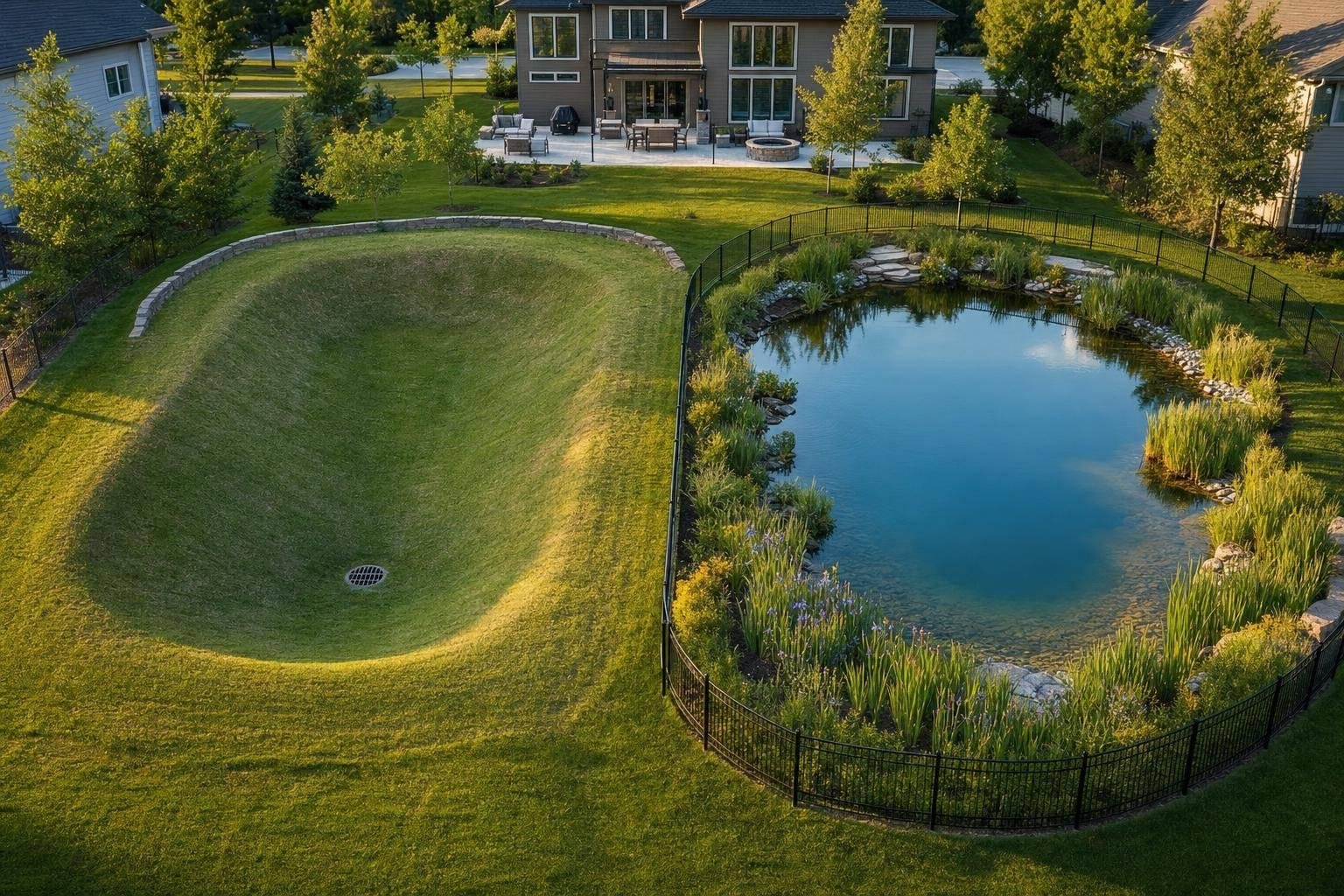
If you want more usable yard space, a detention basin usually fits better. If you need a permanent pool for stormwater treatment, a retention basin is the better match.
I’d sum it up like this: detention basins drain in about 24 to 72 hours, while retention basins hold water year-round. That one difference affects soils, groundwater, setbacks, planting, safety, and how much of the lot stays usable.
Before I place either type on a Maryland residential site, I’d check:
- Storage purpose: temporary holding vs. permanent pool
- Soils: whether the ground drains well or holds water
- Groundwater: whether the basin floor sits at least 2 feet above seasonal high groundwater for dry basins
- Setbacks: common spacing from homes, property lines, wells, and septic areas
- Standing water: whether water should disappear after a storm or stay in place
- Planting: dry-basin grasses vs. wet-edge and pond plantings
- Safety: slope, visibility, and water-edge risk
- Yard use: whether the basin can double as open lawn space
Quick Comparison
| Factor | Detention Basin | Retention Basin |
|---|---|---|
| Water | Drains after storms | Stays year-round |
| Drain time | 24–72 hours | Permanent pool |
| Best fit | Smaller lots | Larger lots or shared space |
| Soils | Must allow drawdown | Must hold water or use liner |
| Groundwater | Basin floor often 2 feet above seasonal high table | Must be checked for pool stability and soggy edges |
| Yard space | More usable between storms | Less usable due to pond and buffer |
| Safety | Lower day-to-day risk | Higher due to open water |
| Planting | Grasses, sedges, meadow cover | Aquatic, shoreline, and upland zones |
A dry basin is often easier to fit into a suburban yard. A wet basin needs more room, more edge planning, and more care around standing water.
Retarding Basins (Detention Ponds) Explained: Types, Components, Site Selection & Boyd Sizing Method
sbb-itb-843f8be
Detention Basin Site Planning: Dry Storage and Controlled Release
Detention basin siting starts with one hard rule: the basin needs to drain back to dry ground within 24 to 72 hours. That window affects almost everything else, including where the basin fits on the lot and how the outlet gets sized and protected.
The best spot is usually a natural low point where runoff already collects. From there, shallow swales can guide water from roofs, driveways, and lawns to the inlet. The goal is simple: move runoff away from walkways, foundations, and septic components. The basin floor also needs to sit at least 2 feet above the seasonal high groundwater table.[14][17][16] If groundwater sits too close to the surface, the basin may not drain the way it should.
Setbacks also shape the layout. Common guidance calls for at least 10 feet from property lines, 50 feet from private wells or septic systems, and 30 feet or more from buildings.[14][17][16][1] On a small suburban lot, that can shrink the list of workable locations fast. That’s why an early site check can save a lot of trouble later.
Soils, Drainage, and Standing Water Limits for Detention Basins
The basin floor needs to drain after each storm, not hold onto shallow puddles for days. A minimum bottom slope of 1–2% toward the outlet helps keep small pools from lingering.[8] If the native soil drains slowly, an underdrain may be needed to avoid muddy ground and poor drawdown.
Fast drainage also helps cut down mosquito habitat. The outlet structure should empty the basin within the design window while still keeping peak discharge at or below pre-development rates.[18][15]
Planting and Safety for Normally Dry Basins
Because a detention basin stays dry most of the time, native grasses, sedges, and low-maintenance herbaceous plantings usually make the most sense for the basin floor and side slopes.[17][2][13] They can handle wet-dry cycles and help hold soil in place. That matters because bare basin floors can erode fast, especially near inlet and outlet points during heavy rain.
Side slopes should be 3:1 or flatter, especially near play areas.[9][10][11][12] Good sightlines from the house to the basin also help. If you can see the basin easily, it’s much easier to spot clogged outlets, debris buildup, or damage after a major storm.
Retention basins follow different rules because they keep a permanent pool of water.
Retention Basin Site Planning: Permanent Water Storage
A retention basin, or wet pond, keeps a permanent pool of water for stormwater storage and water-quality treatment. Since that pool does not drain out, the site has to deal with standing water all year without causing trouble for nearby buildings, utilities, or adjacent lots.
That shifts the planning process right away. The first things to look at are the size of the drainage area feeding the basin, whether the soil can hold a stable pool, and how groundwater may interact with the basin. In plain terms, retention basins usually fit larger residential sites or shared drainage areas better than very small yards. They take up more room, depend more on site conditions, and can shape how the rest of the lot is used.
Setbacks are tighter than they are for a dry basin. Some local standards require retention basins to be at least 20 feet from structures or property lines, 50 feet from steep slopes, and 100 feet from septic tanks or drainfields.[6] On a small lot, those buffers can eat up a big share of the usable yard.
Soils, Groundwater, and Nuisance Risks for Retention Basins
Soils play a bigger role here than they do with a dry basin. Clay-heavy soils are better at holding a permanent pool. Sandy soils, karst, and fractured-bedrock sites can let water leak out too fast. In more permeable soils, especially when the pool sits more than 6 inches above the seasonal high water table, the basin may need a liner or a compacted low-permeability layer.[7][25]
Groundwater can be a mixed bag. Shallow groundwater may help keep the pool in place, but it can also increase the chance of saturating nearby ground and affecting foundations.[4][23][25] That can spill over into day-to-day site issues, including soggy lawns and harder maintenance access.
Permanent water also brings problems that dry basins usually avoid. Algae can build up in shallow, nutrient-rich water, and when that algae decays, it can smell bad. Open water often attracts geese. Shallow stagnant spots can also support mosquitoes. The usual fix is good basin shaping: deeper water in the center, steady margins, and planted shoreline buffers.[10][22]
Planting Zones, Appearance, and Safety Around Permanent Water
Planting around a retention basin is usually laid out by water depth, moving from the center outward. The emergent zone, usually 0 to 18 inches deep, supports sedges, rushes, and other native wetland plants rooted in submerged soil.[20][24] Those plants help hold the shallow edges in place and filter sediment.
Just beyond that, a shoreline fringe of hydric grasses, ferns, and native shrubs extends about 1 foot inland from the permanent water level.[19][21] Farther from the edge, upland plantings help hold the slope as conditions get drier. Some county stormwater standards also call for a planted buffer of at least 25 feet around the basin, with at least 15 feet of that buffer outside the pond perimeter.[27]
Safety matters more here than it does with a dry basin. Slippery banks, soft edges, and permanent water create a clear drowning risk, especially for children and pets. A shallow littoral shelf around the edge – usually about 1 to 2 feet deep and 10 feet wide – can support emergent planting and make the drop into deeper water less abrupt.[26] Banks should stay gentle enough to lower fall risk. In places where access is harder, stone steps or retaining walls can help people reach the basin and keep the edge in place. These differences stand out most in a side-by-side look at storage goals, soils, planting, safety, and yard space.
Retention vs. Detention Basin Site Planning: Side-by-Side Comparison
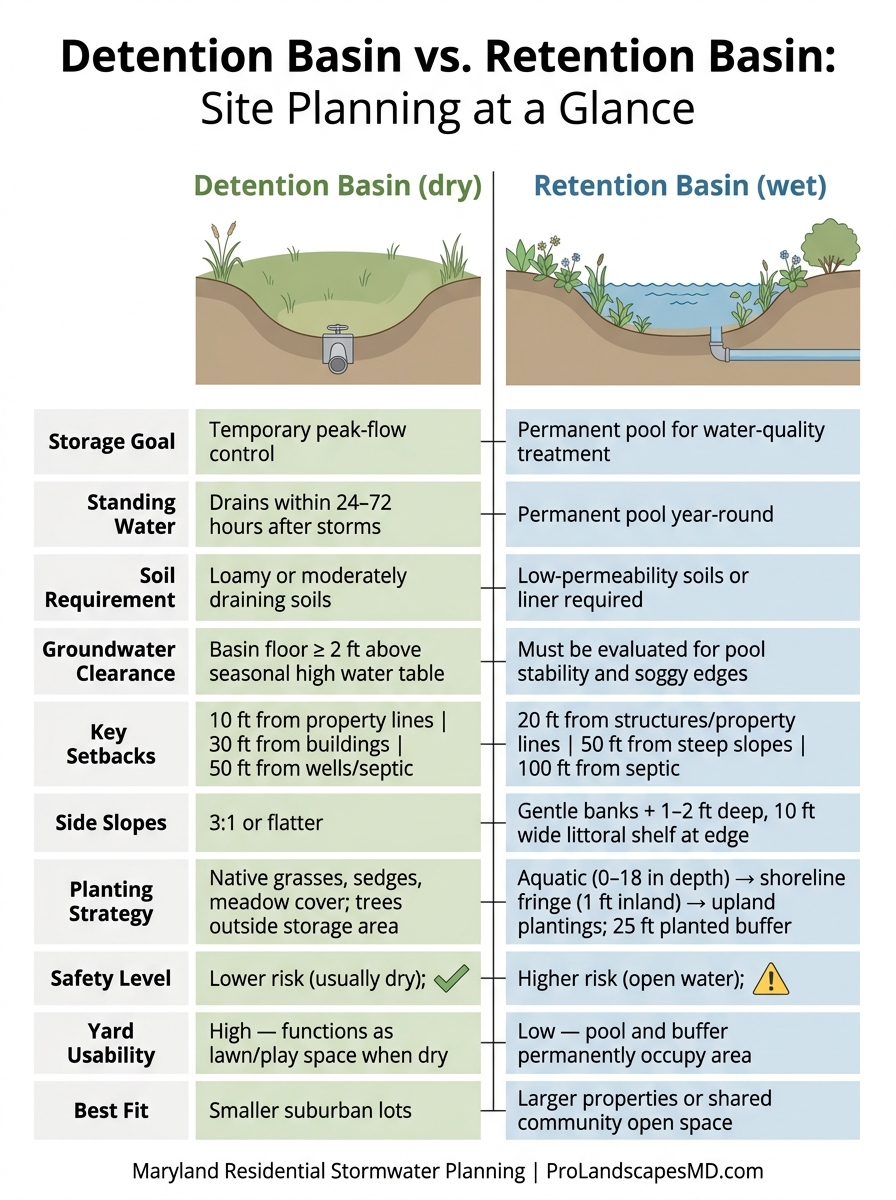
Detention vs Retention Basin: Side-by-Side Site Planning Guide
The difference between these two basin types isn’t just about whether water stays put. It affects where the basin can go, how the lot gets graded, what you can plant, and how much of the yard stays usable. At the center of it all is one key question: Should the basin drain all the way between storms, or keep water in place all year? That answer shapes what will work on a Maryland property.
The fastest way to compare them is side by side.
| Planning Factor | Detention Basin (Dry) | Retention Basin (Wet) |
|---|---|---|
| Storage goal | Temporary peak-flow control | Permanent pool for water-quality treatment |
| Soil need | Loamy or moderately draining soils that support full drawdown | Low-permeability soils that hold water, or a liner where soils are too permeable |
| Groundwater | Works only if full drawdown still occurs | Must be evaluated carefully so the pool stays stable without saturating nearby areas |
| Standing water | Not expected between storms | Expected year-round |
| Planting strategy | Turfgrass or native meadow grasses; trees placed outside the main storage area | Aquatic, shoreline, and upland plantings arranged by water depth |
| Safety concern | Lower, since it is usually dry, but slopes and access still matter | Higher; permanent water requires shallow shelves and clear sightlines |
| Yard space use | Higher; can function as lawn or informal play space when dry | Lower; the pool and buffer permanently occupy the area |
| Best fit | Smaller lots and drainage problems | Larger sites or shared open space |
Storage Goals, Soils, and Water Level Expectations
The main split is simple: a detention basin has to empty, while a retention basin has to keep water. A detention basin slows stormwater and releases it at a controlled rate, then drains within the design window, often in 24 to 72 hours.[2][28] If it doesn’t drain as planned, the system isn’t doing its job.
Retention basins work differently. They depend on a steady pool, so soils and groundwater matter much more. If the soil drains too fast, the basin may need a liner. If groundwater sits too high, the pool and nearby ground conditions need close review. That’s one reason dry detention basins and wet ponds are not interchangeable. Dry detention basins also do not provide the same water-quality treatment as wet ponds, which matters if the goal goes beyond runoff control.[30]
Planting, Safety, and Yard Space Tradeoffs
A dry basin usually gets planted with turfgrass or native meadow grasses that can take short-term flooding and still be mowed or used as open yard space once dry. Trees and shrubs are usually placed outside the main storage area so they don’t get in the way of drainage or upkeep.
A retention basin needs a different planting plan. The layout usually follows water depth, with aquatic plants near the edge, shoreline plants just above that zone, and upland planting around the outer rim. It’s a more layered setup because the basin stays wet.
Safety is also a bigger part of the plan around permanent water. A dry basin generally brings less risk, but it still needs gentle side slopes and clear access for mowing and inspections. A wet pond needs more deliberate edge work: shallow perimeter shelves, stable footing near the water, and clear sightlines from the house to help lower risk for children and pets.[3][29]
Which Basin Type Fits a Central Maryland Property
For many Maryland homes, the lot size makes the choice pretty quickly. On smaller suburban lots, a detention basin often makes more sense because it deals with runoff while keeping more of the yard usable. A retention basin tends to fit better on larger properties or in shared community open space, where permanent water is acceptable and there’s room for the added safety and edge-design needs.
Pro Landscapes MD handles drainage assessment and stormwater installation across central Maryland, including grading and French drains, to help match the right basin type to your lot before work begins.
Conclusion: Choosing the Right Basin Layout for Your Property
After weighing storage, soils, planting, safety, and how the yard needs to function, the last decision comes down to one thing: does the site need dry storage between storms, or a permanent pool? A retention basin only makes sense when the property can handle standing water safely and still fit the buffer that code requires.
Once you pick the basin type, the layout still has to meet local stormwater and grading rules. This isn’t something to tack on at the end. The final plan needs to follow Maryland stormwater rules, local grading limits, outlet control, and maintenance access[5][31].
Safety and planting need to be part of the first layout draft, not added later. They affect erosion control, maintenance work, and the risk around basin edges. That’s where early planning pays off.
Pro Landscapes MD helps central Maryland homeowners with drainage assessment, grading, and stormwater planning before work begins.
FAQs
Which basin is better for a small yard?
For a small yard, a detention basin is usually the better fit.
A retention basin keeps water in place all the time, so it often takes up more room. In a smaller space, that can be a tough tradeoff.
A detention basin works differently. It holds extra stormwater during heavy rain, then drains and dries out afterward. That makes it a better match for small yards because it uses space more efficiently, gives you more flexibility in how the yard functions, and often means less upkeep.
How do soil and groundwater affect basin choice?
Soil and groundwater play a big role when you’re choosing between retention and detention basins.
Retention basins hold a permanent pool of water. They’re often a better fit for sites with high water tables because they may need to intersect groundwater to keep that water level in place.
Detention basins, on the other hand, stay dry between storms. They’re usually a better match for properties with lower water tables.
Soil texture matters too. If the site has low-permeability soils, a retention basin may need design changes to reduce water loss.
Do retention basins need more maintenance and safety planning?
Yes. Retention basins usually need more maintenance and safety planning than detention basins because they keep a permanent pool of water.
That permanent water changes the job. It often means more routine plant management, water quality testing, sediment removal, and added safety steps like bank stabilization, signage, and regular inspections.
Detention basins are usually dry between storms, so maintenance is often simpler.
Chat with Us