









- bhavya gada
- No Comments
The short answer: I’d plant a retention basin like a wetland and a detention basin like a flood-and-drought meadow.
If water stays in the basin all year, plants must live in wet soil or standing water. If the basin drains within 24–72 hours, plants must handle short floods, dry periods, slope erosion, mowing limits, and clear access to outlets and spillways. In Maryland, that split matters even more because many storms are small – about 90% are under 1.25 inches – but storm bursts and winter freeze-thaw can still stress plants and soils.
Here’s the plain-English breakdown:
- Retention basins: plant by water depth
- Detention basins: plant for wet-then-dry cycles
- Retention basins: fit submerged and emergent aquatic plants
- Detention basins: fit native grasses, sedges, rushes, and wildflowers
- Both types: keep trees and shrubs away from embankments, risers, pipes, spillways, and outlets
- Maryland sites: need plans that support stormwater treatment, erosion control, and habitat at the same time
Quick Comparison
| Feature | Retention Basin | Detention Basin |
|---|---|---|
| Water pattern | Holds water year-round | Drains after storms |
| Usual depth | Permanent pool, often 3–8 ft | Dry between storms |
| Best plant focus | Aquatic and shoreline plants | Wet-meadow and slope plants |
| Main planting rule | Match plants to depth | Match plants to flood and dry swings |
| Main risk if planted wrong | Rot, washout, weak shoreline cover | Bare soil, erosion, poor cover |
| Wildlife use | Fish, amphibians, water birds | Pollinators, songbirds |
If you want the simplest rule, it’s this: wet pond plants for retention, meadow-style flood-tolerant plants for detention.
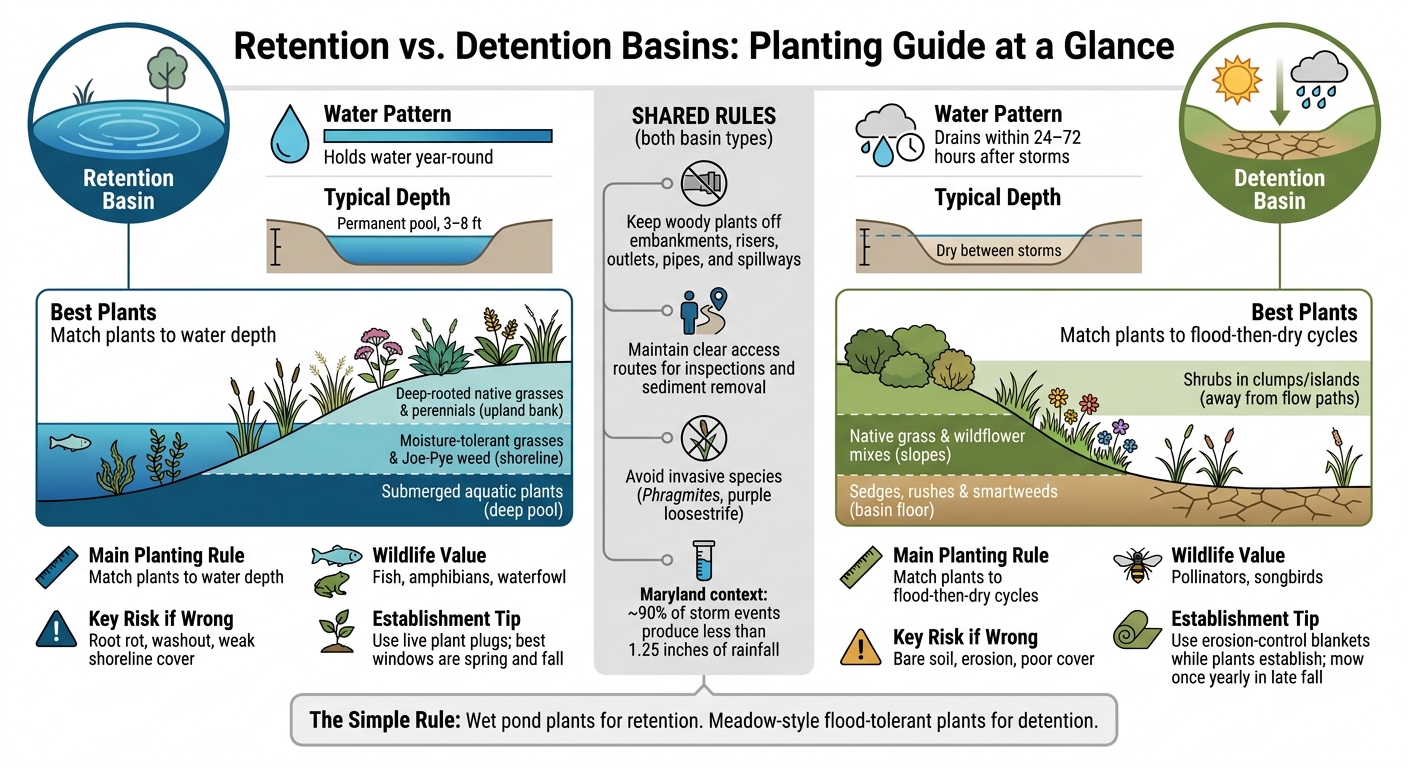
Retention vs. Detention Basins: Planting Guide at a Glance
Detention Basins and Retention Ponds BMPs
sbb-itb-843f8be
Site conditions that shape planting design in each basin type
Water patterns do more than move stormwater around. They create different planting zones and set hard limits on maintenance. Before you pick any plants, read the site closely. Soil moisture, how long water sits, how fast stormwater flows, and where crews need to get in with equipment all affect what will live in a basin.
Planting zones in retention basins
Plant in the littoral zone and along the shoreline, where shallow water can support emergent and submerged aquatic plants.
Planting zones in detention basins
Detention basins dry out after storms, so plants need to handle two very different conditions: short-term flooding and long dry stretches. That’s a tough mix.
Compaction from construction often leaves the basin floor dense, which slows infiltration and makes plant establishment harder. In most cases, native grasses, sedges, and wildflowers are a better fit for basin bottoms and slopes. They help hold soil in place, improve infiltration, and support wildlife.
Turf grass is still common on detention basin slopes. But it usually leads to more mowing and gives wildlife less to work with. Keeping the right plants in the right spots helps maintain habitat value without getting in the way of inspections or sediment cleanup.
Safety and access limits in both basin types
Plant survival is only part of the job. Protecting the basin’s structures comes first.
Keep woody plants off embankments and away from risers, outlets, pipes, spillways, and other control structures. In detention basins, place shrubs in clumps away from the main flow path so maintenance crews can do their work without tearing up plantings. Clear access routes for inspections and sediment removal need to stay open at all times.
Retention basins: planting for permanent water and wildlife habitat
Because retention basins hold water year-round, planting needs to follow water depth, not just flood tolerance. Each zone does a different job. Open water supports submerged plants, shallow edges support emergent species, and the upper bank fits plants that can handle drier soil. When you match each plant to the right depth, the basin can support layered wildlife habitat.
Plant types by water depth and shoreline zone
| Zone | Water Condition | Recommended Plants | Wildlife Benefit |
|---|---|---|---|
| Deep Pool | Permanent pool (3–8 ft) | Submerged aquatic plants | Fish habitat |
| Littoral Shelf | Shallow (0–12 in) | Emergent sedges, rushes, native emergent plants | Fish spawning, aquatic insects |
| Shoreline | Saturated/Moist | Moisture-tolerant grasses, sedges, Joe-Pye weed | Bank stability, runoff filtration, pollinators |
| Upland Bank | Mostly dry | Deep-rooted native grasses and perennials; shrubs in clumps | Erosion control, birds, pollinators |
The littoral shelf is where emergent aquatic plants tend to do best. Just above that, the shoreline works well with moisture-tolerant grasses and sedges that help hold the bank in place and filter runoff. Higher up, deep-rooted native grasses and perennials are a strong match. Shrubs should go in small clumps, not across the entire slope. [2]
Establishment practices that reduce erosion and plant loss
In zones that flood often, use live plant plugs instead of seed. Seed can wash out during storms before it has time to root. Plugs have a head start because they are already rooted, so they settle in faster and stay put better in wet soil. [2]
In Maryland, the best planting windows are spring and fall. Use plugs, mulch bare soil, and mow once a year after plants are established. [2]
When grading and replanting help
Grading and erosion control matter because plant success depends on stable shorelines and firm soils. If the edge keeps slumping or washing out, even the right plant mix can struggle. Detention basins work by a different rule: plants there need to handle both periodic flooding and long dry stretches.
Detention basins: planting for dry bottoms, storm flow, and low maintenance
Detention basins empty out after storms, so the planting has to handle two very different conditions: short periods of flooding and long stretches of dry weather. That’s why plant selection is a balancing act between flood tolerance, erosion control, and easy access for upkeep. Plants also need to stay out of the drainage paths that help the basin do its job.
Native grasses and herbaceous mixes for basin bottoms and slopes
Swap turf for deep-rooted native grasses and wildflowers, and mow once a year in late fall, after frost, when the ground is firm. [2]
For the basin floor, wet-meadow plants like sedges, rushes, and smartweeds are a strong match because they can handle periodic flooding along with dry spells. On side slopes, native grass and wildflower mixes help hold soil in place and support pollinators and birds. Their deep roots may also help improve infiltration over time. [1]
Shrub placement, erosion control, and retrofit methods
Place shrubs in clumps so crews can still get in for maintenance and birds get edge habitat. Putting shrubs in islands, instead of scattering them across the basin floor or slopes, helps keep them out of drainage paths and away from annual mowing areas. [2] Set up this way, shrubs can give birds cover without getting in the way of flow.
While plants are getting established, use erosion-control blankets and sediment controls to limit soil loss before native seed or plugs take hold. You can seed by drilling through existing grass or by removing the sod layer first and then replanting. If the basin sits next to a paved road or parking lot, use salt-tolerant species along those edges. [2]
Stormwater landscape services for older detention basins
Older basins often have hard channels that push low flows away from planted areas. Many of these detention basins were built with concrete low-flow channels that move small storm flows out fast, which means many smaller storms bypass planted areas in channelized basins. [2]
A retrofit can include removing concrete channels, regrading low spots, and replanting with native meadow species. When those concrete channels come out, low flows can spread through planted areas instead of skipping past them, which helps filtration and plant establishment. [2]
Retention vs. detention basins: planting comparison and Maryland takeaways
Comparison table: where plant choices overlap and where they differ
Here’s the simplest way to tell these planting plans apart.
| Feature | Retention Basins | Detention Basins |
|---|---|---|
| Hydrology | Permanent pool | Drains after storms |
| Plant Types | Aquatic plants | Native grasses, sedges, rushes, and wildflowers |
| Wildlife Value | Fish, waterfowl, and amphibians | Pollinators and songbirds |
| Erosion Control | Shoreline stabilization | Deep-rooted native grasses and protected flow paths |
| Structural Limits | Permanent pool depth | Fast drain time and clear flow paths required |
In Maryland, this distinction matters even more. Frequent small storms and steady invasive-species pressure have a big effect on what actually survives.
Maryland-specific design points for wildlife-friendly basin planting
Across the Mid-Atlantic, about 90% of storm events produce less than 1.25 inches of rainfall [2]. That’s a big reason native planting matters so much in detention basins, which are built to treat those smaller, more common storms.
Invasive species such as Phragmites (common reed) and purple loosestrife are a serious problem in both basin types across the region. If left unchecked, they can crowd out native plantings fast [1]. Let native vegetation flower. That helps feed birds and pollinators and adds habitat value [2].
For Maryland properties under MS4 requirements, planting plans need to support stormwater function and habitat at the same time.
Key planting differences property owners should remember
Retention basins need zone-based wetland planting. That usually means submerged species in open water, emergent plants along the littoral shelf, and native shrubs or grasses in the upland buffer.
Detention basins work differently. They need vegetation that can handle periodic flooding and then dry out between storms. In practice, that often means wet-meadow mixes, native grasses, and shrubs planted in clumps or islands.
FAQs
How do I know if my basin is retention or detention?
Check whether it has a permanent pool of water. A retention basin holds water at all times, while a detention basin is usually dry between storms and fills only for a short time during heavy rain.
You can also tell by its job: retention basins help with water quality and support wildlife, while detention basins use outlets and drainage systems to control how fast water is released.
Which native plants handle both flooding and drought best?
For detention basins and other spots where water levels swing up and down, floodplain species are a smart fit. They can handle both soaked soil and dry stretches without much fuss.
Good native choices include switchgrass, black-eyed Susans, golden alexanders, New England aster, and mountain mint. Along with handling those shifting conditions, these plants help filter runoff and support local pollinators.
When should a basin be replanted or retrofitted?
A basin should be replanted or retrofitted when vegetation starts to fail, upkeep turns into a constant chore, or the site is no longer doing enough for water quality and habitat.
Retrofitting can make a big difference for dry detention basins that mainly cut peak storm flows and not much else. It also helps when the basin has stubborn issues like sediment buildup, erosion, or soil that won’t let water soak in well. Adding native, deep-rooted plants can improve infiltration and filtration while also supporting wildlife habitat.
Chat with Us