









- bhavya gada
- No Comments
If water keeps cutting through your yard, a planted buffer can slow it, hold soil in place, and help keep sediment out of nearby water. On most home sites, I’d start with at least 35 feet, aim for 50 to 100 feet where space allows, and use three planting bands: wet-edge trees, middle shrubs, and outer grasses or flowers.
Here’s the short version:
- I’d use buffers along streams, ponds, swales, and wet low spots
- I’d keep the strip continuous, because gaps let runoff shoot through
- I’d match plants to moisture: wet soils near water, drier soils farther upslope
- I’d plant trees about 8 to 12 feet apart
- I’d install in spring or fall for trees and shrubs, and late spring for warm-season grasses
- I’d watch the first 1 to 3 years closely for watering, weed control, mulch, and deer damage
- I’d fix channelized flow first, often with a level spreader or an upslope rain garden
A few numbers matter most. A 35-foot strip can trap much of the larger sediment, while 50 to 75 feet gives runoff more time to soak in. On slopes over 15%, I’d lean toward 50 to 75 feet or more. I’d also mulch plants with 2 to 3 inches of wood chips and water about 1 inch per week during dry spells in the first years.
The biggest mistakes are simple: turf to the waterline, buffers that are too narrow, plants in the wrong soil, and downspouts dumping water into one hard stream. Fix those, and the planting has a much better shot at working for the long term.
| Topic | What I’d do |
|---|---|
| Minimum width | 35 feet |
| Better target | 50 to 100+ feet |
| Steep slope target | 50 to 75 feet |
| Zones | Trees near water, shrubs mid-buffer, grasses at outer edge |
| Tree spacing | 8 to 12 feet |
| Best planting time | Mid-March to mid-May or September to November |
| Grass planting time | May to June |
| Early care | Water, weed control, deer protection, replant losses |
If I were planning a home riparian buffer in Central Maryland, that’s the framework I’d use first.
Riparian Buffer Maintenance Challenges – Better Buffers for Cleaner Water
sbb-itb-843f8be
Buffer Width and Plant Zones That Work
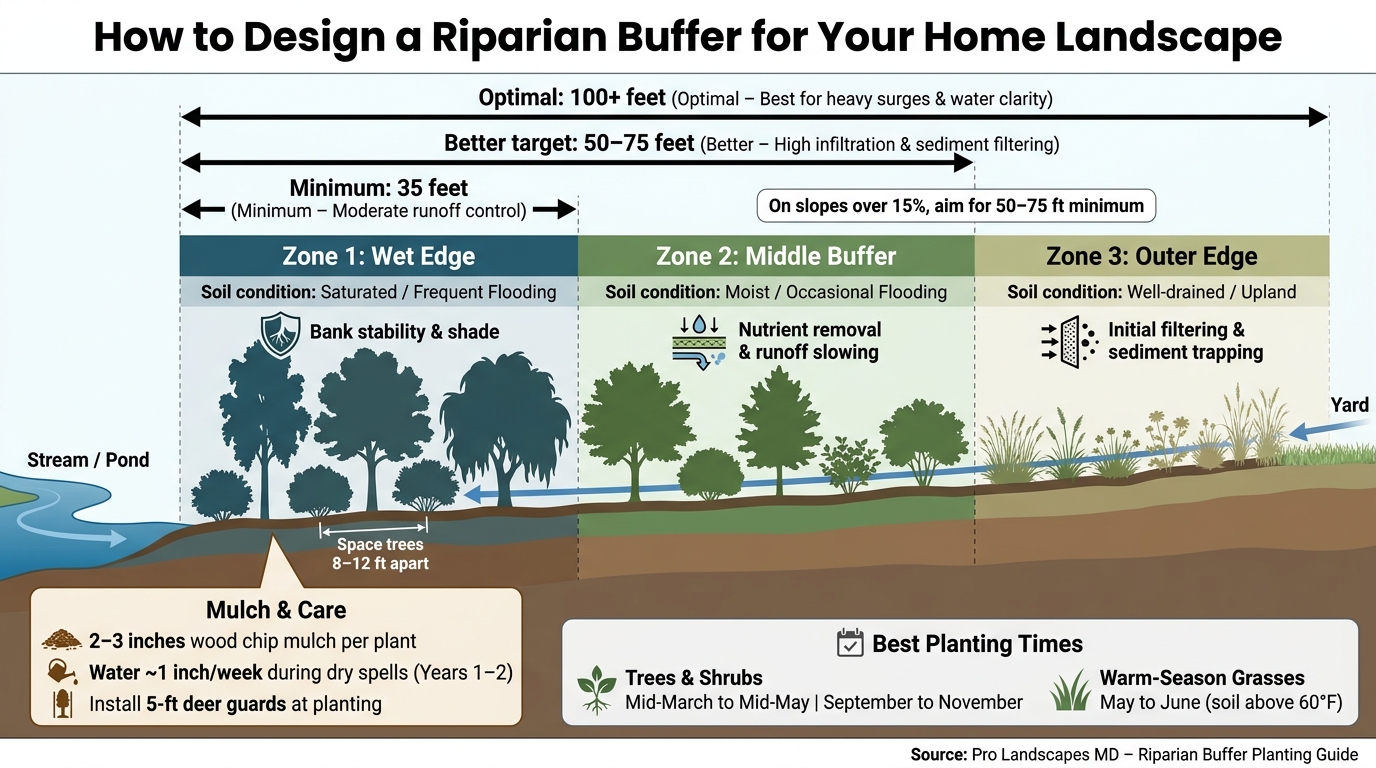
Riparian Buffer Planting Zones: Layout, Width & Plant Guide
Buffer width and zone layout shape how well a planting strip slows runoff and filters what’s in it. Wider buffers do more, but even a narrow, unbroken strip with the right plants can cut runoff and sediment.
How Wide Your Buffer Should Be
A 35-foot buffer is a practical minimum. If you want better nutrient removal, including nitrogen and phosphorus, plus more shade to help regulate water temperature, 50 to 100 feet or more is a better goal.
Slope matters too. If your yard drops steeply toward the water, especially more than 15%, aim for at least 50 to 75 feet. That extra room gives runoff more time to slow down and soak in instead of shooting straight through the planting area.
| Width | Runoff Control | Sediment Capture |
|---|---|---|
| 35 feet | Moderate; slows surface flow | High; traps most large particles |
| 50–75 feet | High; allows infiltration | Very high; filters fine silts |
| 100+ feet | Optimal; handles heavy surges | Highest; best for water clarity |
The Three Planting Zones and What Each One Does
A good buffer isn’t just a random mix of plants. It’s split into three zones, and each one has a clear job.
| Zone | Typical Location | Core Purpose | Best Plant Types |
|---|---|---|---|
| Zone 1 | Water’s edge | Bank stability and shade | Moisture-tolerant native trees: willow, sycamore, river birch |
| Zone 2 | Middle of the buffer | Nutrient removal and slowing runoff | Mixed shrubs and trees: Dogwood, Serviceberry |
| Zone 3 | Outer edge of the buffer, farthest from water | Initial filtering and sediment trapping | Native grasses, sedges, and wildflowers |
Zone 1 holds the bank in place and shades the water. Zone 2 works like the middle filter, where shrubs and understory trees slow runoff and help remove nutrients before water moves farther inland. Zone 3 is the first line of defense on the outer edge, slowing sheet flow before it reaches the rest of the buffer.
Adjusting the Zone Layout for Small or Irregular Yards
When lot lines, patios, driveways, or fences eat into your space, continuity matters more than hitting the exact same width everywhere. A buffer without gaps will do a better job than one with breaks, since water can slip through open spots and miss the vegetation.
If space is tight, focus first on the jobs done by Zone 1 and Zone 3. Put your thickest, most absorbent planting where water enters the buffer from the yard or from a hard surface. Around utility lines, use Zone 3 plants like grasses and low shrubs so the strip still filters runoff without getting in the way of access. In a narrow 35-foot buffer, layering plants by height with groundcovers, shrubs, and at least one canopy tree can help the strip filter more effectively.
After the layout is set, the next step is matching plants to each zone’s moisture level.
Choosing the Right Trees, Shrubs, and Grasses
Once the zones are set, the next step is simple: pick plants that match each area’s moisture level. A plant that likes wet feet won’t do well on higher, dry ground. The reverse is also true.
How Trees and Shrubs Control Runoff and Stabilize Banks
Trees do the heavy lifting here. Their canopy catches rainfall before it slams into the soil, which helps cut splash erosion. Below the surface, deep roots hold soil in place on slopes and help steady streambanks.
Shrubs help in a different way. Their thick stems slow water moving across the surface, which gives it more time to soak in instead of washing away. When you combine trees, shrubs, and groundcover, you get better runoff control from top to bottom.
What to Plant in Wet, Moist, and Drier Buffer Areas
Each species should fit its moisture zone.
| Buffer Zone | Soil Condition | Recommended Trees | Recommended Shrubs | Grasses & Forbs |
|---|---|---|---|---|
| Zone 1 (Wet) | Saturated / Frequent Flooding | River Birch, Sycamore, Black Willow | Buttonbush, Silky Dogwood, Smooth Alder | Lizard’s Tail, Soft Rush |
| Zone 2 (Moist) | Moist / Occasional Flooding | Red Maple, Pin Oak, Swamp White Oak | Winterberry, Spicebush, Arrowwood Viburnum | Cardinal Flower, Joe-Pye Weed |
| Zone 3 (Drier) | Well-drained / Upland | White Oak, Black Walnut, Eastern Red Cedar | Serviceberry, Ninebark, Blackhaw | Native sedges, wildflowers |
In spots that get fast-moving floodwater, flexible-stemmed plants such as Silky Dogwood and Black Willow are a smart fit. They can bend under flood pressure instead of snapping or getting pulled out.
For tree spacing, 8 to 12 feet apart is a good starting point. From there, adjust based on how wide each species gets at maturity so the canopy can close in over time.
Throughout the planting, stick with native Maryland species. They’re suited to local weather swings and support wildlife in the Chesapeake Bay watershed.
When to Bring in a Professional Planting Designer
If runoff or grading is already causing damage, plant selection is only part of landscape projects in Maryland. The site itself matters just as much. On steep slopes, in heavy clay, or where drainage is tricky, Pro Landscapes MD can review grading, soil, and runoff patterns before planting.
Installation and Early Maintenance
Once the buffer layout and plant zones are set, installation is where things either hold together or start going sideways. If runoff enters as sheet flow, the buffer can do its job. If water starts carving channels, it can tear through new work fast.
Site Preparation, Grading, and Planting Order
Before you plant anything, figure out exactly where water enters the buffer. That step matters more than people think. If runoff is already cutting a channel or piling into a low spot, it can wash around or under new plants before they get established.
A good fix is a level lip spreader: a shallow stone trench that spreads runoff into sheet flow across the buffer.
After that, remove invasive plants first, including multiflora rose and Japanese honeysuckle. Leave healthy native trees in place. They hold soil, slow erosion, and give new plants some shade. If the site has steep slopes or active erosion, get professional grading done before planting.
Once water is moving evenly, plant from the bank outward, starting with the biggest material first. The order should be:
- Large canopy trees first to set spacing
- Understory shrubs next
- Groundcovers or seed mixes last
That sequence helps the buffer fill in with better structure from the start.
Best Planting Times for Maryland Landscapes
For Maryland landscapes, the best planting windows for trees and shrubs are early spring (mid-March to mid-May) and fall (September to November).
Fall is often the better option for container-grown plants. Cooler weather cuts watering stress, and roots get time to settle in before summer heat hits. Spring is a good fit for bare-root seedlings, but you’ll need to water them steadily through July and August.
Planting during these windows gives roots time to establish before the next storm season, which helps the buffer start slowing and filtering runoff right away.
Warm-season grasses like Switchgrass and Little Bluestem play by different rules. Wait until late spring (May to June), when soil temperatures stay above 60°F. In spots with active erosion, use plugs. Seed can take 2 to 3 years to establish, and heavy rain can wash it out before it gets a foothold.
After planting, the first three years come down to three jobs: water, weed control, and plant protection.
Key Maintenance Tasks in Years 1 Through 3
Each task below helps keep continuous cover in place and the bank stable. That’s what lets a buffer keep working storm after storm.
| Task | Year 1 | Year 2 | Year 3 |
|---|---|---|---|
| Watering | About 1 inch per week during dry spells | About 1 inch per week during dry spells | Generally unnecessary |
| Weed Control | Monthly hand-pulling or mowing | Spot-treat invasive regrowth | Monitor for new invasives |
| Deer Guards | Install 5-foot vented tubes or wire cages and check monthly | Adjust ties and stakes | Remove if tree exceeds 6 feet tall |
| Mowing | None except to knock back weeds | Spot-mow invasive patches | Once annually in late winter |
| Plant Health | Replace any dead stock promptly | Aim for under 10% loss | Prune for structure and safety |
Apply 2 to 3 inches of wood chips or shredded hardwood as mulch in a ring around each plant, but keep mulch off the trunk. At planting time, install 5-foot vented tubes or wire cages to protect young trees.
Common Mistakes That Weaken Runoff Control and How to Fix Them
Buffers That Are Too Narrow, Patchy, or Mostly Turf
A buffer can look fine on paper and still fail in practice. The big reason: runoff finds the weakest path. If water can slip around or cut through the planted area, the buffer loses much of its job.
One common problem is a planted strip that’s too narrow or broken up. In many yards, that happens because mowing continues right to the water’s edge. Turf may look neat, but it doesn’t do much heavy lifting during storms. Its roots are shallow, so it holds less soil when water starts moving. Strips narrower than 35 feet, especially turf-covered ones, tend to move runoff along instead of slowing and filtering it.
Patchy planting causes the same kind of trouble. Gaps between plant groups act like open lanes. Runoff gathers there, picks up speed, and cuts straight toward the water instead of moving through thick vegetation. A simple fix is to stop mowing 10 to 25 feet from the bank and replace that area with native trees, shrubs, and tall grasses. Over time, those plants form continuous root zones that help hold soil and slow flow.
Wrong Plant Choices and Poor Water Management
Most planting failures come back to two issues: plants that don’t fit the site’s moisture conditions and water that arrives in one hard stream.
Dry-site ornamentals placed in wet soil usually fail fast. Once those plants die, they leave bare ground behind. Bare patches erode quickly, and weeds often move in right after. The fix is to match plants to each part of the buffer: wet soils near the bank for Zone 1, moist-site species upslope in Zone 2, and drought-tolerant plants only at the outer edge in Zone 3.[1][2]
The other big issue is concentrated flow. If a roof downspout or driveway drain sends water into the buffer as a single stream, that stream can carve a channel straight to the water. When that happens, most of the vegetation gets bypassed.[3][4] A level spreader helps by turning that flow into sheet flow across the buffer. Better yet, send downspout runoff into an upslope rain garden before it reaches the buffer.
Conclusion: The Basics That Make a Home Buffer Work
Use the table below to match the problem with the fix.
| Mistake | Impact on Runoff Control | Corrective Action |
|---|---|---|
| Mowed lawn to the waterline | Fast runoff, bank erosion, little filtration | Stop mowing 10–25 feet from bank; plant native trees, shrubs, and tall grasses |
| Buffer narrower than ~35 feet | Minimal sediment and nutrient removal | Expand vegetated width toward 35–50+ feet; densify planting near runoff entry points |
| Dry-site plants in wet soils | Plant death, bare patches, erosion | Replace with moisture-tolerant native riparian species matched to site conditions |
| Concentrated downspout or driveway discharge | Channelized flow, bypassed vegetation, gully formation | Install a level spreader or redirect flow to an upslope rain garden |
| Ignoring weeds and invasives in years 1–3 | Loss of desired plants, reduced buffer function | Regular monitoring, spot removal, and prompt replanting of failed areas |
| Steep slopes, complex drainage, or regulatory requirements | DIY fixes may be ineffective or non-compliant | Consult a professional for planting, grading, and drainage solutions |
Pro Landscapes MD can help with buffer planting, grading, and drainage on central Maryland properties.
FAQs
Do I need a riparian buffer if I only have a wet spot, not a stream?
Even if you don’t have a stream, buffer-style plantings can still help with wet spots around your property. Riparian buffers are made for waterways, but the core idea works in other soggy areas too: use plants to slow water down, spread it out, and help it soak into the ground.
A rain garden planted with water-loving native species can improve infiltration, catch sediment, and cut down on pollutants. It also gives you a practical way to deal with runoff without turning the space into a muddy mess. The key is to watch how water moves across your property. Once you see where it collects and how fast it flows, it’s much easier to pick plants that help hold soil in place and support drainage.
How do I know which plants match the wet and dry parts of my yard?
First, look closely at your site conditions: soil type, drainage, and moisture levels. Grab a shovel and check just below the surface for wet soil or signs of compaction. That quick check tells you a lot about what will grow well and what will struggle.
Native plants are usually your best bet. They already fit local conditions, so they typically need less upkeep over time.
For the wettest spots near water, go with bottomland species such as sedges, rushes, black willow, and red-osier dogwood. In drier areas, like the tops of slopes, plant drought-tolerant grasses, shrubs, or hardwoods such as white oak.
What should I fix before planting if runoff is cutting channels through the area?
If runoff is carving channels or gullies through the planting area, fix that concentrated flow before you install the buffer. If you skip this step, new plantings can wash out.
Use erosion-control materials like straw matting. You can also add swales to redirect runoff into vegetated infiltration areas, and check that downspouts aren’t emptying onto surfaces that erode easily. Once that’s handled, plant dense native vegetation to help hold soil in place and reduce future erosion.
Chat with Us