









- bhavya gada
- No Comments
If I want to protect a Maryland streambank, I need a planted buffer with native trees near the water, shrubs in the middle, and grasses or sedges on the outer edge. Even a 10- to 15-foot strip can help hold soil in place, but 35 feet is a common starting point on home lots, and 50 to 100 feet does more for runoff control, shade, and wildlife movement.
Before I plant, I need to check slope, wetness, sun, erosion, and problem plants. If the bank is steeper than 2:1, badly undercut, or water is cutting through one channel, planting alone may not be enough. I may need grading, a swale, or other bank work first.
Here’s the short version:
- Measure from the top of bank, not the water’s edge
- Use three layers: trees, shrubs, then grasses/sedges/groundcovers
- Match plants to moisture, with wet-soil species closest to the stream
- Stagger plants in a triangular pattern to reduce gaps
- Water about 1 inch per week for the first 2 to 3 years
- Mulch 2 to 3 inches deep, but keep it 2 to 3 inches away from stems
- Check the site at least twice a year and replace dead plants
A few strong plant picks from the article:
- Trees: Sycamore, River Birch, Red Maple, Black Gum, Pin Oak, Swamp White Oak
- Shrubs: Buttonbush, Silky Dogwood, Red Osier Dogwood, Winterberry Holly, Elderberry
- Low plants: Switchgrass, Indiangrass, Soft Rush, native sedges
| Buffer width | Main job | Best fit |
|---|---|---|
| 10–15 feet | Basic bank holding and sediment catch | Small urban lots |
| 35 feet | Standard home-lot buffer in Maryland | Many residential sites |
| 50–100 feet | More runoff filtering and habitat cover | Larger suburban or rural lots |
So if I had to boil the whole article down to one idea, it’s this: the best buffer is the longest continuous planted strip the site can fit, built in layers, matched to wet and dry spots, and cared for well in the first few years.
Plan the Buffer: Site Conditions, Width, and Layout
Check Slope, Wetness, Sun, Existing Vegetation, and Erosion
Look at the site before you start landscape projects in Maryland or buy a single plant. Check the slope, how wet the soil stays, how much sun the area gets, what’s already growing there, and whether the bank is washing out.
Slope can change the whole plan. If the bank is steeper than 2:1, you may need grading or bank stabilization before planting. On steep banks, runoff moves faster. And if the bank is badly undercut or already falling apart, new plants may struggle to take hold.
Pay attention to where water sits after storms and where the soil dries out fast. The wet area at the toe of the bank needs plants that can handle soggy ground. The upper part is often much drier, so dry-site plants make more sense there. You should also check for invasive plants like Multiflora Rose or English Ivy. Remove them first so they don’t crowd out your new native plantings.
Some yards have another problem: water doesn’t spread out across the slope at all. It rushes through a gully in one concentrated line during storms. When that happens, a standard buffer planting can get skipped by the flow. In that case, you may need a swale or dry creek bed before the water reaches the bank.
Use what you find on the site to decide both the buffer width and where each type of plant should go.
Choose a Buffer Width That Fits the Lot
The right width depends on your lot and how much pressure the bank is under. In Maryland, guidance often starts with a 35-foot minimum for residential properties, measured from the top of the bank – where the slope flattens and meets the yard, not from the water’s edge [2].
If you have more room, go wider. A wider buffer gives you more room for water quality work and wildlife use. But a small lot can still support a buffer that helps. Even a 10-to-15-foot strip of native plants can hold a bank better and trap more sediment than turf grass. The big thing is continuity. A narrow strip that runs the full length of the stream usually does more than a wider planting that stops halfway.
| Buffer Width | Primary Benefit | Best Fit |
|---|---|---|
| 10–15 feet | Basic bank stabilization and sediment trapping | Very small urban lots or narrow side-yard drainage corridors |
| 35 feet | Nutrient removal and moderate wildlife habitat | Standard Maryland residential recommendation |
| 50–100 feet | Water quality protection and wildlife travel corridors | Larger suburban or rural properties |
Use a Simple Three-Layer Layout
Once you know the width, set up the planting in layers. Think of the buffer as three zones that run along the stream.
Trees belong closest to the water. Their deep roots hold the bank better than grasses alone. Shrubs go in the middle, where they add dense roots and mid-height cover while still helping slow and filter runoff. Grasses, sedges, and groundcovers belong on the outer edge, where the buffer meets the lawn or garden. That outer strip slows runoff coming off grass or pavement and spreads it out before it reaches the inner planting zones.
Even on a tight 35-foot lot, this layout still works. Each zone just gets a little narrower. The job stays the same: slow the water, trap sediment, and hold the bank in place.
sbb-itb-843f8be
Native Maryland Plants for Each Buffer Layer
Match each plant to the soil moisture it will face. If a plant can’t deal with saturated soil, it will likely die at the stream edge. Use several native species in each zone so one weak plant doesn’t drag down the whole buffer. Take the wet, moist, and drier areas you mapped earlier and use them to place each layer. Start at the waterline and move outward: trees first, then shrubs, then low plants along the edge.
Trees for Shade, Deep Roots, and Long-Term Structure
Trees bring the deepest roots and the strongest long-term bank support, so they belong in the wettest zone closest to the water.
At the water’s edge, where soil stays wettest, Sycamore and River Birch do well in saturated ground and can handle periodic flooding. Red Maple also works in wet soil and can keep going as the ground gets drier farther up the slope. In the moist middle zone, Black Gum, Pin Oak, and Swamp White Oak do well and help build long-term canopy cover.
Shrubs for Dense Rooting and Mid-Level Cover
Shrubs add dense roots, mid-level cover, and berries that help with bank stability and habitat.
Near the water, Buttonbush and Silky Dogwood can handle the wettest conditions. In the transition zone between the trees and the upland edge, Red Osier Dogwood, Winterberry Holly, and Elderberry are good fits.
Grasses, Sedges, Rushes, and Groundcovers for Surface Protection
Use low-growing plants on the outer edge to slow runoff and help stop water from carving channels through the buffer.
On the drier upland edge, Switchgrass and Indiangrass help suppress weeds and cover bare soil between woody plants. Closer to the water, Soft Rush and native sedges do well in wet and intermittently flooded ground. Fill open spots between plants with native groundcovers that match the same moisture zone.
Once you’ve chosen your species, space them by mature size and stagger them by layer.
How to Install the Buffer: Spacing, Planting Steps, and Early Care
Prepare the Site and Plant at the Right Time
Once the buffer layout is set, work from the streambank outward. Clear invasive plants and turf only where new roots will grow. That keeps site disturbance limited and helps the soil stay in place.
Before you plant, walk the streambank and check for active runoff channels and gully heads. Fix those trouble spots first. If you skip that step, water can cut around the buffer or wash through it before the planting gets established.
In Maryland, plant bare-root seedlings in early spring or late fall.
Space Plants by Layer and Stagger Them for Better Coverage
After cleanup, spacing makes a big difference. It helps decide whether water filters through the planting or punches straight through weak spots.
Stagger plants in a triangular grid to close gaps and spread roots more evenly [2][1]. Think of it like laying bricks instead of stacking everything in straight lines. You get better coverage, fewer open lanes for runoff, and a planting that knits together faster.
Water, Mulch, Protect, and Replant During Establishment
After planting, the job shifts to establishment care. The first 2 to 3 years matter most.
During that period:
- Water about 1 inch per week
- Add mulch 2 to 3 inches deep
- Keep mulch 2 to 3 inches away from stems
- Use tree shelters or wire cages for woody plants where deer are a problem
- Keep a 3-foot weed-free ring around each plant
- Mow between rows until canopy closure
It also pays to keep an eye on the site. Inspect the buffer at least twice a year and replace failed plants as needed during establishment.
Buffer Designs for Maryland Yards and Key Takeaways
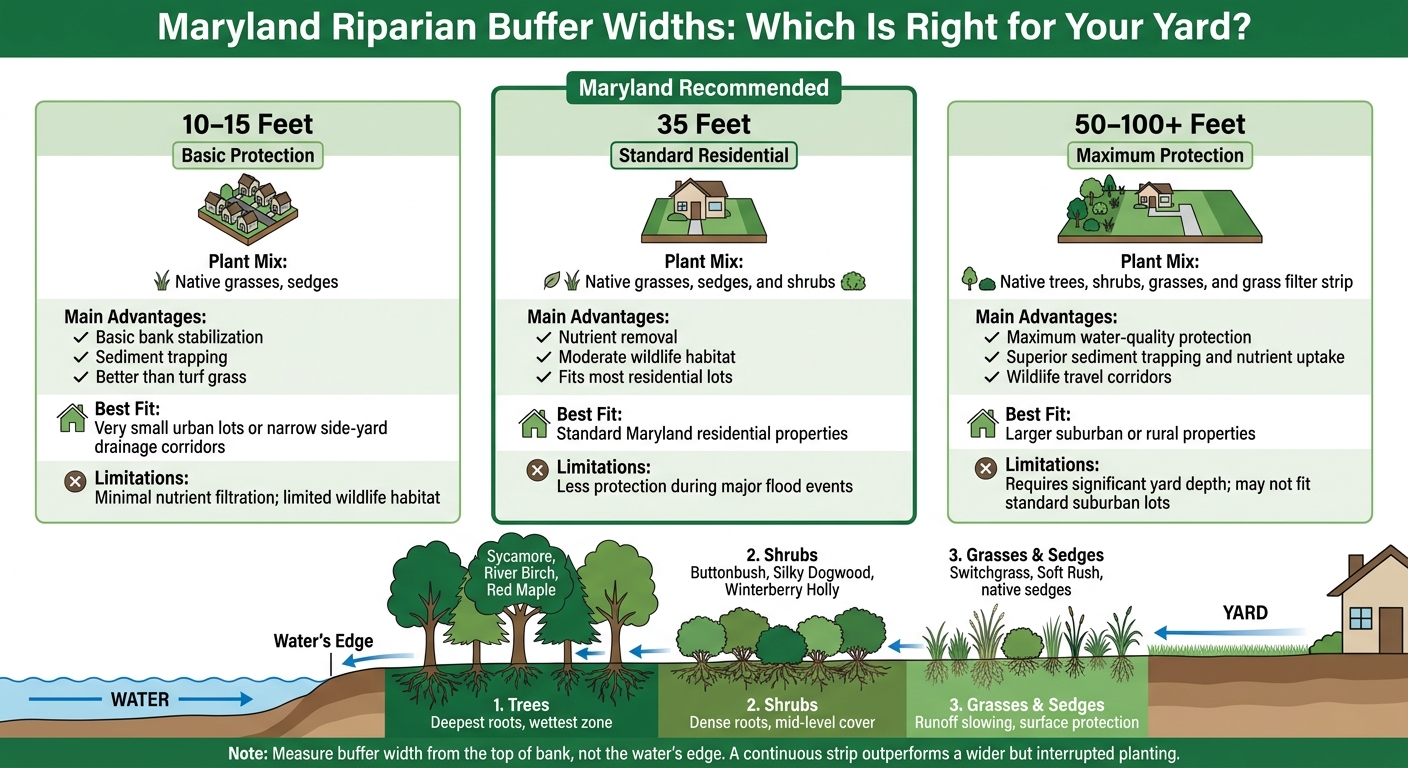
Maryland Riparian Buffer Widths: Which Is Right for Your Yard?
A Narrow 35-Foot Buffer Versus a Wider Three-Zone Buffer
Once you understand the site, the next call is simple: how much buffer width can the yard actually handle?
A narrow 35-foot buffer can work well on smaller lots where yard depth is tight. It usually relies on native grasses, sedges, and shrubs. That setup helps with basic bank stabilization, but it does less to filter nutrients and offers less protection during large flood events.
A three-zone buffer that is 75 feet or more gives you more room to work with. It adds mixed native trees and shrubs in the middle, plus a grass filter strip on the upland side. That wider layout provides stronger nutrient removal and better wildlife habitat [1][2]. It also does a better job trapping sediment and taking up nutrients. The tradeoff is pretty clear: it needs a lot more yard depth, so it may not fit a standard suburban lot.
The best fit depends on the site’s slope, wetness, and how much space the property owner can give up.
| Width Option | Plant Mix | Main Advantages | Site Limitations |
|---|---|---|---|
| Narrow 35-Foot Buffer | Native grasses, sedges, and shrubs | Fits smaller lots; basic bank stabilization | Less nutrient filtration; less protection during major flood events |
| Three-Zone Buffer (75+ Feet) | Native trees and shrubs; grass filter strip on outer edge | Maximum water-quality protection; superior sediment trapping and nutrient uptake | Requires significant yard depth; may not be feasible on standard suburban lots |
Blending the Buffer With Drainage and Residential Landscaping
After you settle on width and plant layers, tie the buffer into the site’s drainage pattern. The goal is to send runoff into the planting, not let it skip past it. If water moves around the buffer, the planting does far less work.
Nearby landscape beds can also blend into the outer edge of the buffer. Native shrubs and plants that handle drier conditions make that transition feel natural, so the buffer looks like part of the yard instead of a hard line between "landscaped" and "not landscaped."
Conclusion: Width, Layering, Native Plants, and Maintenance
The best buffer is the widest continuous strip the site can support. It should be planted in layers and cared for during establishment. Site conditions shape the width decision, and steady watering, weeding, and replanting during the first 2 to 3 years determine whether the buffer lasts over time.
FAQs
Do I need permits before planting along a Maryland streambank?
It depends on the scope of the project. In most cases, you don’t need a permit to plant vegetation on existing substrate along tidal or non-tidal shorelines, as long as you’re not adding fill or using heavy equipment that could damage the area.
You do need permits if the work changes shorelines or wetlands. That includes grading, adding fill, removing existing vegetation, or installing structures.
Because permit rules can vary by state and local jurisdiction, check with your local environmental agencies before you start.
How do I tell if my bank needs stabilization before planting?
Start by figuring out what’s driving the erosion. Look for steep slopes, active soil loss, bare patches, stressed plants, or spots that get worse after rain.
If the bank is too steep, it may need regrading before plants can take hold. And when runoff is heavy or the area is unstable, you may need to put in rock barriers, retaining walls, or timbers before planting – or while the planting work is underway.
What if my yard has room for only a very narrow buffer?
Even when space is tight, a narrow buffer can still help hold streambanks in place and add shade. For full water-quality and habitat gains, the most common minimum buffer widths fall between 35 and 100 feet. That said, smaller buffers still provide some protection.
Put the focus on native vegetation. Keep healthy plants that are already doing well, and remove invasive species before they spread. If planting room is scarce, hardscape features like stone walls, boulders, or timbers can help slow runoff and steady steep slopes.
Chat with Us