









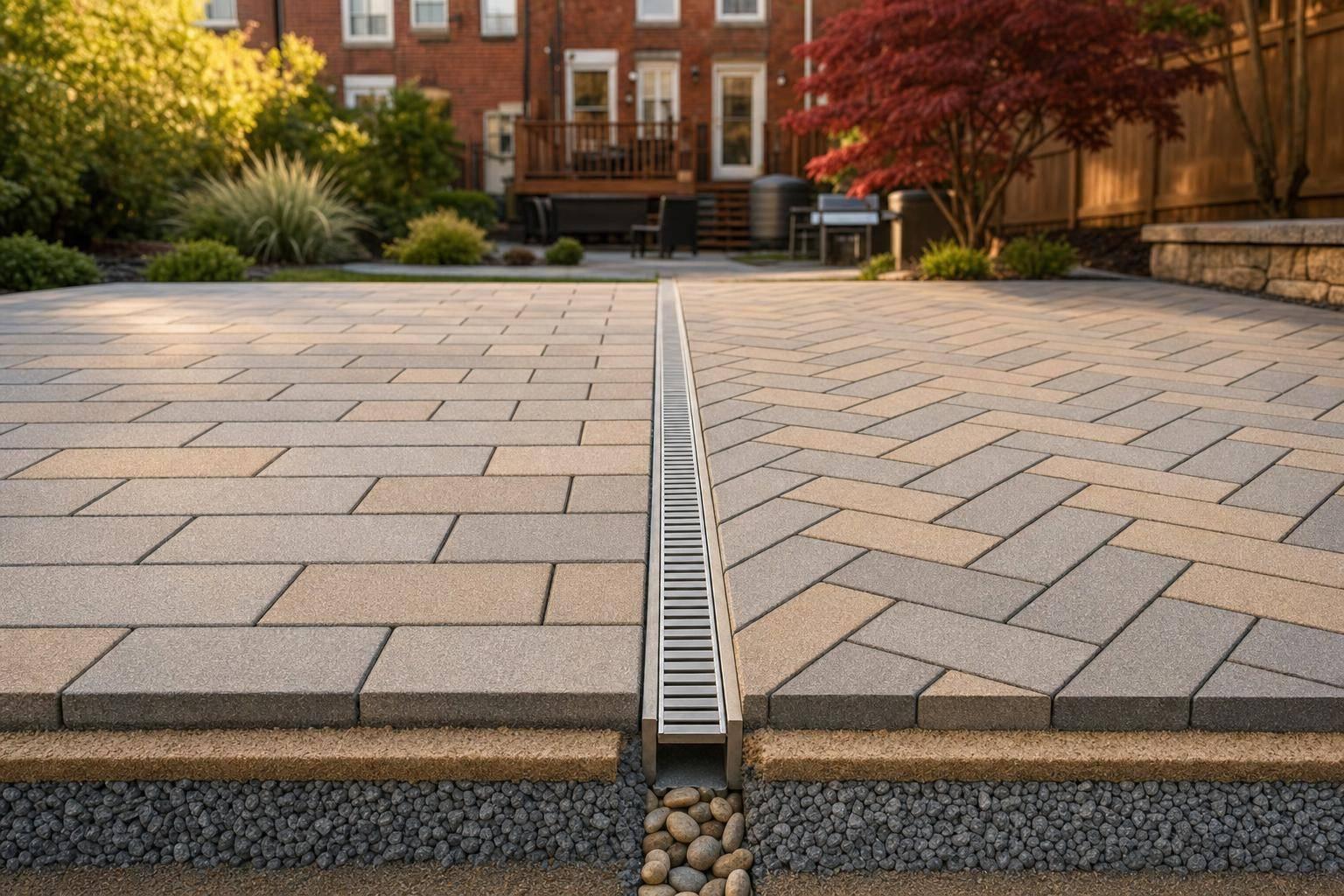
- bhavya gada
- No Comments
If I want the short answer: running bond is usually the better fit for patios and walkways, while herringbone is often the better fit for driveways and other heavy-use areas.
Here’s the simple breakdown:
- Running bond uses offset rows and gives a clean, straight look.
- Herringbone uses a zigzag pattern and holds together better under weight and turning tires.
- In Maryland, freeze-thaw weather makes base prep, drainage, and slope just as important as the layout.
- Waste and cutting are usually higher with herringbone: about 15% to 20%, compared with 8% to 12% for running bond.
- A slope of at least 2% away from the house helps move water off the surface.
If I’m choosing by use first, I’d keep it simple:
- Patios: running bond or herringbone, depending on the look I want
- Walkways: running bond works well in many cases
- Driveways: herringbone is often the safer choice
- Mixed spaces: using both can help separate zones
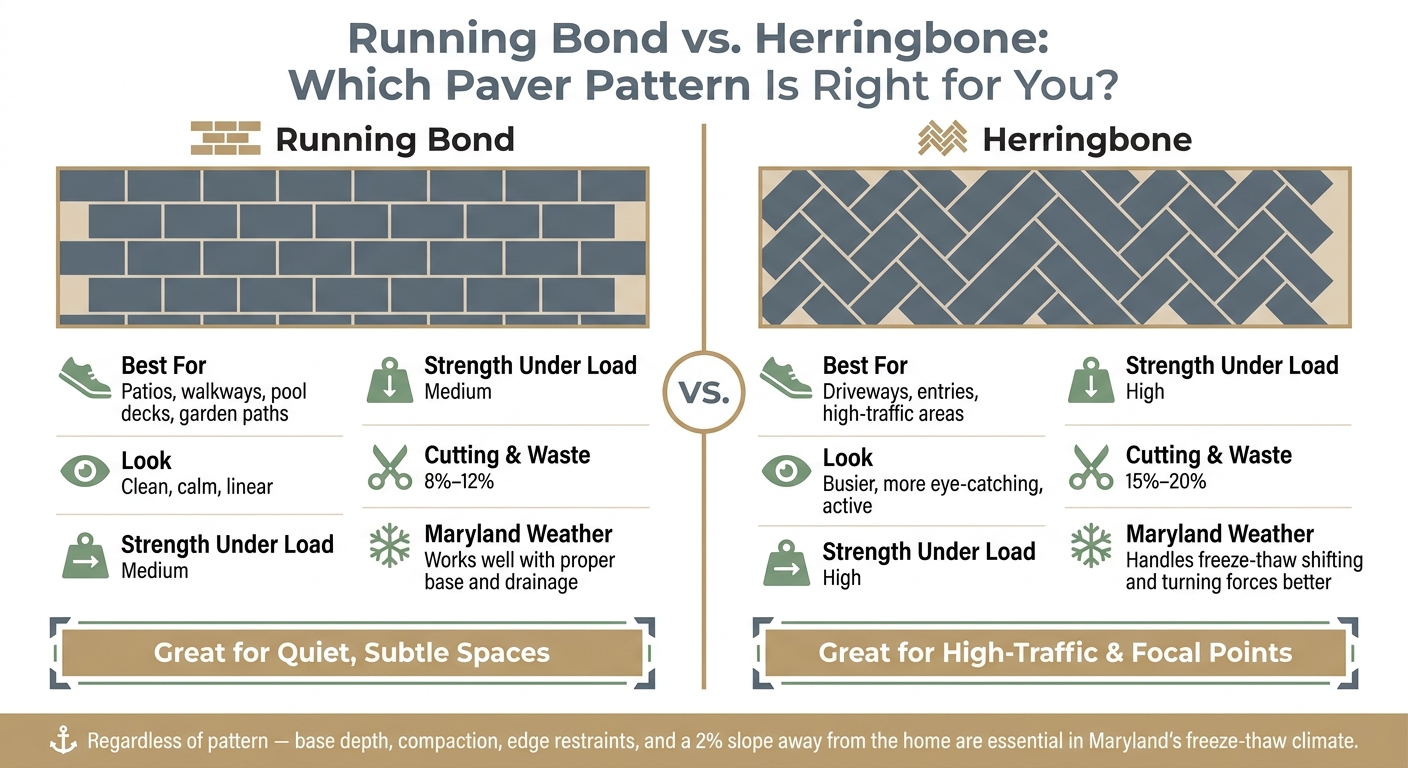
Running Bond vs. Herringbone Pavers: Side-by-Side Comparison
Top 5 Paver Patterns | The Strongest Pattern is…
sbb-itb-843f8be
Quick Comparison
| Pattern | Best for | Look | Strength under load | Cutting/waste | Good fit in Maryland weather |
|---|---|---|---|---|---|
| Running Bond | Patios, paths, pool decks | Clean, calm, linear | Medium | 8%–12% | Works well if base and drainage are done right |
| Herringbone | Driveways, entries, high-traffic areas | Busier, more eye-catching | High | 15%–20% | Handles shifting and turning forces better |
My take: if I want a quiet layout that doesn’t fight the rest of the yard, I’d lean running bond. If I need more hold under traffic or want the surface to stand out, I’d lean herringbone. Either way, the base under the stone matters as much as the pattern on top.
Running Bond vs. Herringbone: How Each Layout Is Arranged
What Running Bond Looks Like
In a running bond layout, rectangular stones are set in parallel rows, with each row shifted by half a stone [3][7]. That offset gets rid of the long vertical joint lines you’d see if every stone lined up exactly. The end result is a clean, linear surface with a strong sense of direction.
You’ll see running bond used often for patios, garden walkways, and pool decks. It’s also simpler to install and usually needs less cutting [1][6]. Because the shape is so straightforward, the bigger comparison comes down to style and how the pattern holds up under use.
What Herringbone Looks Like
Herringbone uses the same rectangular stones, but places them at opposing 45° or 90° angles [3][6]. Each stone fits against the next in a repeating "V" or zigzag pattern. Visually, it feels more active. Instead of moving the eye in one straight path, it creates motion in several directions at once.
That locking pattern does more than change the look. It also makes herringbone stronger from a structural standpoint. The zigzag layout helps resist side-to-side movement and spreads weight more evenly across the surface, which is why it works well for driveways and other high-traffic areas [1][6]. Those differences in visual flow and locking strength play a big role in where each pattern makes the most sense.
Visual Style and Design Uses for Each Pattern
Running Bond for Subtle Spaces
Once the layout is set, the next step is deciding how it should read in the yard. Running bond gives you a calm, linear look, which makes it a good fit for narrow walkways, small patios, pool decks, and garden paths.
It tends to feel quiet and orderly. In tighter areas, that simple rhythm can help the space look clean instead of busy.
Herringbone for Texture and a Clearer Focal Point
Herringbone pulls the eye in. It adds texture and energy, which makes it a stronger pick for central patios, outdoor kitchens, fire pits, and formal entryways.
If running bond stays in the background, herringbone does the opposite. It has more visual movement, so it works well when you want the paving pattern to stand out and help anchor the space.
Matching the Pattern to the House and Site
Appearance matters, but it shouldn’t be the only factor. The pattern should also fit the home’s materials and the job the space needs to do.
Running bond works well for a restrained, linear feel. Herringbone fits a more formal, high-contrast focal point. A good rule of thumb: if the area is meant to guide movement quietly, running bond often makes more sense. If it’s meant to draw attention, herringbone usually does that better.
Durability and Best Uses for Patios, Walkways, and Driveways
Style helps narrow the field. But traffic, weight, and ground movement usually make the final call.
How Running Bond Holds Up Under Foot Traffic and Light Loads
Running bond does well with foot traffic [3][4]. Because the joints are staggered, cracks have a harder time traveling in one straight line. That gives it an edge over straight stack patterns in spots where the base may shift a bit over time [7].
Its weak point is joint length. The pattern has longer joint lines, so the interlock is only moderate. Under turning tires or heavier loads, those joints can let pavers move little by little [3][4]. On a backyard patio or garden path, that usually isn’t a big deal. On a driveway, it deserves a second look.
If someone wants running bond on a driveway for the look, it tends to work better when it’s laid width-wise [4].
Why Herringbone Works Well for Driveways and High-Traffic Areas
Herringbone stands out because of its V-shaped layout. That shape locks the pavers together and spreads weight and pressure in more than one direction. That’s why it’s often used for driveways, parking areas, and other spots that see a lot of traffic [1][3].
In Maryland, freeze-thaw cycles make that interlock even more important. Water can slip into the joints, then expand when it freezes. A pattern with less interlock is more likely to shift or heave when that happens. Herringbone handles that kind of movement better than running bond [3][8].
That edge matters most where the surface deals with both weight and turning forces.
The downside is the install. Herringbone needs exact 45° cuts around the edges, which adds labor time and leads to more material waste. That waste is usually 15% to 20%, compared with 8% to 12% for running bond [7].
Where Each Pattern Works Best
Running bond fits patios and walkways. Herringbone fits driveways and other high-load areas.
In Maryland, drainage and base prep can make just as much difference as the pattern itself when it comes to how long the surface holds up.
Choosing the Right Layout for a Maryland Property
Climate, Drainage, and Base Preparation
Once you’ve picked a pattern, the next step is the site itself. That’s what often decides how well the surface holds up over time.
Maryland’s freeze-thaw cycles put stress on joints and the base, so durability doesn’t come down to layout alone. The base under the stone matters just as much as the pattern on top. In Maryland, both layouts need deep excavation, a compacted base, edge restraints, and at least a 2% slope away from the home [3]. Low-absorption stone like bluestone or limestone is also a smart fit for Maryland’s seasonal weather [2].
These site conditions can also shape the layout choice. In some spaces, one pattern does the job. In others, mixing patterns makes more sense.
Using One Pattern or Combining Both
Some properties call for a single pattern. Others look and function better with a mix.
A common setup is herringbone for driveways and main entries, where the surface needs to handle more traffic, and running bond for side paths or smaller patios. When you combine patterns, a contrasting border or soldier course helps the shift feel planned instead of random. It’s a simple move, but it can make the whole layout look cleaner. Mixed patterns can also define zones without adding walls or fencing [3][5].
How Pro Landscapes MD Can Help Plan and Install the Right Pattern

When the site is graded the right way, the layout tends to last longer and look cleaner. Pro Landscapes MD designs and installs paver patios, walkways, driveways, grading, and drainage systems across central Maryland and Washington, DC. Their team can help match the layout to the site, traffic, and drainage needs.
FAQs
Which pattern lasts longer in Maryland weather?
In Maryland weather, herringbone is usually the tougher pick. Its 45- or 90-degree interlocking pattern holds pavers together more tightly, so it does a better job of resisting shifting and side-to-side movement during freeze-thaw cycles.
Running bond is still a solid, flexible choice for patios and walkways. But for driveways and other high-traffic areas where long-term stability matters more, herringbone is often the better fit.
Can I use running bond on a driveway?
Yes. Running bond can work for a driveway and hold up well when it’s installed the right way.
That said, herringbone is often the better pick for heavier loads because its interlocking pattern does a better job of resisting movement. If you go with running bond, you’ll get the best stability by laying the pavers side-to-side across the driveway instead of running them lengthwise.
Should I mix both patterns in one project?
Yes. Mixing these patterns in one project can add visual interest and improve structural performance.
For example, you might use herringbone in high-traffic areas and running bond for walkways or the main patio. That mix helps define different zones, adds extra strength where it matters most, and keeps the design from feeling flat. Just make sure to factor in each pattern’s material waste when setting your budget.
Chat with Us