









- bhavya gada
- No Comments
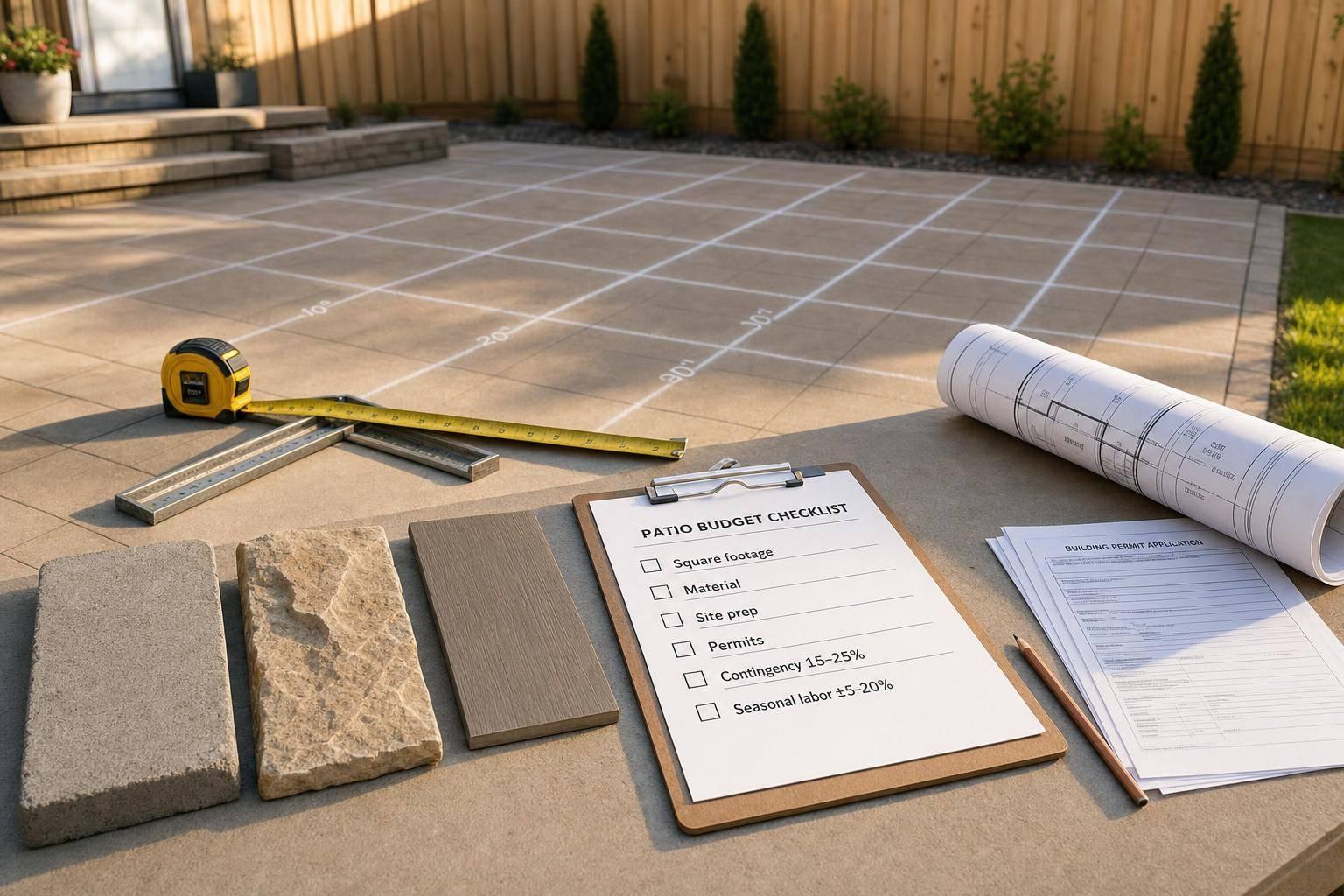
If I want a patio budget that holds up, I need to price more than just the surface. In central Maryland and Washington, DC, a patio can run from $5 to $50+ per sq. ft. installed, and the final cost often shifts based on season, soil, drainage, labor, permits, and add-ons.
Here’s the short version:
- I start with square footage
- I match it to a material price range
- I add site prep, grading, drainage, permits, and delivery
- I hold back 15% to 25% for surprise costs
- I check whether fall or winter may lower labor pricing by 5% to 20%
A fast first estimate looks like this:
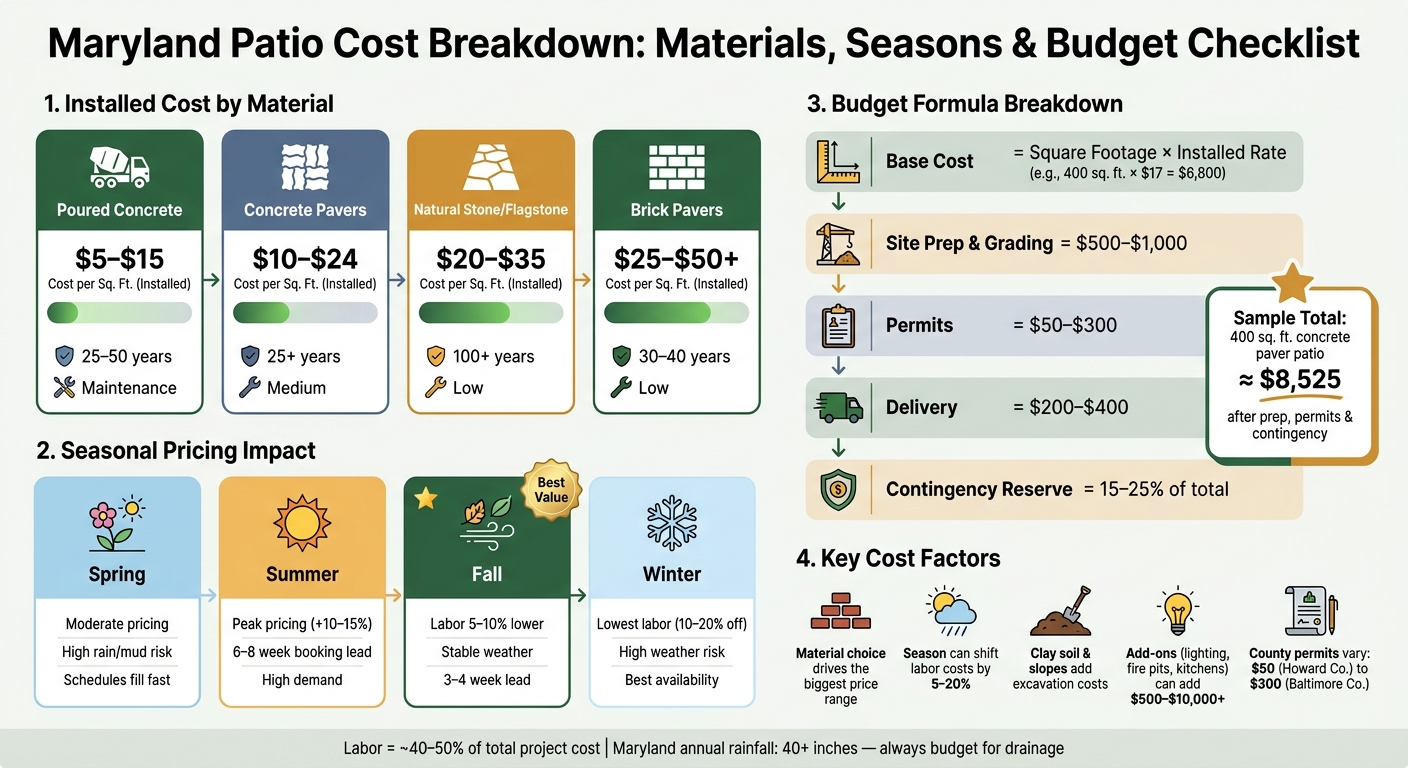
- Base patio cost = square footage × installed rate
- Site prep/grading = about $500 to $1,000
- Permits = about $50 to $300
- Delivery = about $200 to $400
- Contingency = 15% to 25%
For example, a 400 sq. ft. concrete paver patio at $17 per sq. ft. starts near $6,800 before prep, permits, delivery, and reserve funds. After those are added, the budget lands much closer to the full project number.
What changes the total most?
- Material choice: concrete costs less up front; stone and brick cost more
- Season: summer often runs 10% to 15% higher; winter labor may drop 10% to 20%
- Site conditions: clay soil, slope, drainage issues, and tight access can add labor and base work
- Extras: lighting, fire pits, steps, walls, and outdoor kitchens can push the total up fast
- Local rules: some counties have permit or stormwater review thresholds
If I were budgeting this project, I’d treat drainage and base prep as fixed costs, not optional items. That’s because Maryland’s freeze-thaw cycles, clay-heavy soil in many areas, and 40+ inches of yearly rain can lead to shifting, pooling, and uneven surfaces when prep is skipped.
Maryland Patio Cost by Material & Season: Full Budget Breakdown
Patio Materials Price Guide | Gravel to Travertine
sbb-itb-843f8be
Quick comparison
| Item | Typical Cost or Impact |
|---|---|
| Poured concrete | $5 to $15/sq. ft. |
| Concrete pavers | $10 to $24/sq. ft. |
| Natural stone/flagstone | $20 to $35/sq. ft. |
| Brick pavers | $25 to $50+/sq. ft. |
| Spring | Mid pricing, but more rain and delays |
| Summer | Peak demand, often 10% to 15% higher |
| Fall | Often the best mix of price and weather |
| Winter | Lowest labor rates, but more weather risk |
| Contingency fund | 15% to 25% |
| Labor share | About 40% to 50% of total cost |
Bottom line: I’d build the budget around material, season, prep, drainage, permits, and extras from the start, then compare bids line by line instead of looking only at one total.
1. Review Typical Patio Cost Ranges in Maryland
Before you think about timing, get a baseline price first. In Maryland, patio costs can swing a lot based on the material, so it helps to start with installed price ranges and then adjust for site conditions. Use the Maryland installed-rate ranges below as your starting point, then account for seasonal demand in the next section.
Installed Cost Ranges by Square Foot
Poured concrete is usually the lowest-cost entry point at $5–$15 per sq. ft. installed. But there’s a tradeoff: it’s more exposed to freeze-thaw damage. Concrete pavers fall in the $10–$24 per sq. ft. range and make repairs simpler if a few pieces shift or crack. Natural stone and flagstone sit at the high end at $20–$35 per sq. ft. installed, and they can last 100 years or more [1].
| Material | Typical MD Cost (Installed/sq. ft.) | Durability | Maintenance Level | Seasonal Price Sensitivity |
|---|---|---|---|---|
| Poured Concrete | $5 – $15 | 25–50 years | Medium (requires sealing) | High |
| Concrete Pavers | $10 – $24 | 25+ years | Low (modular repairs) | Moderate |
| Natural Stone/Flagstone | $20 – $35 | 100+ years | Low | Low |
| Brick Pavers | $25 – $50+ | 30–40 years | Low | Moderate |
Use these installed-rate ranges to sketch out a starting budget before you ask for bids.
Basic Budget Formula for a First Estimate
Use this formula to build a rough first number before you request estimates:
- Square footage × installed rate = base cost
- Add site prep and excavation costs: budget $500–$1,000 for grading or stabilization, and plan for excavation of 10 to 12 inches of soil and a compacted gravel base where needed [1][4]
- Add permit fees: $50–$300 depending on your county [1]
- Add delivery fees: $200–$400 [1]
- Add a contingency reserve: 15%–25% for waste, cuts, and unexpected site conditions [1][3]
Labor usually accounts for 40%–50% of patio costs in Maryland, depending on how simple or detailed the job is.
Here’s a quick example. A 400 sq. ft. concrete paver patio at $17 per sq. ft. starts at about $6,800. Once you add site prep, permits, and contingency, the working budget comes in near $8,525 before any add-ons.
Main Cost Factors to Review Before Requesting Estimates
A few things can push pricing up fast: design detail, demolition work, and tight access for equipment. Curves, multi-level layouts, and detailed patterns can add 10%–20% to labor [1]. Limited access can tack on another $200–$500 [1]. And in some Maryland counties, larger patios may trigger permit needs [1][2].
These baseline costs usually climb during busy spring and summer months, then ease a bit during slower fall and winter periods.
2. Understand How Each Season Affects Patio Pricing
In Maryland, the time of year can change your patio price in a big way. It affects contractor availability, material costs, and how much room you have in the schedule. Once you have a baseline number from Section 1, the next step is simple: line up your budget with the season that gives you the best shot at staying on track.
Spring and Summer Pricing Risks
Spring (March–May) can look like a safe middle ground. The soil is usually workable, and temperatures are mild enough for outdoor construction. But spring weather in Maryland can be messy. Rain and mud often slow excavation, and that can delay curing too. Maryland gets about 3.5–4 inches of rain per month in spring [2], so even a well-planned project can get pushed back.
There’s also a timing problem. Contractor demand starts climbing fast in spring, and by mid-May, many summer calendars are already booked 6–8 weeks out [2]. So even if spring pricing seems reasonable at first, delays and tighter schedules can eat into that advantage.
Summer (June–August) is the busiest stretch of the year. This is peak season, and prices usually reflect it. Material costs can run 10%–15% higher than off-peak periods [2], and scheduling gets a lot tighter. If you want a summer install, it helps to book by mid-May and leave room in the plan for hot afternoons, which can slow crews or shift work hours.
Fall and Winter Price Advantages
Fall, especially from late September through early November, is often the sweet spot. Temperatures are still mild, but conditions are more stable. Curing tends to go more smoothly, humidity drops, and rainfall usually eases to 2–3 inches per month [2]. That steadier weather can make a big difference when you’re trying to keep a project moving.
There’s a money angle too. As contractors come out of the summer rush, labor rates often drop 5%–10% [2]. Permit timing may improve as well. In some Maryland counties, permit applications submitted in September can move in 7–10 days, compared with the more common 2–4 weeks [2]. That matters because a lower quote doesn’t help much if the job gets stuck waiting on approvals.
Winter (December–February) can offer the biggest labor savings, often 10%–20% off [2]. That said, winter comes with the highest weather risk. Freezing temperatures, snow, and wet ground can slow work or call for special equipment. Winter tends to make the most sense for homeowners who can be flexible and want the patio finished ahead of spring.
Season-by-Season Planning Table
| Season | Price Tendency | Scheduling Difficulty | Weather Risk | Best Use Case |
|---|---|---|---|---|
| Spring | Moderate | Moderate | High (Rain/Mud) | Planning and material selection |
| Summer | Peak (10%–15% higher) [2] | High (6–8 week lead) [2] | Moderate (Heat) | Fast curing; immediate use |
| Fall | Lower (5%–10% labor discount) [2] | Moderate (3–4 week lead) [2] | Low (Stable/Dry) | Premium timing for most projects |
| Winter | Lowest (10%–20% labor discount) [2] | Low (High availability) | High (Snow/Freeze) | Budget-conscious; spring ready |
Pick your season first, then use it to set your target bid window and contingency amount. After that, break the quote into labor, prep, materials, and add-ons.
3. Account for Every Line Item in Your Patio Budget
Once you’ve picked your season and bid window, break the full project cost into separate line items. A single all-in quote can blur where the money goes. And when that happens, it’s much harder to spot a weak bid or a missing cost. This simple step turns one big estimate into a budget you can actually use.
Design, Materials, and Installation Labor
Keep labor on its own line. Don’t let it disappear into one blended total.
For materials, give each part its own dollar range. That includes the paver or stone surface at $10–$35 per sq. ft., depending on the material [1], plus the gravel base, geotextile fabric, sand leveling course, and polymeric joint sand. Add design and layout as a separate pre-construction cost too.
Delivery matters more than people expect. For Maryland projects, material delivery fees often run $200–$400 [1]. List that on its own so it doesn’t quietly get folded into the materials number.
When labor and materials are split out, site work is much easier to price with some precision.
Site Preparation, Grading, and Drainage
Site prep is where budgets often go sideways. Excavation, hauling, demolition, and grading can add $500–$1,000 on hard sites [1]. If access is tight, manual excavation may tack on another $200–$500 [1].
Maryland’s clay soil adds another layer to think about. A compacted gravel base and geotextile fabric help keep the patio stable through freeze-thaw cycles. Skip that, and the surface can shift over time.
Drainage should sit inside the base budget, not as an afterthought. Maryland gets more than 40 inches of rain per year [4], and patios need at least a 1%–2% slope away from the house to stop pooling and lower the risk of foundation damage [2]. Whether the plan calls for French drains, drain pipe placement, or dry riverbeds, those costs should be built in from day one. They may look optional on paper, but repairs later can hit much harder.
After site work, it helps to price the extras that can change both scope and timing.
Add-Ons That Raise the Total Project Cost
A few upgrades can push the total up fast. Common ones include:
- Retaining walls
- Garden walls
- Natural stone steps
- Fire pits
- Integrated LED lighting ($500–$2,000)
- Outdoor kitchens ($3,000–$10,000+) [1]
These features don’t just add materials. They can change excavation, drainage, and permit needs too. That’s why it makes sense to budget for them up front. If the full plan feels too steep, build the base patio first and add items like lighting or an outdoor kitchen in a later season. Also, check permit costs before you lock the budget.
Next, compare these line items with Maryland-specific site conditions and your target install window.
4. Factor In Local Conditions, Timing, and Next Steps
Maryland-Specific Conditions That Affect Cost
Once you have a base estimate and a rough seasonal window, local site conditions can change the price again.
Maryland soil is different from one region to the next. Eastern Maryland tends to have sandy soil, which drains fast but doesn’t offer much stability. Western Maryland and Prince George’s County often deal with expansive clay that swells and shrinks as moisture levels change [3].
Slope is another cost factor people often miss. A sloped yard in places like Columbia or Ellicott City may need retaining walls, natural stone steps, and major regrading before the first paver is even installed [4]. And if access is tight, which is common in suburban neighborhoods, crews may need to excavate by hand. That can add $200–$500 in labor costs [1].
Permit rules also change by county. Montgomery County requires stormwater management review for projects over 100 sq. ft., while Anne Arundel County has hardscape rules for work within 25 feet of the Chesapeake Bay Critical Area [3]. Permit fees range from $50 in Howard County to $300 in Baltimore County [1].
Before you lock in a budget, call your local building department to confirm setback rules and permit thresholds. Also call 811 at least three business days before digging. Maryland law requires it, and the service is free [3].
Timing Checklist Before You Commit
Use those local details to pick the best installation window. Before you sign a contract, work through a few key decisions:
- Set a target completion date. Then work backward and leave 4–6 weeks for permits and contractor scheduling [2].
- Pick cost or speed. Fall often makes scheduling easier. Winter may reduce labor costs, but weather can throw a wrench in the plan.
- Book early. Spring and summer schedules fill up the fastest. Fall and winter often come with shorter lead times.
- Set aside a contingency buffer. Hidden obstacles and extra excavation for unstable soil can show up after work begins.
That timing choice will help you lock in a final budget that makes sense.
Conclusion: Put Together a Realistic Seasonal Patio Budget
Start with your square footage, choose a material, and adjust for your target season. Add site prep and drainage as fixed line items instead of treating them like extras. Then layer in add-ons like lighting, fire pits, or outdoor kitchens, and plan for any electrical work before installation.
Once you have a rough number, a detailed quote can turn it into a project-ready plan. Pro Landscapes MD serves central Maryland and can turn this checklist into a site-specific line-item estimate.
FAQs
How do I estimate my total patio budget?
Estimate your patio budget by starting with the square footage, then applying material and installation costs of $5 to $40 per square foot.
Labor is a big part of the bill. In most cases, it accounts for 40% to 50% of the total cost.
You’ll also want to budget for site work, permits, and a cushion for surprises. Those extras can add up fast, especially if the yard needs prep before installation begins.
- Drainage: $1,000 to $4,000
- Complex grading: up to $1,000
- Permits: $50 to $300
- Contingency: 10% to 15%
That contingency fund matters more than people think. A patio project can look simple on paper, then hit snags once work starts, like poor drainage, uneven ground, or permit fees you didn’t factor in.
What season is cheapest for patio installation?
Winter is usually the cheapest time for patio installation in Maryland. Demand tends to drop, so contractors may offer labor discounts of 10% to 20%.
Fall can also help you save, with labor discounts in the 5% to 10% range and milder weather that makes scheduling a bit easier. Winter jobs can depend more on weather conditions, though, and in some cases may come with added cold-weather costs.
Which extra costs do homeowners most often miss?
Homeowners often miss a few site-specific costs that can change the budget fast, including:
- Grading sloped yards: $0.04–$2.00 per sq. ft.
- French drains: $1,000–$4,000
- Manual excavation for limited access: $200–$500
- Permits: $50–$300
Weather can also slow the job down, so it’s smart to set aside a 10%–15% contingency fund. It also helps to plan for lighting and utility relocation from the start, which can save you from expensive follow-up work later.
Chat with Us