









- bhavya gada
- No Comments
Sediment control is essential for protecting Maryland’s waterways and complying with state regulations. When rainwater flows over disturbed soil, it carries sediment and pollutants into streams, rivers, and the Chesapeake Bay, harming aquatic life and water quality. Maryland law requires erosion and sediment control plans for projects disturbing over 5,000 square feet of land or moving more than 100 cubic yards of soil. Below are five effective methods to manage sediment during construction or landscaping:
- Silt Fences: Permeable fabric barriers trap sediment from surface runoff. Ideal for slopes and smaller projects.
- Sediment Traps: Temporary basins collect runoff and allow soil particles to settle. Best for areas under 3 acres.
- Sediment Basins: Larger basins designed for bigger projects to slow water flow and let sediment settle.
- Stabilized Construction Entrances: Gravel or aggregate pads prevent mud and sediment from being tracked onto public roads.
- Temporary Swales: Shallow channels guide water flow and reduce sediment on sloped properties.
These methods help keep sediment out of waterways while meeting Maryland Department of the Environment (MDE) standards. Proper installation and maintenance ensure effectiveness, and professional services can assist with compliance.
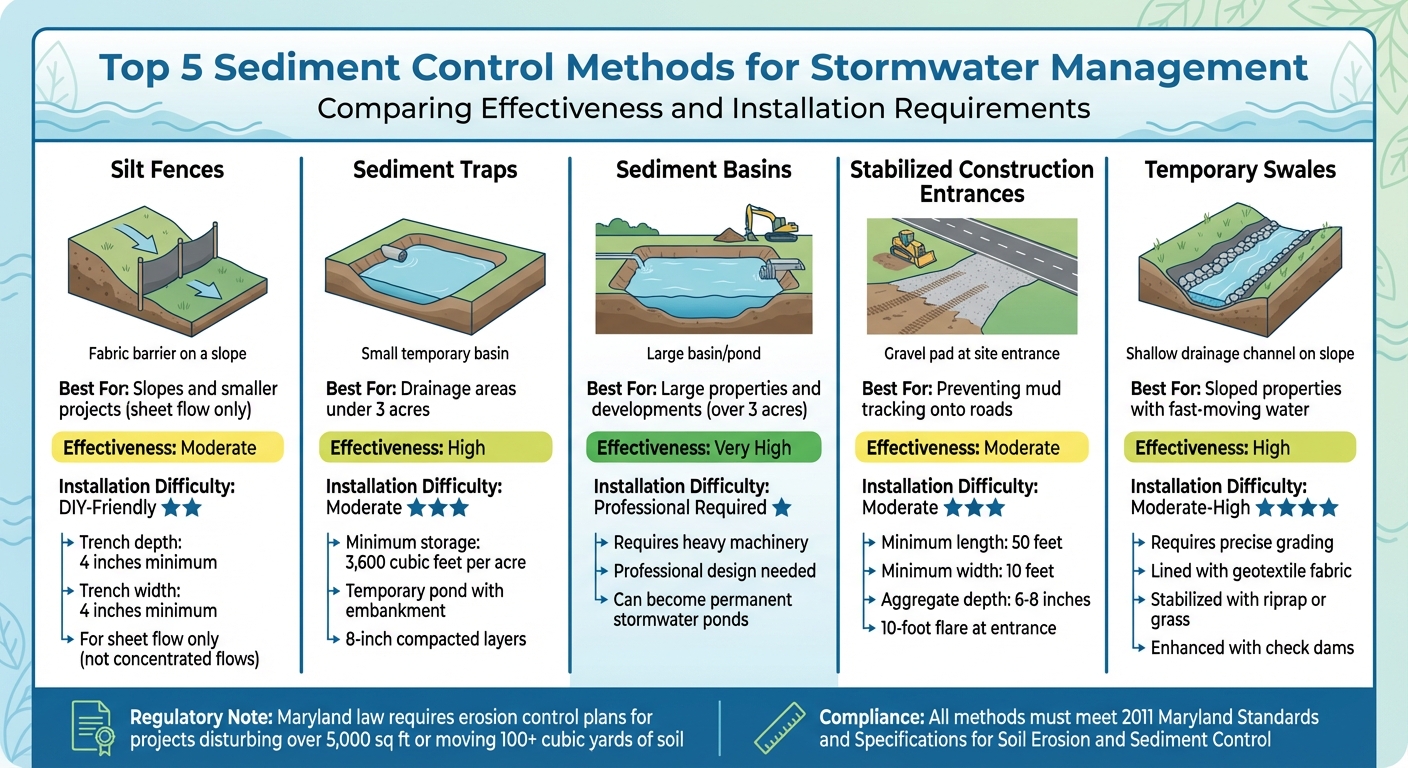
Comparison of 5 Sediment Control Methods for Stormwater Management
1. Silt Fences
How They Help Control Sediment Runoff
Silt fences work by filtering sediment from sheet flow using a permeable fabric barrier. This fabric allows water to pass through while trapping sediment, effectively managing the thin, even layer of water that moves across slopes during rain. They’re specifically designed for this type of surface runoff.
Practical Use for Maryland Homeowners
If you’re a Maryland homeowner tackling landscaping or grading projects, silt fences can be a great tool for managing runoff. When placed along the contour of a slope, they catch sediment before it can leave your property. This helps keep sediment out of streets, storm drains, and nearby waterways. For those unsure about the installation process, companies like Pro Landscapes MD can provide expert assistance.
Installation and Maintenance Tips
Getting the installation right is key to ensuring silt fences work properly. The fabric’s bottom edge should be buried in a trench to stop water from flowing underneath and carrying sediment along with it. According to the Maryland Department of the Environment (MDE), trenches should be at least 4 inches deep and 4 inches wide. Additionally, support posts need to be driven deep into the ground for stability. Following these steps ensures compliance with Maryland’s erosion and sediment control standards.
Meeting MDE Standards
In Maryland, silt fences are recognized as an approved Best Management Practice (BMP) for perimeter control. To meet MDE requirements, they must be installed according to the 2011 Maryland Standards and Specifications for Soil Erosion and Sediment Control. These regulations specify that silt fences are suitable only for areas with sheet flow and should not be placed in ditches, swales, or streams where water is more concentrated. By adhering to these guidelines, silt fences help protect Maryland’s waterways, including the Chesapeake Bay, by keeping sediment out of local streams and other bodies of water.
sbb-itb-843f8be
2. Sediment Traps
How Well They Prevent Sediment Runoff
Sediment traps are temporary basins designed to catch runoff and allow soil particles to settle before the water continues downstream [1]. They work particularly well for capturing larger particles like sand and silt. With extended water retention, even smaller particles, such as clay, can settle out effectively.
Use on Maryland Residential Properties
In Maryland, sediment traps are tailored for drainage areas of 3 acres or smaller, which makes them a smart choice for residential construction sites and smaller subdivisions [1]. Whether you’re adding to your home, leveling your yard, or tackling a landscaping project that stirs up soil, sediment traps can help control runoff before it exits your property. For those seeking professional help, Pro Landscapes MD provides installation and stormwater management services, ensuring efficient solutions for homeowners. These traps are a practical option for managing sediment on residential projects in Maryland.
Installation and Maintenance Requirements
The Maryland Department of the Environment (MDE) mandates that sediment traps must offer a minimum storage volume of 3,600 cubic feet per acre of drainage area. Installation involves clearing the site of trees, stumps, and roots from the embankment foundation, followed by construction in 8-inch compacted layers. Regularly removing accumulated sediment is crucial to maintaining their storage capacity and performance.
Meeting Maryland Department of the Environment (MDE) Standards
Sediment traps are officially recognized by the MDE as a reliable erosion and sediment control measure. To comply with state standards, they must be designed and installed following the 2011 Maryland Standards and Specifications for Soil Erosion and Sediment Control. In Maryland, any project that disturbs over 5,000 square feet of land or involves moving more than 100 cubic yards of soil must meet these regulations. Adhering to these rules ensures your sediment trap operates effectively while keeping your project in compliance with legal requirements.
3. Sediment Basins
How They Prevent Sediment Runoff
Sediment basins work by slowing down stormwater flow, giving sediment particles time to settle before the water is discharged. This process helps keep sediment from reaching nearby waterways, protecting local ecosystems.
Use on Maryland Residential Properties
In Maryland, sediment basins are typically used for larger projects or multi-property developments. For single residential properties, smaller options like sediment traps are often more practical and budget-friendly. However, regardless of the method, proper installation and consistent maintenance are key to ensuring effectiveness.
Installation and Maintenance
To function properly, sediment basins must be correctly sized and maintained to allow enough time for sediment to settle. Regular upkeep ensures the system continues to perform as intended.
Compliance with MDE Standards
Designing a sediment basin requires adherence to Maryland Department of the Environment (MDE) regulations for erosion and sediment control. The MDE sets these standards to make sure sediment control measures work effectively [1]. Consulting with professionals can help ensure your system complies with MDE guidelines while safeguarding your property and nearby areas.
4. Stabilized Construction Entrances
How They Prevent Sediment Runoff
Stabilized construction entrances serve as a barrier between construction sites and public roads. When vehicles leave the site, mud and sediment are dislodged and trapped within the gravel or aggregate. This method prevents sediment from being tracked onto streets, where it could otherwise wash into storm drains during rainstorms.
Use on Maryland Residential Properties
For projects in Maryland, stabilized construction entrances are a proactive way to manage sediment at its source. State regulations require these entrances for any site disturbing over 5,000 square feet or moving more than 100 cubic yards of soil. In areas with limited space, like Bethesda or Silver Spring, contractors design these entrances to comply with state guidelines, ensuring minimal mud tracking onto public roads.
Installation and Maintenance Requirements
The Maryland Department of the Environment (MDE) specifies that stabilized construction entrances should be at least 50 feet long and 10 feet wide, with a 10-foot flare at the entrance to allow for vehicle turns. These entrances are built using 6 to 8 inches of compacted aggregate (such as RC2) placed over a non-woven geotextile fabric, which prevents the stone from sinking into the soil. This setup adheres to the 2011 Maryland Standards and Specifications for Soil Erosion and Sediment Control.
Maintenance is key. The aggregate needs to be topped off as it compacts or clogs with mud. Street sweeping is also necessary to clear any sediment tracked onto public roads. Using modern HDPE trackout mats can cut down on street sweeping by as much as 59% [2].
Meeting Maryland Department of the Environment Standards
"The Department approves the use of FODS as a substitute for SCE in conditions where SCE would typically be specified", says Stewart R. Comstock, P.E., Chief of the Maryland Department of the Environment.
All erosion control measures must align with the 2011 Maryland Standards and Specifications for Soil Erosion and Sediment Control. Entrances should be positioned on the high side of the site to prevent water from flowing onto public roads. In cases where gravel pads alone aren’t effective, adding a wash rack can help, as long as the wash water is directed to a sediment trap or basin.
For Maryland residential projects, working with professionals like Pro Landscapes MD ensures that stabilized construction entrances are installed and maintained according to state standards, providing effective sediment control.
5. Temporary Swales
How Well They Prevent Sediment Runoff
Temporary swales are a practical way to manage water flow and sediment on sloped properties, especially during construction. These shallow drainage channels are designed to guide stormwater away from work areas while allowing sediment to settle. When maintained properly, grass swales with check dams are among the most effective tools for controlling sediment. The Journal of Environmental Management highlights their benefits: "Well-maintained grass swales with check dams or infiltration swales are the best options for runoff volume reduction and removal of sediment and heavy metals" [3].
The secret to their effectiveness lies in how they slow down water flow. Slower water allows heavier particles to settle at the bottom of the channel. Check dams, which are small barriers placed along the swale, create pooling areas that further reduce water speed and trap finer sediment before the runoff leaves the site.
Use on Maryland Residential Properties
Temporary swales are especially useful on sloped residential properties in Maryland communities like Columbia, Ellicott City, and Mount Airy, where the terrain can cause water to flow quickly. These channels help redirect runoff to sediment traps or basins, keeping soil from washing into streets and storm drains during construction or landscaping work.
For properties under EPA and Maryland Department of the Environment (MDE) regulations, swales are a key part of stormwater management. One property manager shared their experience: "Incredible stormwater management service. The owner John consulted on a property I manage and ended up saving us thousands of dollars in environmental fees from the government. Now, our property is compliant with the EPA" [4].
Installation and Maintenance Requirements
To install a temporary swale, start by grading a shallow channel along the natural drainage path. Line the channel with geotextile fabric, then stabilize it using riprap (loose stone) or fast-growing grass. Riprap is particularly important in areas with fast-moving water to prevent erosion and damage to the channel.
Ongoing maintenance is essential. This includes removing sediment buildup, repairing any erosion, and ensuring the check dams remain in place. Hiring certified professionals, like Pro Landscapes MD, ensures the swales are built to meet state requirements and function effectively throughout the construction process.
Meeting Maryland Department of the Environment Standards
Proper installation and maintenance are critical to meeting MDE standards. These standards require temporary swales to handle expected stormwater volumes without causing downstream erosion. The swales must remain functional until the site is fully stabilized and prevent soil displacement within the channel while capturing sediment from upslope areas.
Certified technicians can confirm that swales meet EPA and MDE inspection criteria, helping property owners avoid compliance issues and potential fines [4].
Sediment Control 101 – Best Management Practices & Solutions
Comparison Table
Choosing the right sediment control method involves considering your property’s drainage area and specific challenges. Below is a table summarizing the five approaches, highlighting their effectiveness and key installation factors. This provides a quick reference to help you make informed decisions.
| Method | Effectiveness | Installation Considerations |
|---|---|---|
| Silt Fences | Moderate – designed to handle sheet flow, not concentrated flows. | DIY-friendly; requires trenching at least 4 inches deep at the base to avoid undercutting. |
| Sediment Traps | High – works well for drainage areas under 5 acres. | Created by excavating a temporary pond, often using an embankment method. |
| Sediment Basins | Very high – ideal for large properties; can double as permanent stormwater ponds. | Needs professional design and heavy machinery for proper construction. |
| Stabilized Construction Entrances | Moderate – reduces mud tracking onto streets or nearby areas. | Involves placing stone or similar materials at entry points; best for areas with heavy vehicle traffic. |
| Temporary Swales | High – excellent for sloped terrain with fast-moving water. | Requires precise grading; can be improved with check dams or grass lining to guide water flow more effectively. |
Conclusion
Proper sediment control plays a key role in protecting Maryland’s waterways and aquatic ecosystems. Beyond its environmental importance, it helps avoid infrastructure problems like clogged storm drains and reduced reservoir capacity. Maryland law, enforced by the Maryland Department of the Environment (MDE), mandates effective sediment control, with non-compliance potentially resulting in fines, project delays, or legal consequences.
Professional installation ensures adherence to Maryland Standards, while consistent inspections and timely maintenance keep sediment traps, swales, and other control measures working efficiently. Maintaining detailed records is also essential to demonstrate compliance. These practices not only protect the environment but also help projects run more smoothly.
For homeowners and property managers in central Maryland, Pro Landscapes MD offers expert stormwater management services, including drainage installation, grading, and land leveling. These solutions help safeguard your property and contribute to the health of local watersheds. Effective sediment control is a win for both your property and the broader community.
FAQs
Do I need a sediment control plan for my project?
If your project disturbs more than 5,000 square feet of soil or involves moving over 100 cubic yards of earth, a sediment control plan is required. This requirement aligns with Maryland regulations designed to minimize soil erosion and reduce water pollution.
Which method fits my yard’s slope and drainage area?
When it comes to managing sediment in your yard, the best approach depends largely on the slope and how water drains through the area. For spots with moderate slopes or areas prone to runoff, sediment fences or wattles can help by slowing down water flow and capturing sediment. If you’re dealing with steeper slopes or larger drainage zones, you might need more robust solutions like sediment basins or traps.
For long-term effectiveness, consider combining temporary measures – like mulching and silt fences – with permanent fixes such as planting vegetation to stabilize the soil. This mix can handle even the toughest conditions while offering lasting control.
How often do sediment controls need maintenance?
Regular upkeep and inspections are a must for sediment controls, especially on active sites. These checks, typically done every two weeks, ensure the systems stay effective and meet compliance standards. Staying on top of maintenance helps quickly resolve any issues and keeps stormwater management running smoothly.
Chat with Us