









- bhavya gada
- No Comments
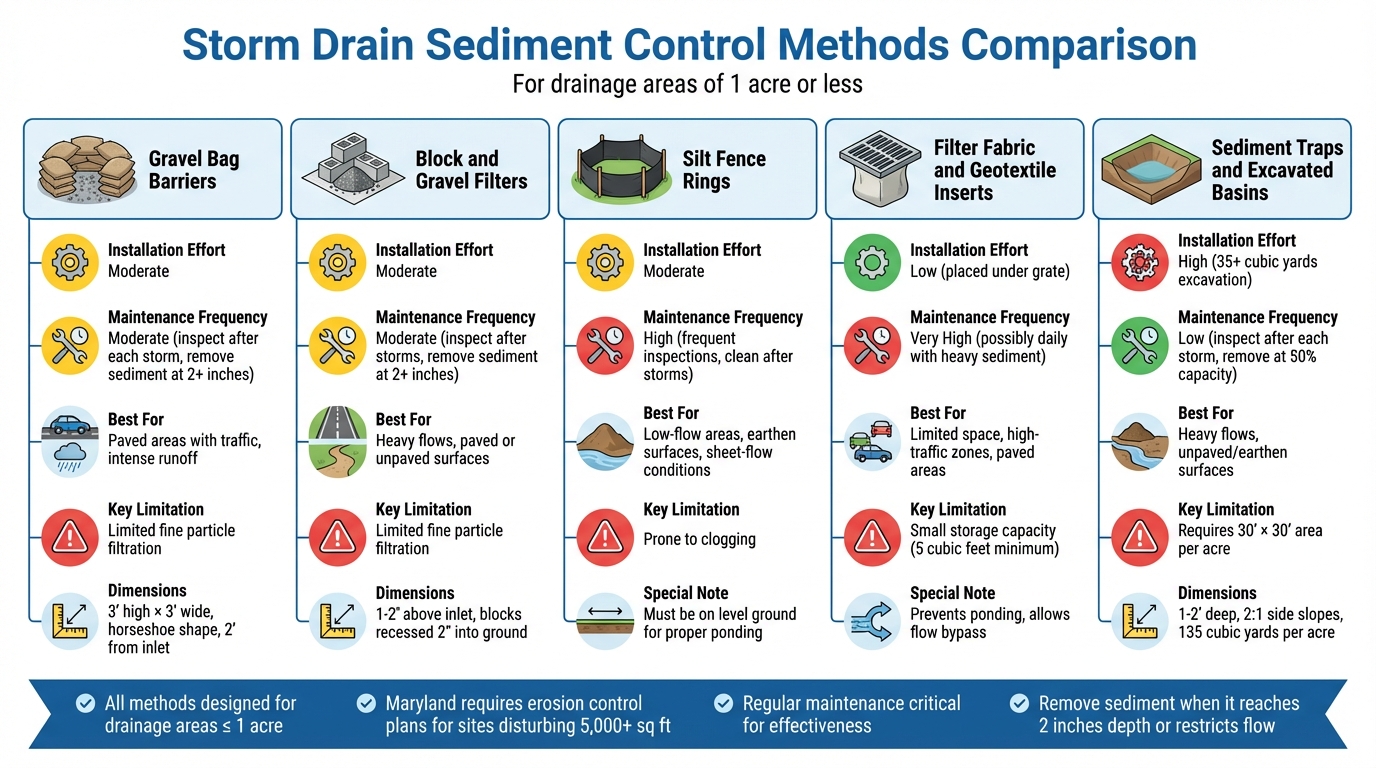
Sediment control for storm drain inlets is crucial to prevent soil, debris, and pollutants from entering waterways and causing blockages. Maryland regulations require erosion and sediment control plans for construction sites disturbing 5,000 square feet or more. Here are five widely used methods to manage sediment at storm drain inlets, along with their pros, installation needs, and maintenance requirements:
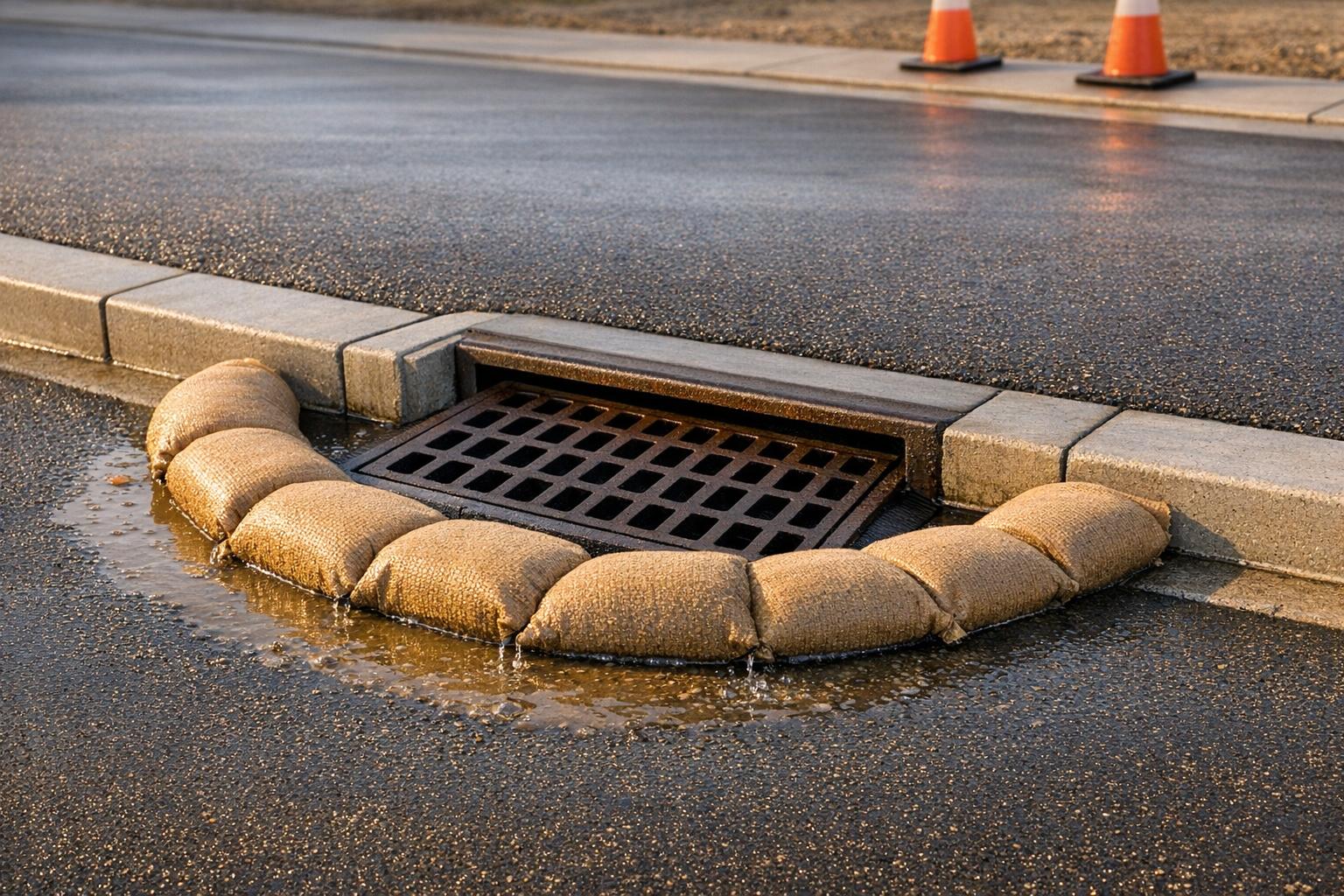
- Gravel Bag Barriers: Slow water flow and trap coarse sediment but struggle with fine particles. Best for paved areas with traffic. Moderate maintenance required.
- Block and Gravel Filters: Handle heavy water flows and prevent ponding. Suitable for both paved and unpaved surfaces. Moderate installation and upkeep.
- Silt Fence Rings: Effective for low-flow areas with earthen surfaces. Require frequent inspections and maintenance.
- Filter Fabric and Geotextile Inserts: Installed under inlet grates, they work well in high-traffic zones but have limited sediment storage. High maintenance needed.
- Sediment Traps and Excavated Basins: Manage heavy flows and coarse sediment. Ideal for unpaved areas but need significant space and initial labor.
Each method is designed for drainage areas of one acre or less and requires regular upkeep to remain effective. Proper installation and maintenance are key to protecting stormwater systems and meeting local regulations.
Comparison of 5 Storm Drain Sediment Control Methods
Inlet Protection
sbb-itb-843f8be
1. Gravel Bag Barriers
Gravel bag barriers are designed to slow down water flow as it approaches a storm drain inlet. By reducing the velocity of the water, these barriers create pooling areas where sediment can settle. Additionally, the spaces between the stones in the barrier help trap coarse sediment [2][4].
Effectiveness
While gravel bag barriers are effective at capturing coarse sediment, they fall short when it comes to filtering out fine particles. This limitation is particularly challenging for meeting Maryland’s strict stormwater management standards. The Illinois Urban Manual highlights this issue:
"The stone filtering medium by no means slows stormwater flow rate as does filter cloth and therefore cannot provide the same degree of filter efficiency when smaller silt and clay particles are introduced into stormwater flows." [2]
Compared to fabric-based systems, gravel bag barriers result in less ponding. However, in high-traffic construction zones, excessive ponding can lead workers to bypass or even remove the barriers altogether, reducing their effectiveness [[1]](https://cms.tacoma.gov/SWMM_WebBook/Responsive HTML5/BookBook/Volume_3_Construction_Site_Stormwater_Best_Management_Practices/BMP_C220_-_Stormwater_System_Inlet_Protection.htm)[2].
Installation Requirements
A standard gravel bag barrier is 3 feet high and 3 feet wide, arranged in a horseshoe shape, and positioned at least 2 feet from the storm drain inlet. This spacing allows water to pool and sediment to settle before entering the drain. These barriers are constructed using sandbags or rock berms, often enhanced with riprap faced with coarse aggregate for better performance. They are most effective for drainage areas of 1 acre or smaller. To further control water flow, a temporary dike can be added on the downslope side to direct water through the barrier and prevent bypass [[1]](https://cms.tacoma.gov/SWMM_WebBook/Responsive HTML5/BookBook/Volume_3_Construction_Site_Stormwater_Best_Management_Practices/BMP_C220_-_Stormwater_System_Inlet_Protection.htm)[2].
Maintenance Needs
Regular maintenance is crucial to keep gravel bag barriers functioning properly. After every storm, inspect the barrier and remove sediment if it has accumulated to a depth of more than 2 inches [3]. If sediment clogs the stones, remove the clogged material from the inlet. Since cleaning gravel on-site is difficult, the clogged stones can be reused as fill, and fresh gravel should be added to the barrier. When cleaning, avoid washing sediment into the stormwater system. Instead, spread the excavated material evenly on-site or store it in a stable location [[1]](https://cms.tacoma.gov/SWMM_WebBook/Responsive HTML5/BookBook/Volume_3_Construction_Site_Stormwater_Best_Management_Practices/BMP_C220_-_Stormwater_System_Inlet_Protection.htm).
Site Suitability
Gravel bag barriers are ideal for paved areas that experience intense runoff and where traffic flow is a concern. They are particularly helpful in locations where standing water could create safety risks or hinder construction activities. For better removal of fine particles, filter fabric can be added to the gravel barrier, though this increases the likelihood of ponding. The barrier should remain in place until the contributing area is fully stabilized and erosion controls are no longer necessary, ensuring the stormwater system stays protected from sediment-related blockages [[1]](https://cms.tacoma.gov/SWMM_WebBook/Responsive HTML5/BookBook/Volume_3_Construction_Site_Stormwater_Best_Management_Practices/BMP_C220_-_Stormwater_System_Inlet_Protection.htm)[2].
2. Block and Gravel Filters
Block and gravel filters use a combination of stacked concrete blocks, wire mesh, and coarse gravel to create a barrier around storm drain inlets. These blocks are stacked without mortar, typically reaching 1 to 2 feet above the inlet, forming a sturdy yet removable structure [[1]](https://cms.tacoma.gov/SWMM_WebBook/Responsive HTML5/BookBook/Volume_3_Construction_Site_Stormwater_Best_Management_Practices/BMP_C220_-_Stormwater_System_Inlet_Protection.htm). Unlike gravel bag barriers, this setup is designed to handle heavy, concentrated water flows without leading to ponding.
Effectiveness
Block and gravel filters are particularly good at managing heavy flows while avoiding standing water. According to the City of Tacoma Stormwater Management Manual, these filters are specifically designed to prevent ponding while effectively controlling sediment [[1]](https://cms.tacoma.gov/SWMM_WebBook/Responsive HTML5/BookBook/Volume_3_Construction_Site_Stormwater_Best_Management_Practices/BMP_C220_-_Stormwater_System_Inlet_Protection.htm). However, while they excel at capturing coarse sediments, they are less effective at filtering out finer particles. Regular maintenance is essential to ensure they perform as intended.
Installation Requirements
To install these filters:
- The first row of blocks should be recessed 2 inches into the ground for stability.
- Additional rows are secured using 2×4 lumber threaded through the block openings.
- Wire mesh with ½-inch openings is placed over the blocks, followed by a layer of coarse gravel (½ inch to ¾ inch in size), which should stop just below the top of the blocks.
- To promote dewatering and prevent ponding, some blocks in the bottom row should be placed on their sides.
- For curb installations, spacer blocks (two concrete blocks laid on their sides) are positioned at either side of the inlet for proper alignment.
It’s important to note that the drainage area contributing to the filter should not exceed 1 acre [[1]](https://cms.tacoma.gov/SWMM_WebBook/Responsive HTML5/BookBook/Volume_3_Construction_Site_Stormwater_Best_Management_Practices/BMP_C220_-_Stormwater_System_Inlet_Protection.htm).
Maintenance Needs
Frequent maintenance is essential to keep these filters functioning properly. The City of Tacoma Stormwater Management Manual highlights that all stormwater inlet protection methods are prone to clogging and require regular upkeep [[1]](https://cms.tacoma.gov/SWMM_WebBook/Responsive HTML5/BookBook/Volume_3_Construction_Site_Stormwater_Best_Management_Practices/BMP_C220_-Stormwater_System_Inlet_Protection.htm). Inspections should occur often, especially after storms, and sediment should be removed once it accumulates to more than 2 inches or starts to restrict water flow [3]. If the gravel becomes clogged, the stones should be removed, cleaned, or replaced. Since cleaning gravel on-site can be difficult, repurposing clogged gravel as fill material and replacing it with fresh gravel is often more practical [[1]](https://cms.tacoma.gov/SWMM_WebBook/Responsive HTML5/BookBook/Volume_3_Construction_Site_Stormwater_Best_Management_Practices/BMP_C220-_Stormwater_System_Inlet_Protection.htm).
Site Suitability
Block and gravel filters are versatile and can be used on both paved and unpaved surfaces, making them suitable for a variety of construction sites. They are especially useful in areas with heavy, concentrated water flows and where preventing standing water is a priority for safety and functionality. These filters are most effective when used until the site’s drainage area is fully stabilized. Additionally, all stormwater inlets downslope and within 500 feet of disturbed construction areas should be protected [[1]](https://cms.tacoma.gov/SWMM_WebBook/Responsive HTML5/BookBook/Volume_3_Construction_Site_Stormwater_Best_Management_Practices/BMP_C220_-_Stormwater_System_Inlet_Protection.htm).
3. Silt Fence Rings
Silt fence rings are circular barriers made from geotextile fabric that wrap around storm drain inlets to trap sediment. They’re designed for low-flow conditions, making them a complementary option to sturdier solutions like block and gravel filters, which are better suited for heavy flows. These rings slow water enough to create a settling pool, allowing sediment to drop out before water continues downstream [5].
Effectiveness
Although geotextile fabrics perform well in controlled lab settings, their real-world effectiveness often depends on proper installation and upkeep. The City of Tacoma highlights that “all of the methods for stormwater system inlet protection are prone to plugging and require a high frequency of maintenance” [[1]](https://cms.tacoma.gov/SWMM_WebBook/Responsive HTML5/BookBook/Volume_3_Construction_Site_Stormwater_Best_Management_Practices/BMP_C220_-Stormwater_System_Inlet_Protection.htm). Silt fence rings are best for drainage areas of 1 acre or less, and they must be positioned on level ground to ensure effective ponding [[1]](https://cms.tacoma.gov/SWMM_WebBook/Responsive HTML5/BookBook/Volume_3_Construction_Site_Stormwater_Best_Management_Practices/BMP_C220-_Stormwater_System_Inlet_Protection.htm)[5].
Installation Requirements
The static slicing method, introduced in 1998, is the preferred installation technique. It keeps soil compacted on both sides of the fabric, reducing the risk of washouts beneath the barrier [5]. Traditional trenching methods should be avoided to maintain soil stability. For proper ponding, the fence must follow a horizontal contour level, and emergency overflows should be added if excessive ponding poses safety risks [[1]](https://cms.tacoma.gov/SWMM_WebBook/Responsive HTML5/BookBook/Volume_3_Construction_Site_Stormwater_Best_Management_Practices/BMP_C220_-Stormwater_System_Inlet_Protection.htm). Additionally, protect all inlets located downslope and within 500 feet of disturbed construction zones [[1]](https://cms.tacoma.gov/SWMM_WebBook/Responsive HTML5/BookBook/Volume_3_Construction_Site_Stormwater_Best_Management_Practices/BMP_C220-_Stormwater_System_Inlet_Protection.htm).
Maintenance Needs
Frequent inspections are crucial, especially after storms [[1]](https://cms.tacoma.gov/SWMM_WebBook/Responsive HTML5/BookBook/Volume_3_Construction_Site_Stormwater_Best_Management_Practices/BMP_C220_-Stormwater_System_Inlet_Protection.htm)[3]. Sediment buildup should be removed when it reaches 2 inches deep or starts impeding water flow [3]. A few hours after a storm, gently disturb the fabric to clear fine particles clogging its pores and restore proper drainage [5]. Excavated sediment should never be washed into the stormwater system; instead, it should be stabilized on-site or stored properly [[1]](https://cms.tacoma.gov/SWMM_WebBook/Responsive HTML5/BookBook/Volume_3_Construction_Site_Stormwater_Best_Management_Practices/BMP_C220–Stormwater_System_Inlet_Protection.htm). If the fabric becomes fully clogged, it should be cleaned or replaced to prevent flooding [[1]](https://cms.tacoma.gov/SWMM_WebBook/Responsive HTML5/BookBook/Volume_3_Construction_Site_Stormwater_Best_Management_Practices/BMP_C220-_Stormwater_System_Inlet_Protection.htm).
Site Suitability
Silt fence rings are most effective on earthen surfaces with gentle, sheet-flow conditions rather than concentrated flows. They’re particularly useful at construction sites where storm drain inlets need temporary protection before permanent stabilization is achieved [[1]](https://cms.tacoma.gov/SWMM_WebBook/Responsive HTML5/BookBook/Volume_3_Construction_Site_Stormwater_Best_Management_Practices/BMP_C220_-Stormwater_System_Inlet_Protection.htm). The rings should only be removed once the surrounding area is stabilized and no longer requires erosion controls [[1]](https://cms.tacoma.gov/SWMM_WebBook/Responsive HTML5/BookBook/Volume_3_Construction_Site_Stormwater_Best_Management_Practices/BMP_C220-_Stormwater_System_Inlet_Protection.htm). Their design makes them ideal for low-velocity flows, offering a distinct advantage over other methods tailored for higher-flow scenarios.
4. Filter Fabric and Geotextile Inserts
Filter fabric and geotextile inserts, often referred to as catch basin filters, are installed directly beneath inlet grates to trap sediment before it enters the storm drain system. Unlike surface barriers that can lead to ponding, these inserts work internally, allowing for flow bypass without overflow, which makes them a safer option for busy roadways and paved areas [[1]](https://cms.tacoma.gov/SWMM_WebBook/Responsive HTML5/BookBook/Volume_3_Construction_Site_Stormwater_Best_Management_Practices/BMP_C220_-Stormwater_System_Inlet_Protection.htm). They are designed to handle drainage areas of 1 acre or less and must offer a minimum of 5 cubic feet of sediment storage [[1]](https://cms.tacoma.gov/SWMM_WebBook/Responsive HTML5/BookBook/Volume_3_Construction_Site_Stormwater_Best_Management_Practices/BMP_C220-_Stormwater_System_Inlet_Protection.htm).
Effectiveness
These inserts are highly effective at capturing coarse sediment, debris, and floatables. However, they are less efficient at filtering out soluble pollutants and fine particles [3]. Their primary drawback is their limited storage capacity compared to options like excavated basins or stone filters, meaning they can fill up quickly [[1]](https://cms.tacoma.gov/SWMM_WebBook/Responsive HTML5/BookBook/Volume_3_Construction_Site_Stormwater_Best_Management_Practices/BMP_C220_-Stormwater_System_Inlet_Protection.htm). One key feature is the high-flow bypass system, which prevents clogging during normal construction activities and reduces the risk of localized flooding [[1]](https://cms.tacoma.gov/SWMM_WebBook/Responsive HTML5/BookBook/Volume_3_Construction_Site_Stormwater_Best_Management_Practices/BMP_C220-_Stormwater_System_Inlet_Protection.htm). Without regular maintenance, however, these inserts can become a source of pollution if captured sediment is re-suspended during subsequent storms [3].
Installation Requirements
These inserts are best suited for construction sites and should include dewatering features to prevent standing water from accumulating between storm events [[1]](https://cms.tacoma.gov/SWMM_WebBook/Responsive HTML5/BookBook/Volume_3_Construction_Site_Stormwater_Best_Management_Practices/BMP_C220_-_Stormwater_System_Inlet_Protection.htm). When combining inserts with stone filters, use larger aggregate (such as IDOT CA-1, CA-2, or CA-3) and ensure the geotextile fabric meets the required Apparent Opening Size specifications: at least 30 for non-woven fabrics and 50 for woven fabrics [6]. Avoid linking inlets in a series; treat each inlet as a separate collection point [3]. This approach ensures better performance and simplifies maintenance.
Maintenance Needs
Frequent inspections are crucial, especially when sediment loads are heavy. Inspect inserts daily under these conditions and remove material once sediment reaches 2 inches deep or starts to restrict flow. After major storms, check for clogging or damage, and clean out leaves, trash, and debris at least twice a year [[1]](https://cms.tacoma.gov/SWMM_WebBook/Responsive HTML5/BookBook/Volume_3_Construction_Site_Stormwater_Best_Management_Practices/BMP_C220_-Stormwater_System_Inlet_Protection.htm) [3]. Never wash removed sediment into the stormwater system; instead, spread it evenly on land or stockpile and stabilize it properly [[1]](https://cms.tacoma.gov/SWMM_WebBook/Responsive HTML5/BookBook/Volume_3_Construction_Site_Stormwater_Best_Management_Practices/BMP_C220–Stormwater_System_Inlet_Protection.htm). To ease maintenance demands, consider pairing inserts with perimeter barriers like gravel bags or silt fences [[1]](https://cms.tacoma.gov/SWMM_WebBook/Responsive HTML5/BookBook/Volume_3_Construction_Site_Stormwater_Best_Management_Practices/BMP_C220-_Stormwater_System_Inlet_Protection.htm).
Site Suitability
These inserts are ideal for paved areas and high-traffic zones where surface ponding could pose safety risks. They’re especially beneficial for inlets that need to stay functional before surrounding areas are permanently stabilized [[1]](https://cms.tacoma.gov/SWMM_WebBook/Responsive HTML5/BookBook/Volume_3_Construction_Site_Stormwater_Best_Management_Practices/BMP_C220_-Stormwater_System_Inlet_Protection.htm). They also work well with bioinfiltration, bioretention, and subsurface detention systems [3]. Once the drainage area is fully stabilized and erosion controls are no longer needed, all inlet protection materials should be removed [[1]](https://cms.tacoma.gov/SWMM_WebBook/Responsive HTML5/BookBook/Volume_3_Construction_Site_Stormwater_Best_Management_Practices/BMP_C220-_Stormwater_System_Inlet_Protection.htm).
5. Sediment Traps and Excavated Basins
Sediment traps and excavated basins are structures built near storm drain inlets to slow down runoff and let sediment settle. These systems are particularly useful for capturing coarse sediment before it enters the drain, allowing storm drains to function early in a project, even before the site is fully stabilized [[1]](https://cms.tacoma.gov/SWMM_WebBook/Responsive HTML5/BookBook/Volume_3_Construction_Site_Stormwater_Best_Management_Practices/BMP_C220_-_Stormwater_System_Inlet_Protection.htm)[2].
Effectiveness
These basins create a temporary pool where sediment can naturally settle out of the water. They’re especially good at managing heavy water flows and have better overflow capabilities than many other inlet protection methods [[1]](https://cms.tacoma.gov/SWMM_WebBook/Responsive HTML5/BookBook/Volume_3_Construction_Site_Stormwater_Best_Management_Practices/BMP_C220_-_Stormwater_System_Inlet_Protection.htm)[2]. To improve their performance, you can add gravel filters or filter fabric to catch finer particles. However, while stone filters help reduce ponding, they’re not as effective at trapping fine sediment [2].
Installation Requirements
These systems work best in drainage areas of 1 acre or less [[1]](https://cms.tacoma.gov/SWMM_WebBook/Responsive HTML5/BookBook/Volume_3_Construction_Site_Stormwater_Best_Management_Practices/BMP_C220_-Stormwater_System_Inlet_Protection.htm)[2]. The depth of the basin should be between 1 and 2 feet, measured from the top of the inlet structure, with side slopes no steeper than 2:1 (horizontal to vertical) [[1]](https://cms.tacoma.gov/SWMM_WebBook/Responsive HTML5/BookBook/Volume_3_Construction_Site_Stormwater_Best_Management_Practices/BMP_C220–Stormwater_System_Inlet_Protection.htm)[2]. Each acre drained requires a storage volume of about 135 cubic yards, with a minimum total volume of 35 cubic yards [[1]](https://cms.tacoma.gov/SWMM_WebBook/Responsive HTML5/BookBook/Volume_3_Construction_Site_Stormwater_Best_Management_Practices/BMP_C220–Stormwater_System_Inlet_Protection.htm)[2]. The footprint needed is significant – approximately 30 feet by 30 feet per acre [[1]](https://cms.tacoma.gov/SWMM_WebBook/Responsive HTML5/BookBook/Volume_3_Construction_Site_Stormwater_Best_Management_Practices/BMP_C220-_Stormwater_System_Inlet_Protection.htm). For optimal performance, align the basin’s longest side with the main inflow direction [2].
To manage drainage, drill weep holes on the inlet side and cover them with screen wire or hardware cloth, along with washed aggregate, to prevent sediment or gravel from entering the storm drain [[1]](https://cms.tacoma.gov/SWMM_WebBook/Responsive HTML5/BookBook/Volume_3_Construction_Site_Stormwater_Best_Management_Practices/BMP_C220_-Stormwater_System_Inlet_Protection.htm)[2]. In some cases, a temporary berm or dike may be necessary on the downslope side to ensure stormwater doesn’t bypass the trap [[1]](https://cms.tacoma.gov/SWMM_WebBook/Responsive HTML5/BookBook/Volume_3_Construction_Site_Stormwater_Best_Management_Practices/BMP_C220-_Stormwater_System_Inlet_Protection.htm)[2]. Routine maintenance is critical to keep the system functioning effectively.
Maintenance Needs
Inspect and clean the basin after every storm until the site is stabilized [[1]](https://cms.tacoma.gov/SWMM_WebBook/Responsive HTML5/BookBook/Volume_3_Construction_Site_Stormwater_Best_Management_Practices/BMP_C220_-Stormwater_System_Inlet_Protection.htm)[2]. Remove sediment once it reduces the basin’s storage capacity by 50%. Spread the removed sediment evenly on-site, but never wash it into the stormwater system. Neglecting maintenance can cause excessive ponding, which might lead to users bypassing or removing the protection, allowing sediment-filled water into the storm drain. After the site is stabilized, remove any remaining gravel and sediment, seal the weep holes, backfill to the final grade, and establish vegetation [[1]](https://cms.tacoma.gov/SWMM_WebBook/Responsive HTML5/BookBook/Volume_3_Construction_Site_Stormwater_Best_Management_Practices/BMP_C220-_Stormwater_System_Inlet_Protection.htm)[2].
Site Suitability
These systems are best suited for unpaved areas where temporary flooding and heavy runoff are expected [[1]](https://cms.tacoma.gov/SWMM_WebBook/Responsive HTML5/BookBook/Volume_3_Construction_Site_Stormwater_Best_Management_Practices/BMP_C220_-Stormwater_System_Inlet_Protection.htm). Unlike block and gravel filters, which can be used on paved surfaces, sediment traps and basins are designed for earthen surfaces. They’re particularly effective during the early stages of construction, where heavy flows and the large space required for these systems can be accommodated [[1]](https://cms.tacoma.gov/SWMM_WebBook/Responsive HTML5/BookBook/Volume_3_Construction_Site_Stormwater_Best_Management_Practices/BMP_C220-_Stormwater_System_Inlet_Protection.htm)[2]. This method works well alongside other techniques to manage the challenges of unpaved construction sites.
Advantages and Disadvantages
Here’s a breakdown of the main pros and cons for each sediment control method, based on the earlier evaluation.
Filter fabric and geotextile inserts are the simplest to install. You just place them under the grate, and they’re good to go. However, they can only hold up to 5 cubic feet of sediment, which means they might need cleaning every day if there’s a heavy sediment load. Pairing them with another control method can help cut down on maintenance demands [[1]](https://cms.tacoma.gov/SWMM_WebBook/Responsive HTML5/BookBook/Volume_3_Construction_Site_Stormwater_Best_Management_Practices/BMP_C220_-_Stormwater_System_Inlet_Protection.htm).
Excavated sediment traps are labor-intensive upfront. They require digging out at least 35 cubic yards of material and need a 30’×30′ area for every acre being managed. But once installed, they’re relatively easy to maintain and handle heavy water flows effectively [[1]](https://cms.tacoma.gov/SWMM_WebBook/Responsive HTML5/BookBook/Volume_3_Construction_Site_Stormwater_Best_Management_Practices/BMP_C220_-_Stormwater_System_Inlet_Protection.htm).
Block and gravel filters strike a balance. They’re moderately challenging to install and work well with concentrated water flows, avoiding excessive ponding. That said, cleaning the gravel in place can be tricky, so replacing clogged stones with fresh material is often the better option [[1]](https://cms.tacoma.gov/SWMM_WebBook/Responsive HTML5/BookBook/Volume_3_Construction_Site_Stormwater_Best_Management_Practices/BMP_C220_-Stormwater_System_Inlet_Protection.htm). For areas with vehicle traffic, gravel and wire mesh filters provide the durability needed to handle heavy loads [[1]](https://cms.tacoma.gov/SWMM_WebBook/Responsive HTML5/BookBook/Volume_3_Construction_Site_Stormwater_Best_Management_Practices/BMP_C220-_Stormwater_System_Inlet_Protection.htm).
Stone-based filters are ideal for construction zones where ponding would cause problems. However, they’re not as effective at capturing fine silts and clays compared to filter fabric options [2].
All these methods are designed for drainage areas of 1 acre or less and require regular maintenance to stay effective [[1]](https://cms.tacoma.gov/SWMM_WebBook/Responsive HTML5/BookBook/Volume_3_Construction_Site_Stormwater_Best_Management_Practices/BMP_C220_-_Stormwater_System_Inlet_Protection.htm) [2].
Here’s a quick comparison of the trade-offs:
| Method | Installation Effort | Maintenance Frequency | Best For | Key Limitation |
|---|---|---|---|---|
| Filter Fabric and Geotextile Inserts | Low | Very High (possibly daily) | Limited space, active areas | Small storage capacity |
| Excavated Traps | High (35+ cubic yards) | Low | Heavy flows, earthen surfaces | Requires 30’×30′ area per acre |
| Block and Gravel Filters | Moderate | Moderate | Heavy flows, paved or earthen | Limited fine particle filtration |
| Gravel Bag Barriers | Moderate | Moderate | Traffic areas, paved surfaces | Limited fine particle filtration |
| Silt Fence Rings | Moderate | High | Low-flow, earthen surfaces | Prone to clogging |
Conclusion
The discussion above highlights how selecting the right sediment control method hinges on factors like project scale, runoff intensity, and site-specific conditions. For smaller residential projects, catch basin inserts are a practical choice. These devices fit neatly under grates, handle high-traffic areas effectively, and help prevent ponding. On the other hand, large construction sites benefit more from options like excavated basin protection or block and gravel filters. These methods are better equipped to manage heavy, concentrated water flows but do require more space – around 30 feet by 30 feet for every acre of contributing drainage area [[1]](https://cms.tacoma.gov/SWMM_WebBook/Responsive HTML5/BookBook/Volume_3_Construction_Site_Stormwater_Best_Management_Practices/BMP_C220_-_Stormwater_System_Inlet_Protection.htm).
Most sediment control devices are designed for drainage areas of up to 1 acre [[1]](https://cms.tacoma.gov/SWMM_WebBook/Responsive HTML5/BookBook/Volume_3_Construction_Site_Stormwater_Best_Management_Practices/BMP_C220_-Stormwater_System_Inlet_Protection.htm). Maintenance needs vary depending on the method, as explored earlier. It’s crucial to inspect these devices after each storm and, when cleaning, avoid washing sediment into the stormwater system. Instead, distribute the excavated material evenly across the land and stabilize it properly [[1]](https://cms.tacoma.gov/SWMM_WebBook/Responsive HTML5/BookBook/Volume_3_Construction_Site_Stormwater_Best_Management_Practices/BMP_C220-_Stormwater_System_Inlet_Protection.htm).
Proper installation and regular maintenance make all the difference in ensuring these systems work as intended. Pro Landscapes MD specializes in the professional installation and upkeep of sediment control systems throughout central Maryland, including areas like Howard County, Montgomery County, Carroll County, Frederick County, Prince George’s County, and Baltimore County. Their services cover stormwater management, grading, land leveling, and erosion control, all while ensuring compliance with local regulations. Whether it’s installing catch basin filters or maintaining excavated basins, they help prevent environmental issues and costly fines for both residential and commercial projects.
Finally, remember to remove inlet protection only after the drainage area is stabilized with permanent vegetation or effective erosion control measures [[1]](https://cms.tacoma.gov/SWMM_WebBook/Responsive HTML5/BookBook/Volume_3_Construction_Site_Stormwater_Best_Management_Practices/BMP_C220_-_Stormwater_System_Inlet_Protection.htm). With consistent care and proper installation, these systems play a vital role in safeguarding water quality and keeping sediment out of storm drains.
FAQs
Which inlet protection method is best for my site?
The most effective inlet protection method hinges on factors such as flow volume, sediment levels, and the site’s layout. Popular choices include excavated drop inlets, block and gravel filters, gravel and mesh filters, catch basin filters, and curb inlet protections with a wooden weir.
For areas with heavy water flow or smaller sites, excavated drop inlets are a solid option. On the other hand, gravel and mesh filters are great for high-flow areas but come with the trade-off of needing more frequent maintenance.
How often do inlet sediment controls need maintenance?
Regular inspection and maintenance of inlet sediment controls are essential, particularly before and after rainstorms or snowmelt. These frequent checks are especially important following storm events to confirm that the controls are working as intended and remain effective.
When can storm drain inlet protection be removed?
Storm drain inlet protection should be taken out once the area has been stabilized and sediment control objectives have been achieved. This usually happens after construction is complete and erosion is managed. The exact timing, however, depends on the specific conditions of the site and the maintenance practices in place.
Chat with Us