









- bhavya gada
- No Comments
If your Maryland project touches an SHA road, right-of-way, or state drainage system in 2026, you may need both cards before work starts. The short version: the MDE Green Card comes first, the SHA Yellow Card is separate, the online SHA course takes about 6 to 8 hours, you need 80% to pass, you get 2 exam attempts, registration expires after 6 months, and the Yellow Card lasts 3 years.
Here’s what I’d pay attention to right away:
- Know which card applies
- Green Card = statewide Maryland responsible personnel training
- Yellow Card = SHA-only work tied to roads, right-of-way, drainage, or SHA-funded jobs
- Expect more focus on field records in 2026
- BMP installation and maintenance
- QA checklist use
- Design change paperwork during construction
- Watch the course rules
- 100% online
- Chrome only
- Laptop or desktop only
- No tablet or phone support
- No course audio
- One email per person
- Don’t miss the testing limits
- 80% passing score
- 2-hour test window
- 2 attempts total
- Re-register and pay again if both attempts are used
- Plan staffing early
- The rule applies to the person on-site, not just the company
- If certified staff are missing or expired, grading or drainage work can be delayed
If I were planning work near an SHA road or storm drain, I’d confirm the site superintendent and E&S manager hold current cards before permits, scheduling, or mobilization.
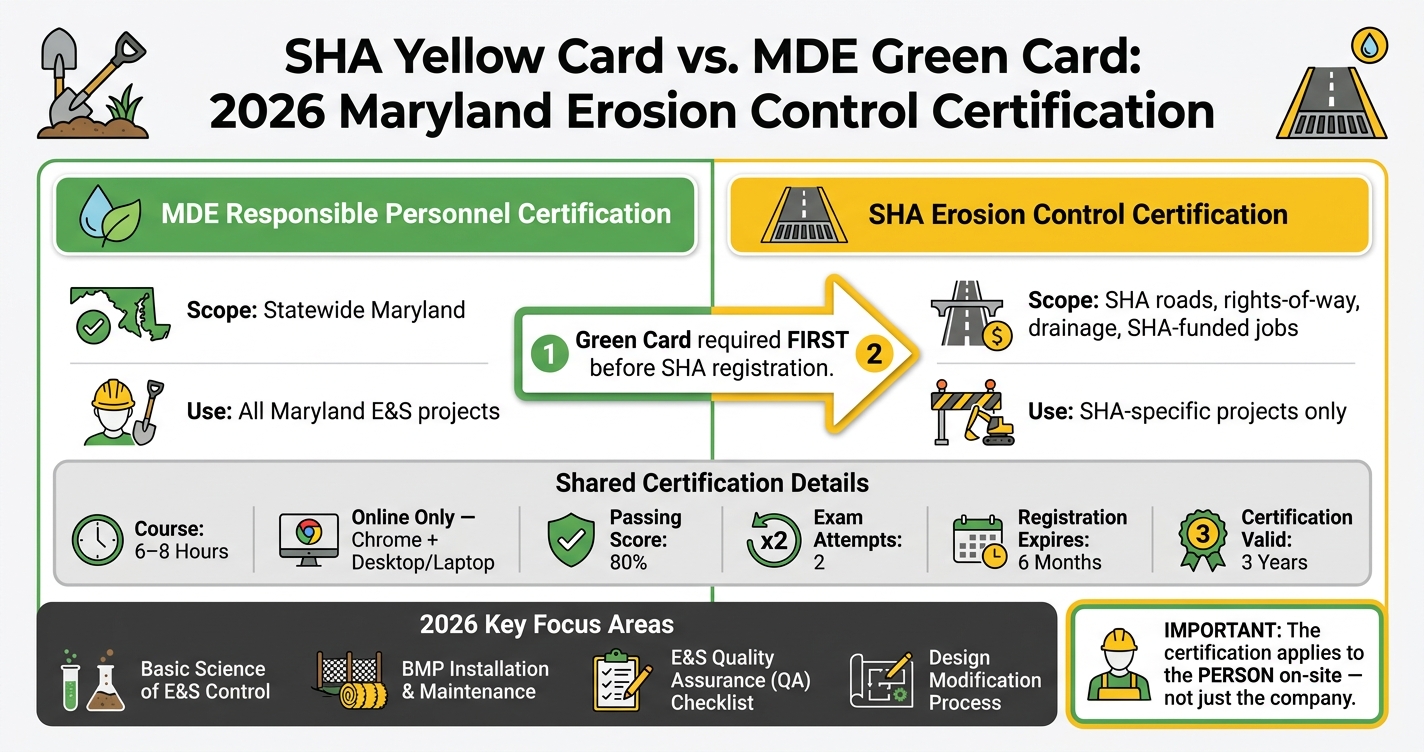
SHA Yellow Card vs. MDE Green Card: 2026 Certification Requirements at a Glance
2026 Designated Erosion Control Inspector 101 Webinar
sbb-itb-843f8be
Why the 2026 Updates Were Made
Maryland’s erosion and sediment control rules come from statewide MDE requirements and SHA project rules. The 2026 certification updates were made so SHA personnel stay in step with current rules, SHA specs, and field compliance procedures.
State Permit and Stormwater Rule Changes Affecting SHA Training
The 2026 curriculum was revised to match current SHA standards and what crews are expected to do in the field. It puts extra focus on the Basic Science of Erosion and Sediment Control, control installation and maintenance, the SHA E&S Quality Assurance checklist, and the Design Modification Process [1].
In plain terms, the training is built around what happens on the jobsite. SHA wants crews to know not just which controls to use, but also how to document issues and make adjustments in the field the right way.
SHA Responsibilities and Project-Level Compliance
SHA manages its own projects, so the certification also spells out how field personnel handle compliance on state-owned corridors. The 2026 updates make SHA’s project-level role clearer within the statewide MDE framework. On SHA projects, certified personnel must follow SHA quality assurance and design modification procedures in state rights-of-way [1].
That’s why the training goes beyond general state rules. It also covers SHA-specific QA steps and design modification procedures that crews are expected to use in the field.
Key 2026 Certification Updates to Know
The 2026 updates center on three things that matter most for SHA project compliance: what people must learn, how the course and exam work, and where the new rules differ from earlier ones.
Curriculum Changes in BMPs, Phasing, and Documentation
The shift toward project-level compliance shows up most clearly in the 2026 curriculum for field personnel.
The 2026 curriculum puts more weight on field documentation and verification, not just installing controls. It also places added focus on the Basic Science of E&S Control, control installation and maintenance, the QA checklist, and the Design Modification Process [1].
The QA checklist now sits at the center of field compliance. It serves as the main field compliance record. The Design Modification Process is also spelled out more directly, which lines up with the need to track and manage site changes in a structured way.
Training, Exam, and Recertification Requirements
The course is 100% online, takes about 6 to 8 hours to finish, and works only in Chrome on a laptop or desktop. Mobile devices and tablets are not supported [1]. Each person registering must use their own email address. Shared admin or office emails can no longer be used for multiple sign-ups [1]. One more detail: the current online course has no audio because Flash Player was discontinued [1].
The exam requires an 80% passing score and must be finished within a 2-hour uninterrupted testing window. Test takers get only two attempts before they must register again and pay a new fee [1]. If a registration is not finished, it expires after 6 months [1].
| Feature | Pre-2026 Requirement | 2026 Requirement |
|---|---|---|
| Registration | Office/admin email allowed for multiple users | Unique email per person required [1] |
| Course Audio | Audio available (Flash-based) | No audio (Flash discontinued) [1] |
| Exam Attempts | 2 attempts | 2 attempts [1] |
| Passing Score | 80% | 80% [1] |
Previous vs. 2026 Curriculum Focus
The table below shows where the curriculum emphasis has moved. The core topics are still familiar, but the expected depth and field use are now more specific.
| Subject Area | Previous Focus | 2026 Updated Focus |
|---|---|---|
| Core Science | General erosion principles | Basic Science of E&S Control [1] |
| Field Application | Installation of BMPs | Installing and maintaining E&S controls [1] |
| Compliance Monitoring | Visual inspections | Using the E&S Quality Assurance (QA) checklist [1] |
| Administrative Process | Standard permit review | Detailed Design Modification Process [1] |
On active SHA jobs, this change shows up in day-to-day work. Documentation and field adjustments are no longer side tasks. They are a main part of staying in compliance.
What These Updates Mean for Maryland Property Projects
Projects Most Likely Affected Near SHA Roads and Drainage
Projects connected to SHA roads are the ones most likely to feel these rule changes. That includes driveway tie-ins, grading work near the right-of-way, and drainage repairs that connect to SHA storm drains.
Before any work starts, make sure the superintendent and E&S manager hold both the SHA Yellow Card and the MDE Responsible Personnel Certification [1]. If a project touches SHA roads or drainage systems, those certifications may show up during permitting and inspections.
How Erosion Control Compliance Protects Property and Schedules
Poor erosion control can throw a project off track fast. It can stop work, delay crews, stretch out timelines, and increase the chance of sediment runoff or damage to nearby infrastructure.
If grading or drainage work happens near public infrastructure without current certified supervision, the odds of running into compliance problems go up. And here’s the part many property managers and HOAs can miss: the rule applies to people, not companies. So it’s smart to confirm the exact on-site superintendent before work begins [1].
That makes the compliance checks below one of the main planning steps to handle upfront, not halfway through the job.
How Pro Landscapes MD Supports Compliant Drainage and Site Work

When a job includes drainage or grading, the site plan should account for erosion control from the start. Pro Landscapes MD provides:
- drainage installation
- drain pipe placement
- drainage repair
- French drains
- stormwater management
- grading
- land leveling
- yard leveling
- paver driveways
The company serves Howard, Montgomery, Carroll, Frederick, Prince George’s, and Baltimore counties. For projects near SHA roads or storm drains, it helps to start with drainage and grading plans that factor in erosion control from day one.
Main Compliance Takeaways for 2026
The SHA Yellow Card and MDE Green Card are not the same thing. You still need the Green Card before SHA registration.[1] That part hasn’t changed.
What has changed for 2026 is the stronger focus on field paperwork and fixing site changes faster. In plain English, crews need to document what happens on-site more carefully and move more quickly when conditions shift.
The 2026 training puts more weight on BMP installation and maintenance, the E&S Quality Assurance checklist, and the Design Modification Process. Those are the parts that shape day-to-day site compliance and field changes.[1]
The timing rules matter more than they may seem at first glance. If certification slips, grading and drainage work can get held up. Here’s the key part:[1]
- Registration expires after 6 months
- Candidates get two exam attempts
- Certification lasts 3 years
- Recertification takes 6 to 8 hours
If your project involves grading, drainage, or hardscaping near SHA roads or state-maintained drainage systems, check that certified personnel are in place before work begins.
FAQs
Who needs both cards?
Contractor superintendents and erosion and sediment control managers on Maryland State Highway Administration projects must hold both certifications.
To get the MDOT SHA Erosion and Sediment Control Certification, also called the Yellow Card, you first need the Maryland Department of the Environment Responsible Personnel Certification.
What work requires the SHA Yellow Card?
The SHA Yellow Card is not linked to a specific job task.
Instead, it’s a required certification for contractor superintendents and erosion and sediment control managers who work on Maryland State Highway Administration construction projects.
It shows they’re qualified to implement, install, and maintain erosion and sediment controls in line with state regulations.
What happens if a certified person is not on-site?
On SHA construction projects, contractor superintendents and erosion and sediment control managers must have a valid Yellow Card certification. During quality assurance inspections, officials verify that these credentials are current.
If a project doesn’t follow its approved erosion and sediment control plans, SHA may issue a low rating and stop earthwork – or even shut down the entire project – until the problems are fixed and a satisfactory rating is restored.
Chat with Us