









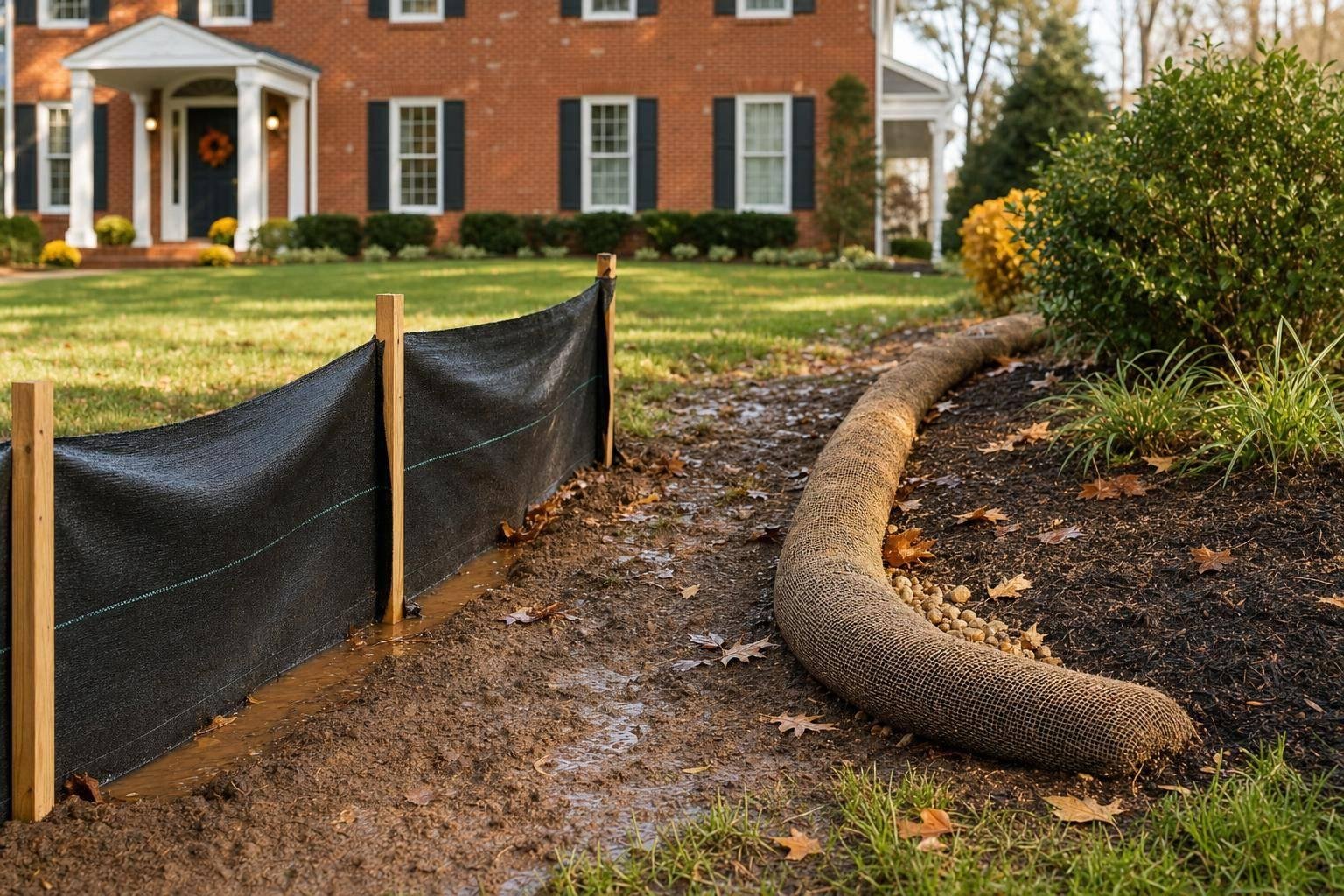
- bhavya gada
- No Comments
If you need the short answer: silt fence fits short, open runs, while filter sock fits tight, landscaped, or hard-to-trench areas. In many Maryland yards, both can work, but the better pick depends on slope, runoff pattern, install labor, cleanup, and how long the barrier needs to stay in place.
Here’s the plain-English takeaway:
- Use silt fence for short-term perimeter control on open sections with sheet flow.
- Use filter sock where trenching is hard, around roots or pavement, or where you want less yard disturbance at removal.
- Neither option is for fast channel flow.
- In Maryland, formal erosion and sediment control plans are often required at 5,000 sq. ft. of disturbance or 100 cu. yd. of soil.
- Installed cost often starts around $1.14 to $3.66 per linear foot for silt fence and $2.00 to $4.00 per linear foot for filter sock, though site access and layout can push pricing higher.
Quick Comparison
| Criteria | Silt Fence | Filter Sock |
|---|---|---|
| Best use | Short-term construction edges | Longer yard protection or hard-to-trench spots |
| Install | Trenched and staked | Set on grade, no trench in many cases |
| Flow | Best with shallow sheet flow | Lets more water pass through |
| Sediment cleanup point | About 25% of fence height | About 50% of sock height |
| Removal | Fabric, posts, trench repair | Mesh removal; some products may stay in place |
| Best yard fit | Open slopes, straight runs | Tight side yards, roots, beds, pavement edges |
If I were sizing up a Maryland yard, I’d keep it simple: pick silt fence for clean, open runs and filter sock for tighter, touchier parts of the site. That’s the core of this comparison.
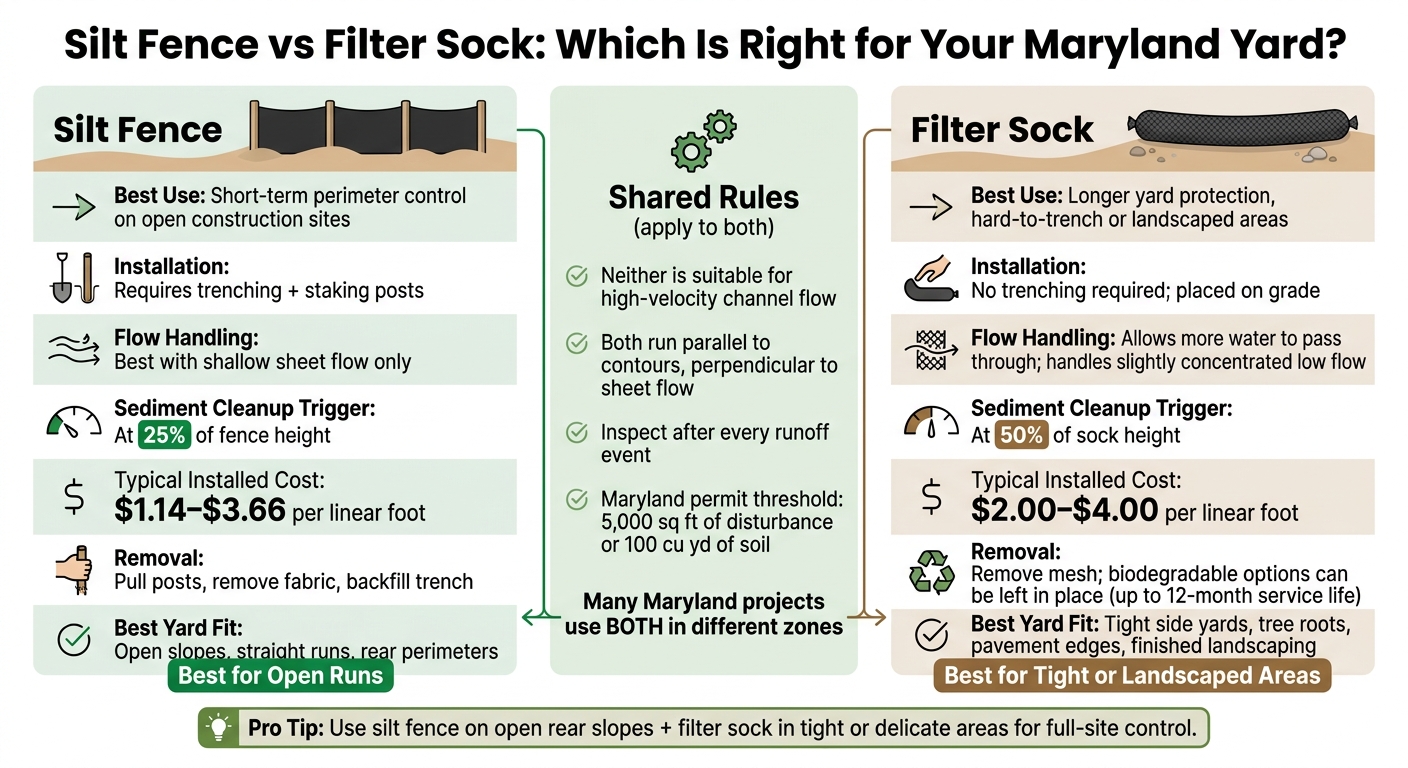
Silt Fence vs Filter Sock: Maryland Homeowner Comparison Guide
Filtrexx BMP Comparison: Compost Sock, Silt Fence, Straw Wattle
sbb-itb-843f8be
Silt Fence for Home Drainage and Grading Projects
A silt fence is a temporary fabric barrier held up by wood or metal posts and trenched into the soil. Its job is simple: slow runoff and catch sediment before it moves downhill. For Maryland homeowners, that makes it a common short-term pick for controlled, shallow runoff.
Best Install Areas and Slope Limits for Silt Fence
Silt fence goes along the downhill edge of disturbed soil, where runoff moves as sheet flow. It fits best on small to moderate residential slopes where water stays spread out instead of gathering in a swale. Once flow starts to channel, the fence can get overwhelmed and stop working as well. That’s why placement matters so much here: silt fence does its best work when runoff stays shallow and evenly spread.
That leads straight to the next issue: cost and upkeep.
Cost, Runoff Handling, and Soil Retention
This is often a lower-cost material option, but there’s still labor involved. The fence needs trenching, staking, and later removal, so the total job isn’t just about the fabric itself.
As for performance, silt fence does a good job holding sediment when runoff stays shallow. But once water volume picks up, results can drop off fast. In plain terms, it works well within its lane, but it’s not built for heavy or concentrated flow.
Maintenance, Cleanup, and Removal After the Project
Silt fence should be checked for a few common problems:
- Sediment buildup
- Torn fabric
- Loose posts
- Undermining
After the site is stable, remove the fence by pulling the posts and taking out the backfilled trench soil. Then fix any small soil disturbance along the fence line. If you need longer-lasting protection, or you’re dealing with areas where flow is less even, compost filter sock is the next option to compare.
Compost Filter Sock for Residential Erosion Control
When trenching is hard or runoff doesn’t move in an even pattern, compost filter sock is often the better choice. A compost filter sock is a flexible mesh tube filled with compost or wood chips and placed on the ground across sheet flow. It works best where trenching is difficult and runoff stays shallow. For longer projects or yards where the layout needs to bend around what’s already there, it also gives you more flexibility than silt fence.
Where Filter Sock Works Best in Maryland Yards
Filter sock fits well along the downslope edge of grading work, at the bottom of a newly leveled lawn, and at intervals along a slope to slow runoff. Because it sits low to the ground and can curve around shrubs, driveways, and existing plantings, it’s a practical pick for landscaped spaces.
In central Maryland yards with tight access, established plantings, or steep or rocky areas where trenching is hard, that flexibility can make a big difference. And that same trait also shapes how the sock handles flow and cleanup.
Cost, Flow-Through Performance, and Soil Hold
Installed compost filter sock usually costs about $2 to $6 per linear foot, depending on diameter, fill material, and site access [3][4][5]. Smaller 8- to 12-inch socks used on garden-scale projects tend to cost less. Larger 18- to 24-inch socks for higher-flow or steeper areas cost more.
Field studies show compost filter socks let more water pass through than silt fence. One study found ponding height behind a 24-inch silt fence was 75% greater than behind a 12-inch compost filter sock [7][6][1]. Even with that higher flow-through, research found no significant difference in sediment capture between socks and silt fence [1][9].
Maintenance, Cleanup, and Longer-Term Use
Socks need regular checks for displacement, undercutting, and sediment buildup upslope. After storms, inspect for movement, washout underneath, and buildup. Remove sediment once it reaches half the sock’s height [10][11][13].
At the end of the project, cleanup usually means removing the mesh and deciding whether the fill can stay in use. Compost or wood media can often be spread on the property as a soil amendment or mulch if it meets local and product-specific quality guidelines. Synthetic mesh should be collected and disposed of unless the product is specifically biodegradable. Sediment that built up upslope should be redistributed on stable areas or removed as needed. On longer projects, sections that are still in good shape can sometimes be moved and used again instead of tossed right away.
Some biodegradable socks can be left in place, and their mesh breaks down over time. Biodegradable products can have a service life of up to 12 months [14]. In Maryland, it’s still smart to confirm the removal plan before wrapping up the job.
Silt Fence vs Filter Sock: Direct Comparison for Maryland Homeowners
Here’s the fast way to size them up.
| Attribute | Silt Fence | Filter Sock | Maryland Notes |
|---|---|---|---|
| Typical installed cost | About $1.14–$3.66/LF low-end; contract samples can run $3.25–$11.00/LF [3][4][17] | About $2.00–$4.00/LF low-end; 8- to 12-inch products about $4.84–$5.92/LF [3][4][18] | Pricing varies by access and length [17][18] |
| Installation effort | Requires trenching and posts [8] | No trenching; placed on grade [19] | Easier around roots, pavement, and tight side yards |
| Best placement and slope fit | On contour below disturbed soil and along defined perimeter runs [12] | Along perimeters, toe of slopes, near inlets, and where trenching is difficult [7][15][16] | Both run parallel to contours, perpendicular to sheet flow [19] |
| Runoff handling | Slows sheet flow; ponds water so sediment settles out [2][12] | Slows sheet flow; handles slightly more concentrated low-flow runoff when installed correctly [7][16] | Neither is meant for high-velocity channel flow [8] |
| Sediment retention | Remove buildup at about 25% of fence height [12] | Remove buildup at about half the sock’s visible height [19] | Inspect after every runoff event [12][19] |
| Cleanup | Remove fabric and posts; backfill trench [12][8] | Biodegradable socks may be left in place [19] | Filter sock disturbs finished landscaping less during removal [19] |
| Best fit | Short-term construction control [12][8] | Longer yard protection during landscape establishment [19] | Many Maryland projects use both in different zones [15][16] |
Use these differences to match the barrier to your lot.
Short-Term Construction Control vs Longer Yard Protection
Silt fence makes more sense for short, defined work windows. It’s built for active construction areas where you need a perimeter control for disturbed soil [12][8].
Filter sock fits better when the barrier needs to stay put while grass, beds, or other plantings get established [19]. That can matter on Maryland yards where the dirt work ends, but the site still needs protection for weeks after.
Choosing Between These Two Options for Central Maryland Lots
On many Central Maryland lots, the layout makes the choice pretty simple.
Filter sock usually works better in spots that are awkward to trench, like:
- Tight side yards
- Areas with roots
- Pavement edges
- Finished landscaping
Silt fence tends to fit open rear slopes and long, straight perimeter runs better. If you’ve got room to trench and drive posts, it can be a solid pick for those cleaner stretches.
In plenty of Maryland projects, it’s not an either-or call. Contractors use silt fence in open zones and filter sock in tighter or more delicate areas [15][16]. That mix often gives the site the control it needs without making removal a headache later.
Conclusion: Picking the Right Sediment Barrier for Your Maryland Project
After looking at installation, water flow, and cleanup, the right pick usually comes down to a few on-site details. Think about the slope, how runoff moves across the property, how long the project will last, and how much you want to protect the finished look of the yard.
Use silt fence for short-term perimeter control on open runs where trenching is practical. Use compost filter sock when you want easier setup, better flow-through, and less disturbance around turf, tree roots, or finished landscaping.
The total cost can vary based on site access, labor, project size, and how long the barrier needs to stay in place.
If your project also calls for grading or drainage work, professional installation can help keep the barrier lined up with the site plan. Pro Landscapes MD handles grading, drainage installation, yard leveling, and yard repair across central Maryland.
FAQs
How do I know if my yard has sheet flow or channel flow?
Walk your property during or right after a moderate rain. That’s often the easiest way to spot what the water is doing.
Sheet flow moves in a thin, even layer across the ground. Channel flow moves faster and starts to carve out clear paths, ditches, or gullies in the soil.
You may also notice clues like mud on walkways, exposed tree roots, or patches where grass just won’t grow. Those signs can point to active runoff.
Can I use both silt fence and filter sock on one project?
Yes. Using both silt fence and filter sock on the same project is common. In many cases, it gives you better erosion and sediment control than relying on just one option.
Here’s a simple way to think about it: each tool does a different job.
For example, silt fence can work well for perimeter control on gentle slopes. Filter sock can help protect tree roots, inlets, or rocky areas where trenching isn’t practical.
Used together, they can cover more of the site and handle problem spots more effectively.
Will I need a permit for my Maryland grading project?
In Maryland, you’ll usually need a grading permit if your project disturbs 5,000 square feet or more or moves 100 cubic yards or more of fill.
That’s the general rule. But local rules can get stricter fast.
Permits are often required no matter the project size in sensitive areas, such as the Chesapeake Bay Critical Area, historic districts, floodplains, wetlands, or land near watercourses. Since rules can change from one county or municipality to the next, it’s smart to check with your local permitting office or Soil Conservation District early.
Chat with Us