









- bhavya gada
- No Comments
If your soil is packed hard, your tree roots struggle for air, water, and food. I’d sum it up this way: soil aeration helps roots breathe, soak up water, take in nutrients, grow deeper, and handle stress with less trouble.
In central Maryland, this matters more because many yards have heavy clay soil. Clay compacts fast from foot traffic, mowing, and time. Then rain tends to sit on top, and dry summer weather can leave the ground hard and tough for roots to push through. For most yards here, the best time to aerate is spring (March–April) or early fall (September–October).
Here’s the short list of what aeration does for tree roots:
- Gets more oxygen into the root zone
- Helps water soak in instead of pooling or running off
- Moves nutrients closer to roots
- Gives roots room to grow deeper and spread out
- Helps trees deal with heat, drought, and wet weather
A few signs you may be dealing with compacted soil:
- Water pooling after rain
- Hard ground that is tough to dig
- Thin turf around trees
- Dry soil that sheds water
- Trees that seem stressed in summer
| Root-zone issue | What aeration helps with |
|---|---|
| Low oxygen | Opens small air spaces in soil |
| Poor drainage | Helps water move down into the ground |
| Shallow roots | Gives roots space to grow lower |
| Low nutrient flow | Helps water and nutrients reach roots |
| Stress from heat or drought | Supports stronger root function |
I see aeration as a simple step that helps trees in clay-heavy yards, especially when compaction keeps coming back.
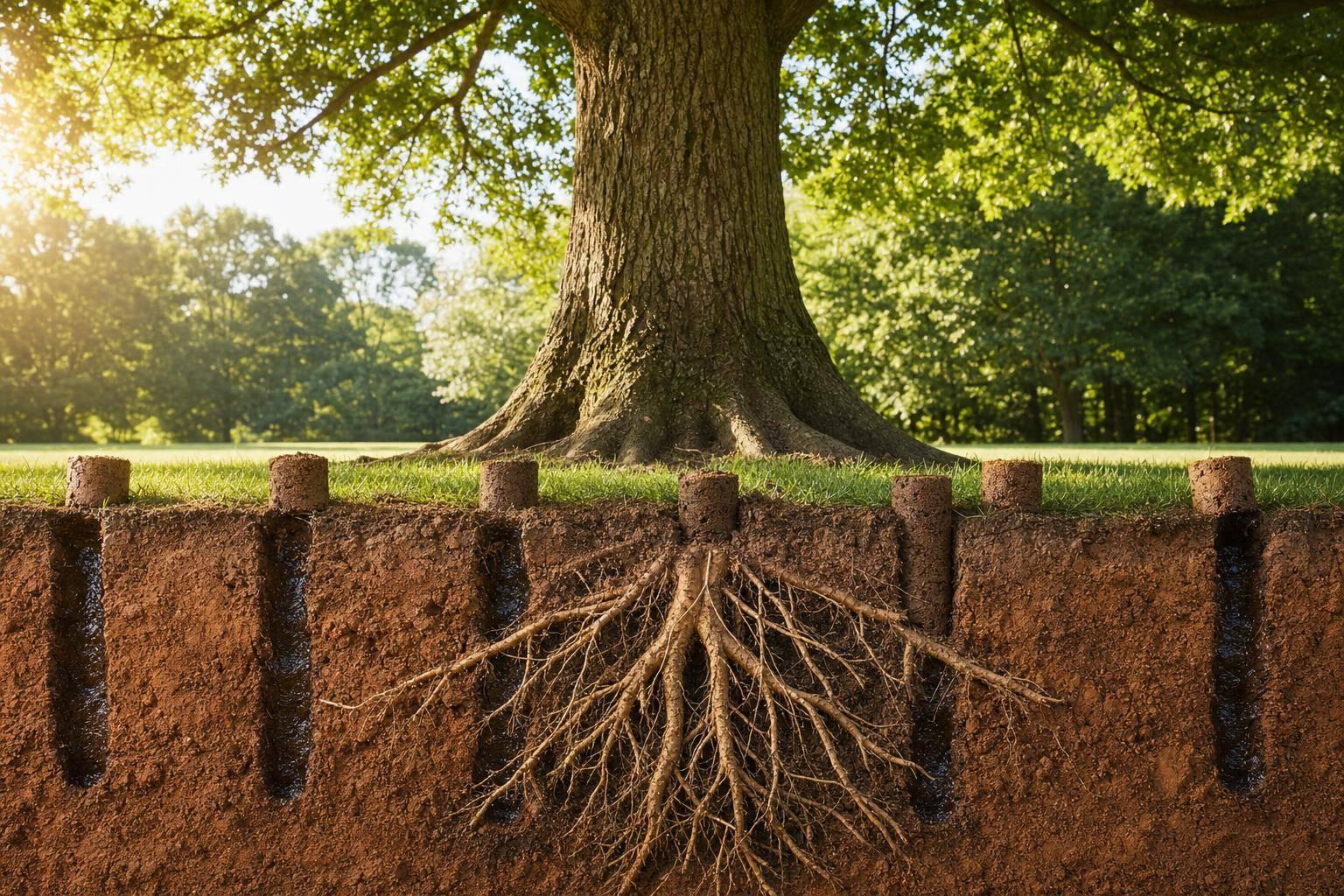
Aerating & De-Compacting Soil Around an Oak Tree
Why Soil Compaction Harms Tree Roots
Healthy soil has small pore spaces that move oxygen, water, and nutrients into the root zone. But foot traffic, mowing, heavy equipment, and even natural settling can press that soil down over time. When that happens, those pore spaces collapse[1][3]. The soil gets dense, and roots have a much harder time pushing through it.
That lack of space creates a bigger problem: roots need oxygen to respire. Without enough of it, roots tend to stay shallow and weak. That can leave trees more exposed to drought, pests, and disease[1][5]. Compacted soil also slows root growth, which puts stress on both turf and trees.
Water movement takes a hit too. Instead of soaking into the ground, water may sit on the surface or run off before it ever reaches the root zone[1][4]. In Maryland, this is an even bigger issue because clay-heavy soils compact more easily and drain poorly[1][4]. In heavy clay soil, compaction often adds to drainage problems and root stress.
Once compaction is relieved, the first thing that improves is oxygen flow, which helps root respiration.
1. Improved Root Oxygen and Respiration
The first payoff is immediate: aeration gets oxygen back to roots that have been struggling. In compacted Maryland clay, that matters a lot. When soil gets packed down, oxygen can’t move through it well, and roots need oxygen for respiration – the process that keeps them alive and helps them grow.
Core aeration pulls out small plugs of soil, which opens space for air to move back into the root zone without packing the clay even tighter [1][2]. Once those channels open up, roots can respire the way they should again. That supports deeper root growth and helps roots hold up better under stress [2][3].
Healthier roots also support steadier canopy growth and help the lawn bounce back faster after summer heat [1][3].
Once respiration gets back on track, water movement and nutrient uptake tend to improve next.
2. Better Water Absorption and Drainage
Those same channels also help water move down into the root zone. When aeration opens up the soil, water can reach the roots instead of running off the surface. The holes created by core aeration let water soak in rather than sit on top. That matters a lot in Maryland, where heavy clay soil tends to compact.
The payoff is steadier moisture around the roots, even during hot, dry stretches. Instead of evaporating off the surface, more water gets to the part of the soil where trees can use it.
A well-aerated root zone needs less frequent watering [4]. If water pools around your trees after rain, that’s often a sign that compaction is blocking infiltration [4].
Better water movement also helps nutrients stay available to the roots.
3. More Nutrient Uptake and Soil Microbial Activity
When water sinks deeper into the soil, nutrients can move with it. But they don’t just drift down to the roots on their own. In compacted soil, the pore space they need gets blocked, which slows that movement [2][3].
Aeration opens up channels in the soil, giving nutrients a clearer path into the root zone [2][3]. With core aeration, the plugs pulled onto the surface break down over time and feed organic matter and nutrients back into the soil [2]. That helps support the soil biology behind nutrient uptake.
Low-oxygen soil also makes life harder for the helpful microbes that break down organic matter into forms roots can absorb. These microbes do their best work in loose soil with plenty of oxygen [1][2].
In Maryland clay soil, it makes sense to aerate before fertilizing. That way, nutrients can move through the new channels instead of sitting near the surface [4][3].
sbb-itb-843f8be
4. Stronger and Deeper Root Growth
When roots run into a dense soil layer, they often stay close to the surface. That can leave a tree less stable and less able to handle dry weather [1][2].
Core aeration helps by pulling out small soil plugs and opening up space in the ground [2]. Instead of crowding near the top, roots have room to grow down and out.
That matters for two big reasons. First, deeper roots help anchor the tree more firmly. Second, a broader, deeper root system can reach moisture farther below the surface during dry spells, which improves drought resistance [1][3]. It also gives the tree a stronger base for overall health.
5. Better Overall Tree Health and Stress Resistance
These gains add up over time. When roots work better, trees are in a much better spot to deal with drought, heat, and heavy rain [1][4]. Regular aeration also helps cut down on standing water around the root zone, which can lower the chance of root rot and other disease issues [1][4].
It also helps trees bounce back faster after heat, drought, and heavy rain [4]. And because well-aerated trees tend to stay healthier on their own, they often need less extra watering and fertilizer [4].
Compacted Soil vs. Aerated Soil in the Root Zone
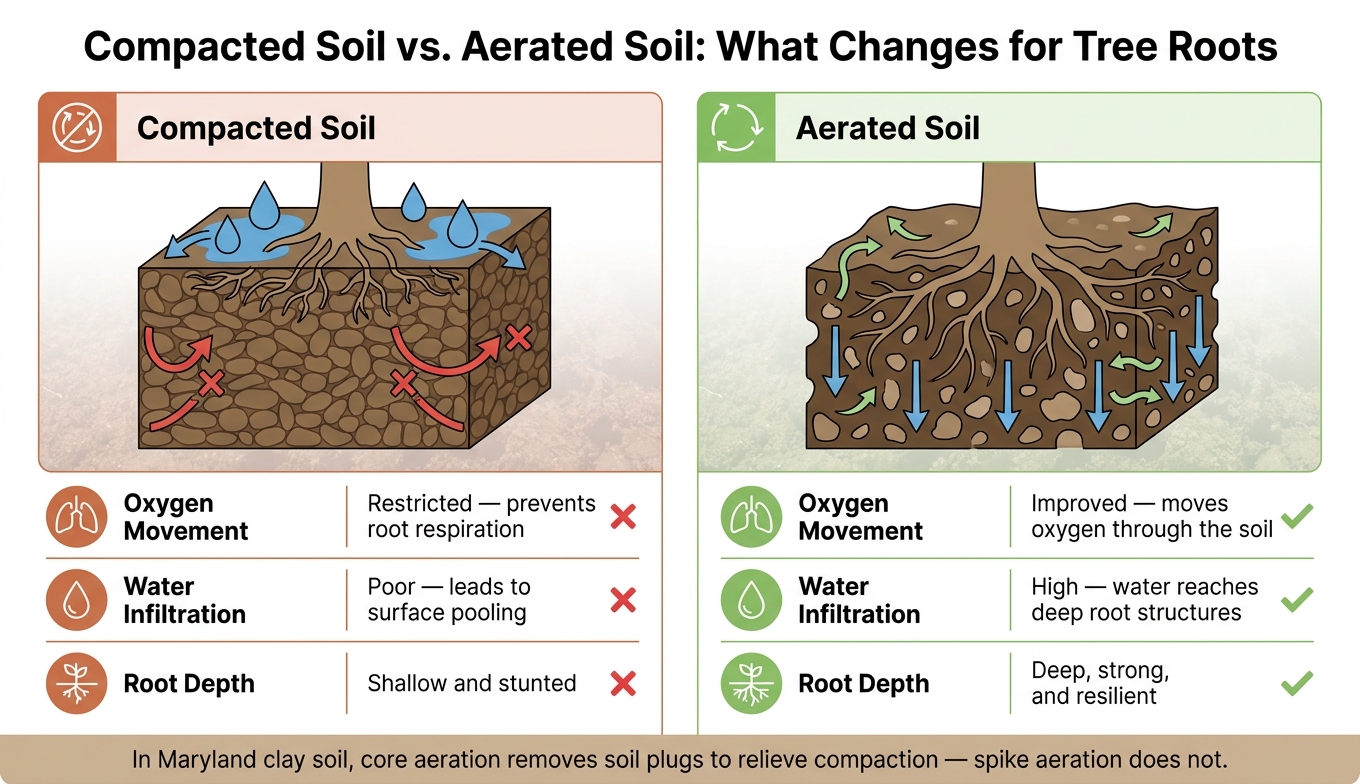
Compacted Soil vs. Aerated Soil: What Changes for Tree Roots
Compacted soil cuts off the flow of air, water, and nutrients. Aerated soil opens those paths back up and helps roots do their job.
When people, mowers, or heavy equipment move across the lawn, the soil gets pressed down. That pressure shrinks pore space and makes it harder for roots to grow. Aeration creates small channels in the soil so oxygen, water, and nutrients can move down to the root zone instead of getting stuck near the surface.
Here’s the short version:
| Feature | Compacted Soil | Aerated Soil |
|---|---|---|
| Oxygen Movement | Restricted; prevents root respiration | Improved; moves oxygen through the soil |
| Water Infiltration | Poor; leads to surface pooling | High; water reaches deep root structures |
| Root Depth | Shallow and stunted | Deep, strong, and resilient |
In Maryland’s heavy clay soil, core aeration helps ease compaction because it removes plugs of soil. Spike aeration doesn’t do that. That gap matters in Maryland landscapes, where soil type and timing play a big role in how well aeration works.
Soil Aeration in Maryland Tree and Landscape Care
In Maryland, those gains show up most in clay-heavy yards. Heavy clay soil packs down with ease, slows air and water flow to tree roots, and often stays wet too long after rain. Aeration opens up the root zone so oxygen can reach the roots and water can move through the soil more easily. For results that last, it helps to pair aeration with drainage work and grading.
When clay soil and poor drainage keep causing trouble, the work on-site makes a big difference. Pro Landscapes MD pairs root-zone aeration with drainage installation, grading, and landscape restoration to build better growing conditions for trees across central Maryland.
Conclusion
Soil aeration helps break up compacted soil so roots can get the oxygen, water, and nutrients they need. That means deeper roots and healthier trees. In compacted ground, it’s one of the simplest ways to give trees a better shot at steady growth.
In Maryland’s clay-heavy soils, that matters even more. Compaction can choke root function and slow drainage. Better airflow in the soil supports root respiration, improved drainage cuts down on pooling and runoff, and stronger nutrient uptake helps trees bounce back and grow well.[1]
For tree and landscape care in Howard County, Montgomery County, and nearby Maryland and Washington, DC communities, Pro Landscapes MD can help.
FAQs
How do I know if my tree soil is compacted?
Compacted soil is often hard or cracked instead of loose and crumbly. You may also notice standing water, poor drainage, patchy growth, or soil that stays dry and dense after hot summer weather.
Plants can struggle too. A common sign is weak plant health, along with roots that have a hard time pushing into the soil.
If you want a closer check, use a soil probe or the Maryland Soil Health Card.
Is core aeration better than spike aeration for trees?
Yes. Core aeration is usually more effective than spike aeration for soil health and root growth.
Spike aeration just pokes holes in the ground. Core aeration removes small plugs of soil instead. That difference matters. It does a better job of easing deeper compaction, especially in clay-heavy soils, and opens clearer paths for water, air, and nutrients to reach tree roots.
When should I aerate soil around trees in Maryland?
In Maryland, the best time to aerate is during active growth, when temperatures are mild and the soil is a bit moist. For most properties, early fall – from mid-September to early November – is the sweet spot.
Spring aeration, usually from late March through May, can also work well. Just skip aerating when the ground is frozen or during intense summer heat, since that can put extra stress on your landscape.
Chat with Us