









- bhavya gada
- No Comments
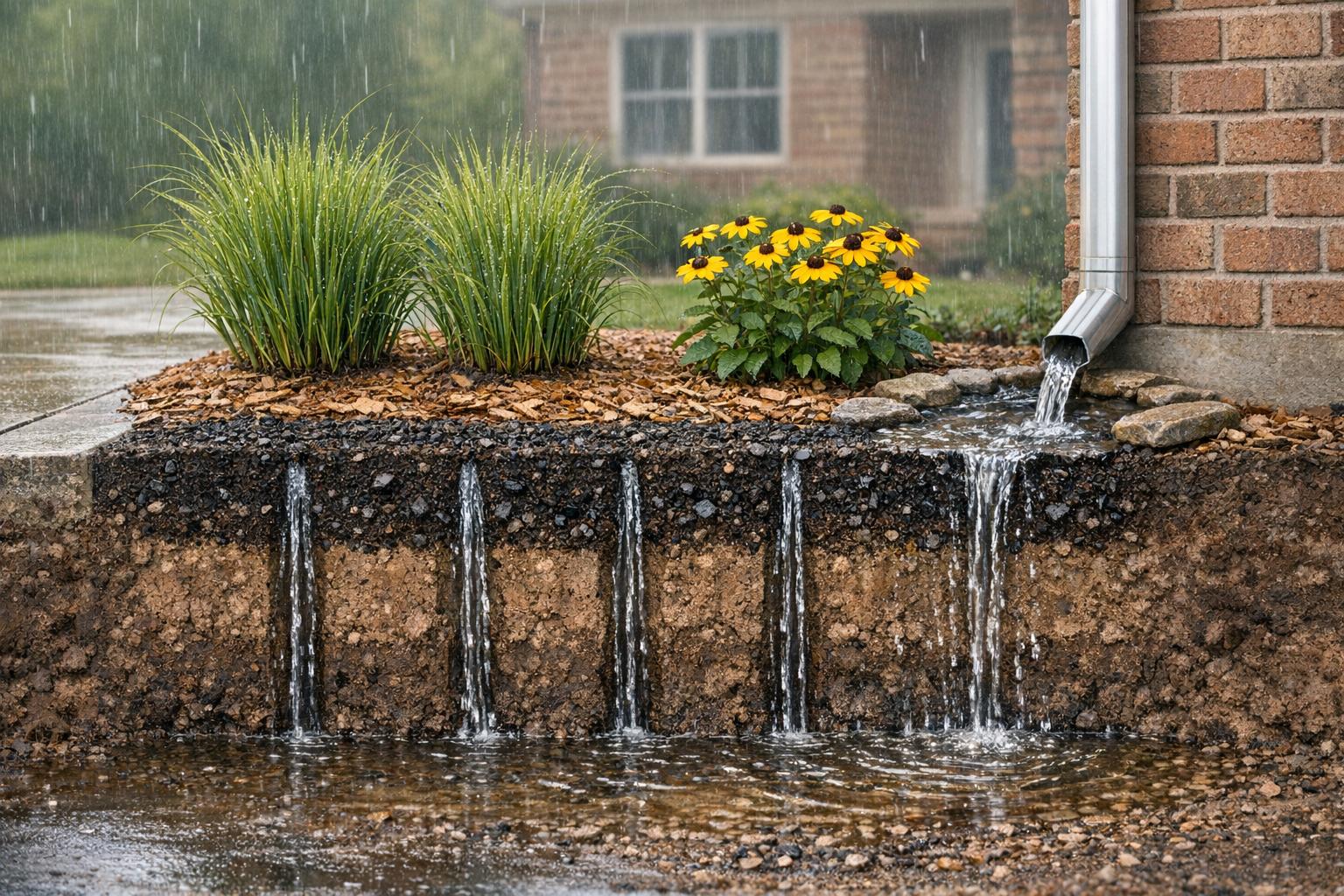
Soil amendments improve water absorption and reduce runoff by enhancing soil structure and porosity. They are essential for managing stormwater, especially in compacted urban soils where infiltration rates are low. Key facts:
- What are soil amendments? Materials like compost, manure, and biochar added to soil to improve water retention, infiltration, and structure.
- Why are they important? Urban soils often become compacted, causing water to run off instead of soaking in. Amendments can increase infiltration rates from less than 1 cm/hr to 20–35 cm/hr within two years.
- Best options for Maryland: Compost, aged manure, shredded leaves, and biochar, especially for clay-heavy soils.
- How to apply? Test soil first, address compaction with deep tillage, and mix amendments into the top 6–12 inches. For lawns, aerate and top-dress with compost.
Soil amendments transform landscapes into stormwater sponges, reducing erosion, runoff, and pollution. Proper application ensures long-term results.
How Soil Amendments Improve Infiltration
Increasing Soil Porosity and Water Retention
Soil amendments play a key role in improving how water moves through soil. By increasing pore connectivity, they help water infiltrate the soil rather than pooling on the surface. This is especially beneficial for clay-heavy soils, which are common in Maryland. Organic amendments enhance soil aggregation, boosting porosity, permeability, aeration, and drainage [3].
These amendments also support soil life. Microbes and earthworms thrive on organic matter, breaking it down into humus. As they tunnel through the soil, they create channels that improve both drainage and aeration [4]. This process leads to what scientists call "connected porosity" – a network of pores that allows water to move vertically through the soil instead of running off. Studies show that biochar can increase total soil porosity by 54.28% and connected porosity by 119.75% [6].
In sandy or gravelly soils, amendments serve a different purpose. Instead of focusing on creating pores, they improve water-holding capacity. Materials like sphagnum peat moss and vermiculite act like sponges, soaking up water and releasing it slowly into the root zone [3][7]. Even mulch can help, reducing moisture loss from evaporation by 10% to 50% [[5]](https://depts.washington.edu/dislc/Soil Amendments/app.htm).
These improvements in water retention and infiltration also reduce runoff and soil erosion.
Reducing Surface Runoff and Erosion
When soil can’t absorb water properly, rainfall often turns into runoff, carrying pollutants and causing erosion. Soil amendments help by encouraging the growth of deep, strong root systems. These roots stabilize the soil, reducing erosion and increasing the amount of water the ground can absorb [1]. This transforms lawns and landscapes into natural stormwater management systems.
Field studies highlight the impact of these methods. Combining deep tillage with amendments and grass establishment can boost infiltration rates from less than 0.4 inches per hour to between 8 and 14 inches per hour. This allows treated soils to handle runoff from nearby impervious surfaces effectively [2]. Together, increased porosity and reduced runoff are vital for managing stormwater efficiently.
sbb-itb-843f8be
Best Soil Amendments for Maryland’s Conditions
Organic Options: Compost, Manure, and Shredded Leaves
Maryland’s clay-heavy soils benefit greatly from the addition of organic matter, which helps improve water infiltration and soil structure. Compost, aged manure, and shredded leaves are among the best options for addressing these challenges. These materials work to loosen compacted clay, create pathways for drainage, and support soil microbes that help bind particles into stable aggregates.
"There is just one practical way to improve clay soil: working in plenty of organic matter." – Jennifer Schutter, Horticulture Specialist, University of Missouri Extension [8]
One standout option in Maryland is Leafgro®, a compost made from leaves and yard waste by the Maryland Environmental Service. It has been widely used in restoration efforts across the state. For example, between 2010 and 2013, Baltimore revitalized an asphalt parking lot by incorporating 3 inches of Leafgro® compost into soil ripped to a depth of 20 inches. The results were remarkable: soil moisture levels jumped from 23.4% to 35.3%, and runoff was reduced by a factor of 30 [10].
For homeowners, applying a 1- to 4-inch layer of compost, aged manure, or shredded leaves and mixing it into the top 6 to 10 inches of soil is recommended [9]. Since organic matter decomposes over time, it’s important to replenish it annually, either in spring or fall. For lawns, aerating first to remove soil cores and then top-dressing with a thin layer of compost can help alleviate compaction and improve drainage [1]. Additionally, mulch mowing – leaving grass clippings and shredded leaves on the lawn – provides a simple way to return organic matter to the soil naturally [1].
Next, let’s examine the drawbacks of inorganic amendments.
Limitations of Inorganic Amendments
While inorganic soil amendments like sand, perlite, and vermiculite can improve drainage and aeration, they lack the biological and nutrient benefits that organic materials provide [9]. Sand, in particular, can be problematic when mixed with clay soils. If not blended correctly, it can create a dense, concrete-like texture that worsens drainage instead of improving it.
Gypsum is another inorganic option often suggested for clay soils, but its effectiveness is limited to specific cases where sodium causes soil structure issues. For most soils in Maryland, gypsum won’t offer the infiltration improvements required for managing stormwater. Biochar, a carbon-rich amendment, can enhance soil structure and reduce nutrient runoff. However, when used by itself, it may lead to nitrogen deficiencies and hinder plant growth. Researchers at the University of Maryland found that combining biochar with yard waste compost can address this problem while also reducing phosphorus runoff by up to 5.6 times and nitrogen runoff by up to 8.8 times compared to using compost alone [11].
Inorganic amendments also have limitations based on site conditions. For example, in regions near Maryland, amendments should be avoided if the water table or bedrock is less than 1.5 feet below the surface or if the land has a slope greater than 10% [12]. Efforts should focus on soils that struggle with infiltration, as there’s no advantage to treating soils that already drain well naturally.
Soil Structure: Water Infiltration and Compaction Demonstration
Steps to Apply Soil Amendments for Stormwater Management
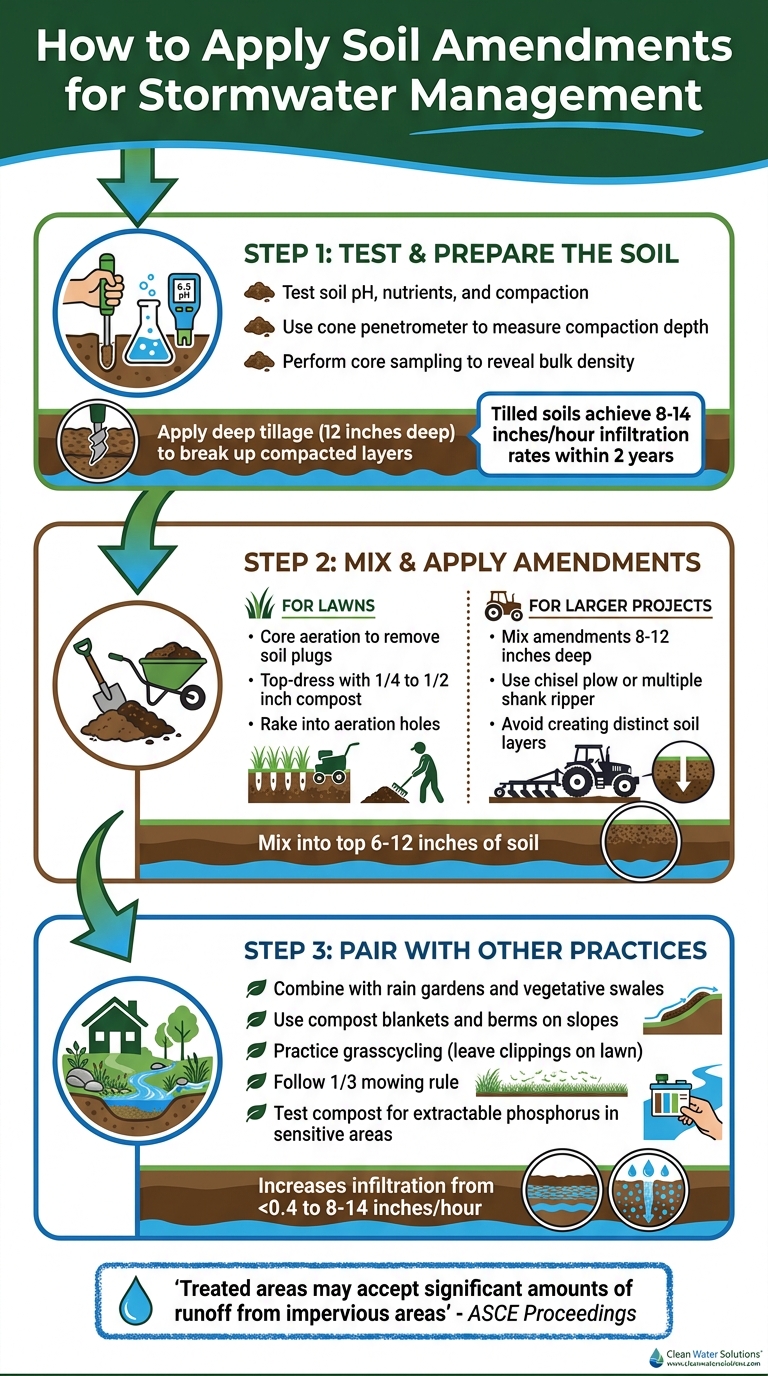
How to Apply Soil Amendments for Stormwater Management: A Step-by-Step Guide
Testing and Preparing the Soil
Before diving into soil amendments, it’s crucial to test your soil. This step helps you understand its pH, nutrient levels, and any compaction issues that could hinder water absorption. Urban soils, in particular, often have poor infiltration rates, making it hard for them to handle even moderate rainfall.
To assess compaction, tools like a cone penetrometer can measure compaction depth, while core sampling reveals the soil’s bulk density [2]. If compaction is present, deep tillage – going as deep as 12 inches – is necessary to break up these dense layers. This method is far more effective than just adding compost to the surface [2]. A 2015 study by Richard McLaughlin and Joshua Heitman from North Carolina State University showed that tilled and amended plots achieved infiltration rates of 8 to 14 inches per hour within two years [2].
"The tilled soils had infiltration rates of 20 to 35 cm hr-1 at the end of at least two years. Because this far exceeds the expected rainfall of 3 to 6 cm hr-1 for 2- to 10-year recurrence storms, the results suggest that treated areas may be able to accept significant amounts of runoff from impervious areas." – ASCE Proceedings [2]
Once the soil is tested and compaction is reduced, it’s time to mix in the right amendments.
Mixing and Applying Amendments
With the soil prepped, the next step is incorporating amendments effectively. For existing lawns, aeration combined with top-dressing works wonders. Core aeration removes small plugs of soil, creating channels for water and reducing compaction. After aerating, spread a thin layer (about 1/4 to 1/2 inch) of high-quality compost and rake it into the aeration holes [13].
For larger projects, such as landscaping or construction sites, amendments should be mixed to a depth of 8 to 12 inches. Tools like a chisel plow or multiple shank ripper ensure thorough blending [13][14]. Be careful not to create distinct soil layers, as this can lead to water pooling or sideways flow rather than proper infiltration [14].
Pairing Soil Amendments with Other Practices
Amending soil is just one part of a broader stormwater management strategy. Combining amendments with additional practices can maximize their impact. For instance, rain gardens and vegetative swales benefit greatly from amended soil, as the increased contact time between runoff and soil leads to more effective pollutant removal [14]. On slopes or erosion-prone areas, compost blankets and berms offer immediate protection while vegetation takes root [13].
For lawns, you can pair amendments with grasscycling – leaving grass clippings on the lawn – and follow the 1/3 mowing rule (only cut a third of the grass height at a time) [1]. This not only strengthens root systems but also helps the soil absorb more water, reducing runoff. When using compost in areas sensitive to water quality, test it for extractable phosphorus to ensure it doesn’t contribute to pollution [14].
Site-Specific Considerations for Soil Amendments
Assessing Suitability for Different Soil Types
Soil reacts differently to amendments depending on its type. In Maryland, soils are categorized into Hydrologic Soil Groups (HSGs), ranging from Group A (high infiltration) to Group D (very low infiltration) [10]. However, urban development often disrupts these natural classifications. Construction activities and mass grading compact native soils, reducing their ability to absorb water [10].
In the Piedmont Plateau region of Maryland, which lies between the Blue Ridge Mountains and the Coastal Plain, gravelly loam soils are common on slopes of 8% to 15% [10]. These soils can benefit significantly from amendments – but only after addressing compaction. The process of deep decompaction is essential. Techniques like deep-ripping to a depth of 20 inches, combined with compost incorporation, can drastically reduce runoff – by as much as 30 times compared to standard topsoiling practices [10]. For example, a field trial in Baltimore, conducted by Dr. Stuart Schwartz at an elementary school from August 2010 to 2013, demonstrated that suburban subsoiling with 3 inches of Leafgro® compost maintained soil moisture at 35.3%, compared to only 23.4% in untreated areas [10].
"The greenspaces in constructed environments (lawns, parks, golf courses, etc.) often have much higher runoff characteristics and lower infiltration characteristics than native forest floor soils." – Craig Coker and Stuart Schwartz [10]
Before applying amendments, it’s crucial to test the soil down to a depth of 1 foot below the proposed amendment area. Key factors to analyze include bulk density, pH, salts, and nutrient levels [15]. A cone index exceeding 2.1 MPa can hinder root growth; in Maryland trials, amended soils stayed below this threshold to a depth of 12 inches, while areas with only topsoil exceeded it at just 4 inches [10].
In addition to tailoring practices to soil conditions, compliance with local regulations is a critical step in the amendment process.
Ensuring Compliance with Local Standards
Maryland’s stormwater management regulations, enforced by the Maryland Department of the Environment (MDE), mandate that jurisdictions restore 20% of impervious surface areas lacking proper stormwater management [10]. Soil amendments can play a role in meeting these goals, but there are specific restrictions to keep in mind.
Avoid soil amendments in areas where the water table or bedrock is within 1.5 feet of the surface [15]. This is particularly important in the Coastal Plain regions, where water table elevations must be carefully evaluated to maintain the required separation depth. Similarly, do not amend soils that are saturated or seasonally wet [15]. Slopes present another challenge – amendments should not be applied on slopes steeper than 10% longitudinally, and they are prohibited on slopes exceeding a 3:1 ratio to prevent instability caused by excess moisture [15].
Avoid placing amendments within the drip line of trees, as this can damage roots [15]. Additionally, in areas near "hot spots" like gas stations, amendments that enhance infiltration may be restricted to prevent groundwater contamination [15]. For reforestation projects using compost amendments, Maryland regulations require achieving a 75% forest canopy within 10 years. For linear utility site restorations, the standard is 90% ground cover within the first year [15]. Lastly, ensure that the downhill slope of any amended area directs water away from existing or planned building foundations [15].
Conclusion
Key Takeaways
Soil amendments can transform compacted soil into a landscape powerhouse that absorbs stormwater, protecting both your property and nearby waterways. By boosting organic matter, you can significantly improve soil infiltration rates – from less than 0.4 inches per hour in compacted soil to an impressive 8 to 14 inches per hour in well-amended areas [2]. This means your landscape can handle runoff from storms producing 1.2 to 2.4 inches of rainfall per hour, often seen in 2- to 10-year storm events [2].
But the advantages don’t stop at stormwater control. For every 1% increase in organic matter, the soil’s water-holding capacity rises, cutting down on irrigation needs and helping plants endure dry spells [16]. Properly designed bioretention areas with 3% to 5% organic content can filter out 80% of suspended solids, 60% of phosphorus, 50% of nitrogen, and 80% of heavy metals from runoff [17]. Organic materials like compost, manure, and shredded leaves are particularly effective in Maryland’s environment, especially when combined with proper grading and drainage systems. These benefits highlight why working with the right professionals is so important for achieving effective stormwater management.
How Pro Landscapes MD Can Help

Pro Landscapes MD takes these proven soil amendment techniques and applies them to landscapes across central Maryland. Specializing in stormwater management, they serve areas including Howard County, Montgomery County, Carroll County, Frederick County, Prince George’s County, and Baltimore County. Their services cover soil testing, amendment applications, and drainage installations such as French drains, dry riverbeds, grading, land leveling, and yard repair.
With their expertise in horticulture, they ensure amendments are applied correctly, reaching the root zone for long-term results. Their approach combines soil improvement with other practices like rain gardens, environmental pavers, and strategic landscape designs to maximize water infiltration. Whether you’re dealing with compacted clay in Ellicott City, managing runoff in Bethesda, or restoring soil damaged by construction in Columbia, Pro Landscapes MD offers solutions tailored to Maryland’s unique soil challenges and regulations. Visit Pro Landscapes MD to transform your property into a functional, efficient landscape that manages stormwater with ease.
FAQs
How much compost should I add for better drainage?
To boost drainage, apply a 1 to 2-inch layer of compost as mulch or blend it directly into the soil. This improves water infiltration and minimizes runoff, making it a practical way to manage stormwater effectively.
How long before soil amendments reduce runoff?
Soil amendments often begin to show results within just a few weeks. Early changes, such as balancing soil pH and boosting water infiltration, tend to happen fairly quickly. However, achieving bigger benefits like improved water retention and a noticeable reduction in runoff can take more time. These outcomes depend on the specific soil processes and environmental conditions at play.
When should I avoid amending soil for infiltration?
If the soil already has a fast infiltration rate – defined as over 8.3 inches per hour – it’s best to avoid adding amendments. In such cases, physical changes might be necessary to slow down water movement. Also, skip amendments that don’t match the soil type or fail to support the desired infiltration objectives.
Chat with Us