









- bhavya gada
- No Comments
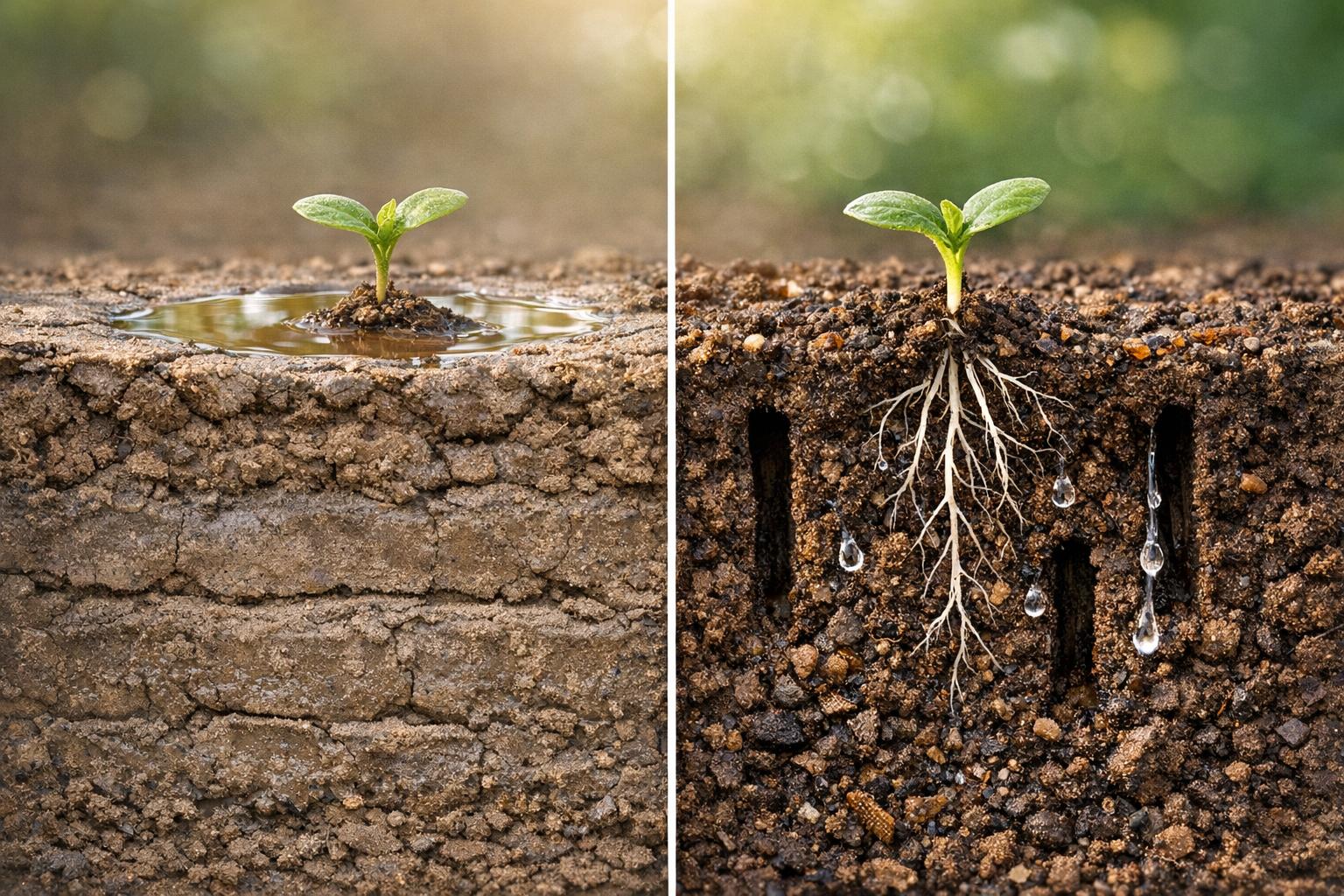
Soil compaction occurs when soil particles are pressed tightly together, reducing the spaces necessary for air, water, and root movement. This can lead to poor plant growth, water pooling, and runoff that harms nearby ecosystems. Common causes include heavy traffic, wet conditions, low organic matter, and construction activities. To prevent or fix compaction:
- Avoid working on wet soil: Use the soil ball test to check moisture levels.
- Reduce heavy traffic: Limit machinery or foot traffic in sensitive areas.
- Aerate compacted soil: Core aeration or air spading improves airflow and water absorption.
- Add organic matter: Compost enhances soil structure and resilience.
- Install drainage systems: Redirect water to prevent pooling and erosion.
Simple actions like these can restore soil health and improve plant vitality while reducing runoff and erosion risks.
How to Fix Soil Compaction & Drainage Problems | Lawn & Garden Tips with Jeff Culbertson
sbb-itb-843f8be
What Causes Soil Compaction
Understanding the reasons behind soil compaction can help you take steps to protect your landscape before issues arise. Compaction typically results from factors like heavy traffic, wet conditions, low organic matter, and construction activities. Let’s break down these contributing factors in more detail.
Heavy Foot and Vehicle Traffic
Frequent movement across the same areas can cause long-term damage to soil. Whether it’s someone walking across your lawn, parking a car under a tree, or repeatedly driving a riding mower along the same path, the weight compresses soil particles. The University of Maryland Extension explains:
The weight of machinery, vehicles, garden equipment, and humans pushes particles together reducing the size and number of pore spaces and removing air from soil [4].
The problem worsens with heavier machinery. For example, equipment with axle loads over 10 tons can compact soil to depths of 2 feet or more [2]. Shockingly, up to 90% of this compaction happens during the very first pass of heavy equipment, permanently altering soil structure [2].
Wet Soil Conditions
When soil is wet, water acts as a lubricant between particles, making it easier for them to slide together and pack tightly under pressure. Soil at field capacity – when it holds the maximum amount of water it can without saturating – is particularly prone to compaction. Activities like walking, tilling, or driving on wet soil can lead to permanent damage [1][5].
A simple way to check if soil is too wet to work with is by performing the soil ball test. Squeeze a handful of soil into a ball and gently poke it. If the ball doesn’t crumble, the soil is too wet to support weight without compacting [5]. This quick test can help you avoid years of damage. Beyond moisture, soil composition and organic matter levels also influence how easily soil compacts.
Low Organic Matter and Soil Composition
The texture of soil plays a big role in its vulnerability to compaction. Clay-heavy soils, for instance, are particularly at risk due to their tiny particle size [4]. Compaction issues often arise when clay makes up more than one-third of the soil’s composition [4].
Organic matter is key to building soil resilience. It helps particles form stable aggregates that resist compression. Without enough organic matter, soil loses its structure and becomes denser. In urban areas, soil bulk density can reach 2.2 g/cm³, compared to the normal level of about 1.4 g/cm³ [3][6]. This increased density reduces pore space, which is essential for roots, water, and air movement.
One common mistake is adding sand to clay soil, which can backfire. Michigan State University Extension cautions:
Adding sand creates the opposite of the desired effect. The soil can become like concrete [5].
Instead of sand, mix 1 to 2 inches of well-decomposed compost into the top 6 inches of soil. This improves structure and lowers the risk of compaction [6][4].
Construction Activities and Tilling
Construction can cause some of the most severe and lasting soil compaction. Heavy machinery compresses both the surface and deeper layers of soil. While surface compaction is caused by tire pressure, deeper compaction – extending 12 inches or more – is due to heavy axle loads [7][3]. Markus Berli, an environmental physicist, explains:
Once you have compaction in the subsoil, it’s irreversible, it’s permanent [8].
Construction often disrupts soil by removing nutrient-rich topsoil, replacing it with poor-quality fill dirt, or even inverting soil layers [3][4]. This destroys natural soil structure that took decades to form. To protect trees during construction, fence off areas around their root zones to keep heavy equipment away from critical feeder roots [1]. If machinery must cross landscaped areas, use double layers of overlapping plywood to distribute the weight [1].
Repeated tilling also damages soil structure over time. It breaks down aggregates, leaving soil with an "alligator skin" texture that becomes harder to manage. Compacted soil can increase the energy needed for tillage by 10 to 16 times at low speeds [2]. This type of compaction further reduces water absorption, compounding the challenges already discussed.
How Compacted Soil Affects Water Infiltration and Drainage
Compacted soil creates a barrier to water flow, negatively impacting plant growth and the overall stability of the landscape. Recognizing these effects is essential for addressing soil health effectively.
Reduced Pore Space and Infiltration
In healthy soil, about 50% of its volume consists of pore spaces – tiny gaps that allow air and water to move freely [5]. When soil becomes compacted, these spaces shrink significantly. Soil particles are pressed tightly together, destroying the pathways that normally let water seep downward [3].
Large pores are especially important because they quickly channel water deep into the soil. Compaction eliminates many of these larger gaps, preventing water from soaking into the ground and moving through the layers below [2]. Amy L. Shober, a soil expert from the University of Delaware, explains:
Soil compaction occurs when the soil structure is compressed, thereby reducing the number and size of the pore spaces between particles [3].
This increased density leaves little room for water to penetrate. When water does manage to enter compacted soil, it pushes out the remaining air in the pores. This lack of oxygen suffocates plant roots, leading to issues like root rot. The University of Maryland Extension highlights this problem:
Water displaces air in the soil pore spaces depriving roots of oxygen, leading to wilting. In extreme cases, water may pond (sit on top of the ground for days following heavy rainfall) and cause plant death [4].
The loss of pore space not only hinders water infiltration but also encourages surface runoff, which can create additional problems.
Increased Surface Runoff
When water can’t infiltrate compacted soil, it stays on the surface and flows away as runoff. On sloped areas, this runoff gains speed, carrying soil, fertilizers, and pollutants into nearby waterways [3][4]. Alexander J. Reisinger, a professor at the University of Florida, points out:
Smaller pores hold less water and reduce infiltration rates, leading to increased runoff and potential for erosion, which can, in turn, increase the delivery of nutrients and other pollutants to nearby water bodies [3].
Bare soil is particularly vulnerable. When raindrops hit exposed areas, they can break apart the weakened soil structure, making it easier for particles to wash away [4]. The University of Maryland Extension elaborates:
Water flowing across soil, especially when bare, carries soil particles and nutrients off-site. This can lead to the build-up of sediment in streams, ponds, rivers, and the Chesapeake Bay that degrades water quality, and disrupts and degrades ecosystems [4].
Signs of compacted soil include water pooling on your lawn for days after rainfall or gullies forming near downspouts or slopes. To check for compaction, you can perform a simple drainage test: dig a 12-inch hole, fill it with water, and measure how fast the water drains. If the rate is less than 1 inch per hour, your soil likely has serious compaction issues [4].
How to Identify Soil Compaction
Spotting soil compaction early is key to addressing the problem before it causes lasting damage. Thankfully, there are some simple ways to determine whether your soil might be compacted.
Visual Signs of Compacted Soil
A quick look at your lawn or garden can reveal early signs of compaction. Bare spots along heavily used footpaths or areas where mower tires repeatedly pass are often telltale signs. Compacted soil, when dry, may develop a crusty surface or display a cracking pattern that resembles "alligator skin." According to the University of Maryland Extension:
Compacted soil can lead to tree and shrub decline or death, of even older well-established plants.
Plants growing in compacted areas might show stunted growth, wilting, or leaves that turn yellow. Over time, trees and shrubs in these areas may experience branch dieback. Another red flag is water pooling on the surface for days after a rainstorm – this indicates poor water infiltration. If you dig into the soil, you might notice shallow or deformed roots, which struggle to grow through the dense layers. While these visual clues are a good starting point, tools can provide more precise measurements of soil resistance.
Using Penetrometers and Probes
To get a clearer picture of soil compaction, you can use tools like cone penetrometers or simple probes. A cone penetrometer gives numerical readings of soil resistance at different depths, making it easier to locate compacted layers. For a more DIY approach, try pushing a stiff steel wire about 12 inches into moist soil. If the wire bends before reaching that depth, compaction is likely present. Another option is to use a sharpened pencil – if it can’t penetrate at least 6 inches into the soil, that’s another sign of compaction.
Mahdi Al-Kaisi from Iowa State University suggests using tools like a tile probe, spade, or penetrometer to gauge soil density. Just remember to perform these tests when the soil is moist but not overly wet, as dry soil naturally offers more resistance and could skew the results.
How to Prevent and Fix Soil Compaction
Reversing soil compaction can restore water infiltration and improve plant health. According to Amy L. Shober, Ph.D., from the University of Delaware:
The easiest way to deal with soil compaction in landscapes is to prevent it from happening.
However, even when compaction is already an issue, the right methods can help reverse the damage.
Aeration and Core Removal
One of the most effective ways to address compaction in lawns is core aeration. This process involves removing small plugs of soil – usually 2 to 3 inches deep – to create pathways for air, water, and nutrients to reach the roots. These soil plugs are left on the surface to decompose naturally, adding organic matter back into the soil. For the best results, aerate when the soil is moist but not overly wet.
For mature trees and shrubs, air spading is a great option. This technique uses high-pressure air to loosen compacted soil around root zones without harming the roots. It’s especially useful in urban areas where soil density tends to be higher. In smaller garden beds, you can use a garden fork to manually aerate. Simply rock the fork back and forth every 8 to 12 inches to gently loosen the topsoil while keeping the structure intact.
After addressing compaction mechanically, increasing the soil’s organic content can further improve its structure and health.
Adding Organic Matter
Incorporating well-decomposed compost into the soil is a simple way to enhance pore space, promote microbial activity, and help soil particles form stable aggregates that resist compaction. Before planting, mix 1–2 inches of compost into the top 6 inches of soil. For established plants, apply a 1-inch layer of compost annually as a topdressing around perennials and shrubs.
For tree roots, a 3-inch layer of organic mulch can provide cushioning and, as it breaks down, enrich the topsoil. Be careful not to add fine sand to clay soils, as this can create a concrete-like texture that worsens drainage. Stick to compost and other organic materials to naturally improve the soil’s structure.
In cases where compaction leads to persistent water pooling, more robust drainage solutions may be necessary.
Installing Drainage Systems
If manual efforts don’t resolve the issue, professional drainage systems can help. Solutions like French drains, grading adjustments, and land leveling can redirect water away from problem areas, reducing the conditions that lead to compaction. For example, homeowners in central Maryland can turn to Pro Landscapes MD for expert drainage installations. Their services include French drains, dry riverbeds, and stormwater management systems tailored to specific property needs. These solutions not only address immediate water issues but also help maintain long-term soil health.
Comparing Soil Amendment Methods
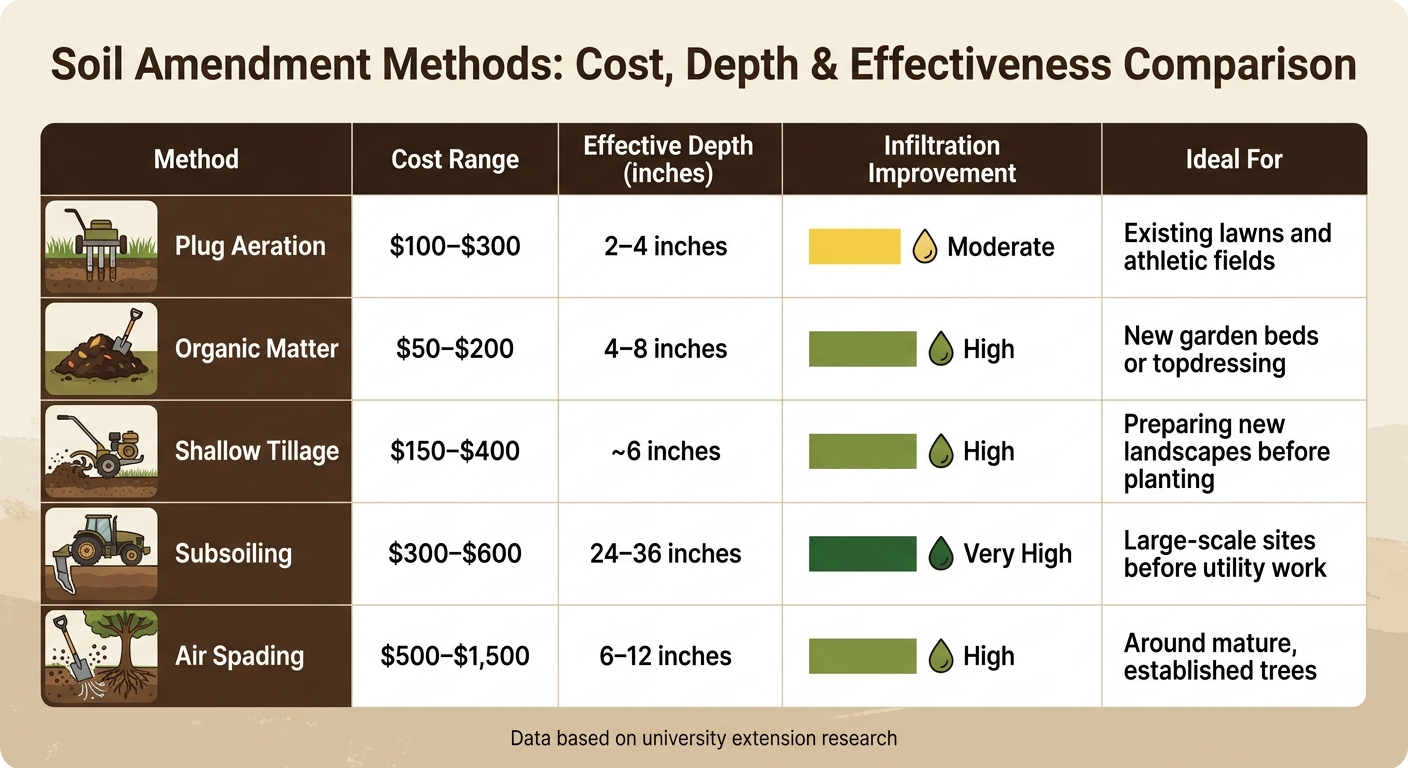
Soil Amendment Methods Comparison: Cost, Depth, and Effectiveness
Soil amendment methods differ based on factors like cost, depth of impact, and their ability to improve water infiltration. Using research from university extension programs, the following table highlights how common techniques measure up in these areas, along with their ideal applications.
| Method | Cost Range | Effective Depth (inches) | Infiltration Improvement | Ideal For |
|---|---|---|---|---|
| Plug Aeration | $100–$300 | 2–4 | Moderate | Existing lawns and athletic fields |
| Organic Matter | $50–$200 | 4–8 | High | New garden beds or topdressing |
| Shallow Tillage | $150–$400 | ~6 | High | Preparing new landscapes before planting |
| Subsoiling | $300–$600 | 24–36 | Very High | Large-scale sites before utility work |
| Air Spading | $500–$1,500 | 6–12 | High | Around mature, established trees |
According to UF/IFAS Extension, subsoiling is unmatched for breaking through hardpan layers. However, it’s rarely practical in urban areas because of potential conflicts with buried utilities and established plants [3].
For most homeowners, a mix of shallow tillage and organic matter strikes the right balance between affordability, safety, and effectiveness. On the other hand, for established lawns, plug aeration is a safer option, although it needs to be done annually to maintain results.
Interestingly, compacted soil requires 10 to 16 times the energy to till compared to healthy soil [2]. This makes prevention a smart long-term strategy. Practices like improving drainage, minimizing heavy traffic, and regularly adding organic matter can reduce compaction issues, saving both effort and money over time.
This comparison highlights how tailored methods can effectively address soil compaction while promoting healthier landscapes.
Conclusion
Soil compaction can severely restrict water infiltration and negatively impact plant growth. When soil becomes compacted, pore spaces shrink, making it harder for water to penetrate and increasing the risk of pollutant runoff. As Jon Traunfeld from the University of Maryland Extension wisely points out:
Evaluating your soil and making necessary adjustments and improvements prior to planting will save you time and money and result in a healthier landscape [4]
Thankfully, compaction is both preventable and fixable. Simple actions like avoiding soil work when it’s wet, adding organic matter, and keeping heavy foot or vehicle traffic away from planting areas can go a long way in maintaining healthy soil structure. For existing landscapes, methods such as plug aeration or mixing in compost can revive the soil’s ability to hold and absorb water. These steps not only cut down on the need for extra irrigation but also help prevent issues like root rot. For stubborn cases that don’t respond to basic fixes, more advanced solutions are available.
In situations of severe compaction, professional techniques such as air spading, deep subsoiling, or installing engineered drainage systems may be necessary. These specialized methods rejuvenate the soil, ensuring your landscape thrives over the long term. Restoring soil structure not only benefits plant health but also helps manage urban runoff and safeguards nearby waterways.
Pro Landscapes MD specializes in addressing soil challenges for properties in central Maryland. Their services include professional soil diagnostics, aeration, drainage system installation, and land leveling. With their expertise, they can tackle both surface and deep compaction issues while ensuring the protection of existing plants and the surrounding environment.
Taking action against soil compaction today can save you from bigger problems down the road. Healthy soil lays the groundwork for vibrant landscapes, improving plant vitality, water management, and the overall longevity of your outdoor spaces.
FAQs
How can I tell if my soil is compacted or just dry?
To figure out whether your soil is compacted or simply dry, there are a few telltale signs to watch for. Compacted soil typically feels dense, struggles to let water soak in, causes runoff, and makes it hard for roots to grow. On the other hand, if the soil crumbles easily in your hand and absorbs water without trouble, it’s probably just dry. Compacted soil limits the movement of water and air, while dry soil maintains its structure and allows water to penetrate.
How often should I aerate my lawn to prevent compaction?
Aerating your lawn once or twice a year can make a noticeable difference. It helps loosen compacted soil, allowing water to soak in more effectively and encouraging stronger root development. This simple step is key to keeping your lawn lush and thriving.
When should I call Pro Landscapes MD for drainage or soil help?
If you’re noticing hard soil, water pooling in your yard, struggling plants or grass, or trees and shrubs that seem to be declining, it might be time to call Pro Landscapes MD. These issues often point to soil compaction or drainage problems. Factors like heavy foot traffic, construction activity, or overuse of wet soil can make these problems even worse.
Pro Landscapes MD can help with services such as aeration, soil restoration, and installing drainage systems. These solutions are designed to improve soil condition and help water absorb properly, giving your landscape the boost it needs.
Chat with Us