









- bhavya gada
- No Comments
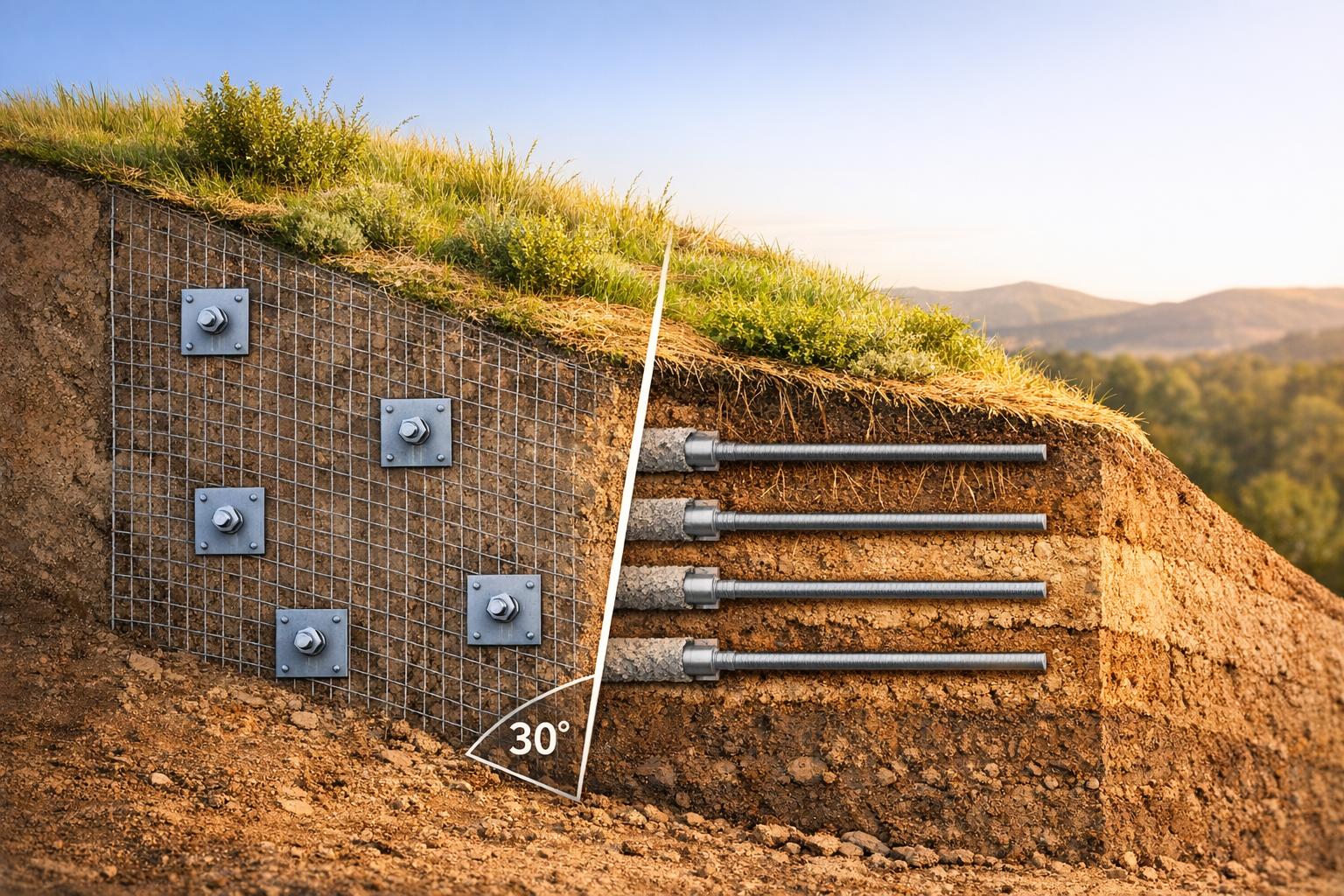
Soil nailing is a practical solution for stabilizing slopes and preventing erosion, especially for homeowners dealing with unstable landscapes. By driving steel bars (nails) into the ground, this method reinforces the soil, strengthens slopes, and minimizes surface erosion. Unlike retaining walls or extensive excavation, soil nailing is less disruptive and works directly on the existing slope.
Here’s the key takeaway:
- What it does: Stabilizes slopes by reinforcing soil with steel nails.
- How it works: Nails are installed at angles, compacting soil and preventing movement.
- Best use cases: Works well for residential slopes, protecting homes, driveways, and utilities.
- Types of nails: Driven, grouted, self-drilling, launched, and helical nails, each suited to specific soil conditions.
- Main benefits: Cost-effective, less invasive, and allows vegetation growth for a natural look.
For Maryland homeowners, soil nailing is particularly useful in areas prone to rain and erosion, offering a long-term solution to protect property and landscaping.
Soil Nailing Stabilizing Slopes Effectively
sbb-itb-843f8be
What Is Soil Nailing?
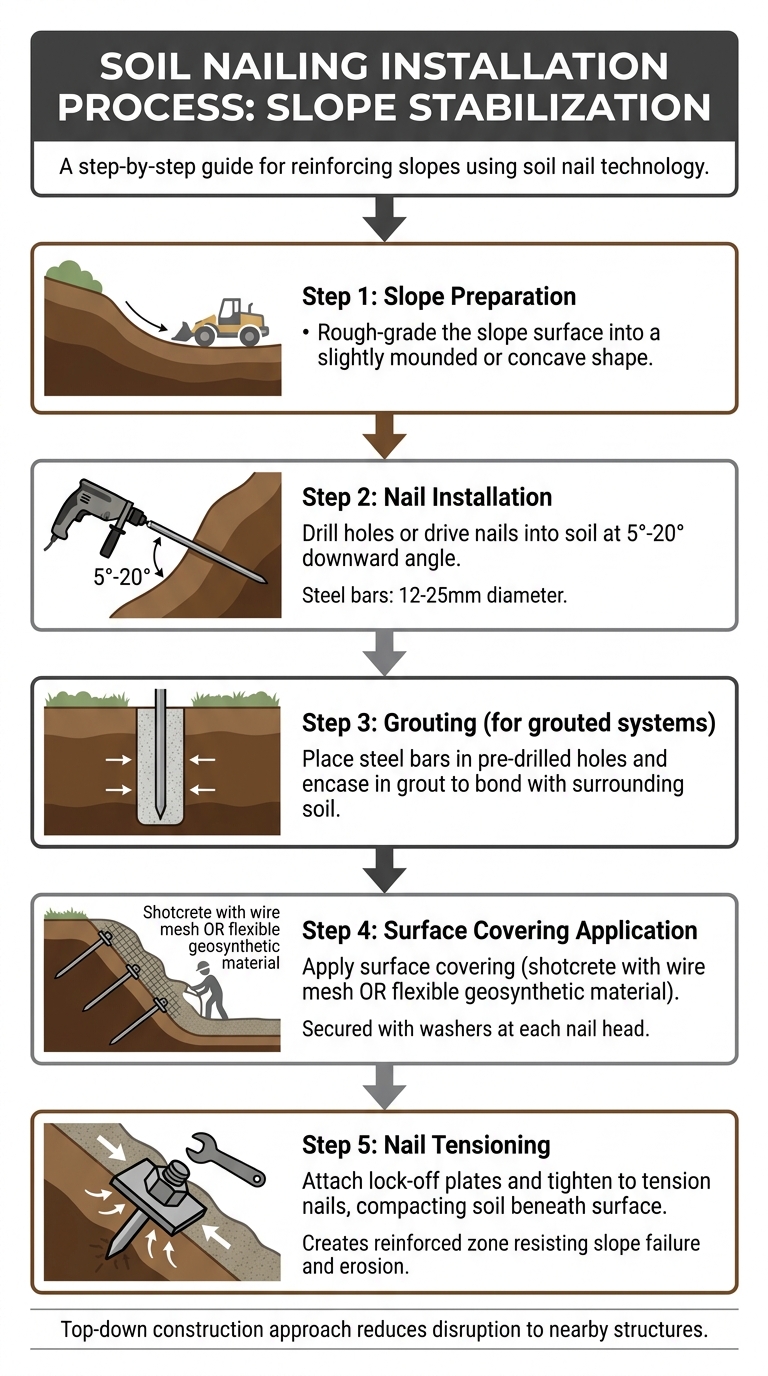
Soil Nailing Installation Process: 5 Steps to Slope Stabilization
For Maryland homeowners dealing with slope instability, soil nailing offers a reliable way to create safer and more visually appealing landscapes. This geotechnical method stabilizes slopes by embedding closely spaced steel bars – referred to as nails – into the ground. These nails function similarly to rebar in concrete, improving the soil’s shear strength and tensile stability [2][4]. While particularly effective in granular soils, soil nailing can also be used in cohesive and noncohesive materials [1].
The nails are installed beyond the natural slip surface of the slope. Once in place, they resist being pulled out by relying on friction between the nail and the surrounding soil, effectively anchoring unstable layers to the stable ground beneath [2]. Typically, the steel bars used range from 12 mm to 25 mm in diameter and are inserted at a downward angle of 5° to 20° from horizontal for optimal performance [2][5].
One of the key advantages of soil nailing for residential properties is its top-down construction approach. Instead of excavating the entire slope all at once, crews stabilize it in sections, starting at the top and working downward [2]. This method reduces disruption to nearby homes, utilities, and landscaping – an important benefit in suburban areas where slopes often sit close to driveways, gardens, and other structures. With this foundation in mind, let’s break down the step-by-step process of soil nailing.
The Soil Nailing Process
The installation process is straightforward but requires precision. First, the slope is rough-graded to prepare the surface, often giving it a slightly mounded or concave shape [2]. Next, crews drill holes or directly drive nails into the soil. For grouted systems, steel bars are placed in pre-drilled holes and encased in grout, which bonds the nails to the surrounding ground [2].
After the nails are installed, a surface covering is added to protect the slope and evenly distribute forces. Traditional methods use reinforced shotcrete – a spray-applied concrete layer with a welded wire mesh and lock-off plates at each nail head [2]. For residential projects, modern alternatives like flexible geosynthetic materials are becoming more popular. These coverings are unrolled from the top of the slope, pinned at the edges, and secured with washers at each nail head [2].
The final step involves tensioning the nails. Crews attach a lock-off plate and nut assembly to each nail head, tightening it to slightly pull the nail. This action compacts the soil beneath the surface covering, creating a reinforced zone that resists both deep-seated slope failures and surface erosion [2].
Various installation methods have been developed to address different challenges at construction sites.
Types of Soil Nailing Systems
The choice of soil nailing system depends on the soil conditions and site-specific constraints. Here’s a breakdown of the main types:
- Driven Nails: Installed using impact hammers, jetting, or compressed air, these nails are ideal for quick installation across a variety of soil types [2].
- Grouted Nails: Inserted into pre-drilled holes and encased in grout, these are best for rocky or cohesive soils where the hole remains stable during installation [4].
- Self-Drilling Nails: These hollow bars drill and grout simultaneously, making them suitable for loose or saturated soils where hole collapse is a concern [4].
- Launched Nails: Fired into the ground at high speeds using compressed air, these nails are effective for loose soils requiring rapid reinforcement. They can achieve shear capacities up to 20% of their axial pullout capacity [4].
- Helical Nails: Screwed into the soil rather than driven or grouted, these provide excellent pullout resistance with minimal vibration [1][2].
| Nail Type | Installation Method | Best Use Case |
|---|---|---|
| Driven Nails | Impact hammer, jetting, or compressed air | Quick installation in various soil types [2] |
| Grouted Nails | Pre-drilled holes filled with grout | Rocky or cohesive soils [4] |
| Self-Drilling Nails | Drills and grouts simultaneously | Loose or unstable soils [4] |
| Launched Nails | Fired into the ground at high speeds | Loose soils needing rapid stabilization [4] |
| Helical Nails | Screwed into the soil | Low-vibration applications [1][2] |
How Soil Nailing Prevents Erosion
Soil nailing tackles erosion through two main mechanisms: deep reinforcement, which stabilizes slopes and prevents large-scale failures, and surface protection, which shields the topsoil from being washed away by water. Together, these methods make soil nailing a go-to solution for Maryland homeowners dealing with erosion issues.
Reinforcing Slope Stability
Soil nails act as passive reinforcement tools – they don’t actively stabilize the slope until movement begins. When soil starts to shift, the nails generate tensile forces that anchor the unstable soil to a more stable layer [2]. As Robert M. Koerner, Director Emeritus of the Geosynthetic Institute, explains:
"The method uses soil nails or soil anchors connected to a geosynthetic surface covering which is tensioned thereby stabilizing the encapsulated soil and providing tensile reinforcement" [2].
Additionally, soil nails bend under pressure, which provides extra shear resistance. As the soil tries to move, the nails create shear force and resisting moments, increasing the slope’s ability to resist displacement [2]. This interaction relies heavily on factors like soil friction, grouting pressure, and the texture of the nail surface [1][3].
When paired with a tensioned surface covering, soil nails can also enhance the soil’s shear strength by compacting or consolidating it. For example, in a 1986 project in Upper Merion, Pennsylvania, a failing silty clay slope was stabilized using a nailed geosynthetic system. By increasing the soil’s friction angle from 20° to 23° and boosting cohesion from 9.5 to 11 kN/m², the team improved the Factor of Safety by 30%, raising it from 0.95 to 1.24. This transformed an unstable slope into a stable one that has remained intact for over three decades [2]. This compaction effect is achieved by tensioning the surface covering against the nail heads, compressing the soil into a denser, more stable form.
While deep reinforcement stabilizes the slope’s core, surface protection is equally important for preventing erosion caused by water.
Surface Erosion Control
Deep stabilization handles soil movement, but the surface covering plays a crucial role in protecting against water erosion. For properties with severe runoff, custom drainage solutions may be required alongside soil nailing. Without this layer, rainwater can strip away topsoil and weaken the bond between the soil and nails, potentially undermining the entire system [1][2]. Traditional shotcrete creates a hard, impermeable surface, but modern geosynthetic coverings offer a more adaptable alternative. These coverings not only prevent erosion but also allow vegetation to grow, adding an extra layer of natural stability.
The installation process involves unrolling the geosynthetic material from the top of the slope to the bottom and securing it with lock-off plates at each nail head. Tensioning the covering immediately densifies the soil and forms a continuous barrier that stops rainfall from seeping into the slope. It also evenly distributes forces across the reinforced area [2], addressing both surface and subsurface erosion in one cohesive system.
Research Findings on Soil Nailing Performance
Recent studies highlight the effectiveness of soil nailing in stabilizing slopes and controlling erosion, especially in residential landscapes. These findings provide valuable insights into how this technique performs under various conditions.
Case Studies in Slope Stabilization
Several projects demonstrate the adaptability of soil nailing to different environments. One notable example took place along the Kaministiquia River in Canada in January 2006. Led by Mike Fabius of the Deep Foundations Institute, the project stabilized a 100-foot urban slope that posed a risk to nearby structures. The team used 1.4-inch diameter nails, extending up to 40 feet long, arranged in a 3-to-5-foot grid. Instead of traditional drilling and grouting, they opted for light equipment to drive the nails directly, significantly reducing costs. Post-construction monitoring confirmed the slope achieved a safety factor of 1.3 with a 75-year design life. Fabius remarked:
"The key to keeping costs low proved to be installation with light equipment working on the slope, and driving the nails without drilling or grouting" [6].
Another example comes from December 2024, when researchers studied the Boualma slope in Morocco’s Middle Rif region. This landslide-prone area near Al Hoceima presented unique challenges due to seismic activity. The study revealed that nail inclination and length are critical, especially in earthquake-prone zones where dynamic loads increase stress on the reinforcement system [1]. These findings offer valuable lessons for applying soil nailing in regions like Maryland.
In Seputeh, Kuala Lumpur, Malaysia, researchers tackled a 50° slope at Persiaran Endah. Shamsan Alsubal, Indra S. H. Harahap, and Nuraddeen Muhammad Babangida found that precise nail spacing and angulation are essential. They observed that increasing the spacing between nails reduced stability, while steeper slopes required nails angled closer to horizontal [5].
These case studies emphasize the importance of tailoring soil nailing designs to specific geotechnical conditions for optimal performance.
Geotechnical Considerations and Limitations
The effectiveness of soil nailing depends heavily on soil conditions, with water saturation being one of the most significant challenges. Hammouti Marwane from Abdelmalek Essadi University explains:
"Water saturation of the soil reduces friction at the soil-nail interface, compromising overall slope stability" [1].
This makes drainage systems a crucial component of any soil nailing project. Without proper drainage, water can weaken the bond between the soil and nails, leading to potential failure.
Other factors, such as bond length and nail spacing, also play a critical role. The bond length behind the slip surface must be adequate to allow nails to reach their full load-bearing capacity [5]. If nails are too short or improperly spaced, they won’t engage enough stable soil to resist movement. Research indicates that nail length has a greater impact on deep-seated slip surfaces, while shallow failures are more influenced by correct spacing and inclination [5]. For residential slopes, where shallow instabilities are common, focusing on proper spacing and nail angles is often more effective than using excessively long nails.
Additionally, many slope failures begin in the lower portion of the hill [4], highlighting the need for thorough site assessments to identify and address these vulnerable areas. These geotechnical considerations underline the complexity of soil nailing and the importance of adapting designs to meet site-specific challenges.
Benefits and Applications of Soil Nailing
Soil nailing is a practical solution for stabilizing slopes, offering a balance of efficiency and minimal disruption. It’s cost-effective and quicker to install compared to traditional retaining walls [4]. Because the process stabilizes soil in place (in-situ), it avoids major disruptions to existing structures, utilities, or landscaping [2]. This makes it an excellent choice for suburban areas where heavy equipment could damage property or disturb gardens and trees.
Pros and Cons Comparison
Weighing the pros and cons of soil nailing helps homeowners and engineers determine its suitability for specific projects.
| Advantages | Limitations |
|---|---|
| More affordable than excavation and reconstruction [4] | Best suited for granular soils; not effective in all soil types [1] |
| Quick to install with minimal site impact [2] | Ineffective in areas with high groundwater or saturated conditions [1] |
| Adaptable to various slope angles [5] | Requires precise nail spacing and angle for optimal results [5] |
| Can support vegetation for a natural look [2][6] | Needs specialized geotechnical design and safety evaluations [5] |
Proper design is critical for soil nailing to perform well. As Robert M. Koerner from the Geosynthetic Institute explains:
"The method falls into the category of ‘ground modification,’ aka soil nails or soil anchors, with the addition of a surface geosynthetic or other flexible covering" [2].
This adaptability allows for "green" facings that encourage plant growth, offering a more natural appearance compared to rigid shotcrete surfaces. This feature makes soil nailing especially appealing for residential areas, where aesthetics matter as much as functionality.
Applications in Residential Landscaping
Beyond its engineering benefits, soil nailing is ideal for stabilizing minor slope instabilities that can threaten homes, driveways, or property boundaries [2]. It’s particularly effective for areas near utility poles, signs, or mature trees where excavation would be disruptive or impractical.
However, moisture management is vital for long-term success. Since water saturation reduces the friction between soil and nails [1], incorporating proper drainage systems is essential to maintain stability over time. This combination of soil nailing and drainage ensures a durable solution for residential landscapes.
Pro Landscapes MD: Local Expertise in Slope Stabilization

Central Maryland’s unique terrain presents property owners with challenges like steep slopes and persistent stormwater runoff. Pro Landscapes MD tackles these issues head-on by combining advanced soil nailing techniques with integrated drainage systems, ensuring effective erosion control and slope stability throughout the region.
Custom Solutions for Maryland Properties
Pro Landscapes MD takes soil nailing to the next level by tailoring it to Maryland’s specific conditions. They start with detailed site assessments, using tools like soil sampling and 3D imaging to understand the soil’s characteristics before deciding on the right anchors [4]. This attention to detail is especially important in areas prone to water saturation, which can compromise the soil-nail connection.
The company doesn’t stop at soil nailing. They incorporate a range of drainage solutions – like French drains, stormwater management, grading, and land leveling – to create a cohesive system. By ensuring that nails, surface attachments, and spacing work seamlessly together, they maximize the stability and effectiveness of their projects [2]. For properties near sensitive areas like mature trees, utilities, or nearby structures, Pro Landscapes MD uses compact 3–4 ton excavators that deliver the necessary power with minimal disruption [4].
This approach ensures that every project is designed to meet the specific needs of the site.
Client Success Stories
Homeowners in cities like Ellicott City, Potomac, Columbia, and Bethesda consistently commend Pro Landscapes MD for their technical expertise and eye for design. By blending slope stabilization with thoughtful landscape design, they not only control erosion but also enhance the visual appeal of outdoor spaces. These success stories highlight how locally adapted soil nailing can improve both the stability and beauty of Maryland properties, creating landscapes that are as resilient as they are attractive.
Conclusion
Soil nailing has established itself as a reliable method for stabilizing slopes and preventing erosion in residential settings. By acting as internal reinforcement – similar to how rebar strengthens concrete – it provides structural stability through three main processes: reinforcement, compaction, and controlling surface erosion [2].
To ensure success, technical precision is key. This includes setting the correct nail inclination (typically between 10° and 20° from horizontal), proper spacing, and sufficient nail length. Additionally, surface coverings must be properly tensioned to compact the soil and boost shear strength [2][5]. As highlighted by Springer Nature, "Soil nailing is a proven technique used to stabilize various types of soils, whether cohesive or noncohesive, with particular effectiveness in granular soils" [1]. Achieving these results requires careful site evaluations, accurate geotechnical modeling, and effective drainage systems to mitigate water saturation, which can weaken the soil-nail connection [1][4].
For homeowners in Maryland dealing with slope instability, combining soil nailing with robust drainage solutions offers a dependable, long-term fix. Pro Landscapes MD exemplifies how tailored techniques, backed by in-depth site assessments and years of expertise, can turn unstable slopes into safe, visually appealing landscapes. This integrated approach not only safeguards properties but also maintains their value and safety for central Maryland communities.
FAQs
Do I need a soil test before soil nailing?
Absolutely. Conducting a soil test is a key step before starting any soil nailing project. It helps determine the properties of the soil, such as its strength, composition, and stability. These insights provide the essential design parameters needed to ensure the slope stabilization process is both effective and reliable. Skipping this step could compromise the long-term erosion control and structural soundness of the project.
Will soil nailing work if my slope stays wet or has runoff?
Soil nailing tends to be less effective on wet slopes or areas with significant runoff because excess moisture can weaken the bond strength and compromise stabilization. That said, implementing proper drainage systems and waterproofing techniques can address these issues, helping to maintain the system’s performance.
How long does a soil nailing system typically last?
A soil nailing system is generally designed to remain effective for about 75 years. For instance, in a slope stabilization project in Canada, 40-foot-long soil nails were used to ensure a 75-year design lifespan. This highlights how soil nailing can provide a reliable, long-term solution for stabilizing slopes.
Chat with Us