









- bhavya gada
- No Comments
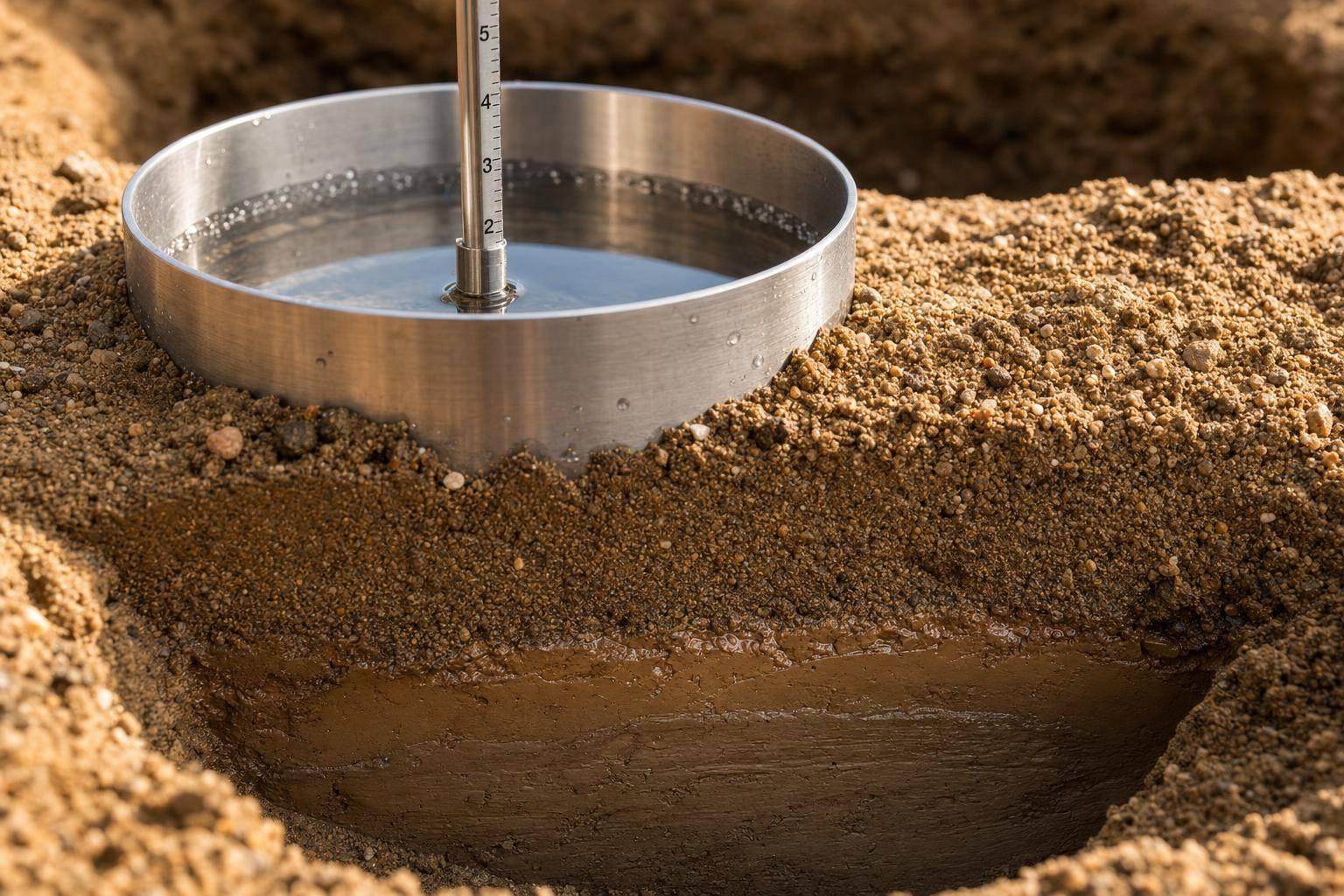
If you want an underground detention system to work, the soil has to match the design. In plain terms: sand often supports infiltration, loam sits in the middle, silt and clay usually need detention-only layouts, and disturbed urban soils need field testing before you trust anything on paper.
I’d boil the article down to this:
- Sandy and loamy sand soils often drain at more than 0.5 in/hr, so they may store runoff and let some soak in.
- Loam and sandy loam soils can go either way, so site testing decides whether infiltration works.
- Silt and silt loam soils usually drain too slowly for infiltration and tend to fit controlled-release detention.
- Clay and clay loam soils are usually too tight for soak-in systems, so they rely on orifices or weirs instead.
- Mixed or disturbed urban soils can hide fill, weak pockets, or contamination, which makes test pits, borings, and infiltration tests a must.
A few numbers matter right away:
- Many designs use 6 inches of clean stone bedding
- A common setback is 10 feet from buildings or property lines
- Systems should usually drain within 72 hours
- Chamber systems may cost about $12–$20 per cubic foot
- Precast vaults may cost about $20–$40 per cubic foot
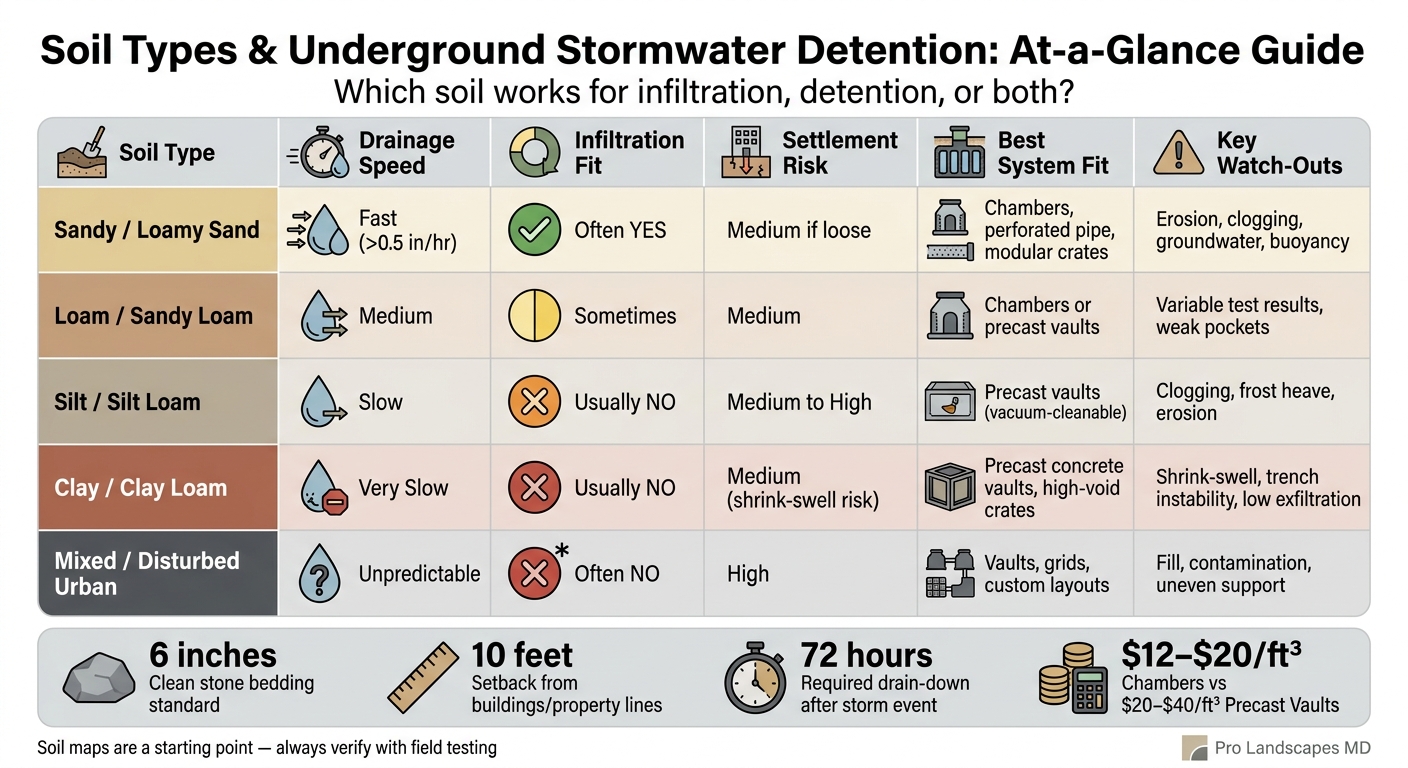
Soil Types for Underground Stormwater Detention: Quick Comparison Guide
Stormwater Dentention & Infiltration Solutions to Optimize Land Use
sbb-itb-843f8be
Quick Comparison
| Soil type | Drainage | Infiltration fit | Settlement risk | Common system fit | Main watchouts |
|---|---|---|---|---|---|
| Sandy / Loamy Sand | Fast | Often yes | Medium if loose | Chambers, perforated pipe, crates | Erosion, clogging, groundwater, buoyancy |
| Loam / Sandy Loam | Medium | Sometimes | Medium | Chambers or vaults | Variable test results, weak pockets |
| Silt / Silt Loam | Slow | Usually no | Medium to high | Vaults | Clogging, erosion, frost heave |
| Clay / Clay Loam | Very slow | Usually no | Medium | Precast vaults, crates | Shrink-swell, trench stability, low exfiltration |
| Mixed / Disturbed Urban | Unpredictable | Often no | High | Vaults, grids, custom layouts | Fill, contamination, uneven support |
So before I’d choose any underground detention setup, I’d focus on three things first: how fast water moves through the soil, whether the base can hold the load, and how the system will be cleaned later.
1. Sandy and Loamy Sand Soils
Infiltration and Exfiltration
Sandy and loamy sand soils are some of the most permeable soils in central Maryland, especially in the Coastal Plain. In many cases, infiltration rates are above 0.5 inches per hour, which means an underground detention system can often do two jobs at once: store stormwater and let part of it soak into the ground [2].
That matters because the system may cut runoff volume, not just slow peak discharge [2]. If the native soil is permeable, infiltration can work well. If the soil is not, the system needs a liner.
There’s a tradeoff, though. Soil that drains fast can also bring groundwater and buoyancy problems. An empty vault or chamber can float if it isn’t designed for saturated conditions. That’s why groundwater conditions need to be checked before using an infiltration-based layout [2].
Bearing and Settlement
These soils drain well, but they don’t always give strong support. If the sand is loose or has been disturbed during site work, settlement can become a problem.
A common fix is simple: place the system on 6 inches of clean, washed stone over a stable base [1]. If there are loose pockets, over-excavate them and replace them with compacted fill [1]. It also helps to install geotextile between the storage bed and the native sand so fines don’t migrate into the system [1].
Construction and Erosion Risk
Sandy soils are usually easy to dig, but they can also be easy to wreck during construction. Sediment can move fast, and once it gets into the system, performance drops.
Strict erosion and sediment controls should be in place from day one. Construction runoff should be kept out of the excavation until the site is stabilized [1]. Pretreatment is also a big deal here. A sediment or grit chamber upstream helps stop debris before it reaches the storage media [1].
Best Detention System Fit
In sandy and loamy sand soils, common choices include:
- Chamber systems
- Perforated pipe in a stone bed
- Modular crate systems [2]
These soils are often a good match for infiltration-based systems when groundwater is low and contamination risk is limited. But when exfiltration is unsafe, a lined detention system makes more sense.
If groundwater contamination or chemical spill risk is a concern, line the system with an impermeable membrane and use a controlled outlet instead of exfiltration [1]. Also keep a 10-foot setback from foundations and property lines [1].
As soil fines increase, infiltration rates fall. At that point, the design usually shifts from infiltration-based detention to detention-only.
2. Loam and Sandy Loam Soils
Infiltration and Exfiltration
Loam and sandy loam fall in the middle. They’re not as free-draining as sand, and they’re not as tight as fine-grained soils.
That middle ground can make design a little tricky. Drainage rates can vary a lot from one site to the next, so site-specific testing is a must. Sandy loam is more likely than loam to meet the 0.5 in/hr threshold, but neither soil should be assumed to pass without testing. In the Piedmont, seasonal high groundwater can also cut into usable storage. So even if drainage looks good on paper, groundwater may change what the system can actually do.
Drainage isn’t the only issue, either. Soil support and sediment control still play a big role in whether the system works as planned.
Bearing and Settlement
After infiltration is verified, the next thing to check is subgrade stability.
Loam and sandy loam can include weak pockets in the subgrade. If those areas are left in place, settlement can become a problem later. In many cases, that means over-excavation and replacement before the system goes in. Geotextile separation should also be used to keep fines from moving into the storage bed.
In these soils, support risk can matter just as much as infiltration. A site may drain well enough, but if the base can’t carry the load, the design still has a problem.
Construction and Erosion Risk
Loam tends to erode easily during construction and can shed fines into exposed detention beds. That’s a fast way to reduce system performance.
Sediment control matters early, not after the damage is done. Sumped inlets or grit chambers upstream can help keep sediment from getting into the system [1].
Best Detention System Fit
When drainage test results and load demands point in different directions, the system type should follow the weaker condition. That’s the safe way to think about it.
Sandy loam with verified infiltration is a good match for chamber systems that provide detention volume and groundwater recharge [2]. If loam falls below the infiltration threshold, or if the system sits under a driveway or another heavy-load hardscape, a precast concrete vault is the better option. It can support H-20 traffic loading and can be reached for vacuum cleaning if sediment builds up [1] [2].
Subsurface detention systems should also be designed to drain down within 72 hours after a 24-hour storm event [1]. In practice, sandy loam may support infiltration, while loam often pushes the design toward detention-only storage.
3. Silt and Silt Loam Soils
Infiltration and Exfiltration
Compared with loam, silt and silt loam usually push a project out of the gray area and into detention-only design. These soils drain slowly, so infiltration usually isn’t a good option. In most cases, they work better with detention-only systems that use controlled release. The 72-hour drain-down requirement after a 24-hour storm event still applies [1].
Bearing and Settlement
Silt is a weak subgrade material, and it can settle after excavation. The standard fix is to over-excavate and replace the area with 6 inches of stone bedding beneath the system [1]. That risk doesn’t stay on paper. It shows up during construction too. If the base isn’t stabilized first, erosion and sediment can get into the system before it’s even in service.
Construction and Erosion Risk
With silt, keeping fine particles out of the storage layer is a big deal. Geotextile wrapping around stone storage beds is required so silt doesn’t move into the void spaces. The standard is AASHTO Class 1 or Class 2 polypropylene fabric with a minimum 16-inch overlap [1].
Upstream pretreatment should also be part of the plan. A sediment trap or grit chamber helps stop fine particles before they enter the storage area [1].
"Stone must be separated from soil media by a geotextile or a pea gravel filter to prevent sand, silt, and sediment from entering the system." – Philadelphia Water Department [1]
Best Detention System Fit
Because silt settles easily and can clog storage, vault systems are usually the best match. They have one big edge over stone storage beds: they can be vacuum-cleaned from time to time to restore capacity [1]. Plastic grid systems can also work, but only if maintenance access is in place and the manufacturer’s limits have been checked [1]. Stone storage beds are the hardest to rehab and usually the weakest choice in these soils [1].
Clay and clay loam are even tighter, so exfiltration becomes less dependable.
4. Clay and Clay Loam Soils
Infiltration and Exfiltration
Clay and clay loam soils are usually too tight for infiltration-based detention. In practice, that means these systems need a controlled outlet instead of depending on water to seep into the ground.
Drawdown is handled with orifices or weirs, not soil seepage.
Bearing and Settlement
Clay can shift or behave poorly under load, so storage components should sit on at least 6 inches of clean, washed stone bedding, such as AASHTO No. 3 or No. 57, to help stabilize the base [1]. If excavation exposes loose or unstable material, over-excavation and replacement with stable fill may be needed before installation [1].
A 10-foot setback from buildings and retaining walls is standard. If that distance can’t be met, a signed and sealed geotechnical analysis is required to review how the excavation could affect nearby foundations [1]. Systems in clay areas must also be designed for H-20 loading, especially beneath parking lots or places that may carry emergency vehicle traffic [2] [1].
Construction and Erosion Risk
Deep excavations in clay need shoring and sheeting to keep trench walls stable during construction [1]. Clay soils also tend to move sediment, so runoff should be directed away from the storage area until the system is fully enclosed.
Upstream pretreatment helps here. Common options include:
- Sumped inlets
- Grit chambers
These measures help keep fines out of the storage bed [1].
Geotextile separation with AASHTO Class 1 or Class 2 material is required around stone storage so fines don’t migrate into the void spaces [1]. If clay is interrupted by fill or disturbed subgrade, don’t rely on a soil map alone. The next step is site-specific testing.
Best Detention System Fit
Precast concrete vaults are often the better fit in clay soils because they can be built as watertight units with their own structural strength, and they’re easier to clean with vacuum equipment [1] [2]. Stone storage beds usually don’t work well in clay. Sediment can build up in the voids, and once it gets in, removal is difficult [1].
In clay soils, precast concrete vaults and high-void modular crates usually fit best because they pair structural capacity with easier maintenance. If the clay profile is broken up by fill, lenses, or disturbed subgrade, move to site-specific testing before choosing the system.
5. Mixed, Layered, and Disturbed Urban Soils
In central Maryland, urban soils are often messy below the surface. You might see fill placed over saprolite in the Piedmont, or disturbed ground over unconsolidated sediments in the Coastal Plain. And that’s where problems start. Hidden layers can lead to settlement and drainage issues that a standard soil map may not show. In these cases, the soil profile matters more than the mapped soil name.
Infiltration and Exfiltration
Disturbed urban soils are often a poor match for infiltration. Compaction, contamination, and unstable fill can make permeability hard to predict. In plain terms, water may not move the way the plans suggest.
That usually pushes the design toward detention-only systems. If contamination or highly unstable fill is a concern, an impermeable liner helps keep stormwater from mixing with the surrounding soil matrix. Once infiltration is off the table, the focus shifts to the subgrade: Can it support the storage structure without trouble?
Bearing and Settlement
Settlement is the main structural issue in disturbed soils. Fill may be loose, unevenly compacted, or just plain unstable. Excavation can also expose weak material that wasn’t obvious at the surface.
Because of that, over-excavation and replacement of unstable subgrade may be needed before installation. Backfill should then be placed in 6- to 8-inch lifts and lightly compacted to limit added disturbance. The standard 10-foot setback from buildings and retaining walls still applies unless a geotechnical analysis shows that a smaller distance will work [1].
Construction and Erosion Risk
Urban sediment is a headache for storage systems because it clogs void space and cuts performance. That’s why pretreatment and erosion control are required.
A few jobsite basics matter here:
- Direct runoff away from open excavation.
- Install sumped inlets or sediment chambers before the system begins receiving flow.
- Keep temporary erosion controls in place until the contributing drainage area is stabilized.
That structural risk is one reason cleanable, self-supporting systems often make more sense on urban sites.
Best Detention System Fit
Different systems fit different site limits. Concrete or fiberglass vaults work well where fill is unstable and setbacks are tight. Plastic grids fit smaller footprints. Stone storage belongs on stable subgrade. Pipe-and-chamber systems work well where the layout needs to flex, especially in high-traffic areas.
For stone storage, separation from surrounding soil is still important. Use geotextile or a pea gravel filter, and AASHTO Class 1 or Class 2 material can be used for that separation [1].
Tradeoffs, Design Implications, and Pros and Cons by Soil Type
Each soil type comes with its own tradeoff. Sand leans toward infiltration. Loam gives you a middle ground between drainage and support. Silt and clay, on the other hand, usually push the design toward controlled discharge instead of soak-in performance.
That matters a lot in central Maryland, where underground detention systems often need to fit under patios, driveways, and retaining walls. In that kind of setup, soil doesn’t just shape drainage strategy. It also affects layout and structural loading.
Sandy soils are a good fit for infiltration, but they need tight sediment control. If fines get into the stone bed, performance can drop fast. Loams tend to offer a better balance of drainage and support, though compaction during construction can hurt that balance if the site isn’t managed carefully.
Clay brings a different set of problems. Shrink-swell movement is a long-term structural risk. As moisture levels change with the seasons, clay can expand and contract, which puts stress on joints over time. Flexible joints and impermeable liners can help, but they also add cost. Silt creates its own headaches too, especially frost heave, erosion, slow drainage, and clogging. That’s why underdrains and erosion-control measures are often built into the design.
If the native soil is permeable, the system may support infiltration. If the soil is impermeable, the design usually needs a liner and a controlled discharge outlet.
Here’s the soil-by-soil tradeoff summary.
| Soil Category | Main Advantages | Main Disadvantages | Typical Mitigation Measures | Suitability for Underground Detention |
|---|---|---|---|---|
| Sandy / Loamy Sand | High infiltration rates; reduces required storage volume | Erosion-prone; fine particles can clog stone beds | Geotextile wrapping; pea gravel filters; bank stabilization | High – ideal for infiltration-focused systems |
| Loam / Sandy Loam | Balanced drainage and bearing strength | Compaction during construction reduces performance | Deep ripping/aeration; strict construction traffic control | High – works well for hybrid infiltration/detention |
| Silt / Silt Loam | Moderate bearing strength when dry | Frost heave; erosion risk; slow drainage; clogging | Underdrains; pretreatment; controlled outlets | Moderate – detention-focused; needs drainage support |
| Clay / Clay Loam | High load-bearing capacity when dry | Very low infiltration; shrink-swell stresses joints; buoyancy risk | Impermeable liners; buoyancy anchors; flexible joints | Low – storage-only |
| Mixed / Disturbed Urban | Often near existing infrastructure | Unpredictable bearing strength; potential contamination; highly variable | Over-excavation; replacement with structural fill; impermeable liners; site-specific engineering | Variable – requires soil testing and custom design |
Cost shifts with soil too. Chamber systems like StormTech run about $12–$20 per cubic foot of storage, while precast concrete vaults run about $20–$40 per cubic foot [2]. In clay or disturbed urban soils, liner installation and over-excavation can push pricing up quite a bit.
Across all soil types, the final design usually comes down to three things: permeability, structural support, and maintenance access.
Conclusion
Across every soil type, the same three things drive the design: permeability, support, and access for maintenance. In Maryland, loams and sandy loams often hit the sweet spot for underground detention because they balance drainage and structural support. Sandy soils tend to work well for infiltration. Silt and clay usually push projects toward detention-only systems. And disturbed urban soils? Those often need site-by-site fixes before you can trust the design.
So the soil name alone doesn’t tell the whole story. What matters more is the measured site profile.
One point applies across the board: a soil map is a starting point, not a final answer. An NRCS soil map will not show where the groundwater table sits, whether the soil has been disturbed, or whether the soil can meet the 72-hour drain-down requirement. Maps help with early screening, but field testing is what guides design [1].
That is why geotechnical evaluation should come first for any dependable design. For central Maryland projects, site-specific geotechnical evaluation needs to happen before final design. Pro Landscapes MD designs stormwater and drainage solutions based on actual site conditions.
FAQs
How do I know if my soil can support infiltration?
You’ll need a site-specific review of soil and subsurface conditions. Pros usually use test pits or soil borings to check percolation rates and look at soil porosity, depth to bedrock, and the seasonal high-water table.
Infiltration usually isn’t feasible in soils with poor porosity, high clay content, restricted drainage, or groundwater that’s too close to the system.
When is a detention-only system the better choice?
A detention-only system makes more sense when land is tight or too expensive for an open-air detention basin. It also fits sites where local zoning rules don’t allow surface water features.
It’s often the go-to option when the system needs to sit under parking lots, roads, or buildings. The same goes for sites where infiltration won’t work because of high groundwater, poor soil porosity, or other limits on the property.
Why is field testing more important than a soil map?
Field testing matters more because soil maps only give you a broad picture. They can point you in the right direction, but they don’t tell you what’s happening under your site.
Direct testing fills in that gap. It can confirm the actual depth to the water table and bedrock, measure percolation rates for 24-hour drainage, and spot local problems like compaction or saturation. Those details affect performance, structural integrity, and compliance.
Chat with Us