









- bhavya gada
- No Comments
Maryland features a variety of soils, each with unique challenges for construction and landscaping. From sandy soils in the Coastal Plain to clay-heavy soils in the Piedmont and hydric soils in floodplains, understanding these differences is essential for durable designs. Subsurface testing – like soil sampling, infiltration tests, and test pits – helps identify potential issues and ensures proper drainage, stability, and long-term performance.
Key Takeaways:
- Coastal Plain Soils: Found in southern Maryland and the Eastern Shore. Sandy soils drain quickly but may shift under weight. Loamy soils are more stable but can hide drainage problems.
- Piedmont Soils: Common in central counties like Howard and Baltimore. Clay-rich soils expand and contract with moisture, risking settling and structural damage without proper preparation.
- Floodplain, Fill, and Hydric Soils: Found in low-lying areas and near rivers. These soils often have poor drainage, variable strength, and may require additional work like drainage systems or deeper foundations.
Why Subsurface Testing Matters:
- Prevents issues like sinking patios, bulging walls, and poor drainage.
- Identifies hidden risks like compacted layers, clay lenses, or high water tables.
- Guides design decisions for footings, bases, and drainage solutions.
Skipping these tests can lead to costly repairs, making them a smart investment for any project.
The Soils of Maryland
1. Coastal Plain Sandy and Loamy Soils
Maryland’s Coastal Plain spans about 45–50% of the state’s total land area, covering much of the Eastern Shore and southern Maryland. The soils in this region are shaped by ancient marine and river sediments – layers of sand, silt, and gravel that are very different from the clay-heavy soils found inland.
On elevated areas, the soils are generally sandy or sandy loam, which drain quickly but lack nutrients and are often acidic. In contrast, lower-lying or depressional areas feature loamy or silty soils, which retain moisture better, provide more nutrients, and are more fertile. These differences in soil types call for careful and specific design considerations.
Sandy soils, while quick to drain, can lose moisture quickly, which affects plant health. They can also shift under hardscape elements if not compacted properly. Loamy soils, on the other hand, retain moisture longer, support a broader range of plant life, and offer better stability for hardscaping. However, even these soils can hide challenges, such as buried clay lenses or organic-rich layers, which may cause unexpected drainage issues or uneven support for structures.
Important to note: Construction activities can compact soil significantly, reducing its infiltration capacity by up to tenfold compared to its natural state. A site that drains well before excavation might perform poorly afterward if compaction isn’t addressed. Post-construction infiltration testing is critical to ensure the soil still functions as expected before planting or paving begins.
Here’s a quick comparison of sandy and loamy soils:
| Aspect | Sandy Soil | Loamy Soil |
|---|---|---|
| Infiltration rate | High to very high | Moderate to high |
| Water-holding capacity | Low | Moderate |
| Natural fertility | Low (often acidic, nutrient-poor) | Moderate |
| Hydrologic soil group | Often A | Often B |
| Hardscaping risk | Settlement if undercompacted | Verify depth to seasonal water table |
| Key testing priority | Compaction, groundwater depth, infiltration | Buried clay/organic layers, drainage rate |
Recognizing these soil characteristics helps in selecting the right subsurface tests to ensure long-term stability. Common subsurface tests like test pits, hand augers, and shallow borings are essential for confirming soil conditions before finalizing designs. Infiltration and percolation tests are particularly crucial for determining the suitability of French drains, rain gardens, and permeable pavers. According to Maryland stormwater guidelines, infiltration-based practices typically require a rate of greater than 0.3 inches per hour to be effective. If shallow groundwater or perched water is detected during testing, subsurface drainage systems – such as those behind retaining walls or under patios – become a necessary inclusion in the design.
Pro Landscapes MD incorporates detailed on-site drainage evaluations into their hardscaping and drainage projects across central Maryland, ensuring the final construction is built to last and perform as intended.
2. Piedmont Clayey and Silty Soils
Maryland’s Piedmont region stretches across central counties like Howard, Montgomery, Carroll, Frederick, and Baltimore, where the soils have formed over millions of years from ancient crystalline bedrock. These soils are dense, with a mix of clay and silt, and feature a clay-enriched subsoil layer – known as an argillic horizon – that typically begins 12–24 inches below the surface. To ensure durable hardscape designs, understanding these soils through detailed subsurface testing is essential. Common soil series in this region include Glenelg, Manor, Elioak, Chester, and Bucks, many of which belong to Hydrologic Soil Group C or D. This classification indicates slow water infiltration and high runoff potential, especially when the ground is bare or compacted.
One of the biggest challenges with these soils is their shrink–swell behavior. The subsoil often contains 30–45% clay, giving it moderate to high plasticity. When wet, the soil expands and becomes sticky; when dry, it contracts and cracks. This movement makes proper drainage and deeper, well-compacted bases critical. Without these measures, patios, walkways, and driveways can experience uneven settling and paver joint separation over time. Retaining walls are also at risk, as saturated soil increases lateral pressure, potentially causing bulging or failure if the structure isn’t properly designed or drained.
Compared to Coastal Plain soils, Piedmont soils require more robust base designs. For example, a compacted crushed stone base of 8–12 inches (or more, depending on the load and test results) is often necessary. A geotextile separation layer is also important to keep fine particles from migrating upward and weakening the base. Retaining wall footings should extend below the local frost depth – around 30 inches in central Maryland – and rest on firm, undisturbed soil. Additionally, free-draining granular backfill and a perforated drain pipe at the base help alleviate hydrostatic pressure.
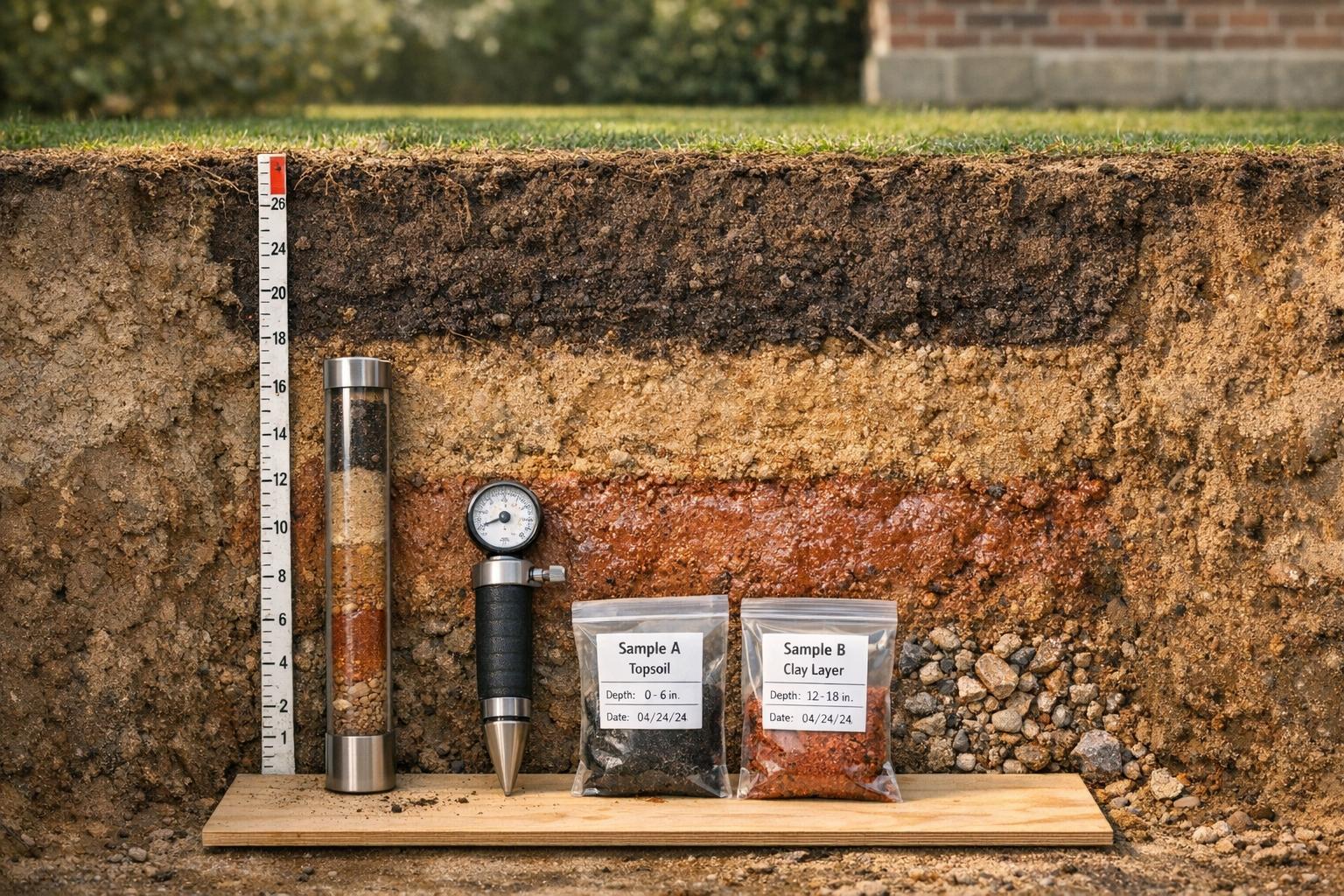
Subsurface testing plays a key role in tackling these challenges. Tools like hand augers or 3–5-foot test pits can reveal soil horizons, seasonal moisture levels, and the depth of saprolite. For drainage solutions, such as French drains or rain gardens, percolation tests often show that the slow permeability of Piedmont clays makes infiltration-only systems inadequate. For larger projects, lab testing for Atterberg limits (including liquid limit, plastic limit, and plasticity index) helps quantify shrink–swell risks and refine compaction targets.
Companies like Pro Landscapes MD address these issues head-on with services such as drainage installation, French drains, grading, land leveling, and stormwater management. These practical solutions are tailored to the unique challenges posed by Piedmont clay soils in central Maryland.
sbb-itb-843f8be
3. Floodplain, Fill, and Hydric Soils
Maryland’s diverse soils often present challenges for designers, especially when it comes to managing water movement and dealing with reworked materials. Building on the analyses of coastal and Piedmont soils, let’s dive into the complexities of floodplain, fill, and hydric soils, along with their unique testing needs.
Floodplain soils are typically found along river and stream corridors like the Patapsco, Patuxent, Potomac, and Susquehanna. These soils are made up of layers of sand, silt, and clay deposited during repeated flooding events. The result? Highly variable bearing capacity, even over short distances. With high water tables and periodic flooding, robust drainage systems are a must. In areas such as Ellicott City, Sykesville, and the Patuxent corridor, hardscape projects often benefit from using free-draining aggregate bases and underdrains to manage water effectively.
Fill soils, on the other hand, are created by human activity. These materials – often a mix of native soil, crushed stone, and construction debris – are used to raise grades or reclaim low-lying land. Older fill areas can be tricky, as they’re often compacted unevenly. Test pits are essential to inspect the integrity of these layers, identify buried debris, and determine where the fill meets native soil. When weak zones are found, the typical solution involves overexcavation, replacing the material with well-graded, compacted aggregate, and adding a geotextile barrier for stability.
Hydric soils are defined by prolonged saturation, which causes redox mottling (distinctive discoloration patterns). These soils are common in low-lying areas of the coastal plain, wetland depressions, and poorly drained flats – especially near Edgewater, Severna Park, and Annapolis. When saturated, hydric soils can compress under load, potentially causing issues like deformed patios or driveways over time. Additionally, working near hydric soils may require compliance with Maryland’s wetland permitting and buffer restrictions, which can limit grading and excavation options.
As with other soil types in Maryland, tailored subsurface testing is critical for proper design. Dynamic cone penetrometer readings and infiltration tests are particularly useful. For all three soil types, relying solely on surface appearance can lead to costly mistakes. Seasonal groundwater monitoring – looking for signs like mottling, seepage in open pits, or standing water after rain – helps in designing effective drainage systems and determining appropriate finished grade elevations. In areas with hydric or fill soils, infiltration tests can reveal whether water needs to be directed off-site rather than relying on soil absorption alone.
Pro Landscapes MD tackles these challenges across central Maryland, offering services like grading, yard leveling, French drains, stormwater management, and dry riverbeds. For communities such as Edgewater, Elkridge, and Columbia – where floodplain and fill soils are common – incorporating drainage planning from the start is key to long-term success.
Pros and Cons of Each Soil Type
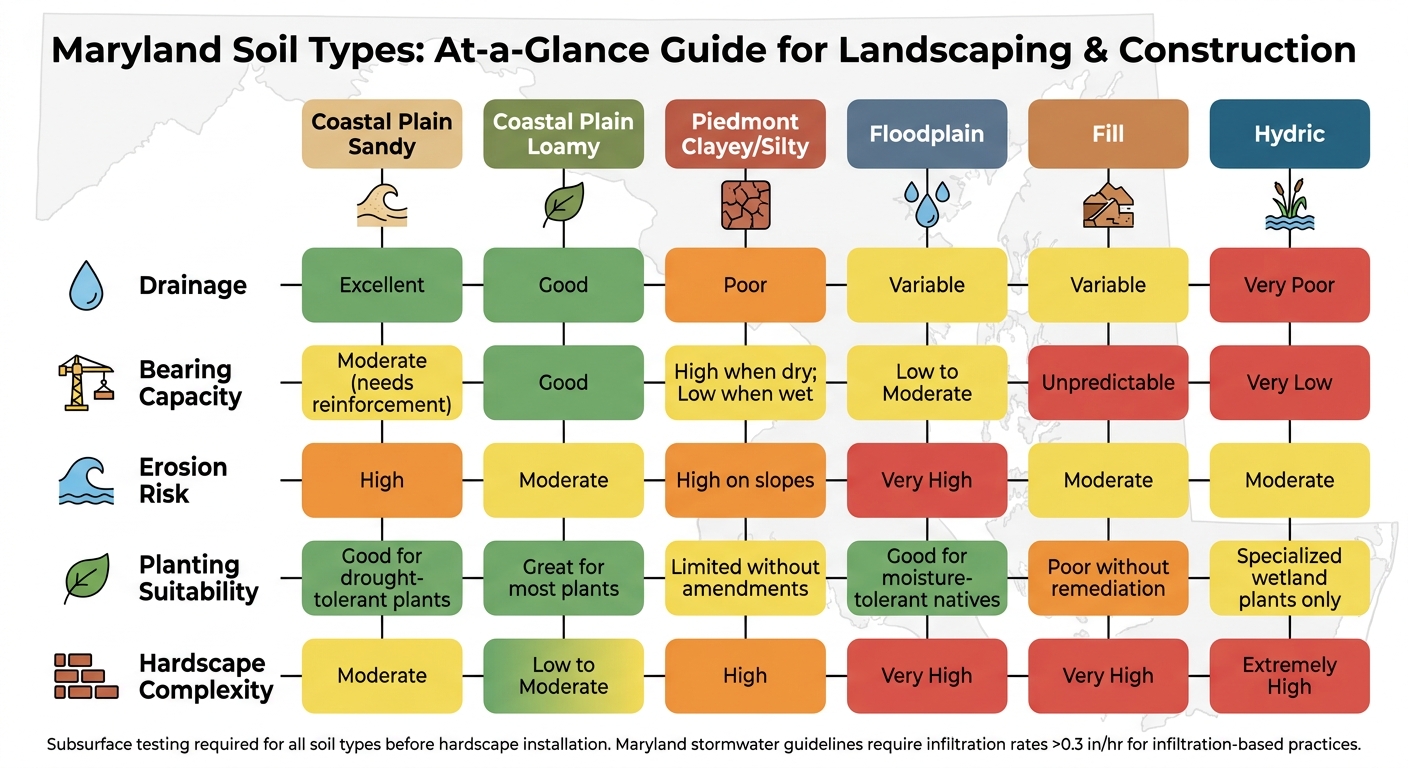
Maryland Soil Types Compared: Drainage, Stability & Hardscape Complexity
Maryland’s diverse soil types each come with their own set of strengths and challenges. Here’s a closer look at how these soils stack up for landscaping and construction needs.
Coastal Plain sandy soils are great for drainage and easy to excavate, with minimal risk of frost heave. However, they don’t hold onto nutrients or moisture well, meaning you’ll need to stay on top of watering and fertilization. For hardscape projects, sandy subgrades can shift under pressure, so a strong base layer is essential. Loamy soils in this region strike a better balance – they’re naturally fertile, drain moderately well, and provide solid support for patios and walkways with standard preparation.
Piedmont clayey and silty soils offer strong support for heavy structures like retaining walls and driveways when they’re dry and properly compacted. But here’s the catch: these soils are very sensitive to water. When wet, they lose strength, which can lead to shifting pavers or tilting walls. Plants also struggle in these soils due to compaction and poor airflow, so adding organic material and aerating the soil can make a big difference.
"Drainage problems are complex and require a custom approach for each project. These issues can cause long-term damage to your property if not handled correctly." – Pro Landscapes MD [1]
Floodplain, fill, and hydric soils are more complicated. Floodplain soils do well for water-loving plants like river birch and red maple, but their tendency to flood and their inconsistent strength make them tricky for hardscaping unless you invest in deeper foundations and erosion control measures. Fill soils can help raise low-lying areas, but they often come with uneven compaction and hidden debris, increasing the risk of settling. Hydric soils are best suited for ecological features like rain gardens, but they’re not ideal for lawns or hardscaping without major drainage work – and they may even require wetland permits.
Here’s a quick comparison of these soil types:
| Soil Type | Drainage | Bearing Capacity | Erosion Risk | Planting Suitability | Hardscape Complexity |
|---|---|---|---|---|---|
| Coastal Plain Sandy | Excellent | Moderate (needs reinforcement) | High | Good for drought-tolerant plants | Moderate |
| Coastal Plain Loamy | Good | Good | Moderate | Great for most plants | Low to Moderate |
| Piedmont Clayey/Silty | Poor | High when dry; low when wet | High on slopes | Limited without amendments | High |
| Floodplain | Variable | Low to Moderate | Very High | Good for moisture-tolerant natives | Very High |
| Fill | Variable | Unpredictable | Moderate | Poor without remediation | Very High |
| Hydric | Very Poor | Very Low | Moderate | Specialized wetland plants only | Extremely High |
There’s no one-size-fits-all solution when it comes to soil. The best approach depends on your specific project and location. This is why subsurface testing is so important – it helps you design hardscapes that work with, not against, the soil’s natural properties.
Conclusion
Maryland’s soils are anything but uniform. From the sandy and loamy soils of the Coastal Plain to the clay-rich grounds of the Piedmont and the hydric, fill-heavy soils in low-lying areas, each type reacts differently to loads, moisture, and seasonal changes. A cookie-cutter approach simply doesn’t work. For example, a design that thrives in Columbia’s clay-heavy soil might fail in Edgewater’s sandy subgrade or on a fill-heavy lot prone to drainage issues.
This is why targeted subsurface testing is so important. Simple measures – like digging test pits, observing how water drains after a rainstorm, and checking compaction before laying a base – give contractors the critical information they need to build durable patios, retaining walls, and walkways that can stand the test of time.
Skipping these steps often leads to costly problems down the road. Issues like sinking pavers, bulging walls, and poor drainage can rack up repair costs and reduce property value. Over the course of 10–20 years, the money saved by avoiding these headaches far outweighs the modest expense of proper testing.
"Drainage problems are complex and require a custom approach for each project. These issues can cause long-term damage to your property if not handled correctly, which is why hiring an experienced team is critical." – Pro Landscapes MD
FAQs
How can I tell what soil type I have on my Maryland property?
Identifying your soil type is key to successful planting and effective drainage. This is especially important in Maryland, where clay-heavy soil is common and can limit water absorption. While professional assessments provide the most accurate evaluation of subsurface conditions, Pro Landscapes MD takes it a step further. They include soil evaluations as part of their landscaping and drainage services, helping ensure your plants flourish and your hardscaping and drainage systems are designed to last.
What subsurface tests are needed before building a patio or retaining wall?
Before starting a patio or retaining wall project, it’s important to evaluate the site for stability and drainage, particularly in Maryland, where clay-heavy soils can pose challenges. A professional assessment can provide insights into soil composition, slopes, and water flow patterns. Pro Landscapes MD specializes in site evaluations, grading, and drainage solutions to tackle issues like steep slopes or areas prone to water buildup, helping to ensure your hardscaping project stands the test of time.
When should I use underdrains instead of infiltration for drainage?
Underdrains work best in situations where the soil struggles to absorb water effectively. These systems are designed to collect filtered runoff and channel it directly into stormwater infrastructure, bypassing the natural absorption process. You’ll often find underdrains used in engineered setups like flow-through planters or tree-box systems, ensuring water is properly managed in areas where infiltration just isn’t an option.
Chat with Us