









- bhavya gada
- No Comments
If your patio gets lots of direct sun and you only need soft light, solar can work. If you want bright, steady light every night, electric is usually the better pick.
I’d break it down like this:
- Solar is easier to install, has $0 power cost, and works best for small, sunny spots.
- Electric costs more up front – often $1,500 to $3,000 installed – but gives you much more light, with about 150–300 lumens per fixture instead of roughly 10–30 lumens from many solar path lights.
- In Maryland, shade, short winter days, humidity, pollen, and storms can cut solar performance.
- Solar lights often last 1–3 years and may need new batteries every 1–2 years.
- Wired low-voltage LED systems can last about 10–20 years with less frequent upkeep.
If you’re choosing between the two, I’d focus on four things first:
- Sun exposure
- Brightness needs
- How often you use the patio
- How much work and cost you want up front
Solar vs Low Voltage Landscape Lighting 💡 Which Is Better?
sbb-itb-843f8be
Quick Comparison
| Feature | Solar | Electric |
|---|---|---|
| Upfront cost | Lower | Higher |
| Installation | DIY-friendly, no wiring | Wiring, transformer, trenching |
| Brightness | Soft, lower output | Brighter, steady output |
| Runtime | Weather-dependent | Runs all night on schedule |
| Shade performance | Weak in shaded areas | Works in shade |
| Winter performance | Often drops | Stays steady |
| Upkeep | Battery and fixture replacement | Occasional system checks |
| Best use | Small sunny edges and accents | Patios, steps, dining, kitchens |
Bottom line: I’d choose solar for small, sunny, low-use areas and electric for larger, shaded, or often-used patios. A mix of both can also make sense.
Solar Patio Lighting
Solar patio lights are self-contained fixtures with a small solar panel, a rechargeable battery, and an LED bulb. They charge during the day and switch on at night on their own.
For Maryland patios that get open sun and have a simple layout, solar lights can be a solid low-effort pick. You can stake them along a walkway or set them around garden borders without wiring or trenching. That makes them handy for small jobs where you want light without turning the yard into a work zone.
Where Solar Lights Work Best
Solar lights are a good match for path-edge lighting. In plain English, they help guide people along a path or show the edge of a garden bed, not light up the whole patio.
They do best in open, sunny areas where the panel can get a full charge. Most standard solar fixtures need 6–8 hours of direct sunlight to run through the night [8].
In day-to-day use, that usually means a sunny patio or a far corner of the yard where running electrical wire would be a pain. Solar makes sense when you want soft guidance lighting instead of broad, bright coverage.
Solar works best in low-demand areas. If you need brighter, steadier light, electric is usually the better route.
Advantages and Limits of Solar Lighting
The biggest upsides are simple:
- No wiring
- No electricity use
- Easy placement and repositioning
They also add nothing to your power bill, which is nice.
But that upside fades fast in shaded yards and during Maryland’s shorter winter days. Dense tree cover is common in central Maryland neighborhoods, and even partial shade can reduce a solar light’s charge. Winter adds another problem: shorter days and weaker sun angles. As a result, many solar fixtures dim or don’t turn on in colder months [3][1].
Brightness is another weak spot. Entry-level solar path lights often produce only 5–15 lumens, and even premium models top out at about 60 lumens [8]. That’s a soft ambient glow. Fine for looks, fine for marking an edge, but not enough for spots where safety matters, like steps or slopes.
There’s also the wear-and-tear side of it. Most solar fixtures need battery replacement every 1–2 years, and many last only 1–3 years before the panel and battery output start to drop [3][5].
When a patio needs more light and more steady performance, electric tends to make more sense.
Electric Patio Lighting
Where solar falls short, electric gives you steady output. Electric patio lighting ties into your home’s electrical system with a low-voltage transformer, so you get reliable light without battery drain or the limits of solar charging. That’s the big draw. Wired fixtures keep working in shade and storms, and they switch on when scheduled and stay on through the night.
Where Electric Lighting Makes More Sense
Electric lighting is the practical pick when you need dependable light every night. That includes outdoor kitchens, dining patios, steps, and slopes where a dim or dead fixture can turn into a real safety issue [1][4].
It’s also the most realistic choice for shaded properties. In many Maryland neighborhoods, mature tree canopies block the sun for much of the day. A solar panel under that kind of cover often won’t charge enough to last through the night. A wired system keeps working no matter the shade or weather [1][4]. The same goes for covered patios and north-facing areas.
A single transformer can also power multiple fixtures across a large patio, which helps create even light across the space [9]. That’s tough to match with standalone solar units.
Advantages and Tradeoffs of Electric Lighting
Electric lights are much brighter and more consistent. Low-voltage LED fixtures usually produce 150–300 lumens of steady output [7], compared with the 10–30 lumens common for a solar path light [7]. That extra brightness works well for cooking, entertaining, and moving safely on steps.
Durable metal fixtures also hold up better in humidity and freeze-thaw cycles than typical solar units [3][2]. Wired LED systems are commonly rated for 25,000 to 50,000 hours of use [4].
The downside is the upfront cost and the work involved in installation. Professional installation usually runs $1,500 to $3,000 and includes trenching, wiring, and transformer setup [5]. That’s a bigger lift than setting out solar lights. But if your patio gets year-round use, electric often ends up being the better value over time [5][7].
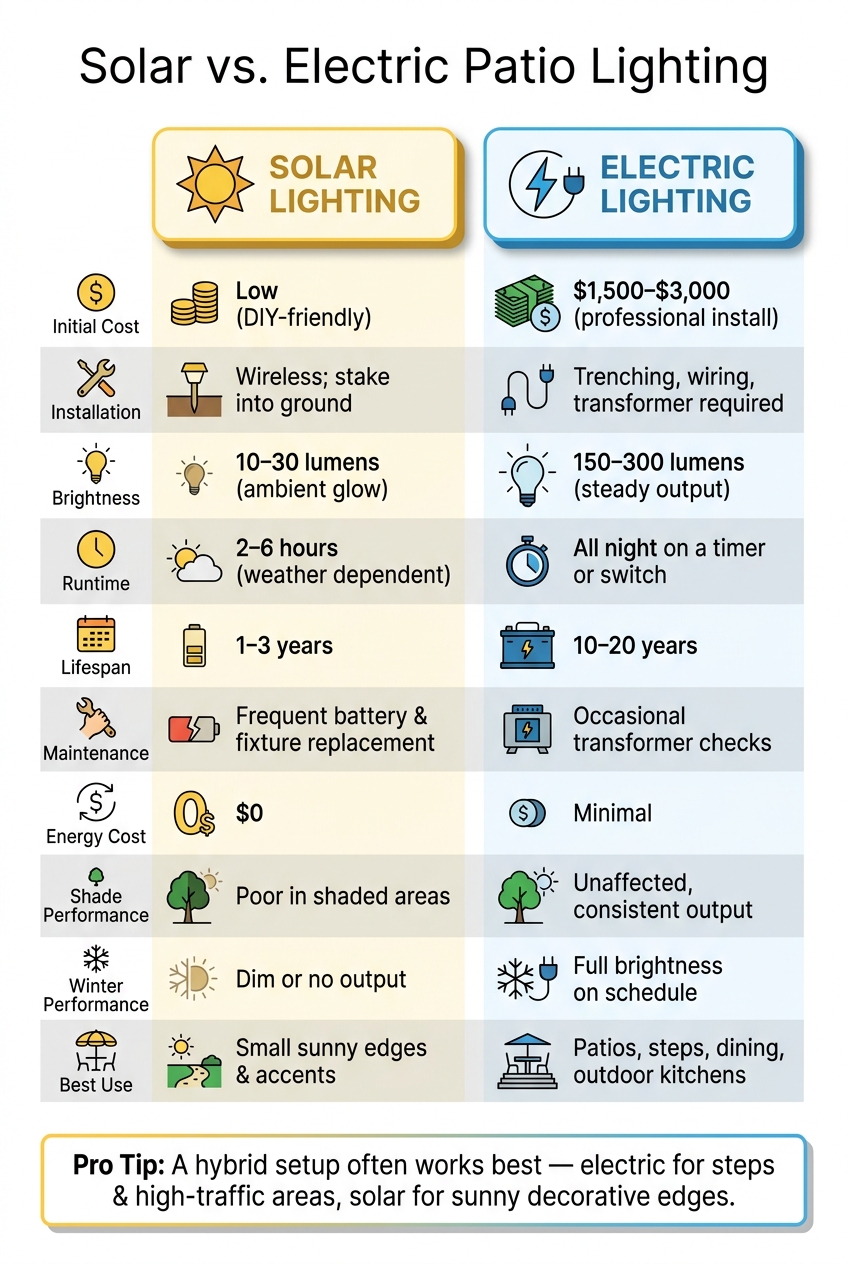
Those tradeoffs stand out most when you compare cost, brightness, and upkeep side by side. The next comparison makes those differences easier to judge.
Solar vs. Electric Patio Lighting: Side-by-Side Comparison
Solar vs. Electric Patio Lighting: Side-by-Side Comparison
Solar and electric patio lighting differ most in cost, brightness, upkeep, and how well they deal with Maryland weather.
Cost, Brightness, and Maintenance
Solar usually wins on upfront price. It’s often DIY-friendly, and there’s no monthly power cost. Electric lighting costs more at the start, but it gives you steadier light and a much longer working life.
Over time, solar can cost more to keep up. Battery swaps and fixture replacements add up, and those early savings can disappear. A wired system with brass or copper fixtures can last 10–20 years with only occasional bulb or transformer checks [3][5].
Brightness is where the gap gets obvious. Solar lights are much dimmer than wired electric lights. A typical solar path light puts out about 10–30 lumens, which works for soft ambient light. A low-voltage LED fixture, by contrast, can produce 150–300 lumens with steady output [7][5].
Here’s the clearest side-by-side view:
| Feature | Solar Lighting | Electric (Low-Voltage LED) |
|---|---|---|
| Initial Cost | Low (DIY-friendly) | $1,500–$3,000 (professional install) |
| Installation | Wireless; stake into ground | Trenching, wiring, transformer required |
| Brightness | 10–30 lumens (ambient) | 150–300 lumens (steady output) |
| Runtime | 2–6 hours (weather dependent) | All night on a timer or switch |
| Lifespan | 1–3 years | 10–20 years |
| Maintenance | Frequent battery and fixture replacement | Occasional transformer checks |
| Energy Cost | $0 | Minimal |
Performance in Maryland Weather and Site Conditions
Maryland weather can be rough on solar lighting. Shade, short winter days, and wet conditions all cut into performance. In winter, many solar lights in Maryland turn on less reliably [3][2]. Dense tree cover across central Maryland makes that even harder to work around. If a panel sits in shade, it may not charge enough to last through the night, no matter the season [3].
Electric systems don’t have that problem. They give you consistent light whether the day was cloudy, the yard is shaded, or winter daylight is short [3][2]. So in many cases, sun exposure is the main thing to look at when choosing between these two options.
| Condition | Solar Performance | Electric Performance |
|---|---|---|
| Dense Tree Shade | Poor; batteries may not charge fully | Unaffected; consistent output |
| Winter (Short Days) | Dim output; short or no runtime | Full brightness on a timed schedule |
| Heavy Rain/Storms | Panels need regular cleaning | Wiring must be protected/buried |
| Humidity & Pollen | Reduces panel efficiency over time | High resilience across all seasons |
In practice, those site conditions often make the choice for you.
Which Lighting Type Fits Your Maryland Patio
Start with sun exposure. That one factor goes a long way in choosing the right setup. Then look at patio size and how often you use the space. Those three things usually point you in the right direction.
Choose Solar for Smaller, Sunny, Low-Use Spaces
Solar is a good match for smaller patios, garden borders, or accent zones that get at least 4 hours of direct sun per day. It also makes sense if you want a simple DIY setup with no wiring, no trenching, and no added power cost on your electric bill [10][6].
Choose Electric for Larger, Shaded, or Frequently Used Patios
Go with electric low-voltage LED lighting for patios that get heavy use, especially outdoor kitchens, entertaining areas, steps, and multi-level layouts that need bright, steady light [1][6].
If your patio sits in the shade, covers more ground, or gets used every night, electric is usually the better pick.
Key Points to Keep in Mind
A hybrid setup often works best. Use electric for steps and high-traffic areas, and solar for sunny decorative edges [6][2].
For new patios, plan the lighting with the hardscape work so the wiring stays hidden and protected.
FAQs
How much sun do solar patio lights need?
Solar patio lights work best when they get direct sunlight for most of the day. If trees, buildings, or steady cloud cover block that sun, the lights may look dim at night – or not switch on at all.
In full sun, they usually do the job just fine. But winter can make things tougher, especially in shaded Maryland yards where daylight is shorter and the sun sits lower. In areas with less sun, lights with separate solar panels can be a smart fix, since you can place the panel in a brighter spot and keep the fixture where you want it.
Are solar lights bright enough for steps and dining areas?
Usually, no. Solar lights work best for soft, decorative lighting. But they often don’t deliver the brightness, steady output, or area coverage you need for steps or main dining areas.
Their performance also depends on weather and direct sun exposure. That makes them less dependable in spots where clear visibility and safety matter most. For those areas, low-voltage electric lighting is the better pick.
Is a mix of solar and electric lighting a smart option?
Yes. Using both solar and electric lighting can be a smart way to light an outdoor space.
Solar works well for accent lighting in garden beds or along paths, where the goal is to add a nice look without using much power. Electric lighting makes more sense in spots where steady brightness, safety, and dependability matter most, like patios, steps, and entryways.
This kind of setup gives you a good balance of appearance, performance, and energy use.
Chat with Us