









- bhavya gada
- No Comments
Maryland homeowners face significant challenges when creating gardens that support pollinators like bees and butterflies. The loss of 90% of the state’s grasslands has reduced critical habitats, and factors like geographic diversity, restrictive weed ordinances, and pesticide use further complicate efforts. However, with the right strategies, you can transform your yard – no matter the size – into a thriving pollinator haven. Here’s how:
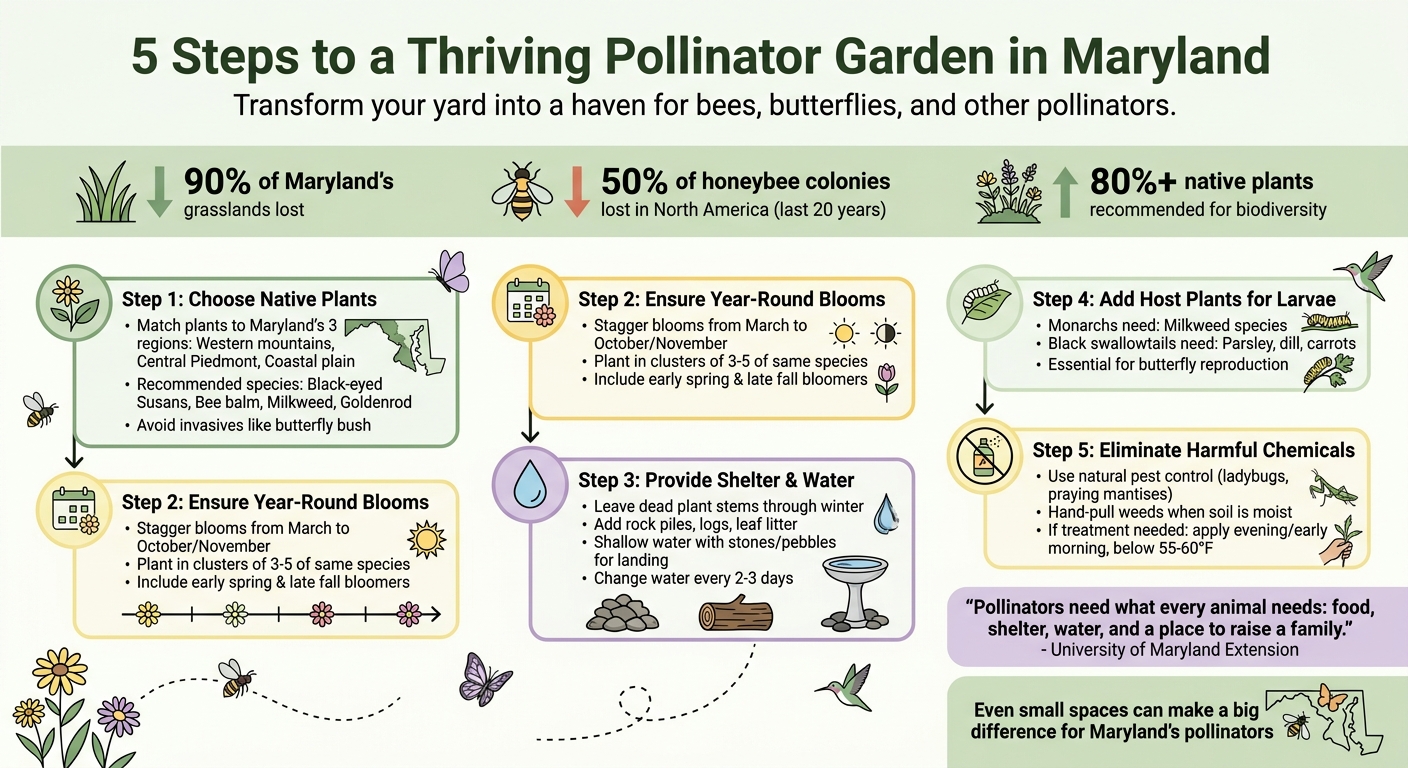
- Choose native plants: Maryland’s varied geography requires selecting species suited to your local soil, sunlight, and moisture conditions, often requiring professional landscaping services to optimize the site. Black-eyed Susans, bee balm, and milkweed are great options.
- Ensure year-round blooms: Stagger flowering plants to provide continuous nectar and pollen from early spring to late fall.
- Provide shelter and water: Leave dead plant stems, add rock piles, and maintain shallow water sources for pollinators to drink safely.
- Avoid harmful chemicals: Use natural pest control methods to protect pollinators from pesticides.
- Maximize small spaces: Even balconies or shaded yards can support pollinators with potted plants, raised beds, and smart plant choices.
5 Essential Steps to Create a Pollinator-Friendly Garden in Maryland
Gardening for Pollinators
sbb-itb-843f8be
Challenge 1: Selecting the Right Native Plants for Maryland
Choosing native plants for Maryland isn’t as simple as picking what looks nice. Maryland’s geography is incredibly varied, split into three main regions: the western mountains (cooler, higher elevations), the central Piedmont plateau (rolling hills), and the coastal plain (warmer, lower terrain). A plant that thrives in one of these areas might not survive in another. As the University of Maryland Extension puts it, "The variety of ecosystems in Maryland makes gardening a challenge and a delight."
Native plants are important because they’re naturally suited to the local soil and climate, meaning they require less water and fertilizer once established, making them ideal for landscape projects in Maryland. They also have built-in resistance to local pests. Beyond that, many of Maryland’s pollinators depend on specific native plants for survival. Some insects can only access the pollen, nectar, or oils they need from particular species during crucial life stages. Without these plants, those pollinators can’t complete their life cycles.
Finding Maryland-Specific Native Species
To start, match plants to your garden’s conditions – think about sun exposure, soil moisture, and soil type. Planting something in the wrong spot wastes time, effort, and resources. For most Maryland gardens, reliable native options include black-eyed Susans, goldenrod, and bee balm. These plants provide vital nectar and pollen for bees and butterflies.
One common mistake is planting invasive species like butterfly bush. While it may look appealing, it spreads aggressively and disrupts ecosystems. Instead, go for native alternatives like blazing star (Liatris spicata), New York ironweed (Vernonia noveboracensis), or butterfly weed (Asclepias tuberosa). These not only offer high-quality nectar but also stay in balance with the environment. Don’t forget host plants – milkweed for monarch butterflies or carrots and dill for black swallowtails. Without these, butterflies can’t reproduce.
Once you’ve identified the right plants, the next step is finding reliable sources to purchase them.
Where to Buy Native Plants Locally
Finding quality native plants takes a bit of effort. The Maryland Native Plant Society is a great resource for locating nurseries that specialize in regionally adapted species. Many general garden centers focus on non-native varieties or sell plants treated with pesticides, which can harm pollinators. That’s why it’s best to stick to specialized native plant retailers.
You can also use the Native Plant Finder website to search for local sources. It allows you to filter plants by bloom time and light requirements, simplifying the planning process. For even more guidance, Howard County’s "Live Green Howard" program offers free pollinator garden templates tailored to Maryland’s diverse conditions – whether your garden is sunny and dry, shady, or prone to wet soil. These templates take the guesswork out of designing a pollinator-friendly space.
Challenge 2: Providing Year-Round Food Sources for Pollinators
Creating a pollinator-friendly garden isn’t just about choosing native plants – it’s also about ensuring they bloom at the right times. Pollinators in Maryland need a steady food supply from early spring to late fall, not just during a short bloom period. The key? Overlapping bloom periods, where different plants flower at different times, offering a continuous source of nectar and pollen.
Pollinators often struggle during early spring and late fall when food sources are scarce. For example, the rusty patched bumblebee emerges as early as March and needs immediate access to nectar. Similarly, many species rely on late-season blooms to build energy reserves for the winter. As the U.S. Fish & Wildlife Service puts it: "Selecting some plants that bloom early and others that keep their flowers late in the season helps ensure food for pollinators when other sources are scarce." [4]
Planning for Different Bloom Times
To keep pollinators well-fed, plan your garden so blooms are staggered throughout the year – from March to as late as October or November. A diverse mix of flowering plants ensures various nectar and pollen options that cater to different pollinators.
Group flowers together to save pollinators energy. Clusters of three to five plants of the same species allow pollinators to visit multiple blooms without expending too much effort flying between isolated plants. Incorporate a variety of colors, shapes, and heights to attract a wide range of pollinators – hummingbirds are drawn to tubular flowers, while bees and butterflies prefer larger blossoms.
And don’t stop at nectar. To fully support pollinators, you’ll need to address the specific dietary needs of butterfly larvae.
Adding Host Plants for Butterfly Larvae
While adult butterflies feed on nectar, their caterpillars depend on host plants for survival and reproduction. Without these plants, butterflies can’t complete their life cycle, no matter how much nectar is available. For instance, black swallowtail caterpillars feed exclusively on plants from the carrot family, such as parsley, dill, and carrots. Monarch caterpillars, on the other hand, require milkweed species like butterfly weed (Asclepias tuberosa) or common milkweed (Asclepias syriaca).
Andrew Kling from the University of Maryland Extension highlights this issue: "For native pollinators to survive, they need specific plant species for their larvae’s diets. Butterflybush fails to nourish caterpillars, hindering butterfly reproduction." [5] Including host plants is essential, as caterpillars consume large amounts of foliage – a clear sign that your garden is thriving and supporting pollinator life cycles.
Challenge 3: Designing a Garden Layout That Supports Pollinators
Even the most stunning flowers can’t fully support pollinators without essentials like shelter, water, and nesting sites. Maryland’s rich ecosystem is home to bees, butterflies, beetles, and other helpful insects, but they’ll only thrive if your garden layout caters to their specific needs. Building on native plant choices and seasonal planning, a well-thought-out layout can take your garden’s pollinator support to the next level.
Creating Shelter and Nesting Areas
Pollinators have diverse nesting habits, so your garden should offer a variety of plant heights and layers. Incorporate trees, shrubs, perennials, and groundcovers to create habitats at different levels [1][6]. For ground-nesting and solitary bees, leave sunny, unmulched patches of well-drained soil and keep dead plant stems intact through winter [1][3][4]. Features like rock piles, logs, and leaf litter are excellent for sheltering beetles and overwintering butterflies. Many pollinators in Maryland go dormant during winter (a state called diapause), relying on undisturbed leaf litter to survive until spring [1].
Installing Water Sources
Pollinators need water, but it must be accessible and safe. Shallow water features with landing platforms – like stones, pebbles, or marbles in bird baths – allow pollinators to drink without risk [7][9]. Butterflies also benefit from "puddling" areas: shallow dishes filled with damp sand or soil that provide essential minerals and salts not found in nectar [7][8].
"Providing a shallow source of unpolluted water for bees and wasps can improve their overall chances of nesting successfully by reducing the time they need to forage, as well as their risk of exposure to pesticides." – Xerces Society [7]
To keep mosquitoes at bay, empty and refill bird baths every 2–3 days [7][8][9]. Moving water, like that from fountains or pumps, also discourages mosquitoes while keeping the water fresh. Place water features in sunny spots near nesting areas, such as bare soil or brush piles, so pollinators can find them easily [7][8].
Eliminating Harmful Chemicals
Creating a pollinator-friendly garden isn’t just about physical elements; avoiding harmful chemicals is just as important. Pesticides and herbicides can kill pollinators or disrupt their foraging and navigation. Over the last 20 years, North America has lost nearly 50% of managed honeybee colonies, with pesticides being a major factor [6]. Instead, encourage natural pest control by introducing beneficial insects like ladybugs and praying mantises to manage aphids [10]. Companion planting with marigolds or using garlic and onions as natural repellents can also deter pests without harming pollinators [10].
"Neonicotinoids can be found in garden pest control sprays. While they are designed to target specific pests, they also can also be lethal to pollinators." – Amber Aguilera, Listing and Classification Division Supervisor, U.S. Fish and Wildlife Service [10]
For weed control, hand-pull them when the soil is moist, or use diatomaceous earth – a natural shell-based barrier – to deal with slugs and snails [10][12]. If chemical treatment is unavoidable, apply products in the evening or early morning when pollinators are less active and temperatures are below 55–60°F [11][6]. Opt for liquid or granular formulations rather than dusts, which can stick to bees and be carried back to their hives. A garden free of toxic chemicals completes the design of a safe, pollinator-friendly space.
Challenge 4: Working with Small or Difficult Garden Spaces
Creating a pollinator-friendly garden doesn’t require sprawling landscapes or perfect conditions. Even the smallest or most challenging areas – like a compact balcony or a shady yard – can become thriving habitats for pollinators. If you’re in Maryland, there are plenty of ways to work with what you have, whether it’s limited space, dense shade, or tricky soil.
Making the Most of Small Spaces
When space is tight, containers and raised beds can be your best friends. On balconies or patios, use pots filled with quality compost or specialized soil to give your plants a strong foundation. Many native perennials do well in these setups and require little upkeep.
Sunlight is another key factor. While some shade-tolerant species exist, many pollinator favorites – like wildflowers and butterflies – prefer full or partial sun. If you have a small yard, test your soil type. Is it sandy and well-drained, or more clay-like and wet? Choose plants that match these conditions. To keep your garden blooming through the seasons, pick a mix of species that flower in spring, summer, and fall. Adding mulch helps retain moisture and keeps weeds at bay. And if you’re starting from seeds in an urban plot, try sowing them in the fall or winter – even over snow – to encourage proper germination [2]. These steps ensure that even the smallest spaces can support pollinators year-round.
Dealing with difficult soil is a common challenge in small spaces, and that’s where smart plant choices make a big difference.
Fixing Poor Soil Conditions
If your soil isn’t ideal, don’t worry – just work with what you’ve got. Maryland’s geography creates a variety of soil types, so instead of trying to change your soil, focus on plants that are naturally suited to it. Native plants are a great choice because they’re already adapted to local conditions and usually need less water and fertilizer once they’re established. Start by assessing your site’s sun exposure, moisture levels, and soil type, then select plants that align with those conditions [1].
For shady gardens, native plants like Virginia bluebells (Mertensia virginica), Woodland phlox (Phlox divaricata), and Columbine (Aquilegia) thrive in Maryland’s woodlands [13][14]. In moist, shaded areas, Turtlehead (Chelone) and Cardinal flower are excellent picks [13][15]. For drier spots under tree canopies, Mountain stonecrop and Virginia bluebells perform well [13].
"Research shows that if biodiversity is your motive, you’d do well to use at least 80% natives by cover, rather than just planting a few." – Dr. Sara Tangren, former Sr. Agent Associate, University of Maryland Extension [13]
If your soil is extremely poor or you have limited ground space, container gardening is a practical solution. Containers let you control the growing medium, ensuring your plants get the nutrients they need. Minimal maintenance practices – like leaving dead plant stalks, fallen leaves, and garden debris in place during winter – can also help. These materials provide organic matter, support soil-dwelling insects, and create overwintering habitats for pollinators. However, if you’re growing evergreen natives like Christmas fern, be sure to clear excess leaves occasionally so they can photosynthesize properly [1][13].
Challenge 5: Reducing Maintenance and Controlling Invasive Species
Creating a pollinator garden shouldn’t feel like a full-time job. By focusing on native plants that naturally thrive in Maryland’s climate and soil, you can cut down on maintenance while still supporting pollinators. Pairing these low-maintenance plants with a proactive approach to managing invasive species ensures your garden stays healthy and resilient.
Choosing Low-Maintenance Plants
Native perennials like blazing star (Liatris spicata), New York ironweed (Vernonia noveboracensis), and butterfly weed (Asclepias tuberosa) are excellent choices for Maryland gardens. These plants not only thrive with minimal care but also provide essential resources for pollinators. For example, leaving dead stalks through the fall and winter offers nesting spots for certain species. If you prefer a tidier look, wait until late spring to prune and relocate the clippings.
Another bonus? Native plants are tough. They can handle minor insect damage, so there’s no need to use pesticides, which can harm the very pollinators you’re trying to attract.
Identifying and Removing Invasive Species
Keeping invasive species in check is just as important as choosing the right plants. These aggressive plants can quickly overrun your garden, crowding out the natives that pollinators depend on. Across the United States, invasive species cause an estimated $120 billion in damages annually [16].
In Maryland, some of the most common offenders include English ivy, Japanese honeysuckle, and Callery pear. To tackle these invaders, start by identifying them using resources like the Maryland Invasive Species Council or the Mid-Atlantic Invaders Tool. For small infestations, manual removal works well. For tougher groundcovers like ivy, consider smothering them with layers of cardboard or newspaper topped with wood chips. If ivy has climbed a tree, cutting a 12-inch section of the vine at the base can stop its spread without harming the tree.
Once invasives are removed, it’s important to fill the gaps immediately with native plants that can hold their ground. Aggressive native species like mountain mint (Pycnanthemum spp.), bee balm (Monarda didyma), or lyre-leaf sage (Salvia lyrata) are excellent choices. These plants not only outcompete invasive species but also help create a self-sustaining ecosystem for pollinators.
Working with Professional Landscaping Services
Getting Expert Help for Custom Designs
Creating thriving pollinator gardens in Maryland often starts with local expertise. While choosing the right plants and designing layouts are key, expert guidance ensures these strategies align with Maryland’s unique conditions. The state’s diverse regions demand customized garden designs. Horticulturists take into account factors like sunlight, moisture levels, and soil type to plan for overlapping blooms that continuously support pollinators. By combining trees, shrubs, perennials, and groundcovers, professionals craft gardens that attract bees, butterflies, hummingbirds, and other essential pollinators [1]. This personalized approach sets the stage for successful garden designs that are both functional and beautiful.
How Pro Landscapes MD Can Help
Pro Landscapes MD specializes in addressing the challenges of pollinator garden design with tailored solutions. Serving Howard, Montgomery, Carroll, Frederick, Prince George’s, and Baltimore Counties, their team brings professional horticultural expertise to central Maryland. They focus on selecting native plants suited to local conditions, ensuring gardens are pollinator-friendly and easy to maintain.
Their services go beyond planting. Pro Landscapes MD handles garden restoration and develops custom designs that are both ecologically sound and visually appealing. They incorporate practical features like water sources – such as birdbaths or pebble-filled shallow dishes – and undisturbed soil areas for ground-nesting bees. Additionally, their designs often include eco-conscious elements, like environmental pavers, to create outdoor spaces that support species like Monarch butterflies.
Even small or compact spaces can be transformed into vibrant pollinator habitats. Pro Landscapes MD achieves this by improving soil quality and leveling yards, ensuring that every garden reaches its full potential.
Conclusion
Creating a thriving pollinator garden in Maryland means focusing on native plants, ensuring blooms throughout the seasons, and practicing sustainable upkeep. The challenges are real – choosing plants suited to Maryland’s three eco-regions, tackling invasive species, and maintaining habitats year-round. With nearly 50% of managed honeybee colonies lost in North America over the past two decades and Monarch butterflies now endangered, the urgency is clear [6].
"Pollinators need what every animal needs: food, shelter, water, and a place to raise a family." – University of Maryland Extension [1]
Even small actions can make a big difference. Planting clusters of native species, providing shallow water sources with pebbles, and leaving dead plant stalks through the winter create essential habitats. These efforts support the 80% of flowering plants and over one-third of human food crops that rely on pollinators to thrive [6].
For those unsure of where to start or facing challenges like poor soil or limited space, local expertise can be a game-changer. Pro Landscapes MD offers tailored solutions for central Maryland homeowners, from native plant installations to sustainable landscape designs. Their guidance ensures your garden becomes both a functional pollinator haven and a beautiful outdoor space.
Every pollinator-friendly garden, no matter the size, restores critical habitats and helps combat ecological decline. Whether you begin with a few native plants in pots or design a full-scale landscape, your efforts directly support Maryland’s pollinators and the ecosystems that depend on them.
FAQs
How do I figure out which Maryland region my yard is in?
To figure out your region in Maryland, start by identifying your county or eco-region – whether it’s the mountain area, Piedmont plateau, or coastal plain. This is important because pollinator garden recommendations differ based on location. You can also tap into local resources, such as the Maryland Department of Agriculture or city-specific programs, to get tailored advice. Understanding your region helps you choose plants that thrive in your local environment.
What’s the best way to plan blooms from spring through fall?
To enjoy blossoms from spring to fall, select a mix of native plants that bloom at different times throughout the growing season. This approach ensures pollinators have a steady food supply. Prioritize native perennials and annuals that thrive in Maryland’s eco-regions, and plan carefully to stagger their bloom periods. Adding host plants and steering clear of invasive species will make your garden even more welcoming to pollinators all year long.
How can I keep my pollinator garden HOA- and ordinance-friendly?
To make sure your pollinator garden aligns with HOA rules and local ordinances in Maryland, consider having it certified as a Pollinator-Friendly Landscape through the Maryland Cooperative Extension. This certification not only validates your efforts but also comes with yard signs to showcase the ecological benefits of your garden. Focus on using native plants – they’re great for supporting pollinators and help avoid the spread of invasive species. Be sure to review your HOA and municipal guidelines thoroughly. For added peace of mind, you can consult experts like Pro Landscapes MD to create a garden that meets community standards while promoting environmental health.
Chat with Us