









- bhavya gada
- No Comments
If your shrub looks drought-stressed in a Maryland summer, spider mites may be the reason. In hot, dry weather, some mites can finish a generation in just 4–7 days, so light stippling can turn into bronzing, webbing, and leaf or needle drop fast.
Here’s the short version:
- Common hosts: arborvitae, juniper, spruce, hemlock, fir, yew, false cypress, boxwood, azalea, rhododendron, holly, viburnum, roses, and burning bush
- Early signs: tiny pale specks, dull gray-green or bronze color, fine webbing, and patchy damage on hot, sunny sides
- Best check: tap a branch over white paper and look for moving specks
- Where mites hit hardest: near pavement, south- or west-facing walls, gravel, dust, and dry soil
- First treatment steps: deep watering, 2–3 inches of mulch, and strong hose sprays on leaf undersides 2–3 times per week
- When to spray: use horticultural oil or insecticidal soap only after you confirm live mites; for boxwood, 15+ mites per tap means it’s time to act
- Season matters: twospotted spider mite peaks in summer; spruce spider mite and southern red mite are more active in spring and fall
If I had to boil it down to one point, it’s this: check early, fix plant stress first, and don’t assume bronzing is just drought.
| Mite type | Peak time | Shrubs often hit |
|---|---|---|
| Twospotted spider mite | Hot, dry summer | Roses, boxwood, viburnum |
| Spruce spider mite | Spring and fall | Spruce, arborvitae, juniper |
| Southern red mite | Spring and fall | Azalea, rhododendron, holly |
That simple pattern – summer mites on many broadleaf shrubs, cool-weather mites on many evergreens and broadleaf evergreens – helps explain why damage keeps showing up at different times of year.
Managing Spider Mite Mayhem with the Purdue Plant Doctor

sbb-itb-843f8be
How to spot spider mite damage before shrubs decline
Hot, dry weather can send mite numbers up fast. That’s why it helps to inspect shrubs early, before the damage spreads and the plant starts to fade.
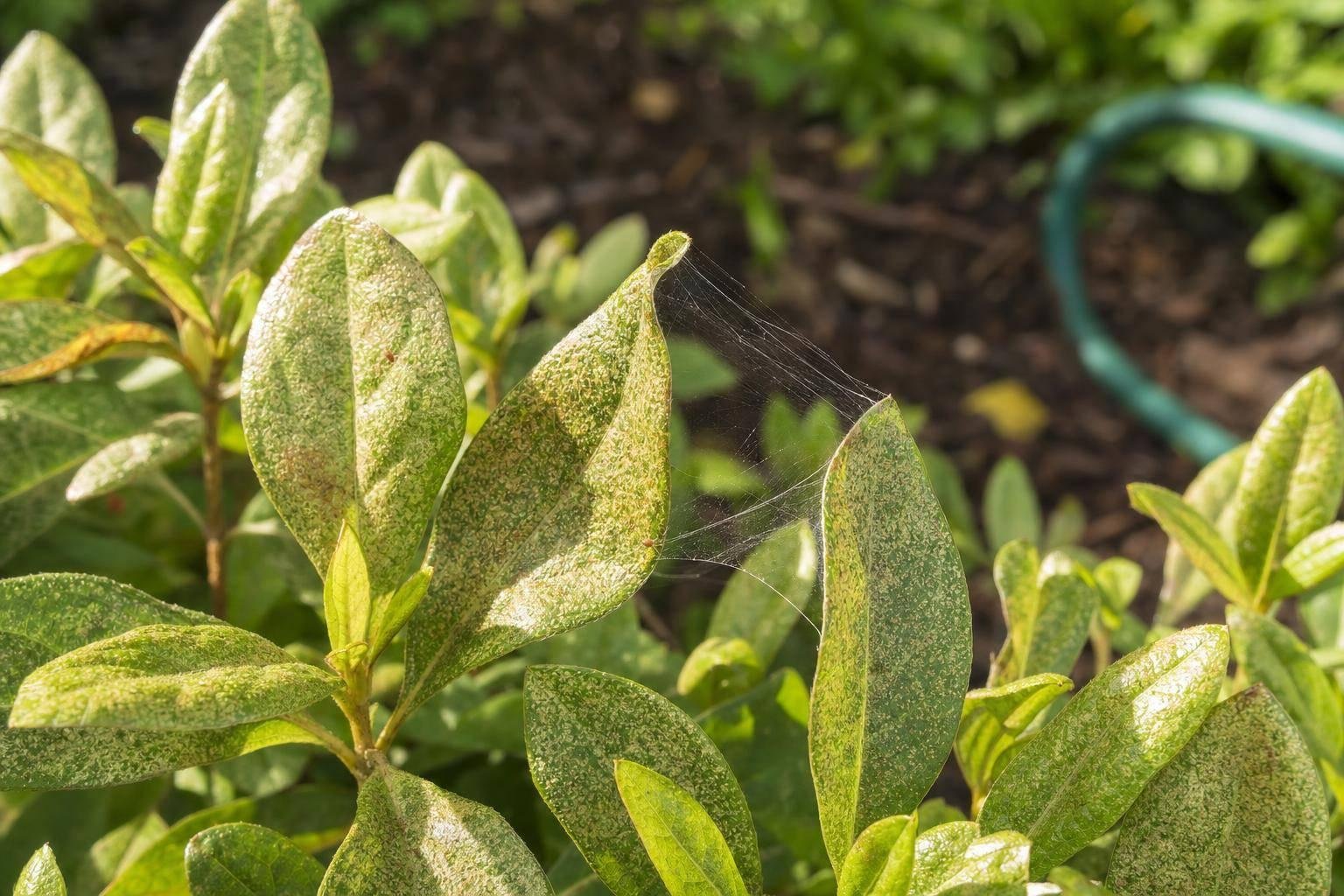
Spider mite injury often shows up after the infestation is already well underway. The first clue is usually tiny pale specks scattered across the leaf surface – yellow, white, or tan dots where mites have pierced individual cells. As feeding continues, those specks start to blend together. Then the whole leaf can shift from healthy green to a dull gray-green, yellowed, or bronze look.
Damage also tends to appear first in the hottest, sunniest parts of the shrub. Look closely at outer branches, upper growth, or the side facing a driveway or a south-facing wall. If one side of the shrub looks flat and bronzed while the shaded interior still looks greener, that uneven pattern points much more toward mites than a soil or nutrient problem. When you notice patchy bronzing, check for webbing and live mites before blaming drought alone.
Fine webbing and how to check for active mites
Fine webbing usually means the infestation is heavier. It’s thin and silky – more delicate than a typical spider web – and often shows up on leaf undersides, between needles, and around shoot tips. In a heavy outbreak, foliage can look lightly draped in cobweb. Dust and debris may get caught in it, which makes it easier to spot.
To check for live mites, use the white paper tap test. Hold a plain white sheet of paper under a branch and give the branch a sharp tap. If mites are there, tiny pepper-like specks will fall onto the paper and crawl slowly across it.
A 10x–20x hand lens or a phone macro lens can help, too. Look for:
- small oval bodies
- tiny translucent eggs
- fine webbing threads near leaf veins
For boxwood, 15 or more mites per tap warrants action.[4]
How decline looks on evergreens versus broadleaf shrubs
Once you’ve confirmed live mites, the next step is to watch how the damage moves through the plant. Evergreens usually dull first to gray-green or bronze. After that, they begin to thin as needles dry out and drop from the outer tips inward.
Broadleaf shrubs look a bit different. They often show mottled stippling, yellowing, bronzing, and early leaf drop. Over time, that can leave the canopy sparse and may lead to fewer blooms the next season.
When mottled bronzing shows up alongside fine webbing on leaf undersides and leaf drop that seems out of place, mites are the more likely cause – not simple drought stress.
Why some Maryland shrub plantings are more prone to mite problems
Once you spot mite damage, the next step is figuring out why certain shrubs keep taking the hit. In a Maryland yard, mite risk isn’t the same from one planting to the next. A shrub’s location, the soil under it, and the extra heat thrown off by nearby surfaces can all shape how bad an outbreak gets and how often it comes back.
Heat, drought stress, and dusty landscape conditions
Shrubs planted against south- or west-facing walls, along driveways, or in narrow strips between pavement and sidewalks deal with some of the roughest growing conditions in the landscape. That helps explain why the same plants often show damage year after year. University of Maryland Extension specifically advises against growing mite-prone shrubs in sites exposed to reflected heat or reduced air circulation, such as near garden walls or pavement.[2] Heat from hard surfaces, dry soil, and poor airflow can weaken shrubs and make mite feeding hit harder.
Dust adds another problem. It helps mites build up and can get in the way of the predators that would otherwise help keep them in check. Rinsing foliage during dry spells can help, but it won’t solve the root issue if the planting site stays hot, dry, and dusty.[6][7]
Site stress helps explain where mites do well. Species timing helps explain when they show up.
Warm-season and cool-season mite activity on landscape shrubs
Different mite species surge at different times of year. In Maryland, shrub plantings can deal with mite pressure from early spring into late fall, depending on the species involved.
Twospotted spider mite peaks during midsummer heat and drought. It feeds on more than 180 plant species, which means it can move across many common landscape shrubs.[8][9] Spruce spider mite, by contrast, is active in cool weather. It overwinters as eggs on needles, hatches in early spring, and builds again in fall on conifers.[5][3] Southern red mite follows a similar cool-season pattern, feeding on broadleaf evergreens in spring and fall instead of during the hottest part of summer.[1][10]
| Mite species | Peak season | Common hosts in Maryland |
|---|---|---|
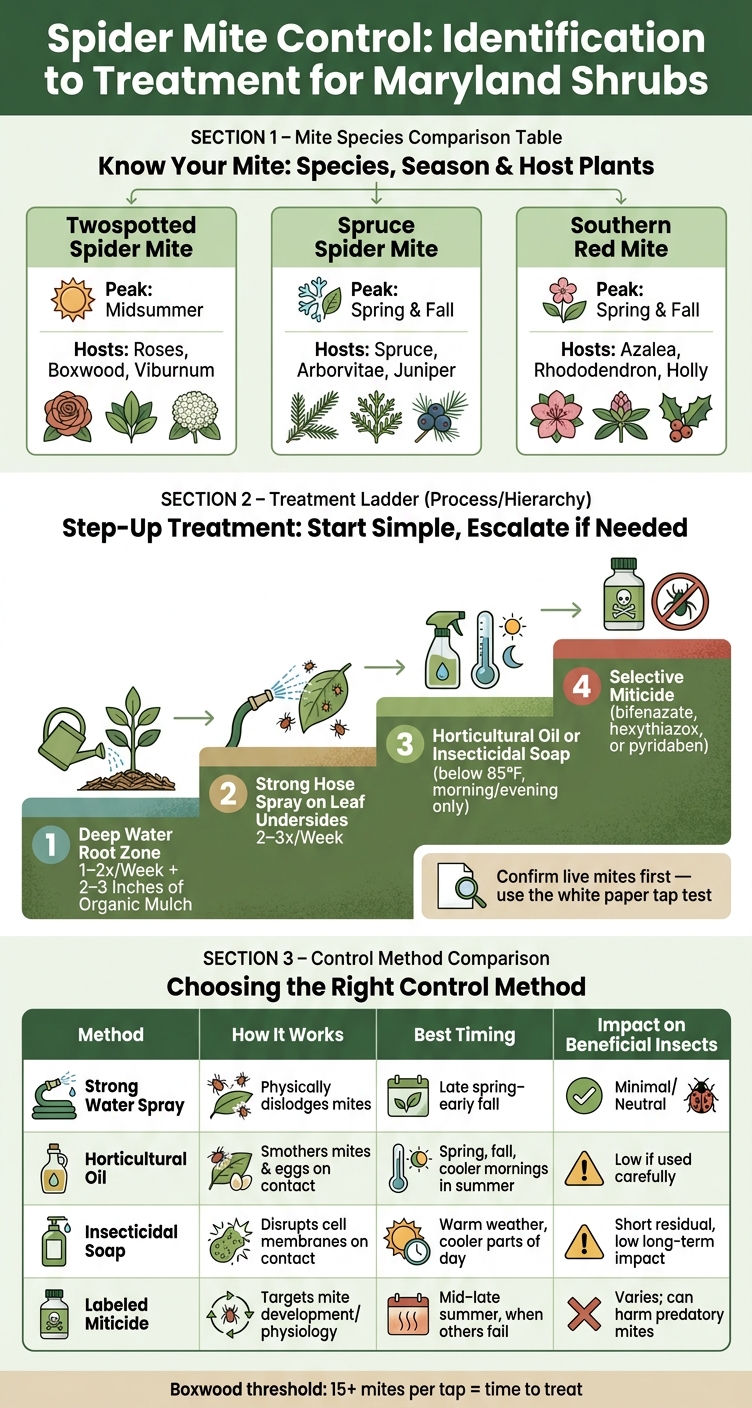
| Twospotted spider mite | Midsummer (hot, dry weather) | Roses, boxwood, viburnum |
| Spruce spider mite | Spring and fall (cool weather) | Spruce, arborvitae, juniper |
| Southern red mite | Spring and fall (cool weather) | Azalea, rhododendron, holly |
Knowing the species and the season makes the control step much more precise.
Care and treatment steps for spider mites on shrubs
Spider Mite Types, Seasons & Treatment Guide for Maryland Shrubs
Once you’ve confirmed mites, start simple. The first goal is to lower plant stress and cut mite numbers down fast before you reach for sprays.
First steps to reduce stress and reduce mite numbers
If a tap test confirms mites, begin with watering and wash-downs. Deep-water the root zone 1–2 times per week during drought. Water early in the morning so less moisture is lost to evaporation. Add 2–3 inches of organic mulch, such as shredded bark or wood chips, over the root zone, but keep it a few inches away from the trunk or stems.
A firm stream of water from a garden hose can do a lot of the heavy lifting. Aim it at the undersides of leaves and into thick inner growth. That knocks mites off the plant and clears away webbing. During hot, dry weather, do this 2–3 times per week.
If some branches already show heavy bronzing and clear webbing, prune them out and bag the clippings for the trash. Don’t toss them into the compost pile. Mites and eggs can survive there.
When oils, soaps, or miticides are worth using
If watering and hose sprays aren’t slowing the outbreak, step up to horticultural oil or insecticidal soap. Both work only when they hit the mites directly, so coverage matters. Spray the upper and lower leaf surfaces, plus the inner foliage, until the leaves are evenly coated.
Timing matters too. Apply during the cooler parts of the day, ideally early morning or late evening, and only when temperatures are below about 85°F. Don’t spray shrubs that are already heat- or drought-stressed unless you’ve watered the root zone first.
You’ll usually need to repeat the treatment based on the label. Why? Because eggs and newly hatched mites often make it through a single application.
If the infestation is severe or keeps coming back, a selective miticide may make sense. Products with active ingredients such as bifenazate, hexythiazox, or pyridaben can help in those cases. Still, these are last-resort tools and need to be used exactly as the label directs.
Comparing control methods for Maryland shrubs
Use the least disruptive option that fits the level of infestation.
| Control method | How it works | Best timing in Maryland | Effect on beneficial insects |
|---|---|---|---|
| Strong water spray | Physically dislodges mites and washes away dust and webbing | Late spring through early fall during active mite periods | Minimal – generally neutral or supportive |
| Horticultural oil | Smothers mites and eggs on contact | Spring and fall; cooler mornings/evenings in summer (below 85°F) | Can harm beneficials if sprayed directly; less disruptive than broad-spectrum products |
| Insecticidal soap | Disrupts cell membranes of mites and other soft-bodied pests on contact | Warm weather; apply in cooler parts of the day | Short residual limits long-term impact; direct spray can harm soft-bodied beneficials |
| Labeled miticide | Interferes with mite development or physiology, sometimes targeting specific life stages | Mid to late summer when populations peak and other controls have failed | Varies by product; can negatively affect predatory mites if not chosen carefully |
Conclusion: Reduce repeat damage and support long-term shrub health
Spider mites are a common reason shrubs turn bronze and start to fade during Maryland’s hot, dry summers. The tricky part is that the damage can look a lot like drought stress. That means people often miss the root cause until the shrubs are already in rough shape. Early detection matters because it helps stop the spread and makes treatment much easier.
Hot, dry weather can lead to fast mite buildup, especially on shrubs planted near pavement, walls, and south-facing exposures.
Key takeaways for homeowners and property managers
To help stop repeat outbreaks, use this order: start with plant stress, then confirm mites, then treat only if needed.
Deep, steady watering and 2–3 inches of mulch over the root zone often do more to make the site less favorable for mites than using a pesticide by itself.
Before treating, confirm that live mites are present. Use the white-paper tap test or a hand lens. Also, skip broad-spectrum insecticides that kill predatory mites and other beneficials along with the pests.
For light infestations, use horticultural oils or insecticidal soaps. For severe or recurring outbreaks, use selective miticides and spray the undersides of leaves exactly as the label directs.
If shrubs decline every summer, Pro Landscapes MD can help address the site conditions that keep mites coming back.
FAQs
How can I tell spider mites from drought stress?
Drought stress usually leads to broad, plant-wide symptoms like wilting, yellowing, and dieback. Spider mite damage tends to show up in a more specific way.
Look for fine webbing between leaves or branches and stippling – tiny yellow or white spots on the foliage. As the damage gets worse, those spots can blend together, turning leaves bronze before they drop.
What shrubs get spider mites most often in Maryland?
In Maryland, spider mites most often show up on boxwood and on evergreens or conifers like spruce. They can also infest shrubs such as holly.
The University of Maryland IPM predictive calendar specifically flags boxwood spider mite and spruce spider mite for monitoring as egg hatch gets closer.
When should I spray for spider mites?
Spray during hot, dry weather, when spider mites are most active, as soon as you spot stippling or fine webbing. If you wait until leaves turn bronze or start dropping, you’re already late.
In Maryland, timing also tracks with degree-days: boxwood spider mite egg hatch starts at around 141 DD, and spruce spider mite egg hatch starts at around 179 DD.
Chat with Us