









- bhavya gada
- No Comments
If I were pricing stone veneer pillars in Maryland today, I’d expect about $1,500 to $8,000 per pillar for most hardscaping projects, with taller or structural builds going far past that. The big cost drivers are height, stone type, footing depth, labor, drainage, and county permit rules.
Here’s the short version:
- Small pillars: about $1,500 to $4,000
- Medium pillars: about $3,000 to $8,000
- Large pillars: about $6,000 to $15,000
- Multiple pillars: often $3,500 to $9,000+
- Manufactured veneer: about $6 to $15 per sq. ft. for material
- Natural stone veneer: about $15 to $30+ per sq. ft. for material
- Excavation: often $2,000 to $4,500
- Soil work: can hit $6,000 to $7,000
- Add-ons like caps, lighting, and detail work: often $500 to $3,000 each
That means the veneer itself is only one part of the bill. In many jobs, the base, core, and site work can shape the final price just as much as the stone you see.
What I’d watch most: keep the height in check, ask if the pillar is decorative or load-bearing, and get site drainage reviewed before work starts. A weak base or bad water flow can lead to repair bills of $1,500 to $4,500 later.
| Item | Typical Cost |
|---|---|
| Small pillar | $1,500–$4,000 |
| Medium pillar | $3,000–$8,000 |
| Large pillar | $6,000–$15,000 |
| Multi-pillar project | $3,500–$9,000+ |
| Repair work | $1,500–$4,500 |
If you’re budgeting for this type of project, I’d treat these numbers as a starting point and expect local labor, access, and permit rules in places like Montgomery County or Baltimore County to shift the total.
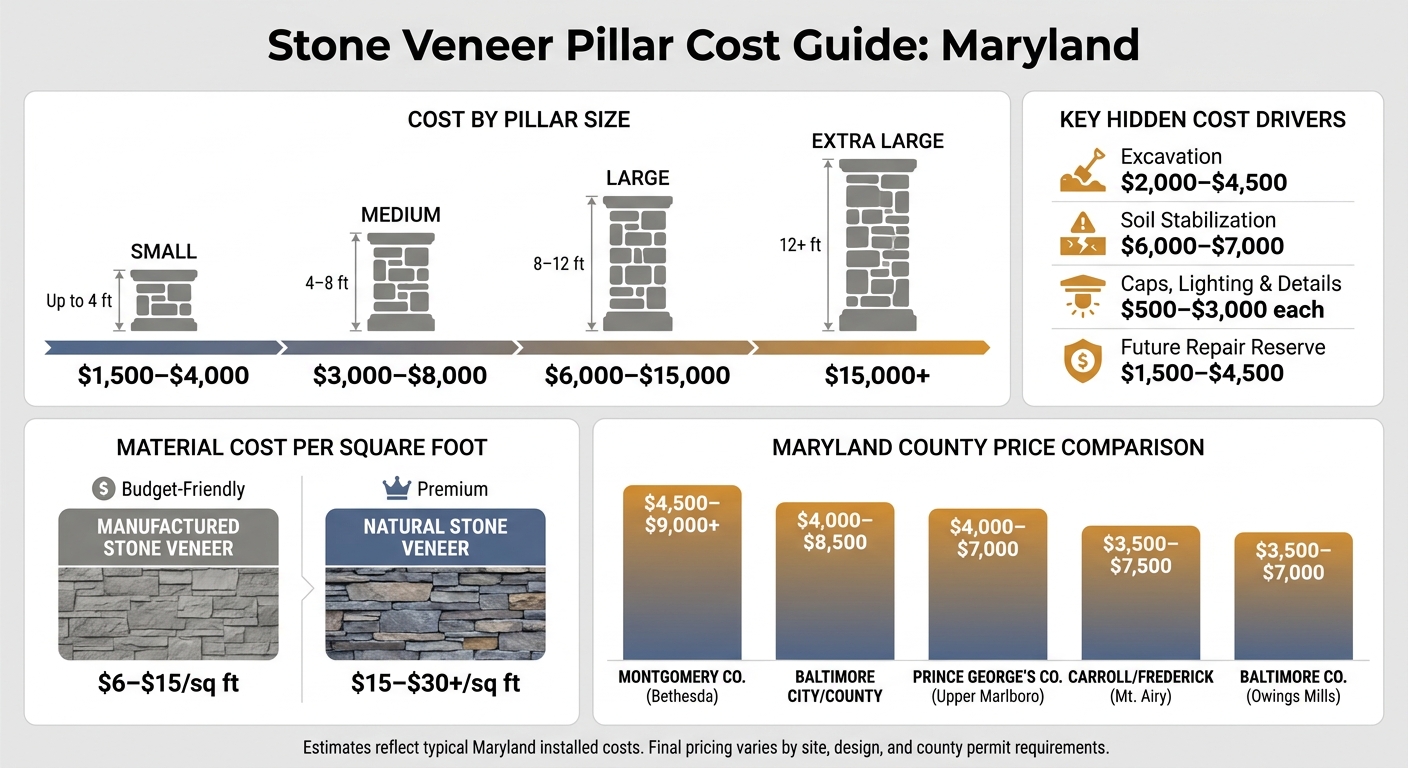
Stone Veneer Pillar Costs in Maryland: By Size & County
Average Stone Veneer Pillar Costs in Maryland
Typical Per-Pillar and Multi-Pillar Price Ranges
In Maryland, installed stone veneer pillar costs usually land in a few common ranges based on height.
Small pillars up to 4 feet tall often cost $1,500 to $4,000 per pillar. Medium pillars from 4 to 8 feet tall usually run $3,000 to $8,000 [2][4][1][3]. Large pillars from 8 to 12 feet tall tend to fall between $6,000 and $15,000, and anything over 12 feet can go past $15,000 [1][3].
For multi-pillar jobs, like entry columns or gate posts, total project costs often range from $3,500 to $9,000, depending on the site and the amount of work involved [4][1][3].
The main things that move the price up or down are material choice, labor, and structural work. In plain English: the stone matters, but the build behind the stone matters just as much.
Stone Veneer Cost Per Square Foot
Manufactured stone veneer usually costs $6 to $15 per square foot for materials only. Natural stone veneer usually starts around $15 to $30 per square foot and can go higher [5][2].
That number only covers the outer facing. It does not include the full installed pillar. The total project cost is higher because it also includes the structural core, excavation, and foundation work [2][1][6].
That’s where many homeowners get tripped up. Veneer pricing can look modest at first glance, but a pillar isn’t just a skin of stone wrapped around thin air.
Cost Table: Small, Medium, and Large Projects
| Project Scope | Typical Height | Estimated Maryland Installed Cost |
|---|---|---|
| Small | Up to 4 feet | $1,500 – $4,000 [2][4][1][3] |
| Medium | 4 – 8 feet | $3,000 – $8,000 [4][1][3] |
| Large | 8 – 12 feet | $6,000 – $15,000 [1][3] |
| Extra Large | Over 12 feet | $15,000+ [1] |
These ranges tend to climb when foundation work gets heavier, reinforcement is needed, or the crew has a harder time getting to the site.
sbb-itb-843f8be
What Drives the Total Cost: Materials, Labor, and Structural Work
Material Choices and Their Effect on Price
Once you get past the base price ranges, the next step is figuring out what makes one pillar cost more than another. A big part of that comes down to materials.
Material choice affects both the veneer price and the support structure behind it. Manufactured stone veneer is lighter and easier to install, which helps keep costs closer to the lower end [5]. Natural stone costs more and often needs a stronger, more expensive support structure [5][2][4].
That difference adds up fast. Two pillars may look similar from the street, but the material behind the finish can change the total by a lot.
Labor, Masonry Work, and Site Preparation
Labor costs climb when the job gets harder to execute. Tight site access, custom matching, and precise masonry work all push the price up.
In Maryland, some of the biggest hidden costs show up in excavation and stabilization. Excavation often runs $2,000 to $4,500 [3][4]. Soil stabilization can reach $6,000 to $7,000 on tougher sites [2][1]. Reinforced cores, capstones, and custom details add more [4][3][2].
It also pays to plan for lighting and drainage early. Retrofitting electrical or drainage work later usually costs more than building it in from the start [3][1].
These cost drivers don’t hit every job the same way. That’s why the same veneer can lead to very different totals depending on the size of the project, the site, and the amount of structural work involved.
Budget Breakdown Table: Three Project Scenarios
| Project Scenario | Key Cost Drivers |
|---|---|
| Small decorative/garden pillar | Basic footing, simple veneer, standard cap |
| Medium porch/structural support pillar | Reinforced core, structural footing, alignment labor |
| Large architectural/entry pillar | Deep footings, soil stabilization, custom caps, lighting |
Structural work and site prep usually create the biggest price swings, and those costs vary by county and site conditions. In central Maryland, those numbers can shift again depending on the local market and the county where the work happens.
How Pricing Differs Across Central Maryland
County and Market Factors That Affect Price
Once you’ve locked in the structure and materials, location becomes the next big cost driver. Stone veneer pillar pricing can change quite a bit across central Maryland. Projects closer to Washington, D.C., and Baltimore tend to cost more because labor rates are higher, demand is stronger, and permitting can take more time [1][2].
In Montgomery and Prince George’s counties, structural or load-bearing columns often need permits, which adds both time and cost [1][6]. In Carroll County and Frederick County, projects may land closer to the lower end of the regional price range. But that doesn’t mean they’re always cheap. Slope, foundation work, and access issues can still add to the total [2][4]. In plain terms: site conditions can change the math in any county.
Maryland County Pricing Comparison Table
The table below gives estimated price ranges for multi-pillar projects across central Maryland. Think of these as starting points, not fixed quotes. Final pricing depends on site conditions, pillar size, and whether the columns need structural support.
These ranges are directional, but they help show where labor, permitting, and site access tend to push costs higher.
| County / Area | Multiple Pillars (Typical Range) | Key Cost Drivers |
|---|---|---|
| Montgomery Co. (Bethesda) | $4,500 – $9,000+ | High labor rates, more complex permitting, taller structural requirements [1] |
| Baltimore City / County | $4,000 – $8,500 | Site access challenges, city permitting, foundation stabilization [2] |
| Baltimore Co. (Owings Mills) | $3,500 – $7,000 | Design complexity, material delivery, local regulations [3] |
| Carroll / Frederick (Mt. Airy) | $3,500 – $7,500 | Terrain and slope variations, foundation reinforcement needs [4] |
| Prince George’s Co. (Upper Marlboro) | $4,000 – $7,000 | Soil preparation, structural permits, site cleanup [6] |
Using Local Experience to Refine Estimates
Local site experience can help tighten an estimate, especially when drainage, soil, and access conditions vary from one property to the next across central Maryland [5]. That kind of on-the-ground knowledge is often what turns a rough range into a more precise project number.
How to Budget Wisely and Protect Long-Term Value
Ways to Lower Costs Without Changing the Design
After regional pricing, the next move is keeping an eye on the features that push the bid up. The simplest way to do that is to keep the design straightforward.
Keeping pillar height modest is the biggest cost lever. Taller pillars need more material, heavier structural support, and deeper footings. That combination drives the total up fast [2][3].
Material choice is another big factor. Manufactured stone veneer can give you a look close to natural stone for less in both material and labor, mainly because it weighs less [5]. And even after you choose the veneer, small design tweaks can still shift the final price.
You can also trim the budget by cutting add-ons that aren’t must-haves. Items like:
- Caps
- Lighting
- Custom detailing
can add $500–$3,000 each [2][3][4].
Maintenance, Repairs, and Design Choices That Affect Long-Term Cost
Lower upfront cost helps, but long-term performance matters more. A pillar that looks fine on day one can turn into a money pit if the drainage is poor or the footing is weak.
In Maryland, good drainage, solid footing, and proper installation have a big effect on long-term cost. When water isn’t managed well, or the base isn’t built right, deterioration tends to happen sooner. That can lead to repair work much earlier than expected [3][7].
It’s smart to leave room in the budget for future fixes and reinforcement. Deterioration repairs can cost $1,500–$4,000, and structural support work can add $1,500–$4,500 [3][7].
Conclusion: Key Costs and Planning Steps
In Maryland, stone veneer pillars usually cost $1,200–$2,800 for one decorative column and $3,500–$9,500 for projects with multiple pillars [1][2][3]. Before work starts, plan for height, structure, drainage, caps, and a repair reserve. For a Maryland estimate, Pro Landscapes MD can review site conditions and county requirements.
Real Stone Veneer Cost: Everything You Need to Know
FAQs
Do I need a permit for a stone veneer pillar in Maryland?
It depends on your local Maryland rules. In many cases, you’ll need a permit for larger structures, anything load-bearing, work that affects property lines, or jobs that involve major excavation.
Since rules can change from one municipality to the next, check your local code before you start. Permit fees usually fall between $150 and $500, depending on where you live.
What makes one stone veneer pillar cost more than another?
Cost mostly comes down to size, scope, and material.
Bigger, taller, or load-bearing pillars usually cost more than smaller decorative ones because they take more labor and more material. And the material itself matters too. Natural stone, manufactured stone veneer, and concrete can each land at very different price points.
Labor can climb for other reasons as well. Tough site conditions, foundation work, tricky excavation, permit needs, and add-ons like caps, lighting, or built-in planters can all push the total higher.
Is manufactured stone veneer cheaper than natural stone overall?
Yes. Manufactured stone veneer usually costs less than natural full-sized stone.
Both can give columns, walls, and outdoor kitchens an elegant, long-lasting finish. But stone veneer is much lighter. That means it’s easier to move, cut, and install, which often brings labor and installation costs down.
Chat with Us