









- bhavya gada
- No Comments
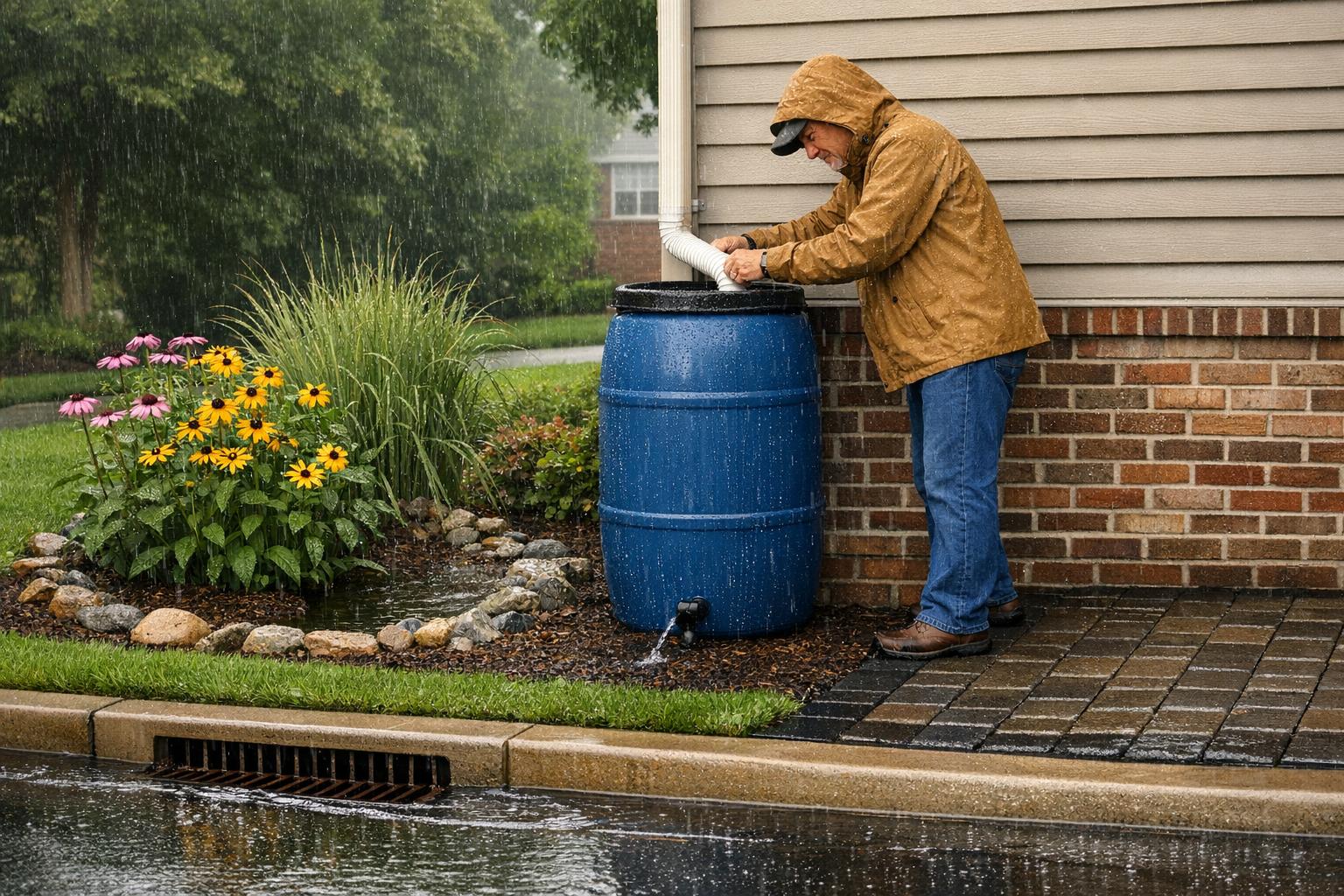
Stormwater fees in Howard County are calculated based on impervious surfaces like roofs and driveways, aiming to fund runoff management and meet federal water quality standards. These fees vary by property type and jurisdiction, with credits available for installing runoff-reducing features such as rain gardens or permeable pavers. Here’s a quick breakdown:
- Howard County: Fees based on impervious area; credits can fully offset costs if criteria are met.
- Baltimore City: Uses a tiered system integrated into water bills; credits reduce fees by up to 50–80%.
- Anne Arundel County: Combines flat rates for homes with impervious-based charges for larger properties; credits capped at ~50%.
Each jurisdiction reinvests these fees into stormwater projects like stream restoration and drainage upgrades. Homeowners can lower fees by improving drainage with approved solutions. Local contractors, like Pro Landscapes MD, can assist with installations that meet county requirements.
Quick Comparison:
| Factor | Howard County | Baltimore City | Anne Arundel County |
|---|---|---|---|
| Annual Fee (Single-Family) | $60 (avg.) | Varies by ERU | $20–$85 |
| Billing Method | Property tax bill | Water/sewer bill | Property tax bill |
| Max Credit | 100% | 50–80% | ~50% |
| Ease of Credits | Moderate | Limited in small lots | Requires documentation |
Homeowners facing runoff challenges can reduce fees and improve property conditions through targeted fixes like permeable paving or rain gardens.
Stormwater Fee Credit Workshop
sbb-itb-843f8be
Overview of Stormwater Fee Programs
Howard County, Baltimore City, and Anne Arundel County each have their own stormwater fee programs, all aimed at the same goal: securing dedicated funding to manage runoff and comply with federal water quality standards. While their objectives align, the methods for calculating fees, criteria for exemptions, and options for homeowners to reduce costs differ significantly across these areas.
This analysis evaluates these programs using four key criteria: Fee Calculation Basis, Exemptions and Credits, Residential Incentive Programs, and Overall Funding Strategy. These factors not only explain how much property owners are charged but also the reasoning behind the fee structures and the available options for reducing costs. Here’s a closer look at how each jurisdiction implements these elements.
At the heart of these programs is a fee structure tied to property characteristics. All three counties base their fees on impervious surface area, as these surfaces contribute to runoff. Baltimore City uses a tiered system based on impervious area categories, while Howard County and Anne Arundel County rely on an equivalent residential unit (ERU) model. Simply put, more impervious surface area means a higher fee.
To encourage on-site stormwater management, all three jurisdictions provide credits for property owners who install features like rain gardens, permeable pavers, cisterns, or green roofs. These credits can lower fees by a set percentage, though the exact percentages, eligibility rules, and renewal processes vary by location.
For residential properties, incentive programs are available to promote smaller-scale improvements that qualify for fee reductions. For example, in Howard County, installing a permeable paver driveway could reduce a homeowner’s annual Watershed Protection and Restoration Fee (WPRF). Local professionals, such as Pro Landscapes MD, can assist with designing and installing these types of improvements to ensure they meet the requirements for fee credits. These details provide a foundation for assessing the advantages and challenges of these programs in the next section.
1. Howard County‘s Watershed Protection and Restoration Fee (WPRF)
Fee Calculation Basis
Howard County’s WPRF is a fee determined by how much impervious surface – like roofs, driveways, and parking areas – exists on a property. Unlike traditional property taxes, it’s not based on the assessed value of your home. Instead, the fee reflects the property’s contribution to stormwater runoff issues, calculated using county records and imagery [2].
For single-family homes, the fee is often a flat rate or tiered based on the typical impervious area for similar properties. Non-residential and multi-family properties are charged differently, using an Equivalent Residential Unit (ERU) system. Here, one ERU corresponds to roughly 2,000–3,000 square feet of impervious area. The fee appears as a separate line item on your property tax bill [2].
This method allows for a fairer distribution of costs while enabling targeted exemptions and credits.
Exemptions and Credits
The WPRF includes several exemptions and credit opportunities to lower or eliminate the fee. Exemptions typically apply to:
- Properties owned by federal, state, or county governments
- Actively farmed agricultural land enrolled in conservation plans
- Undeveloped parcels with minimal impervious surfaces
- Certain nonprofits or religious institutions meeting specific criteria [1]
Fee credits are available for property owners who install approved stormwater management practices. These can include rain gardens, permeable pavements, cisterns, green roofs, or infiltration trenches. Credits are issued as a percentage reduction – sometimes up to 50–100% of the annual fee – depending on the scope of on-site stormwater treatment. Supporting documentation and periodic recertification are required to ensure these measures remain functional [1].
Residential Incentive Programs
Homeowners can take advantage of various incentive programs to offset the upfront costs of stormwater management features. Rebates and cost-sharing programs are available for practices like:
- Rain gardens
- Permeable pavement
- Rain barrels
- Conservation landscaping
- Tree planting
The county also provides technical assistance through workshops, staff guidance, and resources from partner organizations. These programs help homeowners choose the right solutions, size them correctly, and understand ongoing maintenance needs [1].
Local professionals, such as Pro Landscapes MD, can help with installing approved stormwater solutions like environmental pavers, French drains, or dry riverbeds. These projects not only qualify for fee credits but also improve overall property drainage.
Overall Funding Strategy
Revenue from the WPRF is strictly reserved for watershed protection and stormwater management projects. It cannot be used for unrelated county expenses. To complement this income, Howard County also relies on general funds, state and federal grants (including support from the Chesapeake Bay Trust and the Maryland Department of the Environment), and capital improvement program financing for larger projects like stream restorations and stormwater facility upgrades [1].
This diversified funding approach ensures the county has a steady and reliable revenue stream to plan long-term projects, meet MS4 permit requirements, and maintain compliance with federal stormwater standards [2]. It’s a crucial part of the county’s strategy to manage stormwater in a sustainable and effective way.
2. Baltimore City’s Stormwater Utility Fee

Fee Calculation Basis
Baltimore City uses a utility fee approach instead of a general tax to fund stormwater management. This fee is determined by the amount of impervious surface on a property, assessed through GIS mapping and high-resolution imagery. For residential properties, the city employs a flat-rate tier system based on housing types – such as single-family homes, rowhouses, or condos – making billing straightforward and aligning fees with each property’s runoff potential. Non-residential properties follow an Equivalent Residential Unit (ERU) system. For instance, a commercial property with 10,000 square feet of impervious surface would pay $600 annually, assuming a rate of $60 per ERU (where 1 ERU equals 1,000 square feet). Property owners who believe their property has been misclassified can request a review by providing documentation like site surveys, as-built plans, or photos.
Exemptions and Credits
Exemptions from the fee generally apply to properties owned by federal, state, or municipal entities, public rights-of-way, undeveloped parcels with minimal impervious surfaces, and certain nonprofits or religious institutions. Exemption eligibility depends on land use and ownership classification.
Property owners can also earn credits by installing approved stormwater management systems. Examples include rain gardens, green roofs, permeable pavers, cisterns, and bioretention facilities. These credits can reduce the annual fee by 50% to 80%, depending on how much impervious surface is managed. To qualify, owners must submit design plans or as-built drawings, ensure the controls are appropriately sized for the drainage area, and sign a maintenance agreement. Regular inspections are required to maintain the credit.
Residential Incentive Programs
Homeowners in Baltimore can take advantage of rebate and cost-sharing programs to offset the costs of installing stormwater management features. Rebates are available for projects such as rain gardens, native plantings, rain barrels, and permeable pavers, with some programs offering up to $4,000 per property. Additionally, free or low-cost technical support, workshops, and site visits help homeowners choose and design the best solutions. These programs not only reduce upfront costs but also make homeowners eligible for ongoing fee reductions through credits. For those dealing with persistent yard drainage issues, companies like Pro Landscapes MD offer integrated solutions – such as French drains, dry riverbeds, and grading – that can qualify for credits while addressing water problems.
Overall Funding Strategy
Baltimore’s stormwater utility relies on a dedicated revenue stream, ensuring that all funds collected are used exclusively for stormwater-related purposes. These include maintaining drainage systems, retrofitting green infrastructure, constructing new stormwater facilities, and meeting regulatory requirements like the city’s MS4 permit and Chesapeake Bay restoration goals. By tying fees directly to impervious surfaces, this approach provides financial stability and ensures a clear connection between runoff generation and fee responsibility. This funding model sets the stage for examining how Anne Arundel County handles its stormwater fees.
3. Anne Arundel County‘s Stormwater Fee
Fee Calculation Basis
Anne Arundel County takes a hybrid approach to stormwater fees, combining flat rates for residential properties with impervious-area-based charges for larger properties. For residential homes, charges are based on housing type: $85/year for single-family detached homes, $34/year for townhouses or duplexes, and $20/year for condominiums. Non-residential properties are billed using an Equivalent Residential Unit (ERU) system, where one ERU represents about 2,800–3,000 square feet of impervious surface. The rate for these properties falls between $80–$90 per ERU annually. For example, a commercial property with 30,000 square feet of impervious area would account for roughly 10–11 ERUs, resulting in an annual fee of $800–$990.
Exemptions and Credits
The county offers exemptions and credits to help manage stormwater fees. Certain properties, such as federal, state, and county facilities, are either exempt or charged at reduced rates. Properties with on-site stormwater systems that meet current design standards may also qualify for lower fees. Additionally, agricultural land using best management practices (BMPs) and parcels with minimal impervious surfaces may be eligible for partial or full exemptions.
For those looking to reduce their fees, the county provides credits for installing approved stormwater control measures. Examples of qualifying practices include rain gardens, bioretention cells, permeable pavers, vegetated swales, rain barrels, and cisterns. To apply, property owners must submit documentation like site plans, photos, or as-built drawings, and they’re required to maintain the installations. If a system falls into disrepair, the county may revoke the credit.
Residential Incentive Programs
Beyond fee reductions, Anne Arundel County encourages homeowners to participate in incentive programs aimed at improving stormwater management. Rebates are available for installing rain gardens and rain barrels, often through funding partnerships with the Chesapeake Bay Trust. Companies like Pro Landscapes MD can help homeowners design solutions that meet the county’s standards. For example, combining a rain garden with a permeable paver patio not only addresses drainage issues but can also lower the homeowner’s annual stormwater fee.
Overall Funding Strategy
Revenue from the stormwater fee supports the county’s Watershed Protection and Restoration Fund (WPRF), which generates approximately $18–$23 million annually. This fund was established following Maryland’s 2012 stormwater remediation law. While the state relaxed mandatory fee requirements in 2015, Anne Arundel County retained its fee system and adopted a blended funding model. This approach combines fee revenue with general fund contributions, grants, and bonds to finance key projects like stream restorations, stormwater pond upgrades, outfall stabilization, and compliance with MS4 permit requirements tied to Chesapeake Bay TMDL goals. Given its extensive Bay shoreline and high levels of impervious cover, the county’s per-capita stormwater investments stand out compared to other jurisdictions in the region.
Pros and Cons
Stormwater Fee Comparison: Howard County vs. Baltimore City vs. Anne Arundel County
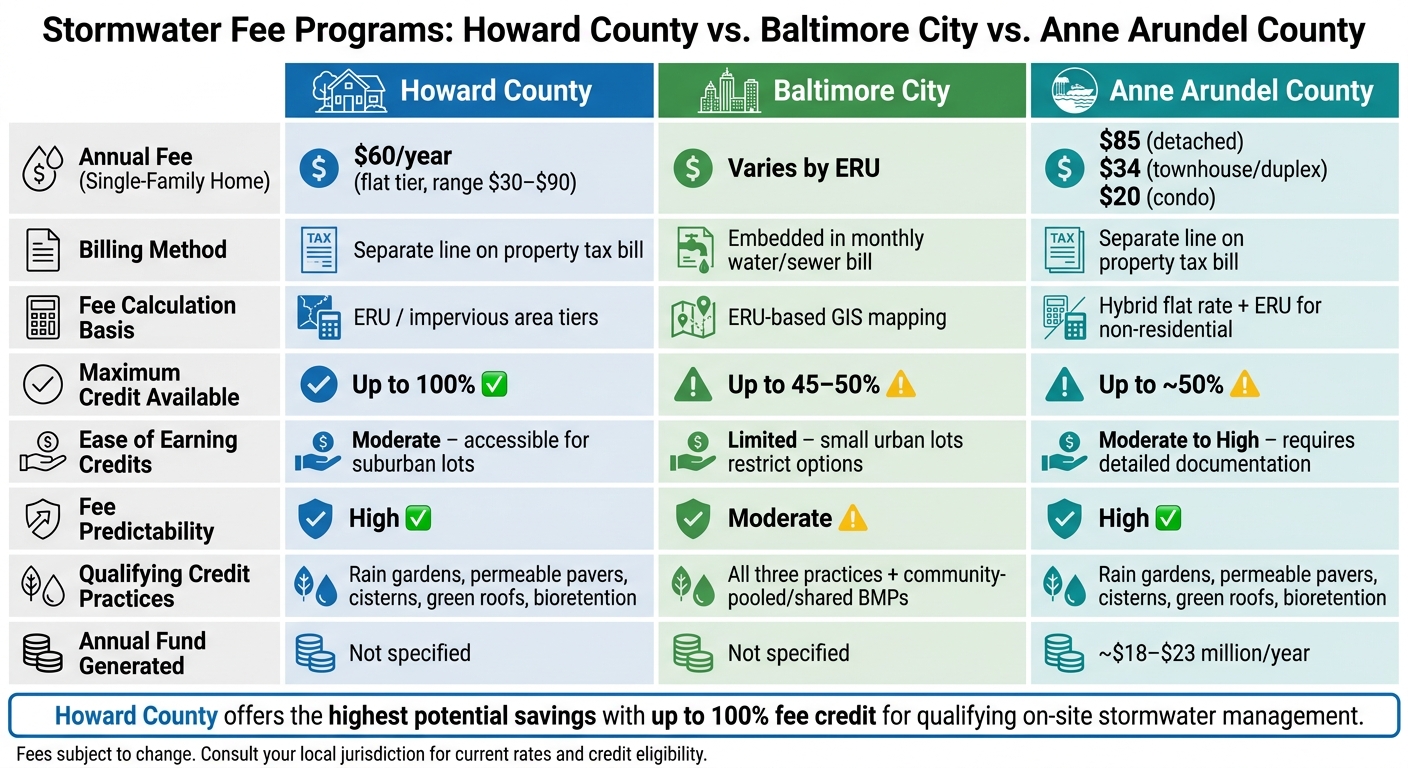
Let’s break down the main aspects of stormwater fee programs for homeowners across three areas: Howard County, Baltimore City, and Anne Arundel County. Here’s a quick comparison:
| Factor | Howard County (WPRF) | Baltimore City | Anne Arundel County |
|---|---|---|---|
| Typical annual cost (single-family) | $60/year (most homes); $30–$90/year range | Varies by ERU | Varies by housing type |
| Billing method | Separate line item on property tax bill | Embedded in monthly water/sewer bill | Separate line item on property tax bill |
| Fee predictability | High – flat tiers are easy to anticipate | Moderate – bundled with rising water costs | High – fixed by housing type |
| Link to impervious area (fairness) | Strong – tiers reflect lot size and surface | Moderate – ERU-based but less granular | Moderate – hybrid flat/ERU model |
| Maximum credit available | Up to 100% for full on-site treatment | Up to 45–50% for on-site BMPs | Up to approximately 50% depending on practices |
| Ease of earning credits | Accessible for suburban lots with space | Limited by small lot sizes in dense neighborhoods | Requires structured application and documentation |
| Administrative burden | Moderate – application and maintenance required | Moderate – credit stacking can be complex | Moderate to high – documentation and renewals needed |
| Visibility of fee on bill | Clear, separate line item | Less visible; embedded in water bill | Clear, separate line item |
This table highlights the distinct approaches each area takes. Howard County stands out with its flat-tier system and the potential to offset fees entirely through proper on-site stormwater management. This makes budgeting easier for homeowners, especially since credits can fully eliminate fees when all criteria are met.
Baltimore City, on the other hand, integrates the stormwater fee into the monthly water bill, which can make the charge less obvious, particularly as water rates continue to rise. However, the city offers a unique option for community-pooled credits. This setup allows neighbors or homeowner associations to collaborate on shared BMPs (best management practices), making it a practical solution in urban areas where individual lot space is tight.
Anne Arundel County keeps things straightforward with its tiered flat rates, but the credit cap of around 50% limits how much homeowners can save, even with green infrastructure investments. The application process can also be cumbersome, requiring detailed documentation like photos, site plans, and periodic renewals, which may deter some homeowners from pursuing credits.
For those considering new impermeable surfaces, taking proactive steps can help reduce fees. Installing permeable pavers or adding rain gardens are great ways to keep costs down while potentially qualifying for credits. Companies like Pro Landscapes MD specialize in designing and installing features such as permeable pavers, French drains, and rain gardens that meet county requirements and address drainage needs.
Conclusion
In all three jurisdictions, stormwater fees are calculated based on impervious surfaces, with the funds directed toward drainage, water quality, and restoration initiatives. The specifics of how these fees are structured, however, can have a big impact on household budgets.
Howard County stands out with its flat-tier model and a more straightforward credit system compared to the more intricate setups seen elsewhere. Still, many homeowners struggle to understand how their fees are calculated or what credits they might qualify for. For smaller properties, the process of applying for credits can feel daunting. On the upside, Howard County reinvests these fees locally, supporting projects like stream restoration and neighborhood retrofits.
For homeowners, these distinctions offer practical takeaways. Think of the Watershed Protection and Restoration Fee (WPRF) as a signal that your property might benefit from site improvements. Signs like a backyard that slopes and pools water, a driveway prone to runoff, or ongoing yard erosion are all indicators that targeted fixes could address real problems – and possibly lower your fee. Simple improvements, such as regrading low areas, installing a French drain, or swapping out concrete for permeable pavers, can make a noticeable difference.
If you’re unsure where to start, consider consulting a local stormwater contractor. Pro Landscapes MD specializes in serving Howard County communities like Columbia, Ellicott City, Elkridge, and Glenwood. They offer solutions such as drainage systems and permeable paver installations that not only manage runoff but also align with the county’s credit criteria. These installations can replace traditional impervious surfaces, improve drainage, minimize winter ice buildup, and even boost curb appeal – all while potentially qualifying for a WPRF reduction.
FAQs
How do I find my property’s impervious area?
To determine the impervious area of your property for stormwater fee calculations, start by visiting Howard County’s official resources. These include the property tax assessment database or the stormwater management portal. Both tools offer information about square footage and non-porous surfaces like roofs, driveways, and patios.
Pro Landscapes MD recommends double-checking this data to better understand your stormwater requirements. They also suggest considering solutions such as permeable pavers or swales, which can help improve drainage and minimize the effects of runoff.
What qualifies for a 100% WPRF credit in Howard County?
The exact qualifications for receiving a full 100% Water Protection Restoration Fee (WPRF) credit in Howard County aren’t detailed here. While Pro Landscapes MD provides stormwater management solutions such as drainage systems, rain gardens, and permeable pavers, it’s essential to verify the eligibility criteria directly with official Howard County resources or the Department of Public Works.
How often do stormwater fee credits need renewal?
The information provided doesn’t clarify how frequently stormwater fee credits need to be renewed in Howard County. To help with proper drainage and runoff management, Pro Landscapes MD offers services such as installing drainage systems, creating swales, and using permeable pavers. For precise details about renewal schedules or local requirements, it’s best to reach out directly to the Howard County government.
Chat with Us