









- bhavya gada
- No Comments
Choosing the right stormwater filtration system can save you money, meet local laws, and protect waterways. In Washington County, stormwater runoff carries pollutants into creeks, rivers, and the Chesapeake Bay. To combat this, property owners must comply with strict regulations, including annual fees for impervious surfaces. Installing effective stormwater systems like rain gardens, sand filters, or permeable pavers can reduce pollution and lower costs.
Key Options for Stormwater Management:
- Rain Gardens: Low-cost, natural filtration using plants and soil.
- Sand Filters: Efficient pollutant removal for residential areas.
- Permeable Pavers: Hardscaping that allows water infiltration.
- Dry Riverbeds: Aesthetic channels that filter runoff naturally.
- French Drains: Underground systems to redirect and clean water.
- Pro Landscapes MD Solutions: Customized designs for complex needs.
Each system has unique costs, maintenance needs, and compliance requirements. For example, rain gardens cost $5,000–$10,000 per acre drained and require monthly upkeep, while permeable pavers offer long-term savings with annual cleaning. Choosing the best system depends on your site, budget, and local guidelines.
Washington County Stormwater Filtration Systems Comparison: Costs, Efficiency & Maintenance
How the Filterra Stormwater Bioretention System Works – Contech Engineered Solutions

sbb-itb-843f8be
1. Bold & Gold Filtration Media
Bold & Gold filtration media is a specialized solution for removing TSS (total suspended solids), phosphorus, heavy metals, and hydrocarbons from stormwater runoff in Washington County [1]. It works by channeling water through engineered media that traps these pollutants, ensuring cleaner runoff.
Filtration Efficiency
This filtration media is crafted to target common stormwater pollutants [1]. Through a combination of chemical and physical processes, it captures fine particles and dissolved contaminants. This makes it particularly suitable for commercial areas with large paved surfaces, where runoff tends to carry higher levels of pollutants [1].
Maintenance Needs
Maintenance is required every 1 to 5 years [1], depending on site conditions. Regular inspections, media replacement, and cleaning ensure the system continues to function effectively. Visible signs of reduced performance help identify when service is needed.
Compliance with Local Standards
Bold & Gold media meets local environmental standards by efficiently removing pollutants like TSS and phosphorus. This not only ensures regulatory compliance but also helps protect nearby waterways from contamination.
2. Sand Filters
Sand filters clean stormwater by passing it through layers of sand and other media that trap particles and absorb pollutants like TSS (total suspended solids), hydrocarbons, nutrients, and heavy metals [1]. As the water moves through the sand, contaminants are physically filtered out.
Filtration Efficiency
These filters are particularly effective at removing pollutants commonly found in residential areas, such as phosphorus from fertilizers and oil from driveways [1]. Some advanced systems use materials like perlite, zeolite, or activated carbon to target specific pollutants. Many manufactured sand filters also feature a siphon-actuated mechanism that ensures water flows evenly through the media, improving pollutant removal [1]. This is crucial, considering over 60% of water pollution originates from non-industrial sources like leaking motor oil and fertilizers [2].
Installation Complexity
Modern sand filter systems often come pre-assembled, making installation quicker and easier than older, cast-in-place systems [1]. They can be configured in various forms – such as catch basins, manholes, or vaults – to suit specific site needs and reduce the system’s footprint [1]. For accurate budgeting, consult an engineer for a site-specific estimate [1]. The simplified installation process pairs well with routine maintenance requirements.
Maintenance Needs
Regular maintenance, typically every 1 to 5 years, is critical [1]. Tasks include inspecting the system, replacing the filter media, and cleaning the structure to prevent clogs and maintain pollutant removal efficiency. Certified maintenance providers can help ensure compliance with local environmental regulations while keeping long-term costs in check [1].
Compliance with Washington County Standards
In Washington County, sand filters must adhere to the Post Construction Stormwater Ordinance and the Resolution LID Manual [2]. Additionally, the Maryland Department of the Environment (MD DOE) has specific approvals for manufactured filtration systems [1]. Before installation, it’s important to consult the local Stormwater Coordinator to confirm the design complies with current county grading and stormwater management requirements [2].
Next, we’ll look at dry riverbeds as another effective option for managing stormwater.
3. Dry Riverbeds
Dry riverbeds are designed to mimic natural seasonal streams, channeling stormwater through carefully arranged rocks. These rocks not only guide water flow but also help filter out pollutants during rainstorms. As water moves through the channel, soil layers beneath the surface work to trap contaminants like phosphates, dirt, and oil, preventing them from reaching storm drains or nearby waterways [2].
Filtration Efficiency
The filtration process relies on the soil layers to capture pollutants as water seeps downward. This is especially important in Washington County, where non-point pollution sources – like motor oil leaks, garden fertilizers, and malfunctioning septic systems – pose a major threat to water quality [2]. By directing runoff through areas with vegetation and natural soil, dry riverbeds can significantly reduce the amount of harmful substances entering storm drains.
Installation Complexity
Building a dry riverbed requires thoughtful planning to ensure it functions properly. The channel must be graded to capture natural runoff and direct it to areas where the soil can effectively filter the water. Rock size and placement play a critical role: larger stones provide structure, while smaller gravel helps with water infiltration and movement. The installation process involves excavation, grading, and carefully placing stones to balance effective drainage with aesthetic appeal.
Maintenance Needs
To keep a dry riverbed functioning efficiently, regular maintenance is essential. This includes clearing debris like leaves and sediment that can block water flow, as well as repositioning stones that may shift after heavy rains. Preventing spills or illicit discharges into the channel is crucial to maintaining its filtration ability. Routine inspections ensure the system operates as intended and continues to protect local waterways [2].
Compliance with Washington County Standards
As with other stormwater systems, dry riverbeds must comply with Washington County’s Post Construction Stormwater Ordinance and the Resolution LID Manual. Any installation affecting the storm drain system requires stormwater approval. Before beginning the project, consult the local Stormwater Coordinator to ensure your design meets the guidelines outlined in the Washington City Grading Manual Ordinance [2].
4. Rain Gardens
Rain gardens work alongside dry riverbeds to naturally manage and filter stormwater runoff. These shallow depressions are designed to collect rainwater, allowing it to pool temporarily. As the water seeps into the ground, the soil and plants filter out pollutants like motor oil, fertilizers, and detergents before they can enter storm drains or waterways. This process not only protects local water quality but also enables plants to absorb extra nutrients while the soil traps harmful chemicals. In Washington County, rain gardens are a widely used Low Impact Development (LID) solution [2].
Filtration Efficiency
Rain gardens excel at filtering pollutants before they can harm lakes and rivers. The soil and vegetation act as natural barriers, particularly effective against phosphates found in soaps and fertilizers. These phosphates can cause algae blooms, which deplete oxygen levels in the water as they decay, endangering aquatic ecosystems [2].
Installation Complexity
Proper planning is key when installing a rain garden. The site must be carefully chosen to capture runoff from roofs, driveways, or other hard surfaces. The area should be graded to direct water into the garden, and the soil must be prepared to ensure adequate drainage and filtration. Since rain gardens must comply with LID regulations, it’s essential to consult Washington County’s Resolution LID Manual and Best Management Practices Standard Notes and Details. Additionally, any installation that could affect the local drainage system requires stormwater approval [2].
Maintenance Needs
Keeping a rain garden functional requires regular maintenance. Avoid overusing fertilizers, especially before rainstorms, to reduce the risk of nutrient runoff. Adding organic soil amendments, like compost, can promote healthy plant growth while minimizing the need for chemical fertilizers. Routine tasks include clearing debris, replacing mulch, and checking the health of the plants. For specific compliance questions, you can contact the Washington City Stormwater Coordinator at 656-6317 [2].
Compliance with Washington County Standards
Rain gardens are an important tool in managing runoff and reducing pollutants in Washington County. They must meet the requirements of the Post Construction Stormwater Ordinance and the Resolution LID Manual. Developers and contractors are expected to follow long-term stormwater management practices. Before starting a project, confirm that your design aligns with local regulations by consulting the Stormwater Coordinator [2].
5. French Drains
French drains are underground systems designed to redirect excess water away from areas prone to flooding while also filtering out pollutants. These systems use perforated pipes surrounded by gravel, which are placed in trenches to channel stormwater away from foundations, yards, or other vulnerable spots. As water flows through the gravel and soil, pollutants like phosphates, dirt, and oil are naturally filtered before the water reaches storm drains or local waterways [2]. This dual-purpose design helps protect structures and improves water quality.
Filtration Efficiency
French drains rely on the natural filtration properties of soil, making them a practical solution for managing stormwater in Washington County. This is especially important in addressing non-point pollution sources, such as motor oil leaks, fertilizers, and septic system issues. To safeguard regional water resources like the Virgin River, these systems must adhere to Washington County’s Best Management Practices Standard Notes and Details [2].
Installation Complexity
Installing French drains in Washington County comes with specific requirements to meet local regulations. The system must comply with grading and post-construction stormwater ordinances. For projects that might affect the municipal storm drain system, approval from the Washington City Stormwater Coordinator (656-6317) is necessary. Depending on the project’s scope and location, additional approval may also be required from the Maryland Department of the Environment (MD DOE). Proper grading, pipe placement, and gravel selection are critical to meeting the standards outlined in the Resolution LID Manual [2][1]. When installed correctly, these systems require minimal adjustments over time.
Maintenance Needs
To ensure long-term performance, French drains need regular maintenance. Sediment buildup can block the drainage system, so routine inspections are essential. Maintenance tasks include clearing debris, checking that perforated pipes are free of clogs, and ensuring the gravel layer remains clean and functional. After heavy rain, inspections should confirm proper water flow. These steps help keep the system compliant with the Post Construction Stormwater Ordinance and maintain its effectiveness [2].
6. Permeable Pavers
Permeable pavers are a type of hardscaping material designed to let water seep directly into the ground below. Unlike traditional concrete or asphalt, these pavers include gaps or are made with porous materials that allow stormwater to flow through naturally. This not only reduces runoff but also filters out pollutants before the water enters storm drains. In Washington County, permeable pavers are used for driveways, patios, and walkways, doubling as an effective stormwater management solution.
Filtration Efficiency
These pavers work by letting stormwater pass through the ground, where the soil acts as a natural filter. The system effectively traps and removes contaminants like total suspended solids (TSS), hydrocarbons, nutrients such as phosphorus, and heavy metals [2][1]. To achieve this level of filtration, proper base preparation and the use of high-quality aggregate materials are critical.
Installation Complexity
Installing permeable pavers requires adherence to Washington County’s Post Construction Stormwater Ordinance and the guidelines outlined in the Resolution LID Manual [2]. The process involves excavating the area, preparing a graded base with specific layers of aggregate, and ensuring the pavers are spaced correctly. While this process is more intricate than standard paver installations, it provides long-term benefits for stormwater management when done properly.
Maintenance Needs
Regular maintenance is key to keeping permeable pavers functioning as intended. Inspections can help identify when maintenance is needed [1]. Tasks include vacuuming or power washing the surface to clear out sediment that may clog the joints, replacing joint aggregate material, and verifying that water is infiltrating effectively. Maintenance is typically required every 1–5 years [1]. Inspections after heavy rain are particularly useful for spotting areas where infiltration might be slowing, allowing for timely cleaning to prevent a drop in performance. These pavers work well alongside other stormwater management strategies, creating opportunities for integrated solutions like Pro Landscapes MD Stormwater Solutions.
7. Pro Landscapes MD Stormwater Solutions

Pro Landscapes MD specializes in stormwater management for Washington County by combining proven filtration technologies with custom drainage solutions. Their approach incorporates biofiltration systems like FocalPoint, widely used across Maryland for urban green spaces, landscaped basins, and roadway curb applications [3]. These systems work hand in hand with traditional methods such as French drains and dry riverbeds, creating tailored solutions for each property. This blend of modern and traditional techniques strengthens Washington County’s overall stormwater management efforts.
Filtration Efficiency
Pro Landscapes MD designs their stormwater solutions to effectively remove pollutants like Total Suspended Solids (TSS), Phosphorus, and Nitrogen [3][1]. For properties needing underground solutions, they offer the Stormwater Management StormFilter. This primary treatment system, approved for use in Maryland, uses rechargeable media cartridges to tackle pollutants [1]. The system can also be configured as a "Volume StormFilter" to address specific runoff volume requirements, ensuring both pollutant reduction and effective water management.
Installation Complexity
Every project begins with detailed site engineering, which includes hydraulic calculations, buoyancy evaluations, and precise sizing of units to meet local regulations [1]. Whether the project involves surface-level solutions like rain gardens and permeable pavers or underground systems requiring excavation, Pro Landscapes MD ensures all technical aspects are handled. Their team prepares detailed drawings and coordinates with Washington County authorities, simplifying the approval process. The complexity of the installation depends on the type of system chosen, but their expertise ensures smooth execution regardless of the project scope.
Maintenance Needs
Pro Landscapes MD installations are designed for long-term reliability, with maintenance intervals typically ranging from 1 to 5 years [1]. Systems include surface-visible indicators and easy-access points for inspection, media replacement, and cleaning [1]. Many of their systems feature a siphon-actuated cleaning mechanism that minimizes sediment buildup, reducing the need for frequent manual maintenance. This proactive design ensures the systems maintain peak performance over time.
Compliance with Washington County Standards
All Pro Landscapes MD stormwater solutions adhere to technologies approved by the Maryland Department of the Environment (MD DOE) [1]. By meeting these standards, the company ensures its installations align with Washington County’s stormwater management strategy. Their team handles the necessary documentation and engineering support, making the compliance process straightforward for property owners. With extensive experience across central Maryland, they design systems that not only meet local regulations but also integrate seamlessly with existing landscapes.
System Comparison Table
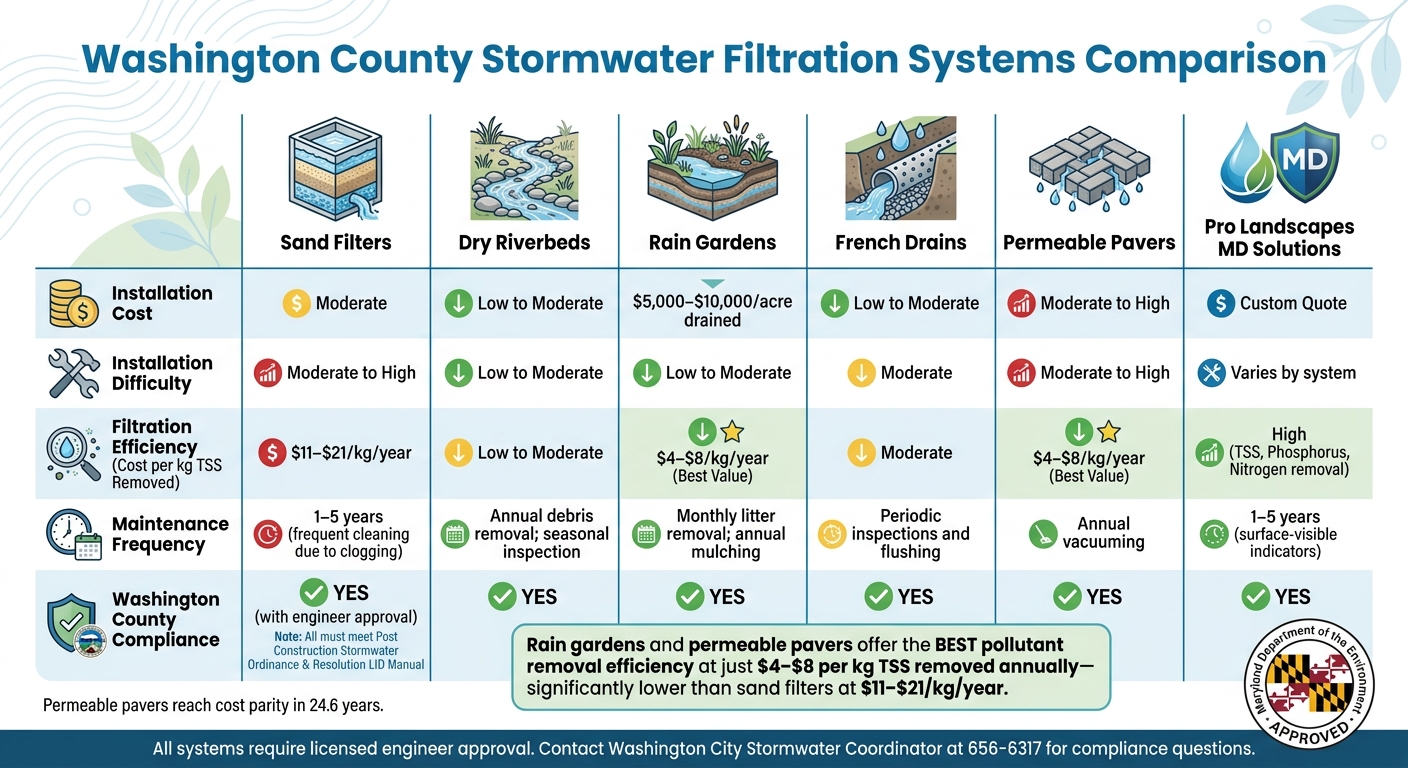
The table below outlines the primary features of various stormwater systems suitable for Washington County properties. It includes details on cost, efficiency, and compliance to help you weigh your options and decide on the best stormwater solution for your needs.
Table: Comparison of Stormwater Systems
| System Type | Installation Cost | Installation Difficulty | Filtration Efficiency (Cost per kg TSS Removed) | Maintenance Requirements | Washington County Compliance |
|---|---|---|---|---|---|
| Sand Filters | Moderate | Moderate to High | Moderate ($11–$21/kg/year)[4] | Frequent cleaning due to clogging | Yes (with engineer approval) |
| Dry Riverbeds | Low to Moderate | Low to Moderate | Low to Moderate | Annual debris removal; seasonal inspection | Yes (with engineer approval) |
| Rain Gardens | $5,000–$10,000/acre drained[5] | Low to Moderate | High ($4–$8/kg/year)[4] | Monthly litter removal; annual mulching[5] | Yes (with engineer approval) |
| French Drains | Low to Moderate | Moderate | Moderate | Periodic inspections and flushing | Yes (with engineer approval) |
| Permeable Pavers | Moderate to High | Moderate to High | High ($4–$8/kg/year)[4] | Annual vacuuming; 24.6 years to cost parity[4] | Yes (environmental pavers approved) |
| Pro Landscapes MD Solutions | Custom Quote | Varies by system | High (TSS, Phosphorus, Nitrogen removal) | 1–5 years; surface-visible indicators | Yes (MD DOE approved technologies) |
Rain gardens and permeable pavers stand out for their pollutant removal efficiency, costing just $4–$8 per kilogram of Total Suspended Solids (TSS) removed annually. This is significantly lower than the $11–$21 per kilogram for sand filters and conventional wet ponds[4]. James J. Houle, Program Manager at the UNH Stormwater Center, emphasizes:
"The results of this study indicate that generally, LID systems, as compared to conventional systems, have lower marginal maintenance burdens (as measured by cost and personnel hours) and higher water quality treatment capabilities as a function of pollutant removal performance"[4].
Key Compliance and Cost Considerations:
- Licensed engineer approval is required for all systems.
- The county prioritizes holding and retention basins for subdivisions but allows Low Impact Development (LID) options, like rain gardens, in commercial and industrial areas with 100 or fewer peak hour trips[6].
- Systems must remain separate from sanitary sewage and avoid causing drainage issues for neighboring properties[6].
When calculating bioretention costs, you can offset traditional landscaping expenses. For instance, if a rain garden installation costs $8,000 but replaces $3,000 worth of standard landscaping, the net stormwater cost is $5,000[5]. While permeable pavers take 24.6 years to reach cost parity, wet ponds achieve it in just 5.2 years[4].
Conclusion
Choosing the right stormwater filtration system for your Washington County property is essential for meeting regulations, safeguarding your investment, and protecting the environment. As Contech Engineered Solutions explains:
"As stormwater quality regulations become more stringent, engineers need a filtration device that can tackle the most challenging pollutants and provide the flexibility to meet the needs of a variety of sites" [1].
Every property has its own set of challenges, from specific pollutant concerns to hydraulic limitations, making tailored solutions far more effective than a universal approach.
The Journal of Contemporary Water Research & Education highlights an important consideration: without proper maintenance, the performance of stormwater Best Management Practices (BMPs) can decline by over 50% within just a few years [7].
To address these challenges, start with a thorough site evaluation to pinpoint key pollutants and choose filtration media that aligns with your needs. Options include PhosphoSorb for phosphorus, Zeolite for soluble metals and ammonium, or Perlite for TSS and oil removal [1]. For infiltration-based systems, conducting percolation tests is critical, and ensure your chosen technology is approved by the Maryland Department of the Environment.
Pro Landscapes MD offers custom stormwater solutions like French drains, dry riverbeds, rain gardens, and environmental paver installations. Their expertise ensures compliance with local standards while tailoring maintenance schedules (typically every 1 to 5 years) to keep your system running efficiently and reduce long-term costs [1].
FAQs
Which stormwater system is best for my property?
The right stormwater system for your property hinges on your unique requirements – whether it’s managing sediment, heavy metals, oil, nutrients, or contaminants like PFAS. It’s also crucial to factor in site conditions and comply with local regulations to ensure the system effectively tackles your specific stormwater issues.
Do I need a licensed engineer and county approval?
Yes, you’ll usually need a licensed engineer and county approval for stormwater filtration systems. This ensures the system complies with local regulations and is designed correctly to manage stormwater effectively.
How can I estimate long-term maintenance costs?
To get a handle on long-term maintenance costs for stormwater filtration systems, you’ll need to keep a few key factors in mind. One of the biggest expenses is replacing the filter media, which often hinges on how much water the system processes and the level of contaminants it filters out.
Routine inspections and cleanings are also essential, along with addressing any necessary repairs that might pop up over time. It’s smart to review service agreements or warranties for details about scheduled maintenance. For a more accurate estimate, touch base with your system provider – they can help create a maintenance plan tailored to your local conditions and how your system is being used.
Chat with Us