









- bhavya gada
- No Comments
Check dams are small structures placed across swales or ditches to slow water flow, reduce erosion, and trap sediment. They are particularly useful during construction or in areas with steep slopes and concentrated runoff. These dams are designed with strict guidelines, such as a triangular shape and a lower center to direct water flow effectively. Materials like rocks, sandbags, or commercial products are commonly used, and proper maintenance – like sediment removal and regular inspections – is essential for long-term functionality. When installed correctly, check dams protect landscapes and improve water quality by preventing sediment from polluting downstream areas.
What Are Check Dams?
Definition and Structure
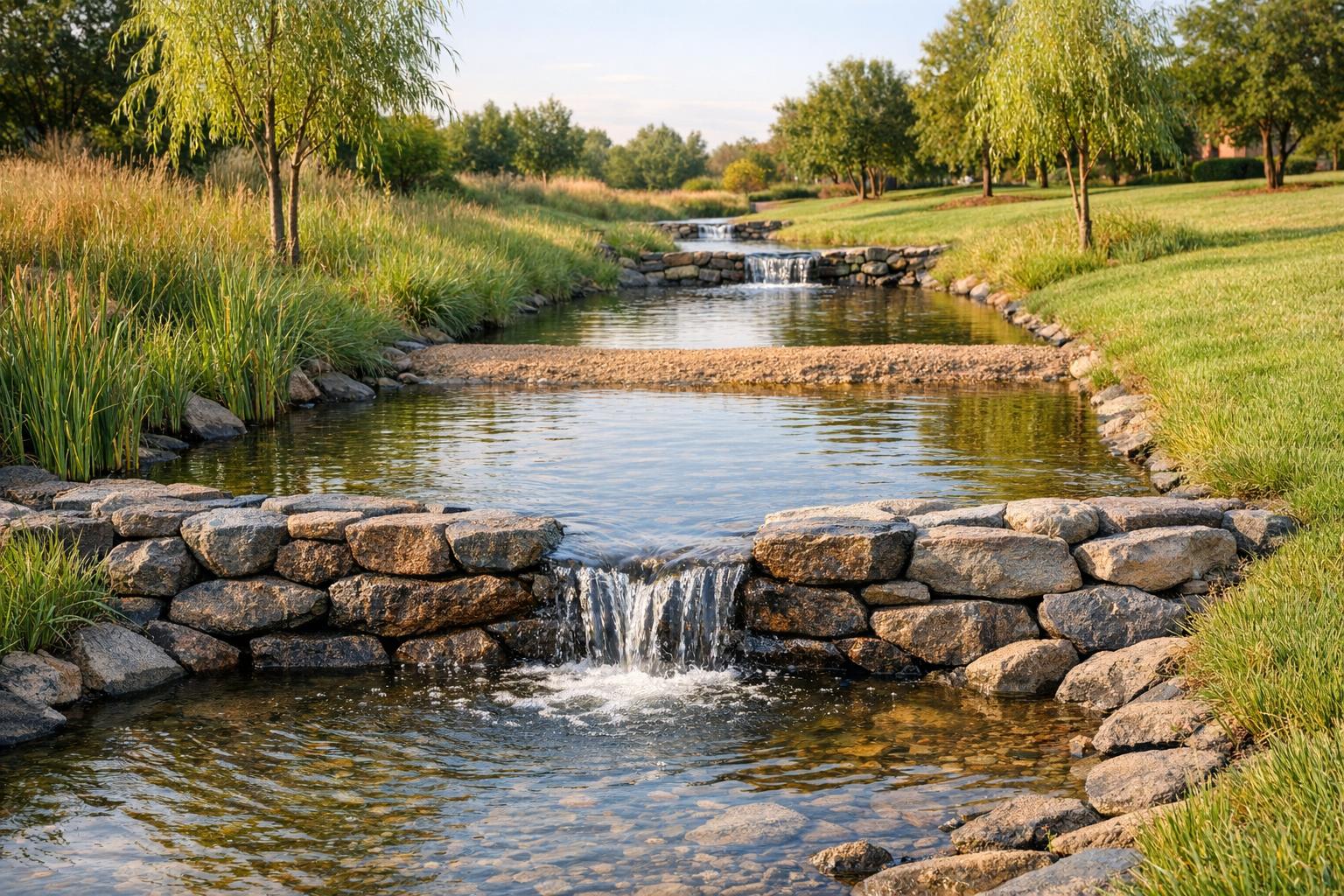
A check dam is a small dam constructed across a swale, ditch, or drainage channel to help manage stormwater runoff. These structures are often temporary, especially during construction projects.
Their design follows strict engineering guidelines to ensure they work effectively. For instance, the maximum height at the center should not exceed 2 feet, and the center must be at least 12 inches lower than the edges. This lower center directs water flow through the middle, preventing it from spilling around the sides. Additionally, the side slopes must have a ratio of 2H:1V or flatter to maintain stability.
When viewed from the side, a check dam has a triangular shape. The City of Tacoma Stormwater Management Manual provides further insight:
Whatever material is used, the dam should form a triangle when viewed from the side. This prevents undercutting as water flows over the face of the dam rather than falling directly onto the ditch bottom [[1]](https://cms.tacoma.gov/SWMM_WebBook/Responsive HTML5/BookBook/Volume_3_Construction_Site_Stormwater_Best_Management_Practices/BMP_C207_-_Check_Dams.htm).
The structure must also extend at least 18 inches beyond the channel abutments and be securely anchored into the ditch banks to avoid washouts. Modern check dams are built from various materials, such as appropriately sized rocks, pea-gravel-filled bags, or specialized commercial products designed for easy installation.
This careful design ensures that check dams effectively manage water flow.
How They Function
Check dams are designed to slow water flow and minimize erosion. When fast-moving water hits the dam, it forms a pool behind the structure. This allows sediment suspended in the water to settle before the water continues downstream.
The triangular design plays a key role in controlling the flow. It ensures water moves smoothly over the dam instead of creating sudden, turbulent drops that could erode the channel’s bottom. The pooling effect upstream further enhances sediment capture, reducing the amount of debris carried downstream.
For extended drainage channels, multiple check dams can be installed in a sequence. The spacing between them is calculated so that the toe of each upstream dam aligns with the top of the downstream dam. This cascade-like setup keeps the water flow controlled along the entire channel. Importantly, these dams must always be placed perpendicular to the water flow to maximize their ability to dissipate the water’s energy.
sbb-itb-843f8be
Functions in Erosion Control
Preventing Erosion
Check dams play a crucial role in slowing down fast-moving water, which is a major cause of erosion. When stormwater flows rapidly, it can detach soil, carve out gullies, and destabilize channel banks.
By installing a physical barrier across a channel, check dams force water to slow down and temporarily pool. This slower-moving water doesn’t have the energy to erode channel beds or undercut banks. As noted in the City of Tacoma Stormwater Management Manual:
Construction of small dams across a swale or ditch reduces the velocity of concentrated flow and dissipates energy at the check dam [[1]](https://cms.tacoma.gov/SWMM_WebBook/Responsive HTML5/BookBook/Volume_3_Construction_Site_Stormwater_Best_Management_Practices/BMP_C207_-_Check_Dams.htm).
This design also minimizes turbulent drops, further lowering the risk of erosion. Check dams are particularly useful in construction zones where exposed soil is most at risk, as well as in residential areas where landscaping projects leave the ground bare until vegetation regrows.
Beyond slowing water, check dams also help manage sediment transport.
Capturing Sediment
Another key function of check dams is trapping sediment carried by runoff. When water slows in the pool behind the dam, gravity takes over, causing soil particles to settle into a sump – a small depression located just upstream of the dam. This process helps keep soil in place, preventing it from being washed into storm drains, nearby streams, or neighboring properties. It also protects downstream water quality by reducing turbidity and minimizing pollution in sensitive aquatic environments.
The sediment retention efficiency improves with a deeper sump, as it provides more room for particles to settle before water flows over the dam. However, regular maintenance is critical. Once sediment fills half the depth of the sump, it needs to be removed to ensure the dam continues to slow water and capture new sediment during future storms. When properly designed and maintained, check dams can serve as effective, long-term tools for erosion control.
Check Dams & How They Should Work by Dr. Jim Spotts, CPESC.
Design and Installation Guidelines
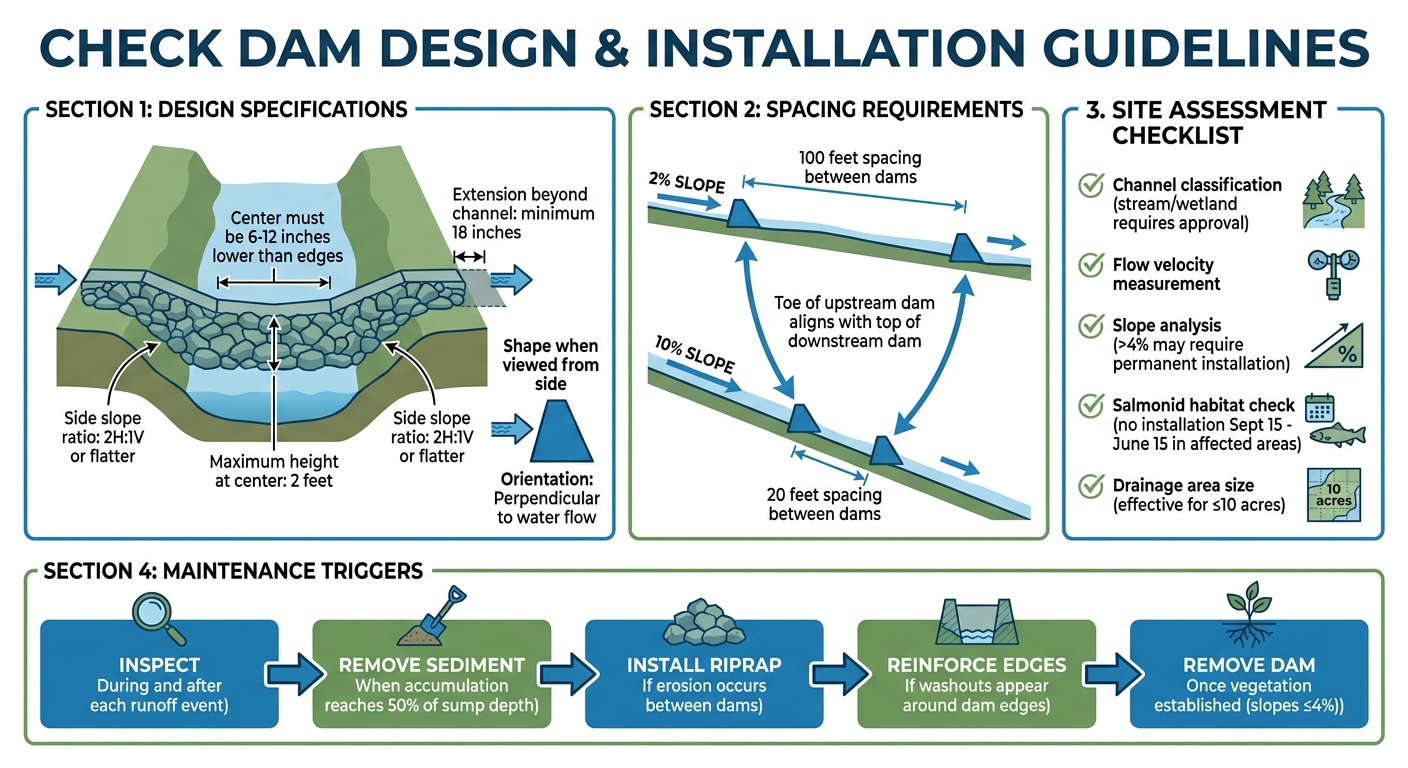
Check Dam Design Specifications and Installation Guidelines
Site Assessment
Start by evaluating the site’s channel classification, flow energy, and slope. This step is crucial to ensure both regulatory compliance and the dam’s effectiveness. First, determine whether the channel is classified as a stream or wetland, as these areas often require approval from state agencies like the Department of Fish and Wildlife. Next, measure the flow velocity to assess its potential for erosion, and analyze the channel’s slope to decide on proper dam spacing and plan for eventual removal once vegetation takes hold. Keep in mind that if the site lies below the predicted backwater area of salmonid-bearing waters, avoid installation between September 15 and June 15 to protect juvenile fish habitats. For channels with slopes exceeding 4 percent, check dams and the sediment they collect should generally remain in place even after grass has fully established. [[1]](https://cms.tacoma.gov/SWMM_WebBook/Responsive HTML5/BookBook/Volume_3_Construction_Site_Stormwater_Best_Management_Practices/BMP_C207_-_Check_Dams.htm)
Once these parameters are established, the focus shifts to designing and installing the dam with precision.
Design Principles
After completing the site evaluation, follow established design principles to ensure the dam performs as intended. The dam’s height and slope must adhere to specific guidelines outlined earlier. To create effective water pooling and reduce flow energy, align the toe of the upstream dam with the top of the downstream dam. To prevent washouts, extend the dam material beyond the abutments and securely key it into the ditch banks. A triangular cross-section design helps prevent undercutting, while a deep upstream sump improves sediment retention. For rock or sandbag dams, place a filter fabric foundation underneath unless a blanket ditch liner is already installed. [[1]](https://cms.tacoma.gov/SWMM_WebBook/Responsive HTML5/BookBook/Volume_3_Construction_Site_Stormwater_Best_Management_Practices/BMP_C207_-_Check_Dams.htm)
Materials and Construction Standards
Choosing the right materials plays a big role in how well a check dam performs and how long it lasts. The materials used directly affect durability and how often maintenance is needed. For instance, rock check dams are known for their durability and are considered semi-permanent, while temporary options like straw wattles, fiber rolls, and silt fences break down faster. Common materials include concrete, earth, and rock, often paired with geofabrics to improve stability and filtration.
When it comes to earth-based check dams, the soil’s composition is a key factor. Experts recommend soil with at least 20% clay content to hold water effectively and reduce seepage. Conducting a soil analysis is essential to ensure the soil’s permeability aligns with the dam’s design requirements [3].
Installation methods also matter. Trenching the dam into the channel’s banks and bottom helps prevent water from bypassing the structure and reduces erosion risks. Regular testing and inspections of materials are important to catch any potential flaws early.
Designs should also take environmental factors into account from the very beginning. Adding sediment barriers and quickly replanting vegetation can help maintain water quality and prevent soil erosion. In areas where ecosystems might be affected, features like sediment traps, vegetative buffers, and fish passages can be added to promote biodiversity. Consulting certified engineers ensures that materials are compatible and the structure is sound [3]. However, meeting these high standards can sometimes lead to delays and increased costs.
Rising material prices and growing project budgets, along with challenges like funding and permitting, highlight the importance of investing in quality construction upfront to ensure the structure’s long-term success [2].
Limitations and Site Suitability
Environmental Limitations
Not all locations are suitable for installing check dams due to certain regulatory and environmental restrictions. For instance, streams and wetlands often require prior approval from state fish and wildlife departments or local planning authorities before any check dam installations can take place. In areas with salmonid populations, there’s an added restriction: no installations are allowed below the expected backwater zone between September 15 and June 15. This protects critical high-flow refuge habitats that juvenile salmonids and emergent fry depend on during the winter months.
Additionally, sites with high-velocity water flows pose a challenge. If the materials used aren’t sturdy enough, they can be displaced, leading to washouts and even more erosion. This is particularly problematic in swales with slopes steeper than 4 percent. In such cases, check dams may need to be treated as permanent structures rather than temporary solutions to effectively manage erosion risks [[1]](https://cms.tacoma.gov/SWMM_WebBook/Responsive HTML5/BookBook/Volume_3_Construction_Site_Stormwater_Best_Management_Practices/BMP_C207_-_Check_Dams.htm).
Maintenance Requirements
Proper maintenance is crucial for keeping check dams functional. After every significant runoff event, inspections should be conducted to assess their performance and check for sediment buildup. If sediment in the upstream sump accumulates to 50% of its depth, it must be cleared out to ensure the dam continues to operate effectively [[1]](https://cms.tacoma.gov/SWMM_WebBook/Responsive HTML5/BookBook/Volume_3_Construction_Site_Stormwater_Best_Management_Practices/BMP_C207_-_Check_Dams.htm).
Maintenance and Inspection Protocols
Keeping up with maintenance starts with regular monitoring. The City of Tacoma Stormwater Management Manual emphasizes the importance of this step: "Monitor check dams for performance and sediment accumulation during and after each runoff producing rainfall" [[1]](https://cms.tacoma.gov/SWMM_WebBook/Responsive HTML5/BookBook/Volume_3_Construction_Site_Stormwater_Best_Management_Practices/BMP_C207_-_Check_Dams.htm). In other words, every storm event should trigger an inspection. This routine is key to catching and resolving issues early.
During inspections, focus on three main areas: sediment buildup, structural integrity, and edge erosion. If sediment has accumulated to half the sump depth, it’s time to remove it to ensure the dam continues functioning effectively [[1]](https://cms.tacoma.gov/SWMM_WebBook/Responsive HTML5/BookBook/Volume_3_Construction_Site_Stormwater_Best_Management_Practices/BMP_C207_-_Check_Dams.htm). Also, look for stones that may have been displaced downstream, as these can block culverts or disrupt other parts of the channel.
Edge erosion is a common problem that can render the dam ineffective. High water flows often cut channels around the sides, bypassing the structure and leading to washouts. If you notice this happening, the City of Tacoma advises immediate action: "If significant erosion occurs between dams, install a protective riprap liner in that portion of the channel" [[1]](https://cms.tacoma.gov/SWMM_WebBook/Responsive HTML5/BookBook/Volume_3_Construction_Site_Stormwater_Best_Management_Practices/BMP_C207_-_Check_Dams.htm). This step can prevent minor erosion from escalating into more severe damage.
For temporary installations in grass-lined ditches, proper removal is just as important as maintenance. Once vegetation in the channel has matured enough to provide protection – and as long as the slope is no steeper than 4% – you should remove both the dams and any sediment that has built up. After removal, the exposed area needs immediate attention. Seed and mulch the spot right away to stop fresh erosion from taking hold [[1]](https://cms.tacoma.gov/SWMM_WebBook/Responsive HTML5/BookBook/Volume_3_Construction_Site_Stormwater_Best_Management_Practices/BMP_C207_-_Check_Dams.htm). This approach not only restores the channel but also reinforces the dam’s role in managing erosion over time.
Here’s a quick breakdown of the essential tasks, when to perform them, and why they matter:
| Maintenance Task | Trigger / Frequency | Purpose |
|---|---|---|
| Visual Inspection | During and after each runoff-producing rainfall | Spot structural issues, displaced stones, or erosion |
| Sediment Clean-out | When sediment reaches 1/2 of the sump depth | Maintain storage capacity and prevent downstream issues |
| Riprap Installation | When erosion occurs between dams | Strengthen the channel bed against strong water flow |
| Edge Reinforcement | If washouts are seen around dam edges | Ensure water flows through the dam, not around it |
| Removal & Seeding | Once permanent vegetation is established | Restore natural flow and stabilize the ground |
Research Findings on Performance
Check dams play a key role in stormwater management by slowing water flow and encouraging sediment to settle. This process not only reduces the velocity of runoff but also allows sediment and pollutants to drop out of the water. Additionally, the temporary pooling behind these structures provides opportunities for water treatment through infiltration and evaporation [4].
When combined with other measures like erosion matting and deep sumps (at least 2 feet deep and 6 feet long), check dams perform much better than when used alone [[1]](https://cms.tacoma.gov/SWMM_WebBook/Responsive HTML5/BookBook/Volume_3_Construction_Site_Stormwater_Best_Management_Practices/BMP_C207_-_Check_Dams.htm)[4]. This pairing enhances the system’s ability to trap particles before they can travel downstream. However, for these benefits to last, regular removal of accumulated sediment is essential.
That said, check dams have limitations. They are generally effective for drainage areas of 10 acres or less [4]. Larger areas can overwhelm the structure, especially during heavy storms, when high runoff volumes may bypass or overtop the dam. This reduces the time needed for pollutants to settle and highlights the importance of proper design and maintenance, as previously discussed.
Spacing between dams is another critical factor for performance. On steeper channel slopes, dams need to be placed closer together to prevent concentrated flow that could erode the channel. For instance, on a 2% slope, dams should be spaced about 100 feet apart, but on a steeper 10% slope, the spacing should shrink to roughly 20 feet [4]. This ensures that each dam effectively slows the flow before it reaches the next one.
Research also emphasizes that specific design details can significantly improve performance. The center of the dam should be 6 to 12 inches lower than the edges to guide water over the structure, avoiding side washouts and edge erosion [4][[1]](https://cms.tacoma.gov/SWMM_WebBook/Responsive HTML5/BookBook/Volume_3_Construction_Site_Stormwater_Best_Management_Practices/BMP_C207_-Check_Dams.htm). Additionally, placing geotextile filter fabric beneath rock dams helps prevent the structure from sinking and maintains its filtering ability over time [4][[1]](https://cms.tacoma.gov/SWMM_WebBook/Responsive HTML5/BookBook/Volume_3_Construction_Site_Stormwater_Best_Management_Practices/BMP_C207-_Check_Dams.htm).
Pro Landscapes MD: Your Partner in Stormwater Solutions

Effectively managing stormwater isn’t just about solving immediate drainage issues – it requires a deep understanding of erosion control techniques, like the use of check dams. Pro Landscapes MD brings this expertise to homeowners and property managers throughout central Maryland, serving areas such as Ellicott City, Bethesda, Columbia, and Towson.
Comprehensive Drainage Expertise
Pro Landscapes MD offers a full range of drainage solutions designed to meet both functional and regulatory standards. Their team follows established design practices to ensure proper sediment retention and water infiltration. This thoughtful approach not only addresses immediate stormwater concerns but also enhances long-term erosion control.
Regulatory Compliance and Smart Design
When it comes to check dam installations, regulatory compliance is key. These structures cannot be placed in live streams or wetlands without prior approval from local, state, or federal authorities [[1]](https://cms.tacoma.gov/SWMM_WebBook/Responsive HTML5/BookBook/Volume_3_Construction_Site_Stormwater_Best_Management_Practices/BMP_C207_-_Check_Dams.htm). Pro Landscapes MD navigates these requirements seamlessly, incorporating check dams into broader systems that may include features like deep sumps and French drains. These additions further improve sediment retention and water infiltration.
Attention to Materials and Construction
The team prioritizes the use of high-quality materials and proven construction techniques. For instance, they ensure stones are securely keyed into ditch banks and extend at least 18 inches beyond the edges to prevent washouts. Additionally, they use filter fabric foundations beneath rock structures to guard against undercutting [[1]](https://cms.tacoma.gov/SWMM_WebBook/Responsive HTML5/BookBook/Volume_3_Construction_Site_Stormwater_Best_Management_Practices/BMP_C207_-_Check_Dams.htm). These practices ensure the durability and effectiveness of their installations.
Maintenance for Long-Term Performance
Proper maintenance is critical to the success of check dams. Pro Landscapes MD advises regular inspections – ideally on a weekly basis – and timely sediment removal. Since sediment buildup should be cleared once it reaches 50% of the dam’s height [[1]](https://cms.tacoma.gov/SWMM_WebBook/Responsive HTML5/BookBook/Volume_3_Construction_Site_Stormwater_Best_Management_Practices/BMP_C207_-_Check_Dams.htm), they guide property owners on maintaining temporary structures until permanent stabilization is achieved. This proactive approach helps preserve the integrity of stormwater systems over time.
Conclusion
Check dams play a crucial role in slowing water flow and reducing energy, making them an important tool for managing erosion and stormwater. When constructed properly, they effectively trap sediment and help safeguard landscapes from heavy rain damage [[1]](https://cms.tacoma.gov/SWMM_WebBook/Responsive HTML5/BookBook/Volume_3_Construction_Site_Stormwater_Best_Management_Practices/BMP_C207_-_Check_Dams.htm). Studies have shown that adding vegetation to these structures can further decrease peak runoff discharge by 12% [5], highlighting their practical impact in stormwater management.
The effectiveness of check dams hinges on accurate engineering and consistent upkeep. For instance, they need to be securely keyed into ditch banks at least 18 inches beyond the abutments to prevent structural failure. Additionally, sediment must be removed once it reaches half the depth of the sump [[1]](https://cms.tacoma.gov/SWMM_WebBook/Responsive HTML5/BookBook/Volume_3_Construction_Site_Stormwater_Best_Management_Practices/BMP_C207_-_Check_Dams.htm). Regular inspections, especially after significant rainfall, are essential to ensure they continue functioning as intended. These details emphasize the importance of professional installation and maintenance.
When properly designed, installed, and maintained, check dams provide reliable control over runoff and erosion [[1]](https://cms.tacoma.gov/SWMM_WebBook/Responsive HTML5/BookBook/Volume_3_Construction_Site_Stormwater_Best_Management_Practices/BMP_C207_-_Check_Dams.htm)[5]. For Maryland property owners, professional expertise is critical to meet the technical requirements, such as ensuring correct spacing and adhering to regulations near streams and wetlands. These tasks demand skills that go far beyond standard landscaping practices.
Pro Landscapes MD offers this specialized expertise to communities across central Maryland, from Ellicott City to Bethesda. Their stormwater management solutions combine check dams with features like French drains and strategic grading, creating systems that protect your property for the long term. Whether you’re tackling erosion at a construction site or managing runoff in an established yard, they provide proven, high-quality solutions tailored to your needs.
FAQs
Do I need a permit to install a check dam?
Yes, you’ll typically need a permit to install a check dam, especially in areas with strict regulations or for certain types of projects. It’s important to review local laws and guidelines to make sure you’re following the rules. Reaching out to local authorities or experts can make the permitting process smoother and help you steer clear of any complications.
How do I know if my slope is too steep for check dams?
Check dams work best on slopes with a ratio of 3:1 or gentler. When slopes are steeper, such as 2:1 or greater than 4%, water flows faster, increasing the risk of erosion and reducing the effectiveness of check dams. In these cases, it’s better to consider other erosion control methods. Also, avoid placing check dams in natural streams unless they’re part of an approved restoration effort. If a check dam is removed, make sure the area is properly stabilized to prevent further erosion.
When should I remove a temporary check dam?
To ensure proper function, remove a temporary check dam after significant storms or once sediment buildup has stabilized and water flow is consistent. Regular upkeep, such as clearing out accumulated sediment, is crucial to prevent it from being re-suspended and to keep the system working effectively.
Chat with Us