









- bhavya gada
- No Comments
Maryland faces unique challenges in managing stormwater due to rapid development, aging infrastructure, and strict water quality standards. Stormwater modeling helps predict runoff, optimize designs, and meet regulatory requirements. Maryland’s regulations focus on reducing pollutants like nitrogen, phosphorus, and sediment to protect the Chesapeake Bay. Tools like TR-55, SWMM, and HEC-HMS are commonly used for compliance and planning.
Key takeaways from Maryland case studies:
- Cabin John Creek: Cost-effective BMP combinations reduced pollution while staying within budget.
- Suburban Maryland: Combining detention ponds with distributed green infrastructure improved performance under current and future storm conditions.
- Mount Rainier: Urban retrofits like bioretention bump-outs and permeable surfaces managed runoff efficiently without major infrastructure upgrades.
Homeowners can apply these strategies by using small-scale solutions like rain gardens, permeable pavers, and bioretention planters to reduce runoff and improve water quality. Professional contractors, like Pro Landscapes MD, can assist with grading, drainage, and other tailored services to implement these solutions effectively.
MDE Stormwater Regulations and Design Manual Updates Listening Session – October 28 (2025)
Maryland’s Stormwater Regulations and Modeling Tools
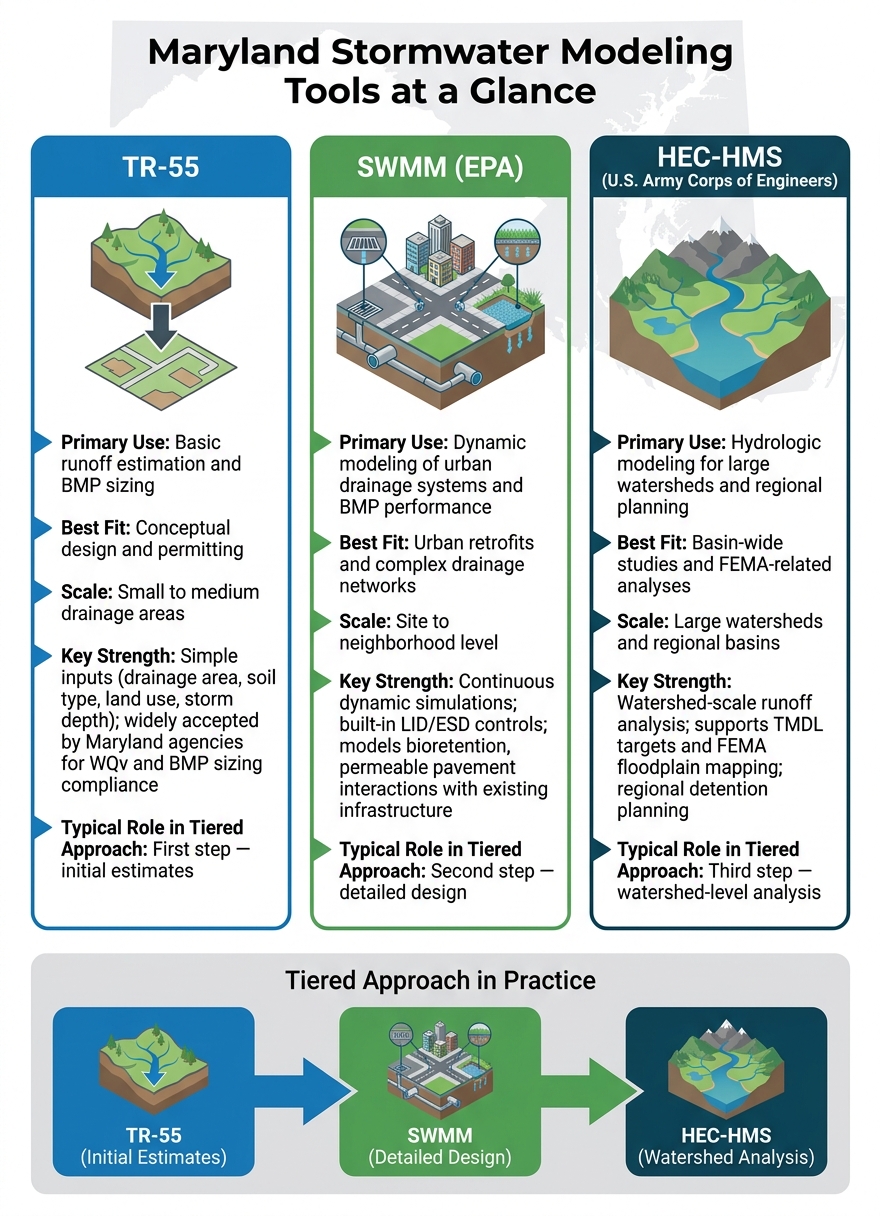
Maryland Stormwater Modeling Tools Compared: TR-55 vs SWMM vs HEC-HMS
Key Stormwater Regulations in Maryland
Maryland’s approach to stormwater management is rooted in the Maryland Stormwater Management Act of 2007, supported by regulations under COMAR 26.17.02. These state-level guidelines set the foundation for all development and redevelopment projects. Local governments, including counties and municipalities with delegated authority, are required to implement these standards – or adopt even stricter ones – through their own ordinances and design manuals.
At the heart of Maryland’s stormwater philosophy is Environmental Site Design (ESD) to the Maximum Extent Practicable (MEP). This principle encourages the use of small-scale, distributed Best Management Practices (BMPs), like rain gardens, bioretention areas, and permeable pavements, before relying on larger, centralized structures like detention ponds. The aim is simple: replicate natural hydrology by managing runoff close to its source.
Maryland’s stormwater regulations also include specific sizing requirements. For instance, projects must handle a water quality volume (WQv) tied to the first inch of rainfall over the site. Beyond that, designs must account for channel protection (1-year storm), overbank flood control (10-year storm), and extreme weather events (100-year storm). These thresholds ensure BMPs are sized appropriately for both flood mitigation and pollutant reduction. Before obtaining permits, engineers must use modeling to demonstrate compliance with these requirements, proving that their designs meet both hydrologic and water quality goals.
Stormwater Modeling Tools Used in Maryland
To meet Maryland’s stringent stormwater standards, engineers rely on a variety of modeling tools tailored to different project needs. Three key tools dominate the landscape:
| Tool | Primary Use | Best Fit |
|---|---|---|
| TR-55 | Basic runoff estimation and BMP sizing for small to medium drainage areas | Conceptual design and permitting |
| SWMM | Dynamic modeling of urban drainage systems and BMP performance | Urban retrofits and complex drainage networks |
| HEC-HMS | Hydrologic modeling for large watersheds and regional planning | Basin-wide studies and FEMA-related analyses |
TR-55 (Urban Hydrology for Small Watersheds) is often the first tool engineers turn to for site-level projects. By inputting factors like drainage area, soil type, land use, and storm depth, they can estimate runoff volumes and peak flows before and after development. Its simplicity makes it ideal for preliminary designs, and Maryland agencies widely accept its outputs for compliance with WQv and BMP sizing requirements.
For more intricate projects – such as retrofits in dense urban areas or systems involving interconnected drainage networks – engineers turn to EPA‘s SWMM (Storm Water Management Model). SWMM allows for continuous, dynamic simulations, making it perfect for modeling how various BMPs (like bioretention cells or permeable pavements) interact with existing infrastructure during multiple storm events. Its built-in support for low impact development (LID) controls aligns well with Maryland’s ESD requirements.
When it comes to large-scale hydrologic studies, HEC-HMS is the tool of choice. Created by the U.S. Army Corps of Engineers, this software excels at watershed-scale analysis. Maryland engineers use HEC-HMS to assess runoff from expansive basins, plan regional detention systems, and conduct floodplain studies for FEMA mapping. This tool also plays a critical role in supporting regional planning and meeting Total Maximum Daily Load (TMDL) targets.
In practice, engineers often combine these tools for a tiered approach: TR-55 for initial estimates, SWMM for detailed designs, and HEC-HMS for broader, watershed-level analyses. This layered strategy ensures compliance with Maryland’s complex stormwater management requirements.
Stormwater Modeling Case Studies in Maryland
Cabin John Creek: Optimizing BMP Portfolios
In Montgomery County, the Cabin John Creek watershed served as a testing ground for smarter stormwater strategies. The main challenge? Meeting Chesapeake Bay TMDL targets for nitrogen, phosphorus, and sediment without exceeding the available budget.
The solution came through the Watershed Management Optimization Support Tool (WMOST), an EPA-supported model capable of analyzing thousands of Best Management Practice (BMP) combinations at once. The team fed the model with detailed information, including land use data, soil types, impervious surfaces, drainage areas, baseline pollutant loads, and the unit costs of various practices like bioretention cells, pond retrofits, and enhanced street sweeping. WMOST then pinpointed the most cost-effective combinations to meet reduction targets while minimizing annualized lifecycle costs.
The results were clear: no single BMP type could meet the targets on its own. Instead, the optimal approach combined retrofitting existing stormwater ponds with distributed green infrastructure and programmatic measures, such as downspout disconnection. The modeling also revealed diminishing returns after a certain point, helping the county prioritize projects based on cost-efficiency. This led to a staged implementation plan that could adapt to changes in grant funding and budgets – a practical framework for other Maryland municipalities navigating MS4 permit requirements.
Green Infrastructure in Suburban Maryland
Many suburban Maryland communities, built around traditional curb-and-gutter systems leading to centralized detention basins, are facing a growing issue: those basins were designed for past storm patterns, not the more intense and frequent storms of the future.
Using continuous simulation tools like SWMM and HSPF, researchers compared conventional detention ponds to distributed green infrastructure (GI) networks in suburban catchments. Under historical rainfall conditions, detention basins generally managed peak flows for major storms but allowed smaller, frequent storms to pass through with high runoff volumes and pollutant loads. In contrast, distributed GI – including bioretention cells, permeable pavement, green roofs, and tree boxes – delivered better volume reduction and water quality improvements for these smaller events, which contribute most of the annual pollutant load.
When modeled under projected mid-21st century extreme weather, traditional basins showed higher overtopping rates, while distributed GI maintained better performance. Although extreme storms occasionally overwhelmed GI networks, they still provided meaningful peak flow reduction and volume control by spreading storage across the watershed. The key takeaway for suburban planners? A hybrid approach that combines regional detention ponds with distributed GI can outperform either strategy alone, addressing both pollutant reduction goals and future stormwater challenges.
Mount Rainier: Managing the First Inch of Rainfall
In Prince George’s County, the City of Mount Rainier faced a common urban challenge: dense impervious surfaces, aging stormwater infrastructure, and declining water quality in the Anacostia River. The city set a specific goal – capture and treat the first 1 inch of rainfall from impervious surfaces, as this "first flush" typically carries the highest pollutant concentrations from streets and rooftops.
Working within the tight constraints of urban rights-of-way, the project team designed a range of streetscape retrofits, including curbside bioretention bump-outs, stormwater planters, expanded tree pits with structural soil, permeable parking lanes, and selective permeable sidewalk sections. Each feature was carefully sized to match its drainage area and storage capacity. Continuous simulation modeling showed that these targeted installations could effectively capture and treat a significant portion of annual first-flush runoff, reducing pollutants like suspended solids, nitrogen, and phosphorus in accordance with Chesapeake Bay Program standards. Importantly, this was achieved without the need for extensive underground pipe upgrades.
The project proved that even in densely developed urban areas, well-planned and modeled streetscape retrofits can deliver measurable hydrologic improvements when data-driven design guides the process.
sbb-itb-843f8be
Applying Case Study Lessons to Central Maryland Landscapes
Adding Stormwater Solutions to Residential Design
Case studies emphasize that a combination of smaller, targeted interventions often works better than relying on a single solution. For homeowners in Maryland, focusing on source control – managing runoff right where it starts – delivers the most effective results. For example, installing a bioretention planter at a downspout, sized to handle the first inch of runoff, paired with a permeable paver driveway over an 8–12 inch open-graded stone base, reflects strategies proven to manage runoff directly on-site.
In areas where natural slopes or depressions gather water, a dry riverbed can be both functional and visually appealing. It helps slow and spread water flow, allows for temporary infiltration in its wider sections, and safely directs any overflow toward a rain garden or vegetated lawn instead of sending it toward a foundation or storm drain. Adding check stones or riffles along the channel further reduces water velocity and erosion, echoing Maryland’s flow-management techniques. By identifying impervious surfaces and pinpointing areas where water tends to concentrate, homeowners can address these "hot spots" first. Solutions like disconnecting downspouts and using bioretention planters, or replacing traditional driveways with permeable pavers, often deliver the best results for the investment. These approaches create a solid starting point for further professional design and intervention.
How Pro Landscapes MD Supports Stormwater Management

Homeowners can take these principles and apply them to their own landscapes with professional guidance. Translating these ideas into practical designs starts with proper grading. Adjusting slopes and leveling yards ensures water flows away from structures and toward designated areas like rain gardens or dry riverbeds, rather than pooling near foundations or basement walls. Pro Landscapes MD provides grading, land leveling, and yard repair services across central Maryland, including Howard County, Montgomery County, and Prince George’s County.
Once the groundwork is set, their drainage and French drain systems help manage subsurface water by routing it through infiltration systems instead of directing it off the property. For homes with ongoing pooling or runoff issues from hardscapes, adding channel drains near driveways and patios – paired with downstream features like bioretention areas or dry riverbeds – creates a distributed system that’s more effective than centralized solutions. Additionally, their eco-friendly paver installations reduce impervious surfaces in areas like driveways and walkways, aligning with the small-scale stormwater management practices highlighted in Maryland case studies.
Conclusion: Moving Stormwater Solutions Forward in Maryland
The examples highlighted here – from Cabin John Creek’s portfolio-based BMP planning to Mount Rainier’s approach to capturing the first inch of rainfall – underscore one key takeaway: modeling turns uncertainty into clear, actionable plans. By simulating scenarios before any physical work begins, engineers and planners can sidestep expensive missteps and allocate limited funds toward strategies that effectively reduce runoff, control peak flows, and limit pollutants entering the Chesapeake Bay.
However, large-scale watershed projects alone can’t shoulder the burden of reducing Bay-wide pollution. Real progress hinges on urban properties adopting smaller, decentralized solutions. When designed and implemented correctly, methods like permeable pavers, rain gardens, and French drains can cut runoff volumes by 60–90% during smaller storms. This makes individual efforts not just symbolic but genuinely impactful at the watershed level.
To turn these insights into action across central Maryland, skilled contractors who grasp both design principles and local regulations are essential. Pro Landscapes MD offers a comprehensive suite of services – grading, drainage systems, French drains, dry riverbeds, environmental pavers, and landscape restoration – all tailored to the BMP strategies proven effective in Maryland’s case studies. Serving areas like Howard County, Montgomery County, and Prince George’s County, they provide homeowners with customized solutions rooted in the same principles driving successful public projects.
The approach is straightforward: evaluate your property, focus on problem areas, and make gradual improvements. Whether it’s a rain garden, a permeable driveway, or redirecting a downspout into vegetation, every small step contributes to a more resilient and environmentally friendly landscape – one that safeguards your property while enhancing local water quality for the long term.
FAQs
Which stormwater model should I use for my Maryland project?
The most suitable stormwater model for your property hinges on factors like drainage requirements, soil type, and the amount of runoff. Some popular options include:
- Modular filtration systems: Examples include bioretention basins and tree-box filters, which help filter and manage water effectively.
- Structural methods: French drains are a reliable choice for directing water away from problem areas.
- Natural solutions: Swales and rain gardens can blend functionality with aesthetics by naturally absorbing and redirecting water.
For areas like driveways and patios, permeable pavers are a practical option, allowing water to pass through instead of pooling. It’s a good idea to consult a professional to assess your property and suggest the best solution for your specific needs.
What does “ESD to the Maximum Extent Practicable (MEP)” mean in practice?
Maryland has embraced a sustainable way to handle stormwater runoff through Environmental Site Design to the Maximum Extent Practicable (ESD to the MEP). This approach focuses on leveraging natural features and techniques to manage water flow effectively. Tools like rain gardens, swales, berms, and permeable pavers are key components of this strategy. They work together to replicate natural drainage systems.
The goal? To capture, treat, and absorb runoff right where it occurs. By doing this, ESD reduces flooding, filters out pollutants, and minimizes erosion – all while ensuring compliance with Maryland’s water quality standards.
What’s the best first stormwater fix for a typical Maryland home?
The best way to tackle stormwater problems for a Maryland home depends on the specific drainage issue you’re dealing with. According to Pro Landscapes MD, the first step is to assess the situation to determine the most effective solution.
Some natural options include berms (elevated soil mounds) and swales (vegetated channels) to help redirect runoff. If water tends to pool on hard surfaces like driveways or patios, permeable pavers can be a great choice. For more serious flooding issues, solutions like French drains or other underground drainage systems may be necessary. Each method addresses unique challenges, ensuring better water management tailored to your property.
Chat with Us