









- bhavya gada
- No Comments
Planning development in Carroll County? Understanding stormwater permit requirements is essential. Here’s what you need to know:
- Stormwater Management (SWM) Plans: Focus on Environmental Site Design (ESD) to maintain water flow, reduce pollution, and stabilize channels.
- Key Requirements: Address runoff for 2-, 10-, and possibly up to 100-year storm events, depending on site risks.
- Regulations: Governed by Chapter 151 of the County Code, aligned with Maryland’s NPDES MS4 permit.
- Submission Process: Follow a 3-stage plan – Concept, Preliminary, and Final plan submissions.
- Documentation: Include technical calculations, ESD practices, and legal records in compliance with local standards.
- Maintenance: Regular inspections and upkeep are required, with specific responsibilities based on property type.
Proper planning and compliance ensure smoother approvals, reduced delays, and long-term water resource protection.
MDE Stormwater Regulations and Design Manual Updates Listening Session – January 20 (2026)
sbb-itb-843f8be
Carroll County Stormwater Regulations
Carroll County enforces its stormwater regulations through Chapter 151 of the County Code, aligning with the NPDES MS4 permit issued by the Maryland Department of the Environment (MDE). These regulations govern discharges into, through, and from the storm drain systems managed by the County and its eight incorporated municipalities [3].
"The purpose of the current stormwater management ordinance (Chapter 151) is to restore, enhance, and maintain the chemical, physical, and biological integrity of streams; minimize damage to public and private property; and reduce the hydrologic impacts of land development."
– Carroll County Government [2]
Chapter 151 applies to any new development that disturbs more than 5,000 square feet of land. However, even smaller projects may require a permit if runoff from the site poses risks to downstream areas [2]. The regulations prioritize Environmental Site Design (ESD) strategies, such as conserving natural features and reducing impervious surfaces, before resorting to structural stormwater solutions like ponds or wetlands. This approach ensures that environmental impacts are minimized from the outset.
Why Stormwater Management Matters
Unregulated runoff can lead to flooding, erosion of stream banks, and the spread of pollutants into local waterways, ultimately degrading stream ecosystems [3]. Rainwater flowing over impervious surfaces – like rooftops, parking lots, and driveways – collects contaminants such as oil, fertilizers, and sediments. This untreated runoff then enters storm drains, eventually reaching streams, rivers, and the Chesapeake Bay.
To address these issues, the county may enforce stricter standards for projects that pose significant risks, such as downstream flooding or environmental harm. Additionally, all stormwater systems, including residential dry wells, must undergo inspections every three years [3]. These measures are crucial for protecting water quality and public safety.
Projects That Require a Stormwater Permit
Certain types of projects have specific requirements under Carroll County’s stormwater regulations:
- Multi-lot residential developments must deed structural stormwater practices in fee simple.
- Commercial, industrial, or institutional projects must place these practices on separate parcels to be maintained by property owners.
Construction activities disturbing over one acre of land usually require an NPDES permit. Some industrial and commercial operations – like metal scrap yards, salvage yards, landfills, and transportation facilities performing vehicle maintenance – are also subject to these regulations.
Exemptions may apply for facilities that discharge wastewater into municipal sanitary or combined sewer systems, as these systems treat the water before it enters natural waterways. Additionally, Maryland facilities may qualify for a "No Exposure" exemption if all industrial materials and activities are fully protected from precipitation and runoff.
3-Stage Submission Process for Stormwater Management Plans
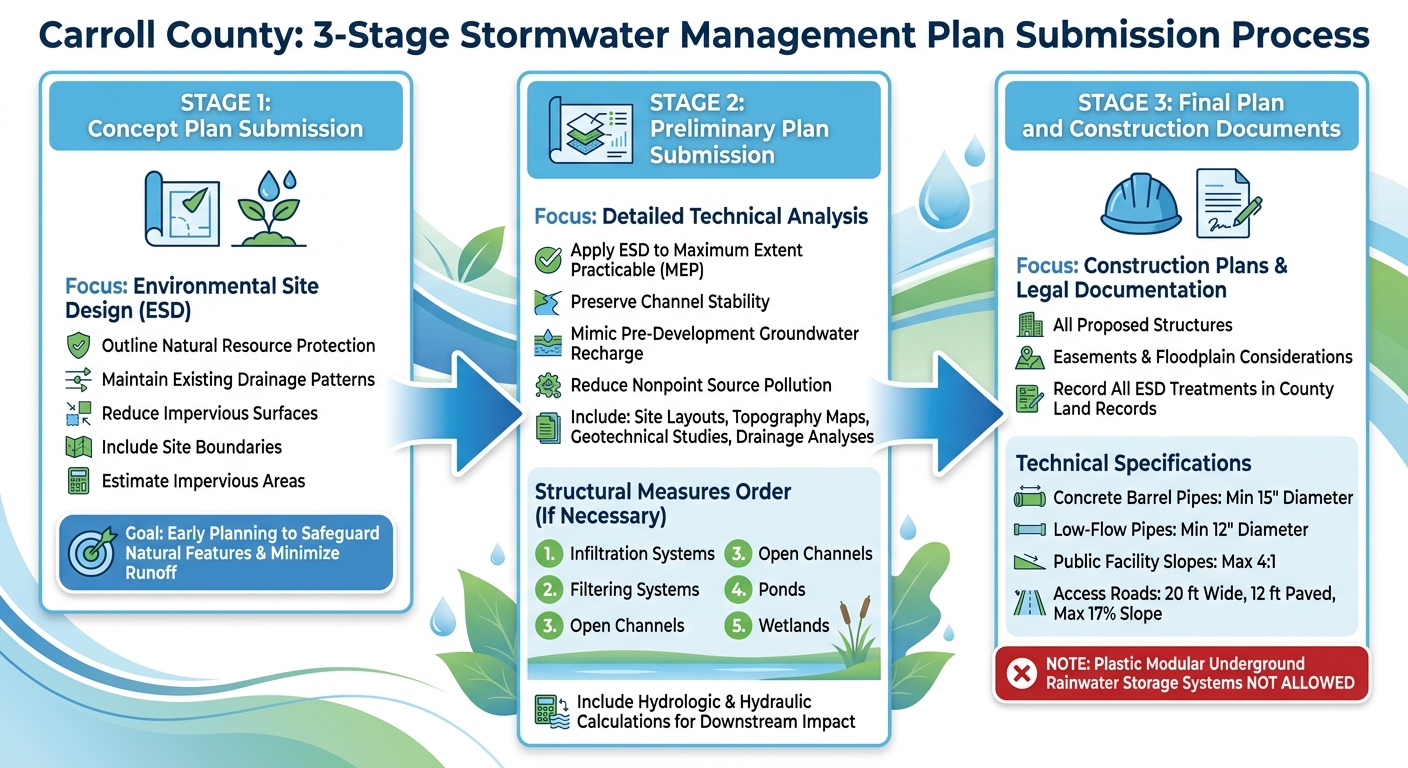
Carroll County Stormwater Permit 3-Stage Submission Process
Carroll County requires developers to follow a three-stage process for submitting stormwater management plans. This phased approach ensures environmental priorities are addressed early on and that final designs comply with all regulations. Each stage builds on the last, guiding developers toward plans that meet both ecological and regulatory goals.
Stage 1: Concept Plan Submission
The first stage emphasizes Environmental Site Design (ESD) techniques. Developers must outline how they will protect natural resources, maintain existing drainage patterns, and reduce impervious surfaces [1]. This submission should include site boundaries and estimates of impervious areas. The focus is on early planning to safeguard natural features, minimize runoff, and limit soil disturbance before construction begins [1].
Stage 2: Preliminary Plan Submission
In this stage, developers must provide a detailed technical analysis. ESD techniques must be applied to the Maximum Extent Practicable (MEP) before considering structural measures [1]. The MEP standard ensures that channel stability is preserved, groundwater recharge mimics pre-development levels, and nonpoint source pollution is reduced [1]. Submissions should include site layouts, topography maps, geotechnical studies, and drainage area analyses. If structural measures are necessary, they must follow a specific order: infiltration systems, filtering systems, open channels, ponds, and finally wetlands [1]. Additionally, hydrologic and hydraulic calculations must evaluate how changes in water flow could affect downstream structures, such as dams or highways [1].
Stage 3: Final Plan and Construction Documents
The last stage involves submitting detailed construction plans and legal documentation. These plans must include all proposed structures, easements, and floodplain considerations. Developers are required to record all ESD treatments and microscale practices in Carroll County’s land records to ensure future property owners remain accountable [1]. Specific technical requirements include:
- Minimum 15-inch diameter for concrete barrel pipes in ponds
- At least 12-inch diameter for low-flow pipes into risers
- Slopes for publicly maintained surface facilities must not exceed 4:1
- Access roads for public facilities must be at least 20 feet wide, with a 12-foot paved surface and a maximum slope of 17% [1]
It’s important to note that Plastic Modular Underground Rainwater Storage Systems are not allowed in Carroll County [1].
Required Documentation for Stormwater Permit Applications
When working through the three-stage submission process, having the right documentation is crucial for a smooth stormwater permit application.
Submitting a complete application means following all state and county regulations closely. In Carroll County, all Stormwater Management (SWM) plans must comply with the Maryland Design Manual and the Carroll County Supplement. These guidelines include specific criteria and checklists tailored to local needs [1]. Missing even a single document can delay your approval, so knowing exactly what’s required from the start is key.
Core Submission Requirements
Your application needs to include technical calculations that prove compliance with environmental standards. These should cover:
- ESD (Environmental Site Design) sizing
- Recharge volume
- Water quality volume
- Channel protection storage volume
Additionally, you must include a downstream impact analysis. This analysis uses hydrologic and hydraulic calculations to evaluate the effects on the first downstream tributary or any points where streamflow is restricted [1].
Another critical step is documenting that all nonstructural ESD practices – like reducing impervious surfaces, preserving natural drainage, and protecting natural resources – have been fully explored before considering structural solutions. Structural Best Management Practices (BMPs) should only be used as a last resort. Be sure to consult the Carroll County Supplement Checklist for any additional local requirements.
Carroll County Supplement Checklist
Beyond state standards, Carroll County enforces its own specific design rules. For example, Plastic Modular Underground Rainwater Storage Systems are prohibited locally. For detailed technical specifications on items like pipes, slopes, and access road dimensions, refer to Stage 3 of the process.
Lastly, legal documentation is a must. This includes recording all ESD treatments and microscale practices – such as maintenance agreements and easements – in Carroll County’s Land Records. These records ensure the long-term functionality of your stormwater management systems and prevent unauthorized changes without county approval [1].
Maintenance, Inspections, and Compliance
Getting a permit is just the beginning. To avoid system failures and costly violations, regular maintenance and strict compliance are crucial.
Regular Maintenance and Inspections
Who handles the maintenance of your stormwater system depends on the type of property you own. In Carroll County, structural stormwater management for multi-lot residential developments is deeded to the county. However, if you own commercial, industrial, or institutional property, the responsibility for system upkeep falls on you [1].
All ownership and maintenance agreements must be recorded in Carroll County’s Land Records. This ensures clear accountability and avoids confusion, especially when properties change hands. Keep in mind, any changes to ESD or microscale practices need prior approval from the county [1].
For publicly maintained facilities, specific access requirements must be met. These include a minimum 20-foot wide access from the facility’s base to a public right-of-way, along with a 12-foot wide paved road. The road should support heavy equipment and adhere to slope restrictions – no more than a 17% slope or 3% cross slope [1]. These guidelines ensure year-round accessibility for inspections and maintenance.
Good housekeeping is key to staying compliant. Regularly inspect tanks and containers, fix leaks immediately, and schedule waste removal to prevent pollutants from entering the system. Additionally, maintain an updated SWPPP signed by a corporate officer, especially after changes like new hires, chemical use, or outdoor storage adjustments [4]. Keeping thorough records in Carroll County’s Land Records further reinforces accountability throughout your project’s lifespan.
These proactive steps help prevent unauthorized discharges and system breakdowns, which we’ll dive into next.
Addressing Illicit Discharges
Preventing illicit discharges is just as important as routine maintenance. In Carroll County, unauthorized discharges – caused by pollutants entering the stormwater system through improper disposal or unauthorized connections – are taken seriously. Installing permanent markers at storm drains can discourage pollutant dumping [4].
Your SWPPP should clearly identify activities on-site that might lead to water pollution and detail the measures in place to prevent unpermitted discharges [4]. Employee training programs are also essential to ensure staff understand their role in preventing pollution and following best practices [4]. Depending on your permit and the type of pollutants involved, you may need to monitor stormwater outflow anywhere from continuously to just once or twice a year [4].
The design of your stormwater system also matters. For example, stormwater pond risers should allow full inspection from top to bottom, making it easier to detect unauthorized connections or other issues [1]. Additionally, pipe outfalls into dry surface facilities should include underdrained plunge pools or forebays. These features help manage sediment and prevent standing water [1].
How Pro Landscapes MD Supports Stormwater Management

Pro Landscapes MD specializes in designing drainage and stormwater solutions that align with Carroll County’s Environmental Site Design (ESD) requirements. Their approach focuses on preserving natural drainage systems through nonstructural methods, ensuring property owners meet compliance standards while improving the usability and appearance of their outdoor spaces.
Drainage and Stormwater Solutions
Pro Landscapes MD embraces Carroll County’s preference for nonstructural stormwater management with a range of targeted drainage services. One key offering is regrading, which redirects water from rooftops and other surfaces by reshaping the terrain to channel runoff away from buildings and into conservation areas or drywells. They also install French drains and dry riverbeds, both effective microscale solutions for managing runoff from smaller impervious surfaces.
In April 2023, the company completed a project for a commercial property in Carroll County that illustrates their expertise. By installing a French drain system, they reduced water pooling by 85%, improving the site’s usability during heavy rains, increasing property value, and cutting maintenance costs. This success highlights how proper stormwater management can deliver practical and financial benefits.
"Our drainage solutions not only address immediate water issues but also enhance the overall landscape, making properties more functional and visually appealing."
- Jane Doe, Operations Manager, Pro Landscapes MD
Beyond addressing drainage issues, Pro Landscapes MD also integrates landscaping and hardscaping to create outdoor spaces that are both functional and attractive.
Landscaping and Hardscaping Services
Pro Landscapes MD takes stormwater management a step further by incorporating eco-friendly practices into their landscaping and hardscaping designs. They use techniques like landscape infiltration and rain gardens, which comply with county-approved ESD methods to manage water flow while enhancing property aesthetics.
For hardscaping, they offer permeable pavement and environmental pavers – solutions designed to reduce impervious surfaces and maintain predevelopment groundwater recharge levels. These materials not only minimize runoff but also provide durable, functional outdoor spaces such as patios, walkways, and driveways. When nonstructural ESD practices are insufficient, Pro Landscapes MD can implement structural measures, like filtering systems, in accordance with the Carroll County Design Manual [1].
Conclusion
Stormwater permits in Carroll County require strict compliance with Environmental Site Design (ESD) principles and detailed documentation at every submission stage. These guidelines form the backbone of the county’s structured, three-phase submission process.
From the initial concept to final construction, all documentation must be complete and adhere to the Maryland Stormwater Design Manual and the Carroll County Supplement [1]. Common mistakes, such as relying on generic templates or missing key deadlines, can lead to permit denials or even stop-work orders [5].
Navigating these requirements can be challenging, which is why professional expertise can make all the difference. Pro Landscapes MD brings hands-on experience with county-approved ESD solutions like French drains and rain gardens, ensuring both compliance and improved property functionality. Meeting these regulations not only protects water quality and the environment but also helps maintain property value. By working with professionals familiar with Carroll County’s specific rules, property owners can avoid costly errors, reduce future maintenance challenges, and design outdoor spaces that are both practical and compliant.
FAQs
Do I need a stormwater permit for my project?
Yes, you’ll need a stormwater permit if your project involves activities such as construction or land development that require stormwater management. This is necessary to meet both local and federal regulations.
What’s the difference between Concept, Preliminary, and Final SWM plans?
Stormwater management plans progress through three key stages, each building on the previous one to ensure a thorough and effective approach:
- Concept Plans: These serve as the starting point, offering a basic outline of potential stormwater management strategies. They focus on generating ideas and setting the groundwork for further development.
- Preliminary Plans: At this stage, plans become more detailed. They include additional specifics that allow for comprehensive review and feedback, helping refine the approach and address any concerns early in the process.
- Final Plans: These are the fully developed and approved versions, ready for execution. Final plans include precise designs, technical specifications, and all the necessary details to move forward with implementation.
Each phase ensures the stormwater management plan evolves methodically, balancing creativity, practicality, and precision.
What documents most often cause Carroll County SWM plan delays?
Incomplete or incorrect stormwater management documentation is the leading cause of delays in Carroll County SWM plan approvals. A key part of this is the Carroll County supplement to the Maryland Stormwater Design Manual, which details local policies and standard designs. These documents demand a meticulous review and proper approval to move forward.
Chat with Us