









- bhavya gada
- No Comments
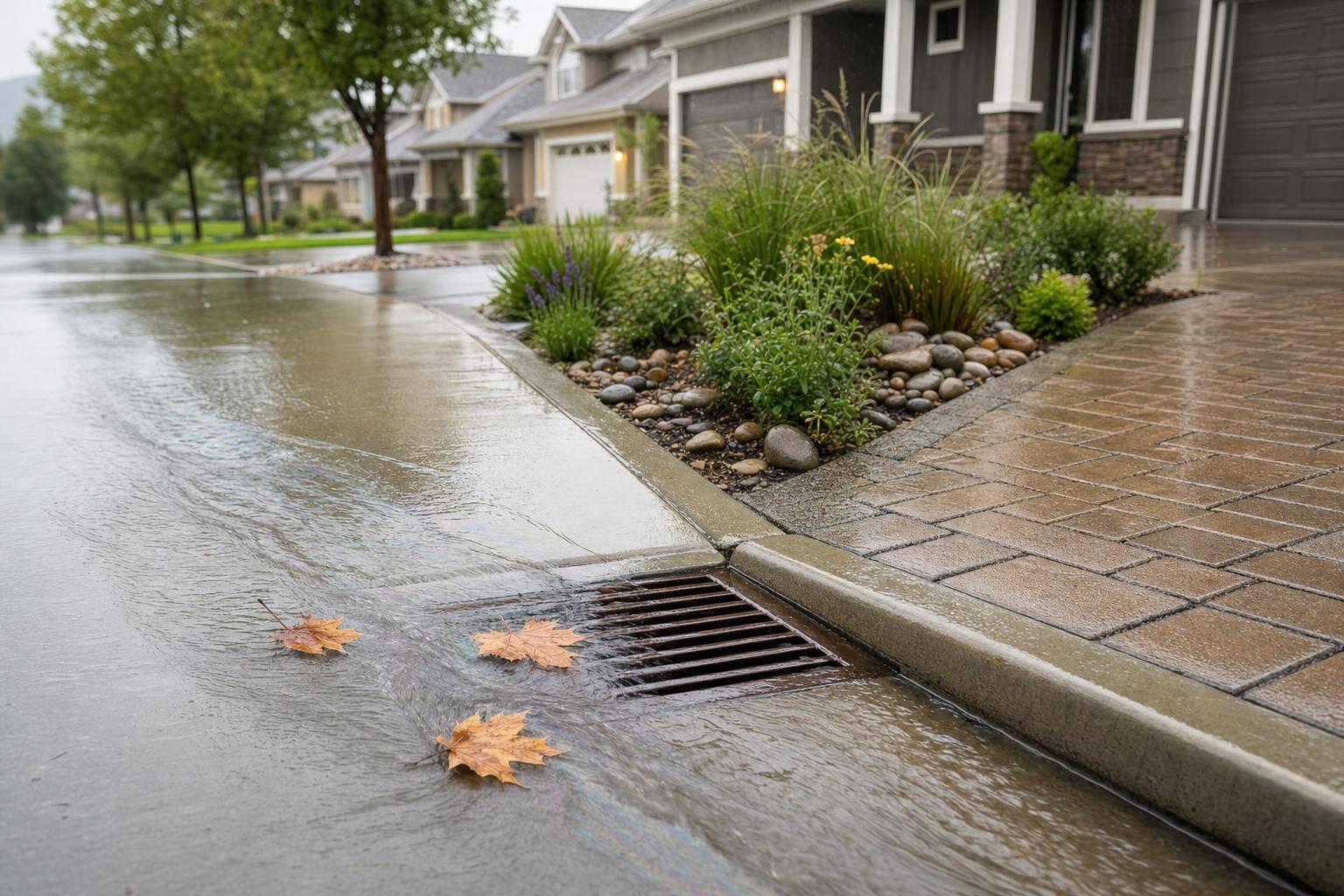
More hard surface usually means more runoff, more pollution, and more stress on streams. If you have a concrete driveway, asphalt parking area, or tight-joint patio, rainwater is more likely to flow off your property instead of soaking into the ground.
Here’s the short version:
- Impervious surfaces block infiltration, so rainfall turns into runoff.
- A typical urban block can send out more than 5 times the runoff of a forested area of the same size.
- When watershed impervious cover reaches about 10% to 20%, runoff can double.
- That runoff can carry sediment, nitrogen, phosphorus, metals, oil, bacteria, and road salt into local streams and the Chesapeake Bay.
- Concrete and asphalt are not the same: asphalt runoff can contain PAHs, while concrete runoff can increase pH and conductivity.
- Permeable systems can cut peak flow by about 89.9% and reduce suspended solids by 70% to 90%.
- Simple site choices matter: send runoff to planted areas, reduce direct flow to storm drains, and keep surfaces clean.
If I had to boil the article down to one point, it would be this: the stormwater problem is not just the surface itself, but how fast water leaves it and what it picks up on the way.
A few of the main takeaways:
- Runoff volume goes up when soil is covered by hard surfaces.
- Flow reaches streams faster, which can wear away streambanks and add sediment.
- Pollutants build up between storms, then wash off during the first flush.
- Winter chloride from deicers can stay in waterways and stack up over time.
- Permeable pavers, porous asphalt, open-joint systems, rain gardens, and grading fixes can lower runoff leaving a site.
- Maintenance matters because clogged joints, dirt, leaves, and extra salt can make runoff problems worse.
| Surface or approach | What happens to rain | Main stormwater risk |
|---|---|---|
| Concrete, asphalt, dense pavers | Water runs off | High runoff and pollutant wash-off |
| Permeable pavers / porous surfaces | Water moves through surface | Lower runoff, but needs cleaning |
| Runoff to storm drain | Water leaves site fast | Less filtering before streams |
| Runoff to planted area / rain garden | Water slows and soaks in | Lower off-site flow and less pollution |
If you own or manage a Maryland property, surface choice, drainage path, and upkeep can make a big difference in how much polluted runoff leaves the site.
Stormwater, Impervious Surface, and Stream Health
sbb-itb-843f8be
What Research Shows About Runoff Volume, Speed, and Stream Damage
Research points to a clear pattern: impervious surfaces increase runoff volume, boost peak flow, and put more stress on streams, especially in developed Maryland watersheds. You can see it in the numbers, and you can see it in stream condition.
Why More Hard Surface Means More Flooding and Erosion Risk
EPA data show that a typical urban block can generate more than five times the runoff of a forested area of the same size. [2] That’s a huge shift. Instead of soaking into the ground, water rushes across pavement, rooftops, and other hard surfaces.
In built-up areas, curb-and-gutter systems and storm drains move that water fast. It reaches streams much sooner than it would under natural conditions, which leads to sudden surges during rain events. Those surges increase erosion, wear away streambanks, and add more sediment to channels. At the same time, less water soaks into the soil, which cuts groundwater recharge and reduces dry-weather base flow. [1]
Impervious Cover Thresholds Tied to Stream Degradation
Research also points to coverage levels where stream damage becomes more likely. Beth Yount, an Extension Educator at Penn State Extension, puts it plainly:
"When more than 10 to 20% of a watershed has impervious cover, that doubles the amount of runoff." [1]
That threshold has direct meaning for Maryland neighborhoods. In the Broad Run watershed, impervious cover rising from 6.3% to 13.1% was projected to increase annual runoff and phosphorus loads under a high-emissions climate scenario. [7]
The pattern also shows up across the Chesapeake Bay watershed. Between 1990 and 2007, impervious surfaces grew by an estimated 34%, while population grew by only 18% over the same period. [2]
Maryland agencies track these thresholds because they help show where stream impacts start to appear. Maryland DNR uses impervious cover to monitor stream health across the state. [1]
Pollutants Washed Off Driveways, Patios, and Walkways
More runoff doesn’t just mean more water moving across a property. It also means more pollution getting picked up and carried away.
During dry periods, driveways, patios, and walkways slowly collect all kinds of residue: dust, oil, pet waste, lawn fertilizer, tire wear, and brake particles. When rain finally hits, that layer gets washed off. The worst part often happens during the first flush – the opening part of a storm, when runoff carries the highest pollutant concentrations because it sweeps away everything that built up since the last rainfall. [1]
Sediment, Nutrients, Pathogens, Metals, and Hydrocarbons
Residential hard surfaces send a broad mix of contaminants into nearby waterways. Suspended solids can make streams cloudy and bury aquatic habitat. Nitrogen and phosphorus – often tracked or washed over from nearby lawns – feed algae blooms that drain oxygen from the water. Research shows a positive link between higher impervious cover and total nitrogen concentrations, while nearby turf coverage tends to be tied to higher total phosphorus levels. [7]
Metals also show up in runoff. Copper, zinc, and lead often come from brake pads, tires, and motor fluids.
Pathogens are another issue. Bacteria like E. coli can land on hard surfaces through pet waste and wildlife activity, then runoff moves them straight into streams with no filtering along the way.
| Pollutant Group | Common Residential Sources | Waterway Impact |
|---|---|---|
| Sediment (TSS) | Soil tracked onto pavement, road wear | Clouds water, destroys aquatic habitat |
| Nutrients (N, P) | Lawn fertilizers, pet waste, leaves | Algae blooms, oxygen depletion |
| Metals (Cu, Zn, Pb) | Brake pads, tires, motor oil | Toxic to fish and aquatic insects |
| Hydrocarbons and PAHs | Vehicle leaks, asphalt sealants | Toxic to wildlife; carcinogenic |
| Pathogens | Pet waste, wildlife | Health hazard; impairs recreational use |
Material-Specific Concerns for Asphalt and Concrete
The paving material matters too. Conventional asphalt can add petroleum-related compounds to runoff, including polycyclic aromatic hydrocarbons (PAHs). Concrete creates a different issue: runoff from concrete can increase pH and conductivity in receiving waters. [3]
Either way, once asphalt or concrete covers a large share of a residential lot, pollutant loads can add up fast.
Winter Salts and Seasonal Pollutant Spikes
In Maryland, winter brings another pollutant into play: chloride. Deicing salts used on driveways and walkways wash into local waterways, and chloride doesn’t break down over time – it builds up.
As Penn State Extension’s Beth Yount notes:
"Road deicers can elevate chloride levels beyond the threshold where fish and other aquatic animals and insects can live or reproduce, which degrades the entire aquatic ecosystem." [1]
That makes the first rain after a dry spell – or after freezing weather – especially important. It can send salt residue and other built-up pollutants into nearby streams all at once, creating a sharp spike in contamination over a short period. [1]
Comparing Hardscape Materials and Designs for Stormwater Risk
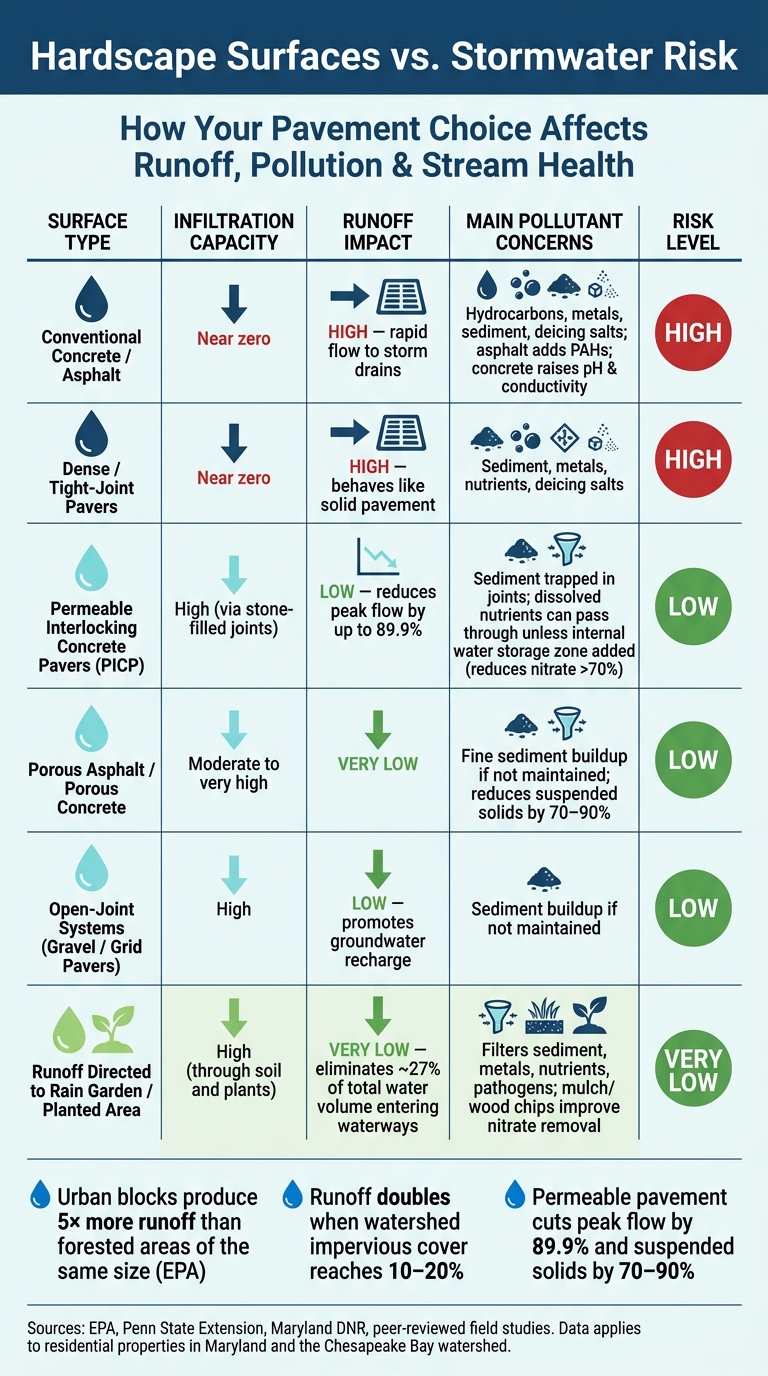
Hardscape Surfaces vs. Stormwater Risk: What Every Maryland Homeowner Should Know
The hardscape material and layout you pick shape how much runoff leaves a site, what pollutants that water carries, and how much filtering happens before it reaches a stream.
Conventional Concrete, Asphalt, and Dense Pavers
Standard concrete, asphalt, and tightly set pavers shed almost all rainfall. Water can’t soak into the surface, so it moves fast, carrying sediment, metals, deicing salts, and other pollutants that have built up since the last storm. If that runoff flows straight into gutters or storm drains, it skips the natural filtering that soil and plants can provide. [1][2]
That’s the core problem with sealed surfaces: they move water off the site fast, and they don’t do much to clean it along the way.
Materials that let water pass through can slow runoff and cut down on pollutant buildup.
Permeable Pavers and Open-Joint Systems
Permeable systems work differently. Instead of pushing water away, they let it move through open joints or porous surface material into a stone base below. From there, water can soak into the soil or drain out more slowly through an underdrain. As water moves through the system, sediment and metals get trapped in the upper layers and the aggregate below. [4]
Field data shows major drops in runoff and pollution. Recent field studies found that permeable pavements reduced peak flow by 89.9% and cut suspended solids by 70% to 90%. Even systems that have been in place for years still reduce metals and nutrients. [3][4]
There is one catch. These systems do a weaker job with dissolved nutrients. Nitrate and orthophosphate can move through the stone base more easily. One fix is to build the subbase with an internal water storage zone. Research shows that setup can reduce nitrate by more than 70% through natural denitrification. [5]
| Material/System | Infiltration Capacity | Runoff Impact | Typical Pollutant Concerns | Common Residential Uses |
|---|---|---|---|---|
| Conventional Concrete/Asphalt | Near zero | High; rapid flow to drains [1] | Hydrocarbons, metals, sediment, deicing salts | Driveways, sidewalks, patios |
| Permeable Interlocking Pavers (PICP) | High (via stone-filled joints) | Low | Sediment trapped in joints | Driveways, walkways, patios |
| Porous Asphalt/Concrete | Moderate to very high | Very low | Fine sediment buildup if not maintained | Large driveways, private access roads |
| Open-Joint Systems (Gravel/Grid) | High | Low; promotes groundwater recharge | Sediment buildup if not maintained | Paths, secondary parking pads |
Low-Impact Residential Hardscaping Options for Maryland
In central Maryland, these differences stand out most on properties with slow-draining soils and runoff that reaches curb drains fast.
Permeable interlocking concrete pavers, or PICP, are a strong fit for driveways, patios, and walkways. They allow infiltration, reduce runoff, and trap pollutants while still handling vehicle loads. When native soils drain poorly, underdrains or an internal water storage zone can help the system keep working as intended. [5]
Gravel paths and open-joint systems make sense in secondary spaces like garden paths or overflow parking pads. They add infiltration in spots that might otherwise end up fully sealed. Pro Landscapes MD installs environmental pavers and can match permeable systems to site drainage needs across central Maryland.
Material choice matters, but the system only works well over time if it’s cleaned and maintained on a routine basis.
Design and Maintenance Steps That Reduce Stormwater Pollution
Stormwater risk depends on layout, drainage connections, and maintenance just as much as surface material.
Once runoff is on the property, design and upkeep decide what happens next: does the water soak into the ground, or does it wash offsite?
Reduce Connected Impervious Area and Direct Runoff Into Planted Areas
The goal is simple: break the path from hard surface to storm drain.
One of the best ways to do that is to stop runoff from moving straight from a driveway or roof into a curb drain. When that direct connection stays in place, stormwater can carry oil, sediment, and metals into local waterways with little to no filtering.
Redirecting downspouts onto grass, gravel, or into a rain garden gives water time to slow down and soak in. Rain gardens filter sediment, metals, nutrients, and pathogens before water reaches a stream [6]. Wood chips or mulch can also improve nitrate removal [6].
Even on tighter lots, small grading changes can help. Shifting runoff toward planted areas instead of a drain lowers the amount of water leaving the site. Infiltration through these kinds of systems can eliminate roughly 27% of the total water volume that would otherwise enter local waterways [5].
Maintain Surfaces to Limit Pollutant Buildup
A well-designed surface can still send pollution downstream if no one keeps it clean.
Regular sweeping removes sediment, litter, and organic debris before stormwater can pick them up. For permeable pavers, removing and replacing the top layer of aggregate in the joints from time to time helps keep infiltration working as intended. It also removes sediment-bound pollutants like heavy metals [5].
Winter salt needs extra care. Deicers can raise chloride levels and mobilize metals already trapped in sediment [1][5]. Using them sparingly – only where they are needed – cuts that risk. Fertilizers follow the same pattern. When they are applied too close to hard surfaces, nitrogen and phosphorus are more likely to wash off in the next rain instead of staying in the soil where plants can use them.
Stormwater Upgrades for Central Maryland Properties
When grading alone does not solve the problem, targeted drainage fixes can change the flow path.
For properties with runoff issues, French drains, dry riverbeds, and regrading can redirect water before it pools or reaches drains.
These fixes work best when they match the site’s slope, soil, and runoff path.
Key Findings for Maryland Homeowners and Property Managers
The research comes back to three plain ideas: less impervious cover, better drainage, and steady upkeep.
Here’s the core issue. The more impervious cover a property has, the more runoff it sends out – and the faster that water moves. A typical city block produces more than 5 times the runoff of a forested area of the same size [2]. And when impervious cover in a watershed hits 10% to 20%, runoff volume doubles [1].
That water doesn’t move alone. Runoff from hard surfaces carries sediment, nutrients, oils, metals, and litter into streams [2].
What you build with matters too. Permeable pavement can cut runoff in a big way and trap suspended solids before they leave the site [3]. Sending runoff into planted areas or rain gardens gives water another layer of filtration before it leaves the property.
Upkeep is what keeps all of this from falling apart. Permeable systems need regular cleaning so pore spaces don’t clog [5]. It also helps to keep surfaces clean and make sure grading sends water toward planted areas, not the street.
For Maryland properties that need site-specific fixes, grading and permeable hardscapes can reduce risk. For central Maryland properties, Pro Landscapes MD can install grading, drainage, and permeable hardscape solutions that reduce runoff over time.
FAQs
How do I know if my hardscape is causing runoff problems?
Check during or after rainfall for common drainage issues:
- Water ponding or pooling on the surface
- Water flowing in sheets across a driveway, patio, or walkway instead of soaking in
- Erosion near the hardscape
These signs can point to excess runoff. And that runoff may carry sediment, debris, or pollutants toward storm drains or nearby waterways.
Which permeable surface is best for a driveway or patio?
Permeable hardscapes are a practical option for driveways and patios because they let stormwater soak into the ground instead of sending it rushing across the surface. That helps cut down on flooding and pollution.
Common choices include porous asphalt, pervious concrete, and permeable interlocking concrete pavers. Pavers are often used for parking areas and light-traffic driveways, while pervious concrete works well for sidewalks and driving surfaces. With the right gravel base, all of these can handle runoff well.
What maintenance helps reduce polluted runoff?
Regular upkeep of permeable hardscapes helps cut polluted runoff. The main goal is simple: keep the surface open so water can drain the way it should.
Vacuum sweep as needed to clear clogs and remove washed-out sediment. After major storms, inspect the surface to make sure water is draining properly.
For interlocking concrete pavers, replace joint material after sweeping and clear away leaves. During snow removal, use a rubber-tipped shovel or a plow with the blade set at least 1 inch above the surface.
Chat with Us