









- bhavya gada
- No Comments
Straw wattles are a simple, cost-effective way to manage soil erosion on slopes. They slow water runoff, trap sediment, and help stabilize soil while vegetation grows. This makes them ideal for properties with bare or clay-heavy slopes prone to erosion during rainfall.
Here’s a quick breakdown of how straw wattles work and compare to other erosion control methods:
- Straw Wattles: Cylindrical tubes filled with straw or wood fibers. They’re easy to install, biodegradable, and effective on moderate slopes. Best for temporary erosion control.
- Silt Fences: Synthetic fabric barriers that pool water to settle sediment. They require more labor to install and are better suited for flat or gently sloping areas.
- Erosion Control Blankets: Rolled sheets placed on bare soil to protect it from rain and support plant growth. Ideal for steep slopes and long-term stabilization.
Each method has its strengths, but straw wattles stand out for their affordability and ease of use. Pairing them with a solid drainage plan ensures better protection for your landscape.
How to Install Straw Wattles for Erosion Control
sbb-itb-843f8be
1. Straw Wattles
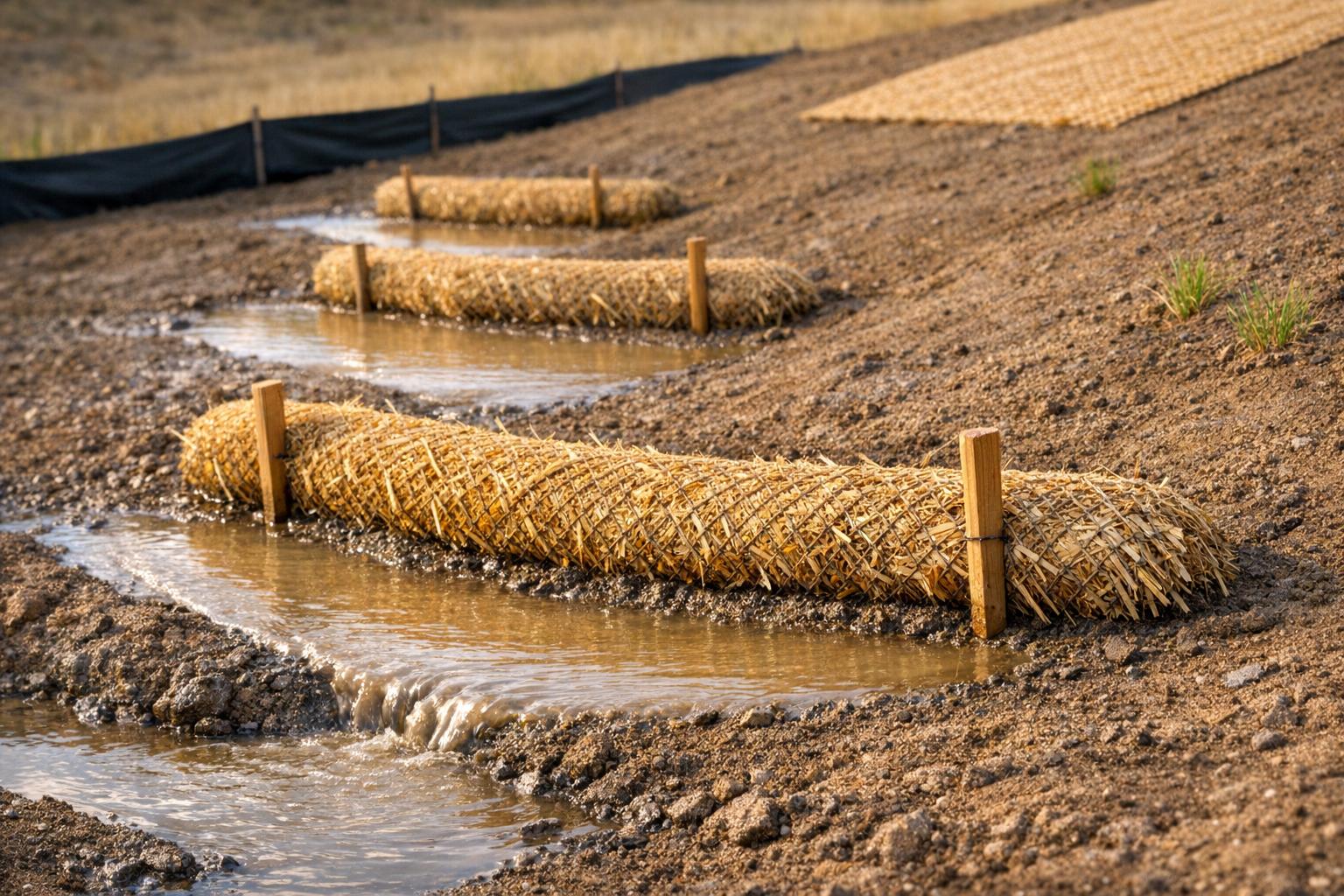
Straw wattles are long, cylindrical tubes – usually about 25 feet in length and 9 inches in diameter – filled with clean straw or wood fibers [1]. These are strategically placed across slopes to slow down water flow, allowing sediment to settle before it can reach storm drains or waterways.
Effectiveness for Sediment Control
Straw wattles are excellent at slowing runoff, trapping sediment, and improving soil water absorption. This is particularly useful on slopes with clay-heavy soils, where rainwater tends to run off quickly, carrying sediment with it.
Ease of Installation and Maintenance
Installing straw wattles is straightforward. Start by digging a shallow trench, about 2–5 inches deep, on the uphill side of the slope. Place the wattle snugly in the trench, ensuring no gaps, and secure it with wooden stakes. The spacing of rows depends on the slope’s steepness:
- 1:1 slope: 10 feet apart
- 2:1 slope: 20 feet apart
- 3:1 slope: 30 feet apart
Once positioned, pack extra soil tightly against the uphill side to prevent water from flowing underneath. These wattles are biodegradable and can remain effective for up to two years, requiring minimal maintenance during that time [2].
Suitability for Slope Gradients
Straw wattles are most effective on slopes where over 70% of the natural ground cover has been lost [1]. They work well on slopes with gradients up to 1.5 horizontal to 1 vertical. Research from the 2012 US20 highway realignment project in Oregon, led by Michael J. Olsen, Anthony M. Rikli, and David N. Sillars, found that placing straw wattles horizontally along slope contours successfully minimized water ponding. The erosion-control advantages far outweighed any minor physical impact on the slope [3].
"Straw wattles were shown to have no significant effect on surficial slope stability, particularly compared to modeling uncertainty and soil variability." – Transportation Research Board [3]
For slopes with a safety factor at or below 1.0, geotextile ground coverings are a better option for consistent erosion control.
Impact on the Surrounding Environment
Straw wattles help stabilize topsoil, preserving nutrients vital for plants, soil organisms, and nearby ecosystems. They also reduce sediment runoff, which can clog storm drains or pollute waterways – an issue of particular concern in areas like Maryland.
"Soil erosion is the process of displacing the most fertile layer of topsoil. This directly affects habitats, environments, and overall ground health." – Julia Michaels, Ph.D., Restoration Ecologist, NativeSeed Group [2]
Straw wattles can absorb up to 400% of their weight in water within 15 minutes and take several days to dry at room temperature [3]. Their efficiency makes them a strong contender for sediment control, setting the stage for a comparison with other methods, like silt fences, in the next section.
2. Silt Fence
Unlike straw wattles, silt fences use synthetic filter fabric to create a temporary barrier that controls sediment-laden runoff. Essentially, a silt fence is made by stretching a thin sheet of synthetic fabric across posts anchored into the ground [5]. While both silt fences and straw wattles aim to manage sediment, their materials and designs make them better suited for different site conditions.
Effectiveness for Sediment Control
Silt fences function by pooling water behind the fabric, giving sediment time to settle before the water filters through. They work best for sheet flow – a thin, even layer of water that spreads across a slope during rainfall. However, they aren’t built to handle concentrated flows, such as those in ditches, channels, or streams, where water pressure can overwhelm the barrier [5]. To keep the fence effective, sediment should be removed once it reaches one-third to one-half the height of the fence [5].
Ease of Installation and Maintenance
Installing a silt fence involves more steps than setting up straw wattles. Posts must be driven at least 16 inches into the ground, and the fabric needs to be buried in a trench at least 4 inches wide and 6 inches deep to prevent water from undercutting it [5]. The ends of the fence should form a "J" shape, turned uphill to block runoff effectively. Post spacing depends on the type of fence: wire-backed fences can have posts spaced up to 6 feet apart, while fences using extra-strength fabric without wire require posts no more than 3 feet apart [5]. Regular inspections are essential, especially during prolonged rain or after storms, to ensure the fence remains intact and functional.
"A silt fence is a temporary sediment barrier consisting of filter fabric stretched across and attached to supporting posts, entrenched, and, in some cases, backed by a wire fence for support." – Geosyntec Consultants [5]
Compared to straw wattles, silt fences cost more to install and require additional labor to set up correctly [1].
Suitability for Slope Gradients
The length of the slope above the fence plays a key role in how well a silt fence performs. Steeper slopes require shorter drainage areas [5]:
| Slope Gradient | Maximum Slope Length Above Fence |
|---|---|
| Less than 2% | 100 feet |
| 2%–5% | 75 feet |
| 5%–10% | 50 feet |
| 10%–20% | 25 feet |
| Greater than 20% | 15 feet |
Additionally, the drainage area for every 100 feet of fence should not exceed 0.25 acres [5]. If these limits are exceeded, the fence may fail to handle the incoming water and sediment.
Impact on the Surrounding Environment
The environmental impact of silt fences is another important consideration. Made from synthetic materials like UV-stabilized woven polypropylene, these fences typically last about 6 months before UV exposure weakens the fabric [5]. In sensitive areas such as floodplains or riparian zones, biodegradable jute geotextile is a better option, as it naturally decomposes over time [4]. If fine clay particles clog the fabric, the fence may lose its filtering ability even if it appears intact, requiring full replacement to restore functionality [5].
3. Erosion Control Blankets
Erosion control blankets provide an effective way to stabilize slopes while vegetation takes hold. These rolled sheets, made from natural or synthetic materials, are placed directly on bare soil to shield it from the impact of rain and runoff. Unlike straw wattles or silt fences, which work by intercepting moving water, blankets protect the soil surface right from the start, helping to keep soil particles in place as soon as rain hits.
Effectiveness for Sediment Control
Erosion control blankets are particularly beneficial for freshly seeded slopes where plant roots haven’t developed yet. They help retain moisture, protect seeds from being washed away, and support the growth of vegetation. Biodegradable blankets typically last between 3 and 35 months [7], which is usually enough time for vegetation to establish and stabilize the soil. For more permanent solutions, Turf Reinforcement Mats (TRMs) are available. These mats do not break down over time and provide lasting structural support for high-stress slopes [7].
Ease of Installation and Maintenance
Installing erosion control blankets requires careful preparation. The ground must be cleared of rocks, twigs, and debris to ensure the blanket lies flat without gaps or air pockets that could lead to weak spots. On slopes, the blanket is unrolled from the top down and anchored into a trench 6–8 inches deep at the crest [6]. Overlapping sections by 6–12 inches and securing them with fasteners spaced every 18–24 inches ensures a tight fit [6][7]. After heavy rain or strong winds, it’s important to inspect for damage like tears or lifted edges and make repairs quickly to prevent further erosion. This thorough installation process makes blankets particularly effective on challenging slopes.
Suitability for Slope Gradients
Erosion control blankets are well-suited for steep slopes. Their ability to conform closely to the ground and remain securely anchored allows them to handle gradients that might overwhelm silt fences. Proper anchoring at the top of the slope is crucial, as gravity and runoff can cause the blanket to shift over time [7]. For extremely steep areas or locations with high water flow, TRMs offer a stronger, more durable alternative to standard biodegradable blankets.
Impact on the Surrounding Environment
Biodegradable blankets, often made from materials like straw, coconut coir, or jute, naturally decompose into the soil once vegetation is established, eliminating the need for removal [7]. Beyond preventing erosion, they help preserve the topsoil layer, which is essential for healthy soil structure. These blankets also trap sediment and any attached chemicals, reducing the risk of runoff contaminating nearby waterways or drainage systems [1].
Pros and Cons of Each Measure
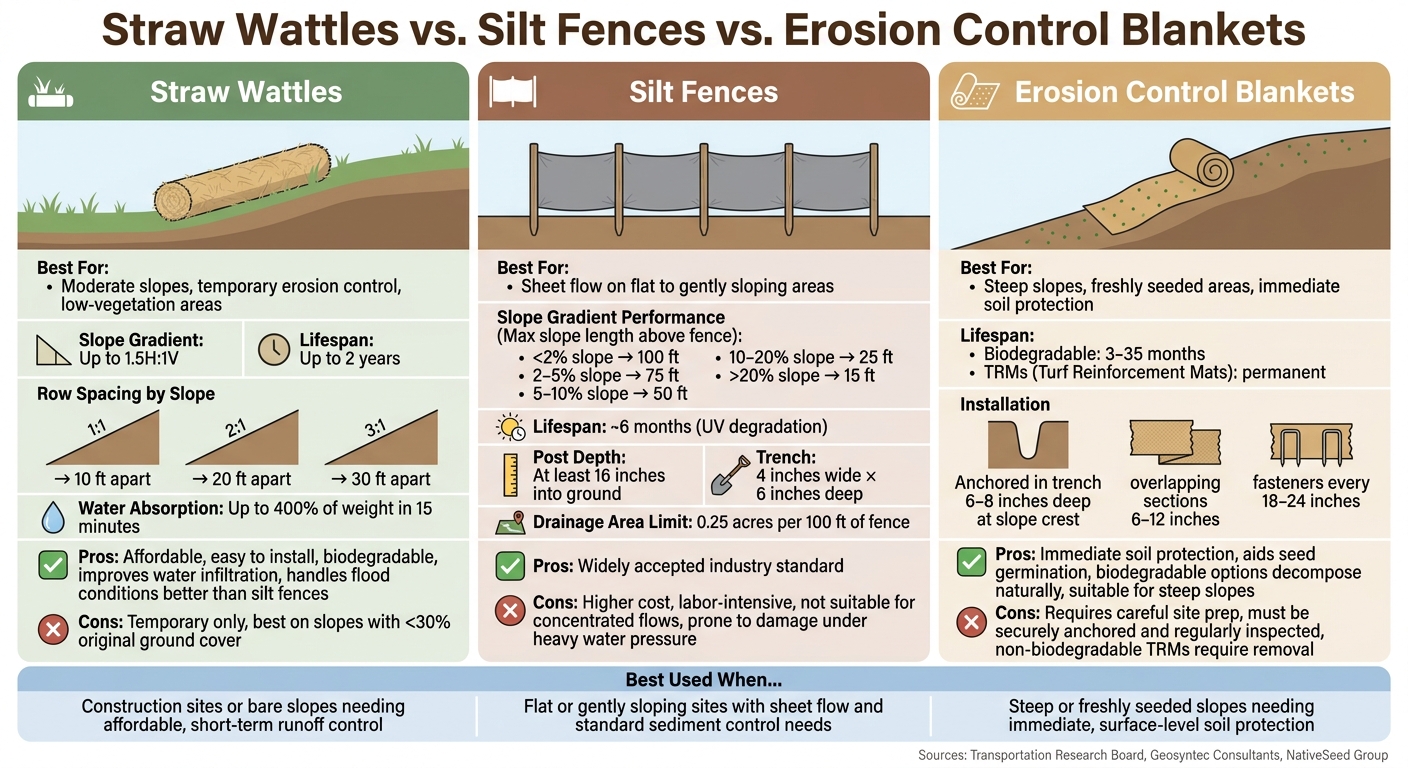
Straw Wattles vs. Silt Fences vs. Erosion Control Blankets: Which Is Right for Your Slope?
Each sediment control measure discussed earlier comes with its own set of benefits and drawbacks. To help you compare them at a glance, here’s a table summarizing the key points for each method. The best choice will depend on factors like your slope’s gradient, the project’s stage, and your budget.
| Measure | Advantages | Disadvantages |
|---|---|---|
| Straw Wattles | Affordable; simple to install; adaptable for shaping and directing water flow; improves water infiltration; performs better than silt fences in flood conditions [1] | Temporary solution; works best on slopes with less than 30% original ground cover [1] |
| Silt Fences | A widely accepted sediment control standard [1] | Higher cost; labor-intensive installation; prone to damage from heavy water pressure due to thin synthetic fabric [1] |
| Erosion Control Blankets | Provides immediate soil protection; aids seed germination and vegetation growth; biodegradable options break down naturally; suitable for steep slopes [1][7] | Requires careful site preparation; must be securely anchored and regularly inspected; non-biodegradable TRMs need removal after use [7] |
This breakdown makes it clear why straw wattles are often chosen for their affordability and flexibility, especially on less vegetated slopes. Silt fences, while more challenging to install, remain a go-to standard in sediment control. Meanwhile, erosion control blankets shine in situations where immediate protection and vegetation establishment are critical, particularly on steeper terrains. Each method serves a unique purpose, offering practical solutions tailored to different project needs.
Conclusion
Straw wattles are a practical and budget-friendly option for controlling erosion on slopes with little vegetation [1]. They shine during construction projects or landscape restoration, where exposed soil is especially prone to runoff. Thanks to their ability to withstand heavy rain and guide water flow, they provide a dependable, short-term solution.
That said, straw wattles are not a permanent fix. While they help slow water and trap sediment, they don’t handle the total runoff volume, which can lead to erosion in other areas if proper drainage isn’t in place. This highlights the need for a well-thought-out drainage plan.
"Healthy infiltration is the best way for the land to store water for plant growth and soil organisms." – NativeSeed Group [1]
To truly protect your landscape, temporary solutions like straw wattles should be part of a larger, long-term erosion control strategy. Consulting a specialist can help assess factors like slope grade, soil absorption, and vegetation, ensuring effective water management. For Maryland homeowners, Pro Landscapes MD offers services such as stormwater management, grading, French drains, and yard repair across Howard, Montgomery, Baltimore, and nearby counties. Pairing straw wattles with a well-designed drainage system is the key to preserving your soil, landscape, and nearby waterways.
FAQs
How do I know if my slope is too steep for straw wattles?
To figure out if your slope is too steep for straw wattles, start by assessing the slope gradient. Straw wattles are most effective on slopes with low surface water flow. They should be installed along the contour of the slope, with a slight downward angle to avoid water pooling behind them. If the slope is particularly steep, you might need to explore other erosion control options that can handle those conditions better.
Can straw wattles cause water to pool or wash out areas downslope?
Straw wattles can indeed cause problems like pooling or washouts downslope if they’re not installed properly or if their storage capacity is exceeded. Their performance depends heavily on placing them correctly and ensuring runoff volumes are managed effectively to avoid these issues.
Should I use straw wattles with seeding or an erosion control blanket?
Straw wattles are a great option for controlling erosion temporarily, managing water runoff, and stabilizing slopes with a grade of less than 30%. On the other hand, erosion control blankets – crafted from biodegradable materials – offer longer-lasting support for slopes and encourage vegetation to grow.
For the best outcome, pair straw wattles with seeding to achieve quick stabilization or use them alongside erosion control blankets to prevent erosion over time and help plants take root. This combination tackles both immediate runoff issues and creates a foundation for long-term vegetation growth.
Chat with Us