









- bhavya gada
- No Comments
If water stays under a patio, the base can fail long before the surface looks bad.
I’d sum it up like this: a patio lasts longer when I dig deep enough, build a draining base, slope the surface 1/8 to 1/4 inch per foot away from the house, and send water to a clear outlet. In Central Maryland, that matters even more because clay soil holds water and freeze-thaw weather can push pavers up in winter and leave them loose by spring.
Here’s the short version:
- I remove soft or organic soil before building.
- I use geotextile fabric to keep soil out of the stone base.
- I place and compact base stone in 2-inch lifts.
- I plan for about 8 to 10 inches below finish grade for many patios.
- I use French drains for water moving through soil.
- I use catch basins and solid pipes for low spots and surface pooling.
- I use dry wells only if the soil can soak up water fast enough.
- I know permeable pavers may still need underdrains in heavy clay.
- I check outlets and cleanouts twice a year and after big storms.
- If water is still there 48 hours after rain, I treat that as a warning sign.
A few numbers stand out. A 12-foot patio should drop about 1.5 to 3 inches from the house to the outer edge. A buried drainage setup can last 30 to 50 years if it stays clear and water can get out.
This article explains how I’d connect the base, slope, buried drains, and upkeep so water does not sit under the patio and cause settling, heaving, or shifting.
Building a French Drain around a paver patio
sbb-itb-843f8be
Start with a Well-Draining Patio Base
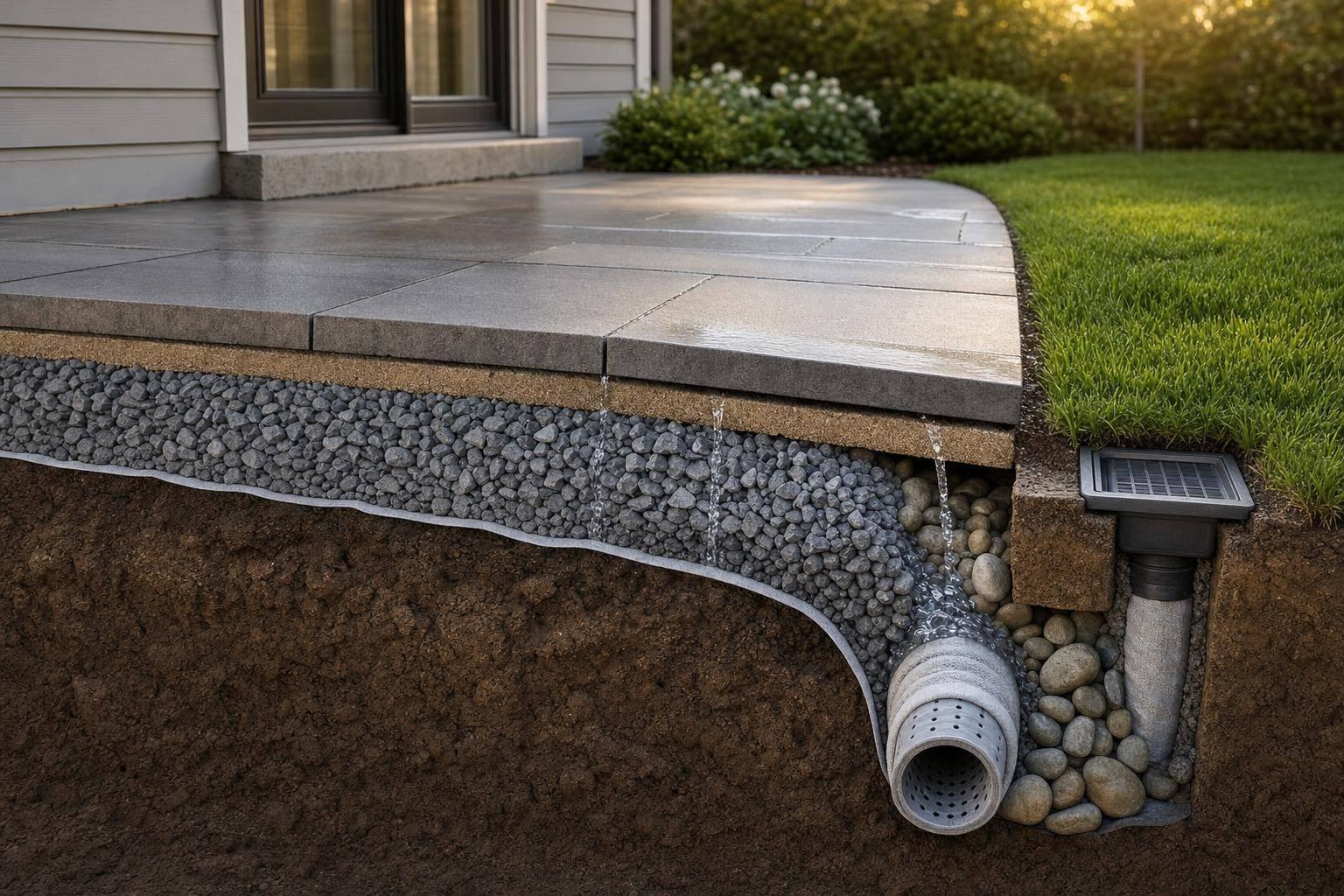
Once you know water is the issue, the next move is simple: build a base that drains instead of holding moisture. A patio base should push water out before it ever gets to the pavers. That means digging out soft, wet, or organic soil and rebuilding with layers that let water pass through.
For most Maryland patios, that usually means excavating 8 to 10 inches below the finished surface level [5].
Natural stone patios, patios that get heavy use, and patios built over clay soil often need the full 10 inches [5]. And this part matters more than many people think. If soft, organic, or unstable soil stays in place, it can keep breaking down below the surface. Over time, that leaves voids behind, and those voids lead to uneven settling.
After you clear the subgrade, place geotextile fabric directly over the compacted native soil before adding aggregate. This fabric keeps native soil from blending into the stone base. It also helps stop clogging, which can slow or block water movement through the base.
Next comes the aggregate. Add it in 2-inch lifts and compact each lift with a plate compactor [5]. A good check: once compacted, the aggregate should feel firm under foot pressure.
Base Materials That Handle Water and Frost
A pro-grade Maryland patio base usually includes a prepared subgrade, geotextile fabric, 4 to 6 inches of compacted 21A crushed limestone, and 1 to 2 inches of concrete sand for the bedding layer [5].
| Material | Drainage Performance | Frost Resistance | Typical Depth | Best Use |
|---|---|---|---|---|
| 21A Crushed Limestone | Excellent | High | 4–6 inches | Standard base for stability and drainage |
| Open-Graded Aggregate | Superior | Excellent | 6+ inches | Permeable systems and heavy clay areas |
| Concrete Sand (ASTM C33) | Good | Moderate | 1–2 inches | Bedding layer directly under pavers |
| Pea Gravel | Avoid in structural bases; it shifts under load | – | N/A | – |
A well-built base can add years to a patio’s life. Poor installation can cut that life short fast [5].
Set the Right Slope and Edge Drainage
Even a strong base won’t help much if the surface pitch is wrong. The patio still needs to move water away from the house. The standard slope is 1/8 inch to 1/4 inch per foot [5]. On a patio that’s 12 feet wide, that equals a total drop of 1.5 to 3 inches from the house side to the outside edge.
Use a 10-foot straightedge and level during installation to check the slope. If the surface varies by more than 1/4 inch over 10 feet, low spots can form. Those spots hold water, and that water can work its way into the base over time [5].
Pay close attention to thresholds, steps, and patio edges. Those are the places where the grade often flattens out or, worse, starts sloping the wrong way if the setup isn’t done carefully [5].
When the slope is set right, surface water runs to the edge. Any water that still gets into the base can then be handled by buried drainage. If water keeps pooling even after the base and pitch are set, buried drains and drain outlets can move it offsite.
Main Subsurface Drainage Techniques for Patios
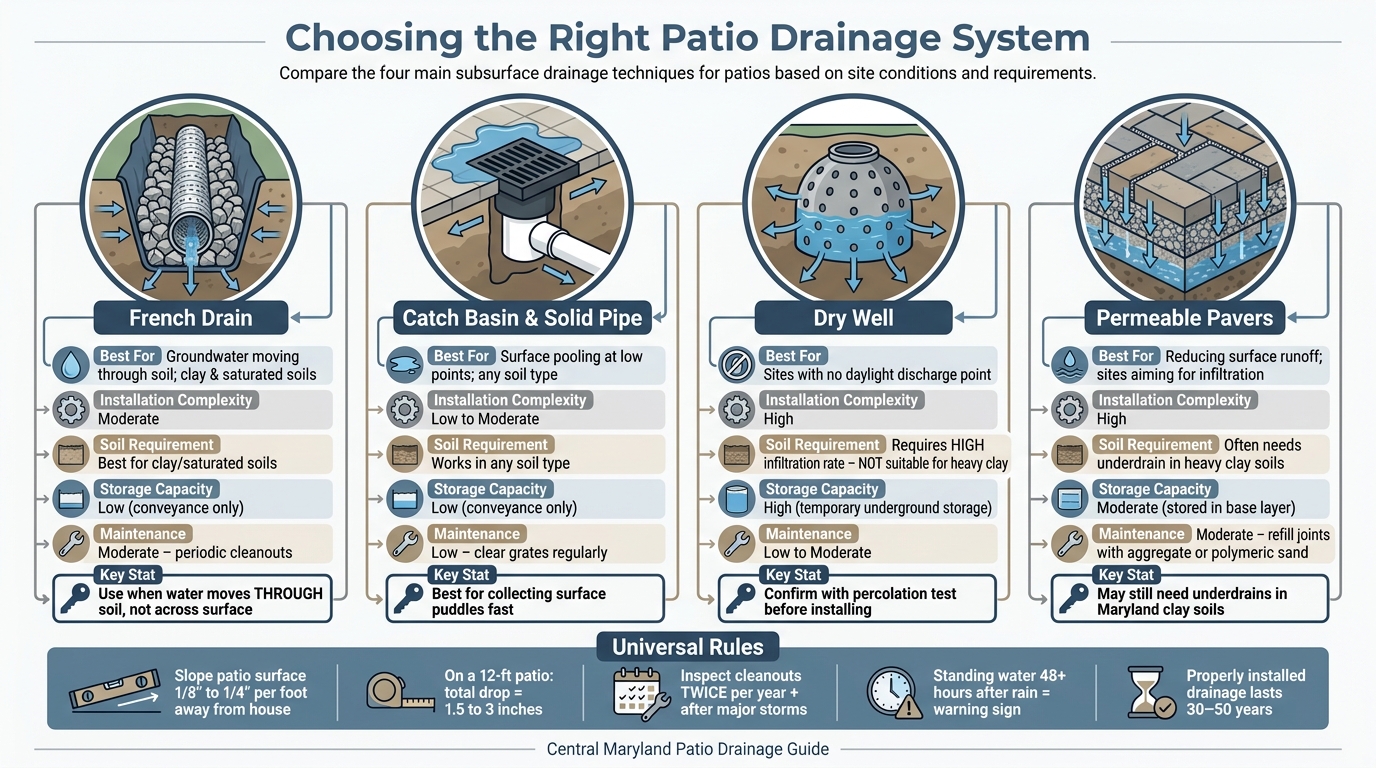
Patio Subsurface Drainage Methods Compared: French Drain vs. Catch Basin vs. Dry Well vs. Permeable Pavers
When grading alone can’t move all the water away, buried drainage takes care of what’s left below the patio. The right setup depends on a few site conditions: where the water starts, how fast the soil drains, how close the patio is to the foundation, and whether you have a clear place to send the water. There isn’t one setup that works for every yard. In Maryland, many patios use more than one method. The three main options are groundwater interception, surface-water capture, and permeable storage.
French Drains Beside or Below the Patio
Use this method when water is moving through the soil, not across the surface.
A French drain intercepts groundwater moving through the soil and sends it to a safe outlet. The installer digs a trench along the uphill side of the patio or foundation, lines it with geotextile filter fabric, fills it with washed angular stone, and places a perforated pipe at the bottom. Water moves through the stone, enters the pipe, and then flows by gravity to a daylight outlet or pop-up emitter.
This setup matters most in clay soils, where water moves slowly. Without filter fabric, fine clay particles can slip into the stone and pipe over time and clog the system. And that’s the key point: French drains are for subsurface groundwater, not surface runoff. If water is moving across the patio surface, a catch basin handles that job better.
Dry Wells, Catch Basins, and Buried Outlet Pipes
Use this method when water is pooling at a low point.
Catch basins sit at low points on or around the patio and collect surface water before it turns into standing water. A grated inlet stays flush with the surface, and a solid outlet pipe carries the water away from the structure to a discharge point. They collect surface water in any soil type and are a practical way to move it off the patio area.
Dry wells do something different. If there’s no practical daylight discharge point, a dry well gives water a place to sit underground for a while. Water collects in a perforated chamber buried in the ground and then slowly soaks into the surrounding soil. The catch is simple: dry wells only work where the soil can absorb water fast enough [2][5]. Use a dry well only when the soil can absorb water fast enough. In heavy clay soils, they may drain poorly after a heavy storm.
Solid outlet pipes don’t infiltrate water at all. They simply move water to a safe outlet. Every drainage system needs a clear outlet.
Permeable Pavers and Open-Joint Paver Systems
Use this method when you want the patio surface itself to drain water downward.
Permeable pavers let water pass through the surface into a stone base below. They take more work to install than standard paver systems because they need special base materials and paver units [5]. In slower-draining clay soils, that stone base by itself often can’t take in heavy rainfall fast enough. Underdrains are often still needed to move water out before it backs up [5].
This quick comparison shows which system fits each site condition. The basic rule is simple: match the system to the source – groundwater, runoff, no discharge point, or permeable storage.
| Technique | Installation Complexity | Soil Requirements | Storage Capacity | Maintenance Level | Best-Use Scenario |
|---|---|---|---|---|---|
| French Drain | Moderate | Best for saturated/clay soils | Low (conveyance) | Moderate (cleanouts) | Protecting foundations from groundwater |
| Dry Well | High | Requires high infiltration rate | High (temporary) | Low to Moderate | Sites with no available daylight discharge |
| Catch Basin & Solid Pipe | Low to Moderate | Collects surface water in any soil type | Low (conveyance) | Low (clear grates) | Collecting surface puddles at low points |
| Permeable Pavers | High | Needs underdrain in heavy clay | Moderate (in base) | Moderate (joint cleaning) | Sites aiming to reduce runoff |
Installation and Maintenance for Maryland Conditions
Match the Drainage System to Your Soil and Site
Once you’ve picked the drainage method, the next step is making sure the install fits your soil and outlet conditions.
In clay-heavy parts of Maryland, like Upper Marlboro and Westminster, clay soils need geotextile fabric and open-graded stone to help keep drains from clogging [2]. In soils that drain better, you have more room to work with. But don’t guess. Percolation testing should confirm whether a dry well or permeable system will work [2].
Soil type is only part of the picture. Grading and discharge location matter just as much. Any buried pipe needs a clear outlet, whether that’s a daylight outlet, pop-up emitter, or dry well [2][4]. Roof runoff can soak a patio base fast, so route downspouts into buried solid pipe that discharges at least 25 feet from the patio edge [3]. If the yard slopes toward the patio, regrading or a trench drain may be needed to catch that flow before it reaches the base [3].
Keep Drains, Joints, and Edges Clear Before Small Problems Grow
After installation, routine checks can stop a small blockage from turning into base failure.
Inspect cleanouts twice a year, and check all outlets after major storm events [2]. Pop-up emitters and daylight outlets should stay clear of mulch and debris so water can drain freely [3].
Permeable joints can settle over time, so top them off with the specified aggregate or polymeric sand [6]. Edge restraints should also be checked each year for movement [6].
| Problem | Cause | Fix | Maintenance |
|---|---|---|---|
| Shifting or sinking pavers | Water undermining the base or poor compaction [1][3] | Regrade the yard; install a trench or French drain [3] | Check edge restraints annually; clear debris from joints [1][6] |
| Standing water on patio | No slope or a flat installation [1] | Retrofit with a 1/8" per foot slope or channel drains [1] | Clear channel drain grates of leaves and mulch |
| System overflow during storms | Blocked outlets or crushed pipes [2] | Replace crushed sections; install pop-up emitters with cleanouts [2] | Flush accessible pipes seasonally to remove sediment [3] |
| Freeze-thaw heaving | Water trapped in the sub-base [3] | Add a gravel drainage layer and weep drains [3] | Keep outlets clear after major storms [2][3] |
Conclusion: How to Keep a Patio Dry and Stable Long-Term
Taken together, these steps help move water away from the patio base instead of letting it sit underneath. A dry, stable patio comes down to four basics: proper excavation and compaction, a steady slope of at least 1/8 inch per foot away from the house, the right subsurface drainage method for your soil, and routine inspections twice a year and after major storms [1][2][4]. Skip just one of them, and water can weaken the base long before you see damage on the surface.
French drains work well for saturated clay. Catch basins and solid outlet pipes help carry surface runoff away. Permeable pavers let water drain through the surface itself. The best choice depends on your soil type, slope, and discharge point [1][2][4]. When those parts line up, the patio holds up better through heavy rain and freeze-thaw cycles.
Properly installed subsurface drainage can last 30 to 50 years with basic upkeep [4]. If standing water sticks around for more than 48 hours after a storm, that’s a sign the system needs attention [4].
For central Maryland homeowners, Pro Landscapes MD can coordinate patio construction, grading, French drains, drain pipe placement, and stormwater management as part of a coordinated drainage plan.
FAQs
How do I know which patio drain type I need?
The right patio drain comes down to one thing: Is the issue surface water or subsurface saturation?
If water collects on the patio, runs toward your house or other structures, or starts washing soil away during storms, you’re dealing with a surface drainage problem.
If the yard stays soft and soggy for days after it rains, or water seems to push up from the ground, that points to subsurface drainage. In that case, a French drain is often the better choice.
Pro Landscapes MD recommends a professional assessment.
Can a patio still fail if the surface looks fine?
Yes. A patio can still fail even when the surface looks level and intact. The trouble often starts underneath, where poor subsurface drainage slowly does the damage.
When water moves beneath the pavers, it can wash out the base and soften the soil below. Over time, that can lead to shifting, sinking, or cracking. It may look fine at first, then start to move little by little.
Pro Landscapes MD helps stop those problems before they start with proper grading, drain pipe placement, and French drains.
When should standing water under a patio worry me?
Standing water under a patio is a problem any time it sticks around. Over time, it can weaken your hardscape and put its structure at risk.
Look for sinking, shifting, or cracking pavers. You may also notice algae, moss, black staining, or mulch washing onto the patio after storms. In Maryland, trapped water can lead to heaving during freeze-thaw cycles, so poor drainage should be fixed before it turns into long-term damage.
Chat with Us