









- bhavya gada
- No Comments
When managing stormwater compliance in Maryland, you need to understand two systems: federal SWPPP requirements under the NPDES permit and Maryland’s local stormwater rules. Both aim to control water pollution but differ in scope, focus, and requirements. Here’s what you need to know:
- SWPPP (Stormwater Pollution Prevention Plan):
- Federally required under the NPDES system.
- Focuses on site-specific erosion and sediment control for construction and industrial sites.
- Includes Best Management Practices (BMPs) like silt fences and sediment basins.
- Requires regular updates and inspections (weekly or bi-weekly).
- Maryland Local Stormwater Rules:
- Go beyond federal SWPPP requirements.
- Enforced by local agencies with stricter standards tailored to Maryland’s geography.
- Cover land-disturbing activities, including municipal system discharges.
- Require additional steps like water quality sampling, lab testing, and staff training.
Key Takeaway: Maryland’s local rules often add layers of complexity, requiring compliance with both federal and local systems. Missteps – like submitting incorrect plans – can result in delays, fines, or stop-work orders.
Quick Comparison
| Feature | SWPPP (Federal/State Level) | Maryland Local Stormwater Rules |
|---|---|---|
| Purpose | Prevent water pollution at construction sites | Broader focus on discharges and erosion |
| Applicability | Construction and industrial sites | Land-disturbing activities, municipal discharges |
| Oversight | EPA or Maryland Department of the Environment | Local and county agencies |
| Key Requirements | BMPs, site maps, regular inspections | Erosion control plans, water sampling, training |
Understanding these differences is essential to avoid non-compliance and costly project delays.
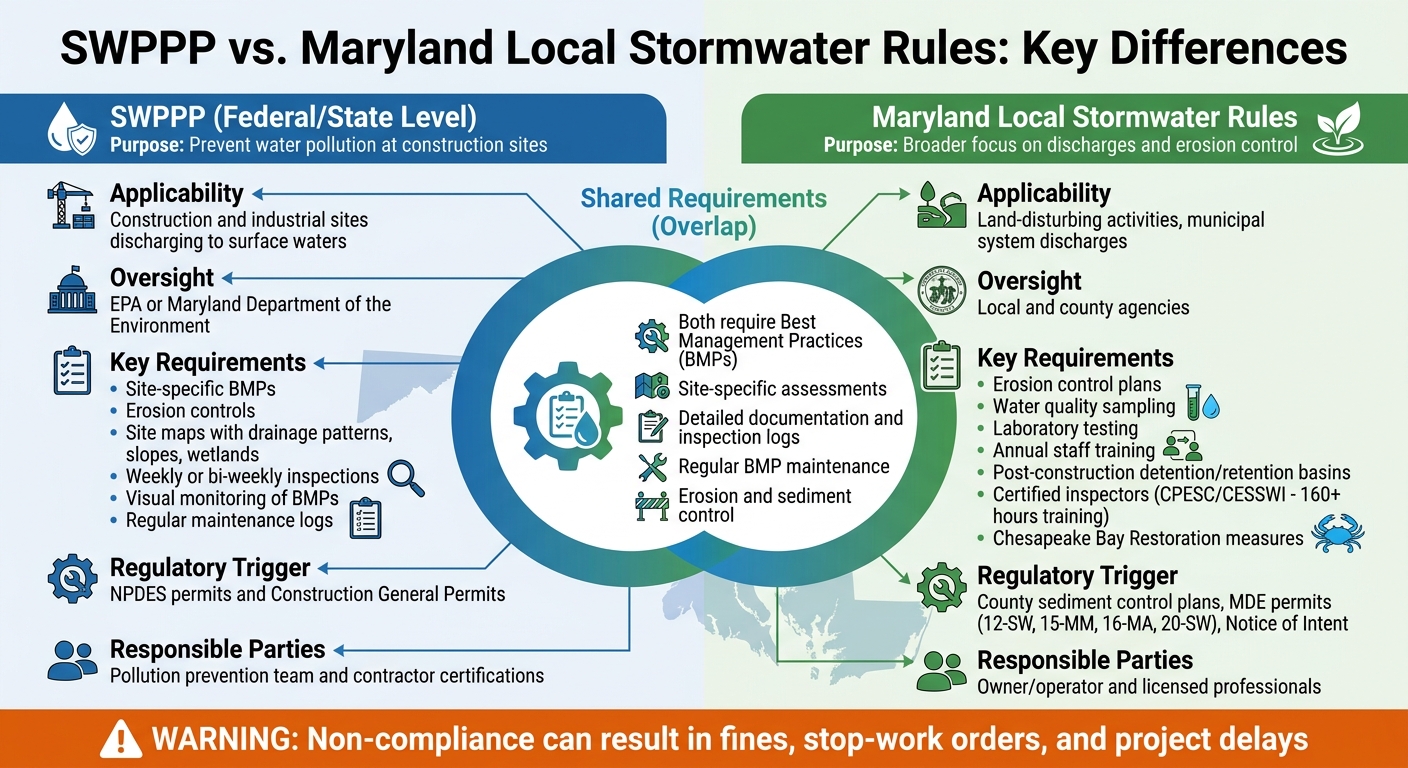
SWPPP vs Maryland Local Stormwater Rules Comparison Chart
MDE Stormwater Regulations and Design Manual Updates Listening Session – January 20 (2026)
sbb-itb-843f8be
Purpose and Scope Differences
The main goal of a Stormwater Pollution Prevention Plan (SWPPP) is straightforward: to prevent water pollution caused by construction activities while adhering to both federal and state environmental regulations [1]. Since every construction site is different, a SWPPP is tailored to fit the specific conditions of each location – taking into account things like topography, soil type, and drainage patterns. This ensures that erosion and sediment control measures are designed to be as effective as possible for the site in question [1].
On the other hand, Maryland’s stormwater regulations take a broader approach. The Maryland Department of the Environment (MDE), working alongside the EPA, oversees pollution control across various industries, such as industrial facilities, mining operations, and marinas [2]. These state regulations require businesses in these sectors to obtain specific permits – like the 12-SW for industrial sites, the 15-MM for mining, and the 16-MA for marinas. A SWPPP is often a required component to secure these permits [2].
The scope of these systems also varies. SWPPPs under the National Pollutant Discharge Elimination System (NPDES) are focused on construction sites and industrial facilities that discharge directly into surface waters [1][3]. Maryland’s local stormwater rules, however, are broader. They cover land-disturbing activities and can include discharges into municipal systems, which are generally not covered by federal SWPPP rules [3]. This means that depending on where stormwater from a project flows, compliance may require meeting both federal SWPPP guidelines and additional local permit requirements. The table below highlights these differences.
Comparison Table: SWPPP vs. Local Rules
| Feature | SWPPP (Federal/State Level) | Maryland Local Stormwater Rules |
|---|---|---|
| Primary Purpose | Prevent construction-related water pollution and manage site-specific erosion/sediment [1] | Monitor and regulate discharges in select industries to protect state waterways [2] |
| Applicability | Construction sites and industrial facilities discharging to surface waters [3] | Activities that disturb the land, including discharges into municipal systems [3] |
| Regulatory Trigger | NPDES permits and state-issued Construction General Permits [1] | County sediment control plans, MDE permit applications, and Notice of Intent (NOI) [2] |
| Regulatory Oversight | EPA or Maryland Department of the Environment [1][3] | Local or County regulatory agencies and water authorities [1][3] |
| Key Requirements | Site-specific BMPs, erosion controls, and regular maintenance logs [1] | SWPPP development plus water quality sampling, lab testing, and annual staff training [2] |
Getting these distinctions right is essential. Submitting a SWPPP to the wrong agency or using a generic, cookie-cutter template can result in permit rejections, delays, or even stop-work orders [1]. In Maryland, navigating compliance often means dealing with multiple agencies, each with its own approval process and timeline. These complexities are critical to understand, as the next sections will explore the consequences of non-compliance.
Main Requirements: SWPPP vs. Local Stormwater Rules
SWPPP-Specific Requirements
A Stormwater Pollution Prevention Plan (SWPPP) is a site-specific document required for facilities seeking a National Pollutant Discharge Elimination System (NPDES) permit under the Clean Water Act [4]. It identifies potential pollution sources and outlines Best Management Practices (BMPs) to minimize stormwater pollutants [4].
Each SWPPP must include a detailed site map showing critical features like drainage patterns, slopes, wetlands, discharge points, and areas designated to remain undisturbed [4]. A pollution prevention team must also be identified, along with a list of contractors or subcontractors responsible for specific tasks. These individuals must provide certifications confirming their compliance with the plan [4].
SWPPPs are not static documents – they need regular updates to reflect changes in personnel, processes, or chemicals. They also define inspection schedules, which typically occur weekly or bi-weekly, to ensure compliance and address potential issues proactively [1][5]. Maintenance strategies are a key component, ensuring that measures like silt fences and sediment basins are functioning as intended to prevent offsite runoff [1][4].
Failing to meet SWPPP requirements can lead to serious consequences. For example, in 2020, a Massachusetts company faced a lawsuit for stormwater damage after failing to establish a SWPPP for its solar array project [4]. Similarly, a California company was fined $3.7 million for clean water violations, despite having a SWPPP, because the plan did not meet federal standards [4]. These cases highlight the importance of adhering to both federal and local regulations.
Maryland Local Stormwater Rules-Specific Requirements
Maryland’s local stormwater regulations add another layer of requirements beyond federal SWPPP standards. These rules emphasize erosion control, sediment management, and post-construction systems like detention or retention basins [4]. Plans must detail stabilization practices – such as seeding, mulching, or sodding – and specify where these activities and sediment traps will be implemented [4].
Unlike federal SWPPPs, Maryland requires compliance with specific discharge permits issued by the Maryland Department of the Environment (MDE). Examples include permits like 12-SW (industrial), 15-MM (mineral mines), 16-MA (marina), and the updated 20-SW industrial permit [2]. These permits often mandate laboratory testing and water quality sampling, which go beyond the visual inspections typical of SWPPPs [2].
Maryland also prioritizes training and certification. Annual staff training on stormwater practices is mandatory [2]. In some jurisdictions, inspectors must hold professional certifications like Certified Erosion, Sediment and Storm Water Inspector (CESSWI) or Certified Professional in Erosion and Sediment Control (CPESC), requiring over 160 hours of training to meet regulatory standards [5]. Plan approvals typically involve owners/operators and licensed professionals, with submissions reviewed by local or county agencies. Additionally, Maryland permits may include specific measures tied to Chesapeake Bay Restoration goals, reflecting the state’s environmental priorities [2].
Understanding these requirements is essential for navigating the often stricter local rules in Maryland.
Comparison Table: Main Elements
| Feature | SWPPP Requirements (Federal/NPDES) | Maryland Local Stormwater Rules |
|---|---|---|
| Primary Focus | Identification of all potential pollutants and site-wide BMPs [4] | Erosion controls, sediment management, and post-construction standards [4] |
| Documentation | Site-specific SWPPP, pollution source assessments, and contractor certifications [4] | Erosion and Sediment Control (ESC) plans and permanent management system designs [4] |
| Site Map Elements | Drainage patterns, slopes, wetlands, and discharge points to MS4s [4] | Specific locations for stabilization activities and structural sediment traps [4] |
| Inspections | Weekly or bi-weekly inspections with defined procedures and timelines [1][4] | Inspections often scheduled after rainfall, snow, or storm events [4] |
| Monitoring | Visual inspections of BMPs and site conditions [2] | Visual monitoring plus mandatory laboratory testing and water quality sampling [2] |
| Responsible Parties | Pollution prevention team and signed contractor certifications [4] | Typically the owner/operator and licensed professionals for plan approval [4] |
| Personnel | Inclusion of a pollution prevention team as outlined in the plan [4] | Often requires certified professionals (CPESC/CESSWI) depending on the jurisdiction [5] |
Where SWPPP and Local Rules Overlap
Federal and local regulations may come from different systems, but they share core priorities. Both emphasize erosion and sediment control (ESC) through Best Management Practices (BMPs) like silt fences and sediment basins, which help reduce sediment runoff [1][7]. Another commonality? These plans aren’t one-size-fits-all. Each project must consider its unique topography, soil type, and drainage patterns when creating site-specific assessments [1].
This alignment extends beyond design to documentation and inspections. Both systems require property owners to maintain detailed records, including site maps, inspection logs, and maintenance reports. These documents are critical for regulatory reviews, with inspections typically happening weekly or bi-weekly [1]. As Eco Permit Pros explains:
A SWPPP is not a ‘set-it-and-forget-it’ document. Construction projects undergo changes, and site conditions evolve, requiring regular inspections and updates to the SWPPP and site maps. – Eco Permit Pros [1]
Local agencies often build on federal requirements, integrating them into their own permitting systems. For instance, Maryland’s General Permit for Construction Activity (Permit No. 20-CP) requires a locally approved erosion control plan before issuing a state-level SWPPP permit. This integration simplifies compliance: tools like Maryland’s Environmental Resources and Land Information Network (MERLIN Online) allow property owners to identify sensitive areas and meet both state and local environmental assessments in one step.
Both federal and local frameworks stress the importance of ongoing BMP maintenance. Without proper upkeep, BMPs can fail to stop pollutants like trash, chemicals, and construction debris from entering waterways [1][6][7]. The EPA’s stormwater management mantra – "slow it down, spread it out, soak it in" – captures the shared goals of minimizing runoff and reducing pollution [6].
These overlapping requirements make compliance more efficient. Treating federal and local frameworks as complementary systems helps managers avoid redundant work and lowers the chances of permit denials or project delays [1]. Understanding these connections allows for unified planning and smoother compliance management.
Compliance Consequences and Penalties
Failing to follow federal SWPPP requirements or Maryland’s local regulations can lead to steep financial and legal repercussions. Both the Environmental Protection Agency (EPA) and Maryland Department of the Environment (MDE) can impose heavy fines for NPDES permit violations. On a local level, agencies like Howard County’s Bureau of Environmental Services can issue stop-work orders, which immediately bring construction projects to a halt [3][9]. These penalties are no small matter – urban areas in Maryland have already poured over $1 billion into clean water infrastructure to meet compliance standards [8].
Local enforcement is carried out through regular site inspections by county officials who check adherence to sediment control standards and local codes [1][9]. These efforts are bolstered by state-level mandates. Maryland issues five-year discharge permits with specific restoration goals. For example, the State Highway Administration is currently required to restore 4,092 acres of impervious surface under its permit [8]. Falling short of these goals can lead to permit reviews or even denials, which can indefinitely delay projects.
The financial implications go beyond fines. Maryland’s Water Quality Finance Administration has already provided $117.8 million in low-interest loans for stormwater restoration efforts, with an additional $257 million in loans pending approval [8]. Despite these investments, only about 25% of the state’s baseline goal has been met, with 43,000 acres of impervious surface restored so far [8]. These challenges are compounded by pressure from environmental advocacy groups.
Organizations like the Chesapeake Bay Foundation (CBF) and Chesapeake Legal Alliance (CLA) closely monitor permits, often challenging those they deem insufficient. CBF’s Maryland executive director, Allison Colden, has criticized the state’s stormwater regulations as inadequate for handling severe weather events. Similarly, CLA’s senior attorney Evan Isaacson has stated that current permits fail to protect communities and meet Chesapeake Bay restoration goals [8]. These groups have successfully pushed for stricter enforcement, meaning that even permits meeting minimum requirements can face legal opposition.
Violations are often tied to poor documentation and improper maintenance of Best Management Practices (BMPs). Issues like incomplete inspection logs, outdated site maps, or poorly maintained silt fences frequently lead to enforcement actions during reviews [1]. To avoid penalties, maintaining thorough records and staying proactive with BMP upkeep is critical [1][3]. Together, these financial, legal, and advocacy pressures highlight the importance of strict compliance with SWPPP and local stormwater regulations.
Conclusion
Understanding the differences between SWPPP requirements and Maryland’s local stormwater rules is crucial to avoiding compliance issues. Federal SWPPPs are designed to safeguard natural water bodies under NPDES permits, while Maryland’s local regulations often focus on discharges into municipal systems and specific county-level mandates. Both require detailed attention. As Eco Permit Pros puts it, "A SWPPP is not a ‘set-it-and-forget-it’ document" [1]. It’s vital to update your plan whenever there are site changes, staff adjustments, or operational shifts to stay compliant.
Regulatory agencies like the MDE and EPA conduct regular inspections. Grapewell Stormwater Consulting cautions, "Your SWPPP is the first thing an MDE or EPA official will review when they come to your facility for an inspection" [10]. Incomplete or outdated documentation can lead to violations or project delays, making consistent updates and thorough record-keeping essential.
Both federal and local regulations demand careful, site-specific stormwater management practices. Regular inspections paired with detailed, customized plans are key to staying ahead of enforcement challenges. With Maryland transitioning to new stormwater permits, professional expertise is more important than ever.
For property owners in central Maryland, expert help can make all the difference. Pro Landscapes MD offers stormwater management solutions tailored to meet Maryland’s strict requirements while protecting the environment. Their services include drainage solutions like French drains, dry riverbeds, and grading, all designed to prevent runoff issues. They also specialize in eco-friendly landscaping and environmental pavers, which help reduce runoff and promote sustainability.
FAQs
Do I need both a SWPPP and a local stormwater plan in Maryland?
In Maryland, whether you need a Stormwater Pollution Prevention Plan (SWPPP) or a local stormwater plan – or both – depends on the specifics of your project and local regulations. Generally, a SWPPP is necessary for construction projects disturbing more than one acre or for certain industrial activities. However, local jurisdictions often have their own stormwater requirements, which may include additional plans to comply with county-specific rules. To stay compliant, it’s essential to review both state and local regulations carefully.
Which agency reviews my stormwater paperwork for my project location?
The Maryland Department of the Environment (MDE) handles the review of stormwater documentation for projects located within Maryland. Their role is to ensure that these projects meet all applicable state regulations and requirements.
What triggers water sampling or lab testing beyond SWPPP inspections?
Water sampling or lab testing outside of SWPPP inspections is often necessary when water quality or compliance issues arise. Common triggers include concerns about endangered species, sediment runoff, or failing erosion controls like silt fences or basins. Testing might also be required if there’s suspected contamination, pollutant levels exceed limits, or during audits. These tests help identify pollutants such as sediments, nutrients, or hazardous substances and ensure compliance with regulations.
Chat with Us