









- bhavya gada
- No Comments
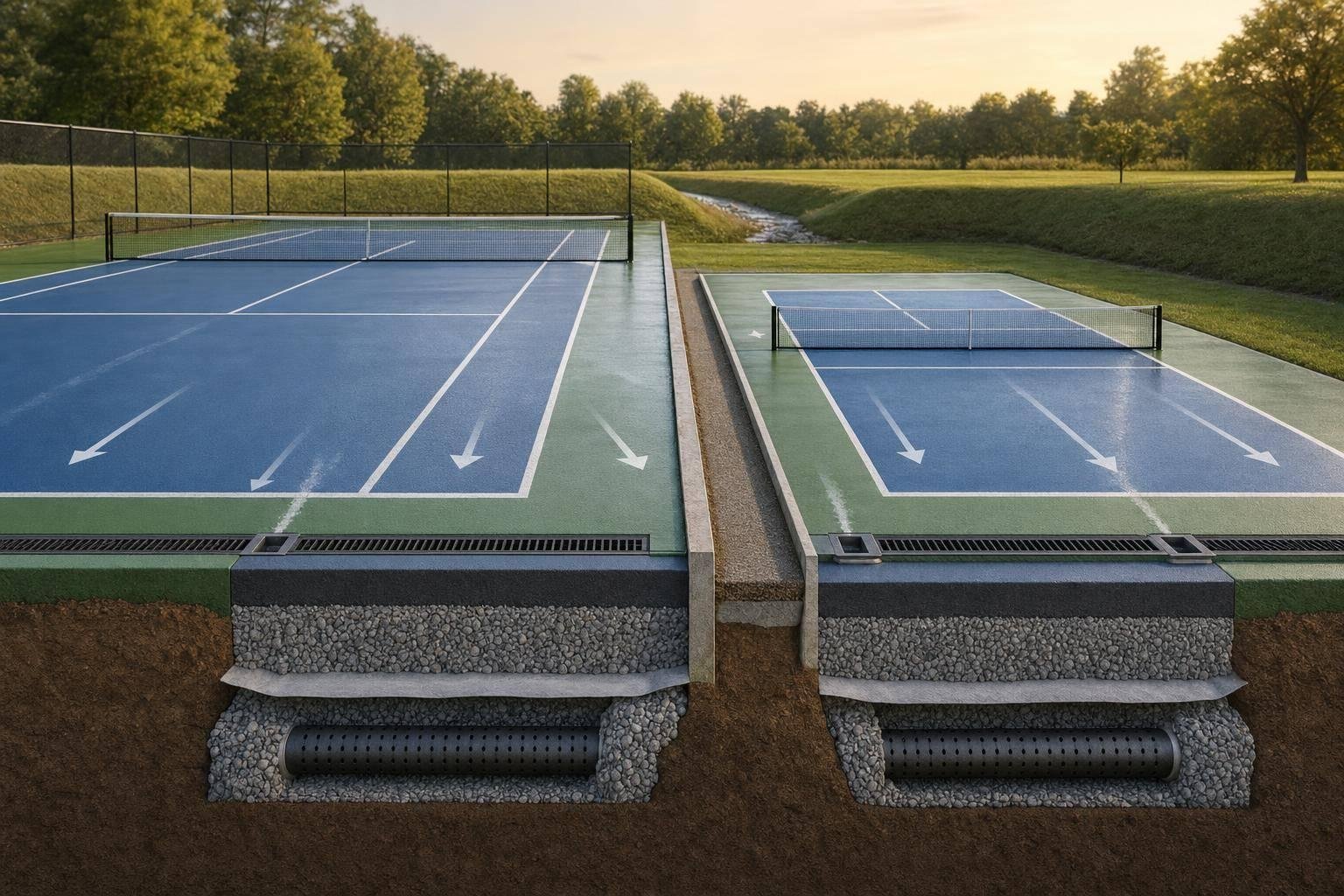
If you get the drainage wrong, both tennis and pickleball courts can end up with puddles, cracks, and freeze-thaw damage. The main split is simple: a tennis court is about 7,200 sq. ft., while a pickleball court is about 1,800 to 2,000 sq. ft. That means tennis courts push off much more rainwater and often need more drains, more pipe, and more grading control.
If I had to boil it down, here’s the answer:
- Both court types need a steady surface slope and a firm base.
- Tennis courts usually need more drainage hardware because they are much larger.
- Pickleball courts often work with a simpler low-side drain setup.
- Maryland sites add extra drainage problems because of clay soils, rolling grades, and freeze-thaw weather.
- Nearby pools, patios, and retaining walls can push extra water toward the court, so the whole area has to drain together.
How To Drain a Future Pickleball Court in Matthews, NC
sbb-itb-843f8be
Quick Comparison
| Item | Tennis Court | Pickleball Court |
|---|---|---|
| Court pad size | About 120 x 60 ft. | About 30 x 60 ft. |
| Surface area | About 7,200 sq. ft. | About 1,800 to 2,000 sq. ft. |
| Water runoff | Higher | Lower |
| Slope need | Steady cross slope | Steady cross slope |
| Drain setup | Often includes perimeter drain, trench drain, catch basins, and collector pipe | Often a low-side trench or channel drain, sometimes with an uphill French drain |
| Grading risk | Low spots are easier to create over the longer surface | Tight layout means small grade errors still show up fast |
| Site limits | More room and pipe planning needed | Often built in tighter backyard spaces |
Bottom line: I’d match the drainage plan to court size, slope, soil, and nearby hardscape – not just the sport being played.
Tennis Court Drainage: Larger Surface, More Runoff, More Infrastructure
A full-size tennis court gives water a long path to travel. And that means even small grading mistakes can turn into puddles.
On a 120-foot court, slight errors in grade can create low spots that hold water and hurt playability. Because the runoff path is so long, tennis courts usually need more than simple grading.
A steady cross slope of about 0.83% to 1% works best. That comes out to roughly 1 inch of drop per 10 feet. Across 120 feet, you’re looking at about 12 inches of total fall.
Base Preparation and Slope Control for a Full-Size Court
Good drainage starts under the court, not on top of it.
Before stone or asphalt goes in, the subgrade should be cleared of organic material and compacted well. A typical base uses 4 to 6 inches of compacted crushed stone or aggregate [1][2]. In central Maryland, clay-heavy soil tends to hold moisture and move under load. That’s why geotextile fabric helps keep the stone base in place and helps the slope stay consistent [2].
If the base settles in one spot, the surface above usually settles too. And once that happens, water sits there.
Perimeter Drains, Trench Drains, and Collector Piping
A tennis court often needs a few parts working together to move water off the surface and away from the base [2]:
- An uphill perimeter drain to intercept groundwater before it reaches the court
- A low-side trench drain to catch sheet flow coming off the surface
- Catch basins at low points to collect water for discharge
- 4- to 6-inch collector piping to carry water to an approved discharge point
Before any excavation starts, call Miss Utility so underground lines can be marked [2].
Pickleball courts follow the same drainage logic. But because the playing area is smaller, they often need fewer collection points.
Pickleball Court Drainage: Smaller Footprint, Tighter Layout, Simpler Collection
A standard pickleball court is about 30 by 60 feet, so it sheds a lot less water than a tennis court. In most cases, that means fewer drain inlets and less hardware on-site.
Still, the basics don’t change. The court needs a steady one-way slope. If the surface falls toward the middle, water can sit in low spots. Over time, that standing water can lead to heaving, cracking, or shifting as freeze-thaw cycles set in [3]. A compacted aggregate base helps move water and keeps that slope steady over time [1][3].
When a Low-Side Channel Drain Is Enough
Because runoff is lower, many single-court pickleball layouts can get by with one low-side trench drain that carries water into buried pipe [1][3]. That’s often enough for a simple layout.
If the soil stays wet, or if an uphill slope pushes water toward the court, it helps to add a perimeter French drain along the uphill side. That drain intercepts water before it gets into the base [3].
Handling Tight Backyard Conditions in Maryland
On residential lots in Maryland, even a simple drainage plan can get tricky fast. Fences, patios, and nearby structures often limit grading space, so you don’t always have much room to work with.
In those cases, geofabric paired with crushed stone can help hold the base in place and limit soil migration [3]. Discharge should run to a pop-up emitter, dry well, swale, or rain garden far enough from the court to keep the base protected.
That’s where pickleball drainage starts to differ from tennis: less runoff, tighter layouts, and usually a simpler collection setup.
Tennis vs. Pickleball Drainage: Key Design Differences
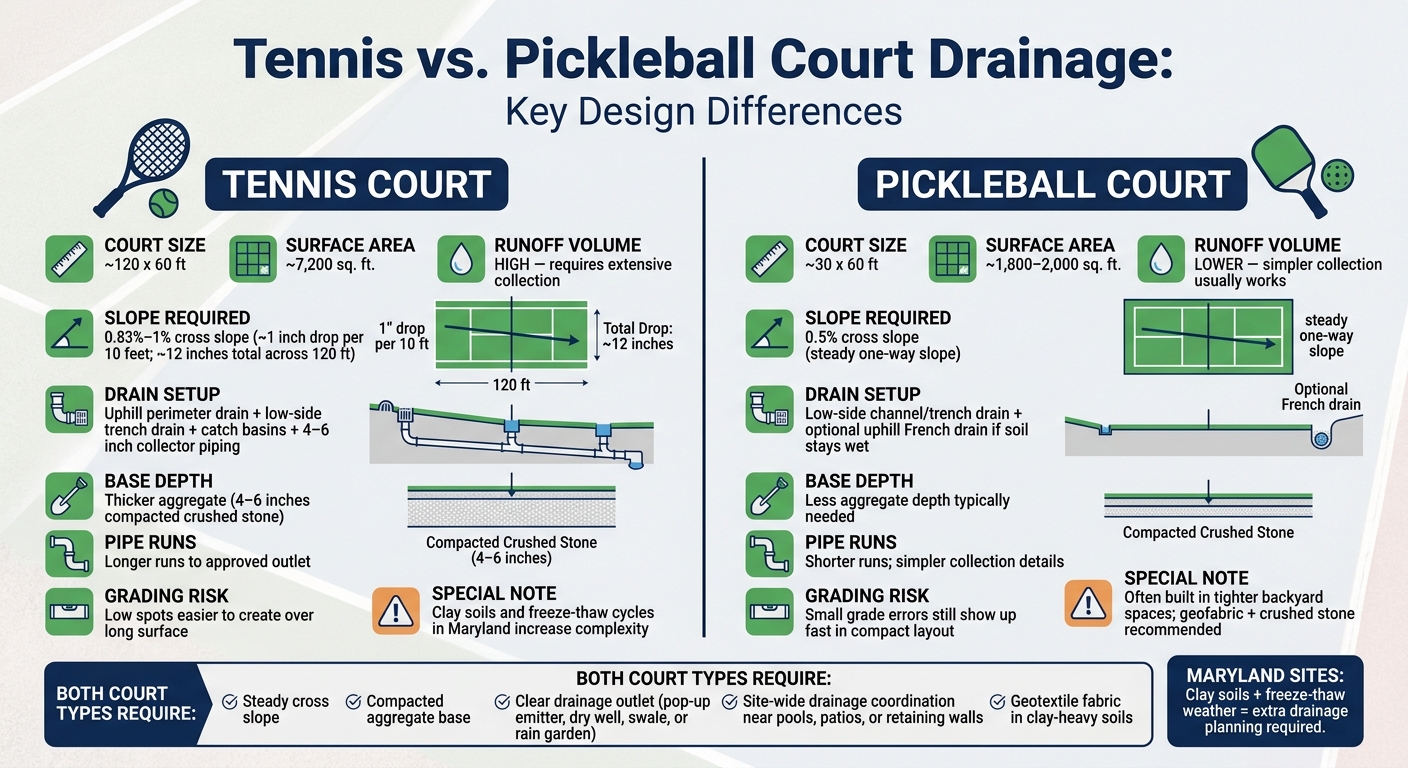
Tennis vs Pickleball Court Drainage: Side-by-Side Comparison
The main difference is scale. Tennis courts are much larger, and that size gap shapes almost every part of the drainage plan.
| Feature | Tennis Court | Pickleball Court |
|---|---|---|
| Surface Area | ~7,200 sq. ft. [1] | ~1,800 sq. ft. [1] |
| Runoff Volume | High; requires extensive collection | Lower; simpler collection usually works |
| Drain Placement | Perimeter drains, trench drains, collector pipe runs | Low-side channel drain or simple perimeter collection |
| Drainage Outlet | Longer pipe runs to an approved outlet | Shorter pipe runs; simpler collection details |
| Base Depth | Thicker aggregate support is often needed | Less aggregate depth is typically needed |
In plain terms, tennis courts usually need more water collection capacity. Pickleball courts usually need less.
Runoff Volume, Base Depth, and Drain System Complexity
Hard court surfaces shed all rain as runoff [1]. That matters a lot more on a tennis court, where the total area is about 7,200 sq. ft. [1]. More surface means more water moving off the court during a storm.
That’s why tennis court builds often use thicker aggregate layers, along with perimeter drains as part of the system. The pipe runs are also longer, and the outfall needs a longer route to an approved outlet [1].
A pickleball court is much smaller, at about 1,800 sq. ft. [1]. Since it sends off far less runoff, shorter pipe runs and simpler collection details are often enough [1].
Playability Risks From Low Spots and Improper Slope
Both court types need a steady 0.5% cross slope [1]. The challenge is that it’s harder to hold that grade across a 78-foot tennis court than across a 44-foot pickleball court [1].
On a tennis court, even a small dip can leave standing water and create an uneven bounce [1]. That can change how the court plays in a hurry.
On a pickleball court, the smaller layout doesn’t give you much room to hide grading mistakes. A low spot near the non-volley zone stands out fast because the playing area is compact. Low spots near the non-volley zone affect play most. So even though the court is smaller, the grading still needs to be precise.
Those layout differences get even more important when the court sits next to a pool, patio, or retaining wall.
Drainage Planning Near Pools, Patios, and Retaining Walls
Drainage gets more complicated when a court connects to another hardscape surface or sits near a grade change. Each surface moves water in its own direction, so the slope and collection details need to work together.
Courts Next to Pools and Patios
Pool decks and patios are already built to move water away from the structure, so the point where they meet a court needs a clean drainage break [2]. One common fix is a channel drain along the edge where the patio or pool deck meets the court. That drain can intercept runoff before it gets onto the playing surface.
Without that detail, water can spill onto the court and lead to standing water.
A pickleball court may be smaller, but the transition still needs the same level of care when it sits next to a pool deck. That problem gets worse when the court sits lower than the surrounding grade.
Courts Below Slopes or Beside Retaining Walls
A court that sits below surrounding grade or next to a retaining wall has a simple problem: water wants to move toward it. In Maryland, rolling topography and clay-heavy soil can make that harder to manage [2].
Behind a retaining wall, drainage stone and perforated pipe help relieve wall pressure and carry water away [2]. But there’s a catch. The outlet for that pipe needs to be routed with care so it doesn’t empty onto the court.
The same idea applies when uphill grades or wall backfill push runoff toward the court. An interceptor trench drain at the uphill edge can catch water before it reaches the playing surface. The court, wall, and nearby hardscape need to drain as one system.
Conclusion: Matching Your Court Drainage Plan to Size, Slope, and Site Conditions
Both court types need a 0.5% cross slope, a stable base, and a clear drainage outlet [1]. Miss just one of those pieces, and you’re asking for trouble: standing water, surface cracking, and freeze-thaw damage can all show up fast.
After that, court size shapes the rest of the drainage plan. A tennis court moves a lot more water than a pickleball court, so it often needs more collection capacity and longer discharge runs [1]. A pickleball court, on the other hand, can sometimes work with a simpler setup, like a channel drain or swale, if the surrounding grade allows for it.
That gap in runoff matters even more on tight residential lots. If a court sits near a grade change or shares space with patios, walkways, or other hardscape, the drainage plan needs to work as one connected system [3].
In Maryland, clay-heavy soils can make that job harder. They often call for professional grading to keep the base stable [2].
On Maryland properties, that kind of site-wide drainage planning often means coordinating grading and hardscaping. For court grading, drainage, and hardscaping in central Maryland, Pro Landscapes MD serves Howard County, Montgomery County, and surrounding communities.
FAQs
How do I know which drain setup my court needs?
Check how water moves around the court and what’s nearby. After rain, look for standing water, soft spots in the base, or erosion along the edges, especially in places where runoff from downspouts, patios, or other hard surfaces tends to collect.
If the soil doesn’t drain well or you’re working with a tight area, an underground setup like a French drain may be the best fit. If the court sits near a retaining wall, the drainage area should line up with the wall’s soil conditions and the risk tied to the slope.
Does clay soil change the drainage plan?
Yes. Clay-heavy soils hold water and drain slowly, so water tends to pool and soak in at a slower rate. That usually means you need stronger drainage detailing than you would with sandy soils.
For a court drainage plan, that can mean larger subsurface drains, extra drainage lines, and proper slopes and outlets so water doesn’t sit on the surface after rain. If clay sits behind retaining walls, engineered backfill and clean drainage stone are often needed as well.
What if my court sits near a pool or retaining wall?
If your tennis or pickleball court is close to a pool or retaining wall, don’t let runoff soak into the backfill. Shape the area so water flows away from the wall instead of draining into the retained soil.
It also helps to build a dedicated drainage zone behind the wall. Use clean angular stone, a nonwoven geotextile, and a perforated pipe with a slope that leads to a safe outlet.
That setup can help cut down on wall pressure, cracking, and freeze-thaw damage around nearby hardscapes.
Chat with Us