









- bhavya gada
- No Comments
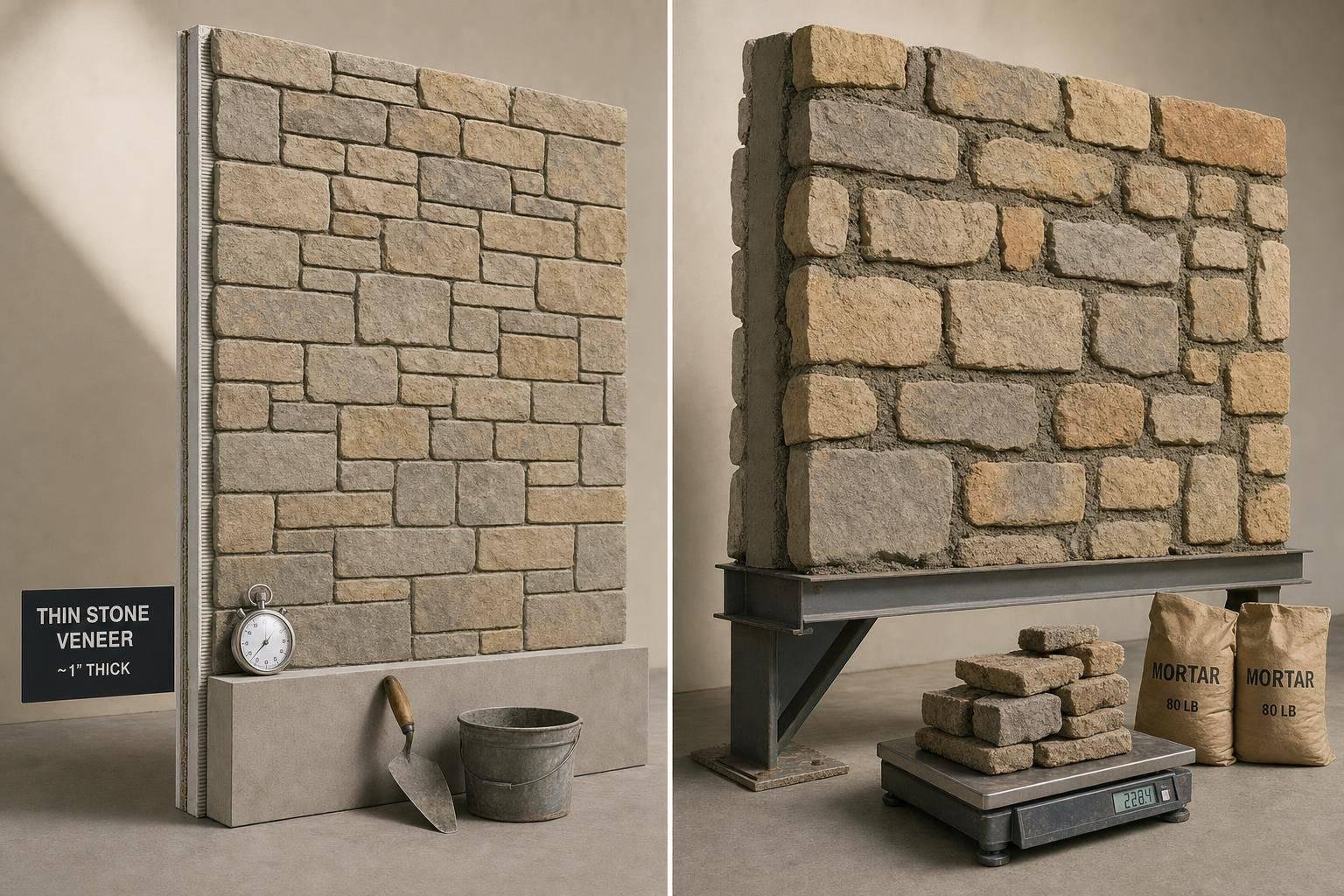
If you want the lower labor bill, thin stone veneer usually wins. I’d expect thin stone to take fewer labor hours, need less wall support, and move at about 80 to 120 sq. ft. per day, while full-bed veneer often lands at just 25 to 50 sq. ft. per day.
Here’s the short version:
- Thin stone veneer is lighter, often under 15 lbs. per sq. ft.
- Full-bed veneer is much heavier at 45 to 55 lbs. per sq. ft.
- Thin stone installs over WRB, metal lath, and a scratch coat
- Full-bed veneer needs a footing or bearing ledge
- If that support is missing on an existing home, labor can jump by 30% to 50%
- Small jobs cost more per square foot because setup time gets spread over less area
- Large jobs lower the per-square-foot labor rate, but full-bed still stays higher
If I were comparing the two for labor alone, I’d keep it simple: thin stone is usually the lower-cost, faster-to-install option, and full-bed veneer takes more time, more skill, and more support work.
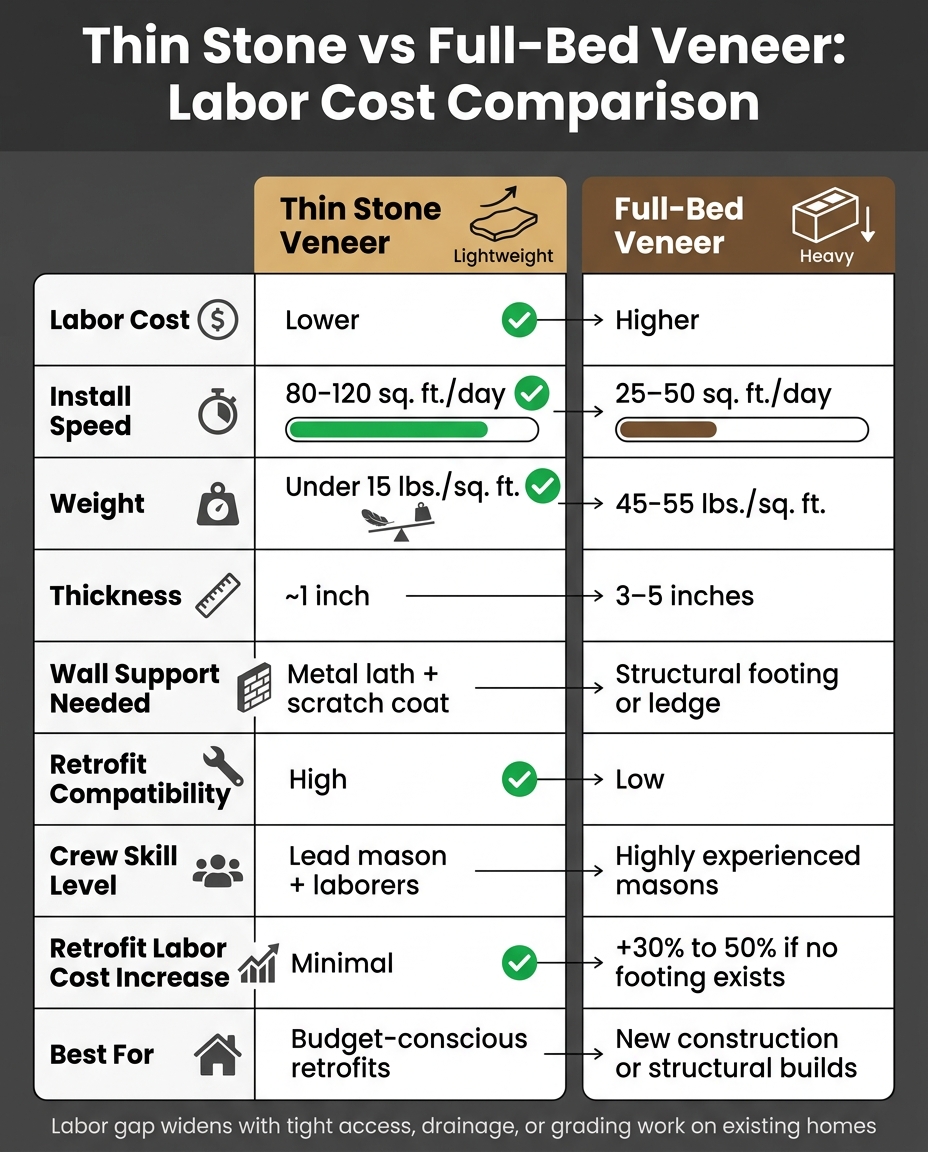
Thin Stone vs Full-Bed Veneer: Labor Cost Comparison
Thinstone V. Full Bed Veneer… What’s The Difference?
Quick Comparison
| Factor | Thin Stone Veneer | Full-Bed Veneer |
|---|---|---|
| Labor cost | Lower in most cases | Higher in most cases |
| Install pace | 80 to 120 sq. ft. per day | 25 to 50 sq. ft. per day |
| Weight | Under 15 lbs. per sq. ft. | 45 to 55 lbs. per sq. ft. |
| Wall support | Existing wall with lath and scratch coat | Footing or structural ledge |
| Best fit for retrofits | Usually easier | Often harder and more labor-heavy |
| Main labor slowdowns | Layout, cuts, pattern match | Support checks, leveling, mortar-bed setting |
For most Maryland homes, I’d expect the labor gap to grow when access is tight or when drainage, grading, or support work is part of the job.
Installation Work: Thin Stone vs Full Bed Veneer
How Thin Stone Veneer Gets Installed
Thin stone veneer follows a step-by-step prep process before the first piece goes on the wall. The crew starts with WRB, then installs metal lath. After that, they apply a scratch coat of mortar and score it while it’s still wet so the next layer has something to hold onto. From there, the installer maps out the pattern, cuts pieces for corners and edges, and sets each stone with mortar. Joint finishing comes near the end, followed by cleanup.
Once the wall prep is done, thin stone veneer usually moves faster because the setting process is more straightforward. In most jobs, the biggest labor slowdowns come from layout, corner cuts, and pattern matching.
How Full-Bed Veneer Gets Installed
Full-bed veneer also starts low and moves upward, but the prep is heavier from the start. Before any stone is installed, the crew has to confirm that a structural footing or bearing ledge is there to support the load. This system is much heavier, so each stone goes into a full mortar bed instead of being attached to a scratch coat. As the courses build up, the crew checks that each one stays level and plumb, then finishes the joints and handles cleanup.
Because every stone has to be set and leveled one by one, the pace is slower across the whole job. Corners, access issues, and more involved layouts can drag things out even more.
Labor Tasks and Time Drivers: Side-by-Side Table
| Task | Thin Stone Veneer | Full-Bed Veneer |
|---|---|---|
| Substrate prep | WRB, metal lath, scratch coat | Verify footing or bearing support |
| Stone setting | Adhered setting after layout and cuts | Set each stone into a full mortar bed |
| Joint finishing | Joint finishing | Joint finishing |
| Cleanup | Less mortar handling and cleanup | More mortar handling and cleanup |
| Primary labor bottleneck | Layout, corner cuts, and pattern matching | Support checks, leveling, and course-by-course setting |
Those added steps affect more than just install pace. They also shape wall support needs, crew size, and how much work can get done in a day.
sbb-itb-843f8be
Structural Support and Crew Requirements
Wall Support, Footings, and Support Conditions
Structural support is the biggest labor cost driver. After the installation method, support conditions are the next big thing that shifts labor pricing.
Thin stone veneer is usually about 1 inch thick and falls under an adhered system. It attaches to metal lath and a scratch coat, which means the existing wall carries the load. There’s no need for a structural ledge.
Full-bed veneer works very differently. At 3 to 5 inches thick and 45 to 55 lbs. per sq. ft., it needs to sit on a structural ledge, like a continuous concrete footing or brick ledge. If that support doesn’t already exist, the crew may have to install new footings or steel shelf angles. On an existing home, that retrofit work can increase labor costs by 30% to 50% before the first stone goes up. In plain terms, no ledge means more prep work, and that prep work adds up fast.
Crew Skill, Crew Size, and Daily Output
Those support needs shape the crew too.
Full-bed veneer calls for experienced masons. Each stone is heavy, and every piece has to be set level and plumb. Thin stone is less demanding on that front. A lead mason can usually handle the installation with help from laborers, which helps the crew keep a steady pace.
That difference shows up in daily output:
- Thin-stone crew: 80 to 120 sq. ft. per day
- Full-bed veneer crew: 25 to 50 sq. ft. per day
More square footage per day means fewer labor hours. And fewer labor hours usually lead to a lower bid.
Support Needs and Crew Demands: Side-by-Side Table
| Factor | Thin Stone Veneer | Full-Bed Veneer |
|---|---|---|
| Wall support required | Metal lath and scratch coat on the existing wall | Continuous concrete footing or structural ledge |
| Retrofit compatibility | High – does not need a structural ledge | Low – often requires new footings or ledge work |
| Weight (lbs./sq. ft.) | Under 15 lbs./sq. ft. | 45–55 lbs./sq. ft. |
| Crew skill level | Lead mason with labor support | Highly experienced masons required |
| Typical crew composition | Lead mason plus laborers | Skilled mason crew |
| Daily output (sq. ft.) | 80–120 sq. ft. | 25–50 sq. ft. |
These production rates set up the square-foot labor ranges in the next section.
Small vs Large Projects: Labor Cost per Square Foot
Small Projects: Why Labor Cost per Square Foot Runs Higher
On small jobs, daily output carries more weight. Fixed setup time gets spread across fewer square feet, so the labor cost per square foot goes up.
That happens because mobilization, surface protection, scaffolding, and day minimums all get loaded into a smaller area. Many masonry crews also charge a day minimum. The same pattern shows up on big jobs too, but the per-square-foot rate falls once the crew can keep working without as many stops and starts.
Large Projects: Lower Labor Cost at Scale
Larger jobs spread those fixed costs across more square feet, which brings down the labor cost per square foot.
Full-bed veneer still comes in higher. The stones are heavier, and the setting pace is slower, which cuts daily output. So yes, project size changes the price. But it doesn’t erase the labor gap between thin stone and full-bed veneer.
Small and Large Project Labor Ranges: Side-by-Side Table
| Project Factor | Thin Stone Veneer | Full-Bed Veneer |
|---|---|---|
| Small project labor cost per sq. ft. | Higher – fixed costs concentrated over less area | Highest – fixed costs plus slower setting pace |
| Large project labor cost per sq. ft. | Drops faster with scale as output stays strong | Stays higher – heavier stones and slower daily output limit savings |
| Why the gap persists at every size | Faster install and higher daily output keep labor lower | Lower daily output (25–50 sq. ft.) keeps labor cost elevated regardless of project size |
Budget Impact and Final Takeaway
How Labor Costs Affect Total Budget and Schedule
Per-square-foot labor costs can snowball fast on bigger jobs. A small gap in labor rate may not look like much at first, but across a large wall or exterior surface, it can shift the budget by a lot.
Labor also affects the schedule. Thin stone veneer takes fewer labor hours and usually goes in faster. Full-bed veneer tends to take longer because it often calls for structural prep, slower setting, and more hands-on masonry work.
Site conditions in Maryland can stretch that gap even further. On residential properties, drainage issues, grading needs, and tight access can all add prep time. That tends to hit full-bed projects harder, especially when the job already includes drainage or grading work.
Choosing the Right Fit for Maryland Homes
In most cases, the decision comes down to support needs and budget. Thin stone veneer is usually the more labor-efficient option. Full-bed veneer asks for more skilled masonry labor and more time on site.
Pro Landscapes MD installs stone veneer, retaining walls, grading, and drainage solutions across central Maryland.
Key Points to Remember
- Thin stone veneer usually has the lower labor cost per square foot because it installs faster and needs less support work.
- Full-bed veneer needs more masonry labor and a longer schedule.
FAQs
Which veneer is better for an existing home?
Thin stone veneer is usually the better fit for an existing home. It’s lighter, and at 0.75 to 1.5 inches thick, it can go over surfaces like masonry or cement board without big structural changes.
Full-bed stone is different. It’s 3 to 5 inches thick and often needs a concrete ledge or structural footing. That makes retrofit work with thin stone veneer simpler, faster, and less invasive.
When does full-bed veneer need extra structural work?
Full-bed stone veneer is usually 3 to 5 inches thick, and that thickness comes with one big issue: weight.
Because it’s so heavy, this type of veneer often needs extra structural work before installation. It usually has to sit on a support system, like a concrete foundation ledge or shelf, so the load is carried properly.
In many cases, an architect needs to calculate the structural requirements. That can include adding wall ties or strengthening the existing wall or floor.
How much does project size affect labor cost?
Project size has a big impact on labor cost because it makes the efficiency gap between thin stone veneer and full-bed stone hard to ignore.
On larger residential jobs, thin veneer often cuts labor costs. The reason is pretty simple: it weighs less, and it installs with direct adhesion. That means you can avoid the structural footings or masonry ledges that 3- to 5-inch full-bed stone needs.
The labor difference adds up fast at scale. A mason may install about 160 square feet of thin veneer per day, compared with about 40 square feet of full-bed stone.
Chat with Us