









- bhavya gada
- No Comments
If site design alone can’t meet Maryland stormwater rules, structural ESD is the next step. In simple terms, you start with ESD first, then use built stormwater measures for the runoff that still needs treatment.
Here’s the short version:
- Maryland uses an ESD-first approach.
- Structural ESD is used only after nonstructural steps are reviewed to MEP.
- Common practices include ponds, wetlands, open channels, infiltration systems, permeable pavement, filters, green roofs, and cisterns.
- Soil testing, grading, drainage, and hardscape layout all affect what will work.
- Plans need to match both state rules and county review.
- Maintenance access and records should be planned from the start.
I’d look at it this way: structural ESD is not just about adding a BMP to a plan. It’s about making sure the site drains correctly, the paperwork supports approval, and the system can still work years later.
A few facts help put this in context:
- Stormwater runoff can increase when land is developed and more surfaces become impervious.
- Permeable pavement and infiltration systems depend on soil conditions below grade, not just surface layout.
- Large systems like ponds often need more land area than tight urban or infill sites can spare.
Bottom line: if you’re planning work on a Maryland property, you need to show that nonstructural ESD was reviewed first, then match the structural practice to the site’s soil, slope, drainage path, and built features.
The rest of this article explains how those parts fit together in plain English.
MDE Stormwater Regulations and Design Manual Updates Listening Session – October 22 (2025)
sbb-itb-843f8be
Maryland Rules That Govern Structural ESD
Once structural ESD is needed, the next step is working through Maryland’s review framework for approval. In plain English, structural ESD has to line up with both state and local stormwater review. That means the design, drainage layout, and project documents all need to match the approved site plan.
With that part set, the next step is figuring out which structural practices make sense for the site.
Main Structural ESD Practices Used in Maryland
Once the rules are set, the next step is picking the practice that fits the site. In Maryland, structural ESD choices usually come down to three things: compliance, site limits, and what can actually be built without causing problems later.
Ponds, Wetlands, and Open Channel Systems
Ponds and constructed wetlands usually make sense on larger sites. They take up a lot of land, and they often come with minimum drainage-area requirements.
Open channel systems can also fit into this group when a site has the room for them and the grading works.
Infiltration Practices and Permeable Pavement
Infiltration practices depend on how well the soil drains. That’s why on-site soil testing needs to happen early.
If the native soil can’t take in water fast enough, infiltration may not work for the site. In plain terms, early site testing isn’t something to squeeze in later. It’s part of the design process from the start.
Permeable pavement can be part of this approach too, but its success still depends on site conditions below the surface.
Filtering Systems, Green Roofs, and Cisterns
If a site can’t fit a pond or support an infiltration practice, other options can fill the gap.
- Filtering systems work well in tighter areas.
- Green roofs cut runoff at the roof level.
- Cisterns store water for reuse.
That kind of flexibility matters on constrained sites, where space is tight and every design choice has to work a little harder.
How to Design and Build Structural ESD Correctly
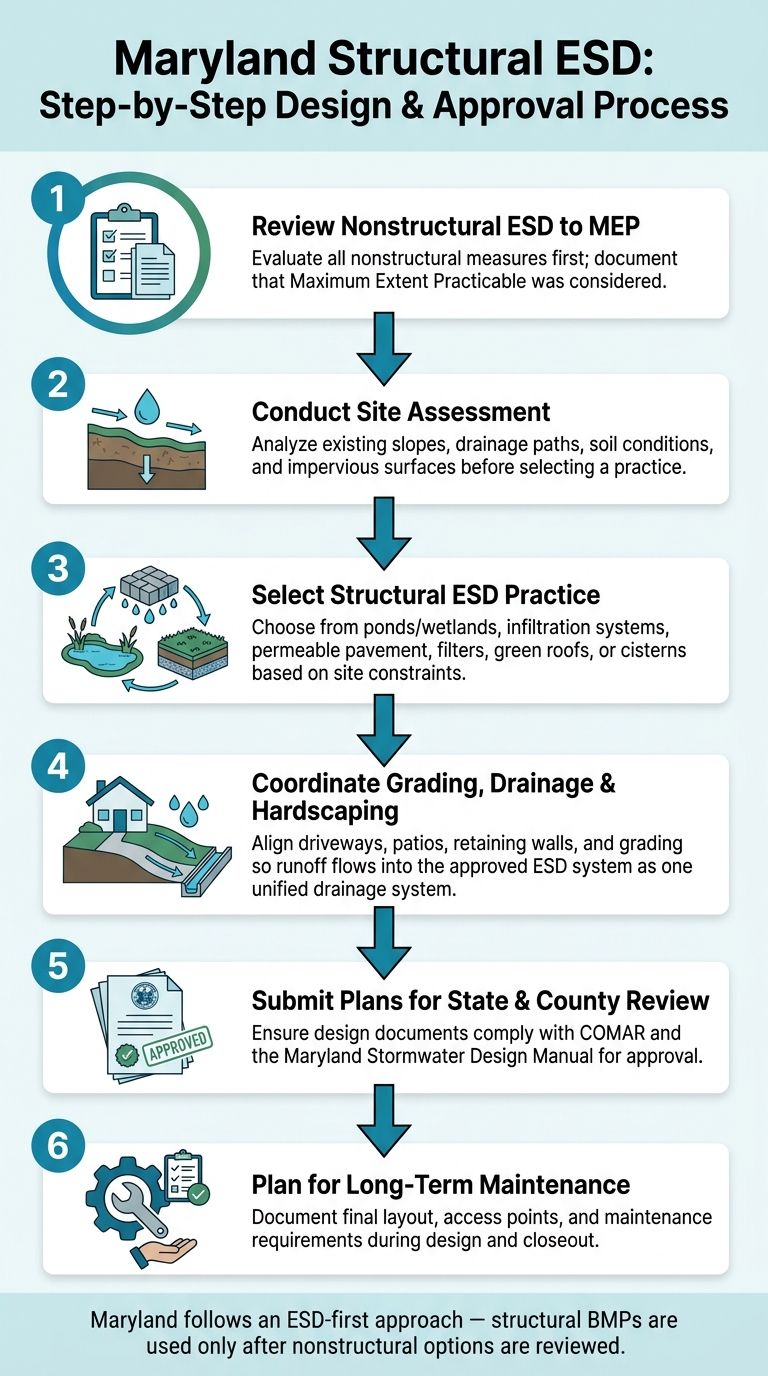
Maryland Structural ESD: Step-by-Step Design & Approval Process
Structural ESD needs to be part of the site plan before grading starts and before any construction crews get to work. Once you’ve picked a structural practice, the next step is simple in theory but easy to get wrong in the field: make sure the site can support it and that the layout fits the grading and drainage plan.
Site Assessment, Hydrology, and ESD Documentation
Start with the site itself. Look at existing conditions, especially slopes and drainage paths, before choosing a structural practice. If water already wants to move a certain way, your design has to account for that. Fighting the site usually leads to problems later.
You also need to document that ESD to the Maximum Extent Practicable (MEP) was reviewed before selecting a structural practice. The record should show that nonstructural ESD was evaluated first. That paper trail helps support county review and Maryland stormwater approval.
Coordinating Hardscaping, Grading, and Drainage
Every hardscape feature affects runoff. A driveway, patio, or retaining wall might seem like a stand-alone item, but each one changes how water moves across the property. That’s why grading and drainage need to be coordinated so runoff moves away from those surfaces and into the approved ESD system.
Put plainly, the site has to work as one drainage system, not a bunch of separate parts that happen to sit next to each other.
Pro Landscapes MD coordinates hardscaping, grading, drainage installation, and stormwater management across central Maryland so the site works as one system.
That coordination should carry straight into closeout documentation and maintenance planning.
Maintenance Planning From Day One
Building the system is only part of the job. The design also needs to make inspection and upkeep possible. If no one can reach key areas or understand how the system was laid out, maintenance turns into guesswork.
Document the final layout, access points, and maintenance requirements during design and closeout so the system can be inspected and maintained and keep functioning as approved.
Conclusion: Key Takeaways for Maryland Homeowners and Property Managers
Once design and implementation are done, the last checkpoint is compliance. Maryland follows an ESD-first approach. That means you start with nonstructural measures to MEP before you add structural practices. Structural BMPs come into play when site design by itself can’t meet stormwater rules.
Structural projects must follow COMAR and the Maryland Stormwater Design Manual. BMP selection also depends on soil, drainage, and built features.
Key takeaways:
- ESD first.
- Follow COMAR and the Maryland Stormwater Design Manual.
- Match BMPs to soil, drainage, and site constraints.
- Account for hardscaping and site features early.
That kind of alignment helps keep the project on track with Maryland requirements.
FAQs
When is structural ESD required in Maryland?
In Maryland, ESD must be used to the Maximum Extent Practicable on all new development projects before any structural stormwater practices are considered.
Put simply, structural methods come later. Teams first need to work through ESD options and show those measures won’t do enough to meet stormwater compliance goals. Also, if you want to alter an existing stormwater management facility, you need formal approval.
How do soil tests affect BMP selection?
Soil tests are a key part of site evaluation because they show which BMPs make sense for a given property. In Maryland, they help teams figure out how well the soil can absorb and filter runoff.
If the soil can’t handle that job well, the project may need custom-engineered soil beds or added drainage, such as underdrain systems, to meet compliance needs. Professionals use these results to pick methods that mimic predevelopment water absorption.
Who approves structural ESD plans?
In Maryland, local county agencies and municipal authorities review and approve structural stormwater and drainage plans under state rules.
For residential projects larger than 30,000 square feet, the plans must also be signed by a licensed design professional and approved by the local Soil Conservation District. If you’re changing an existing Best Management Practice, you’ll need county approval for that too.
Chat with Us