









- bhavya gada
- No Comments
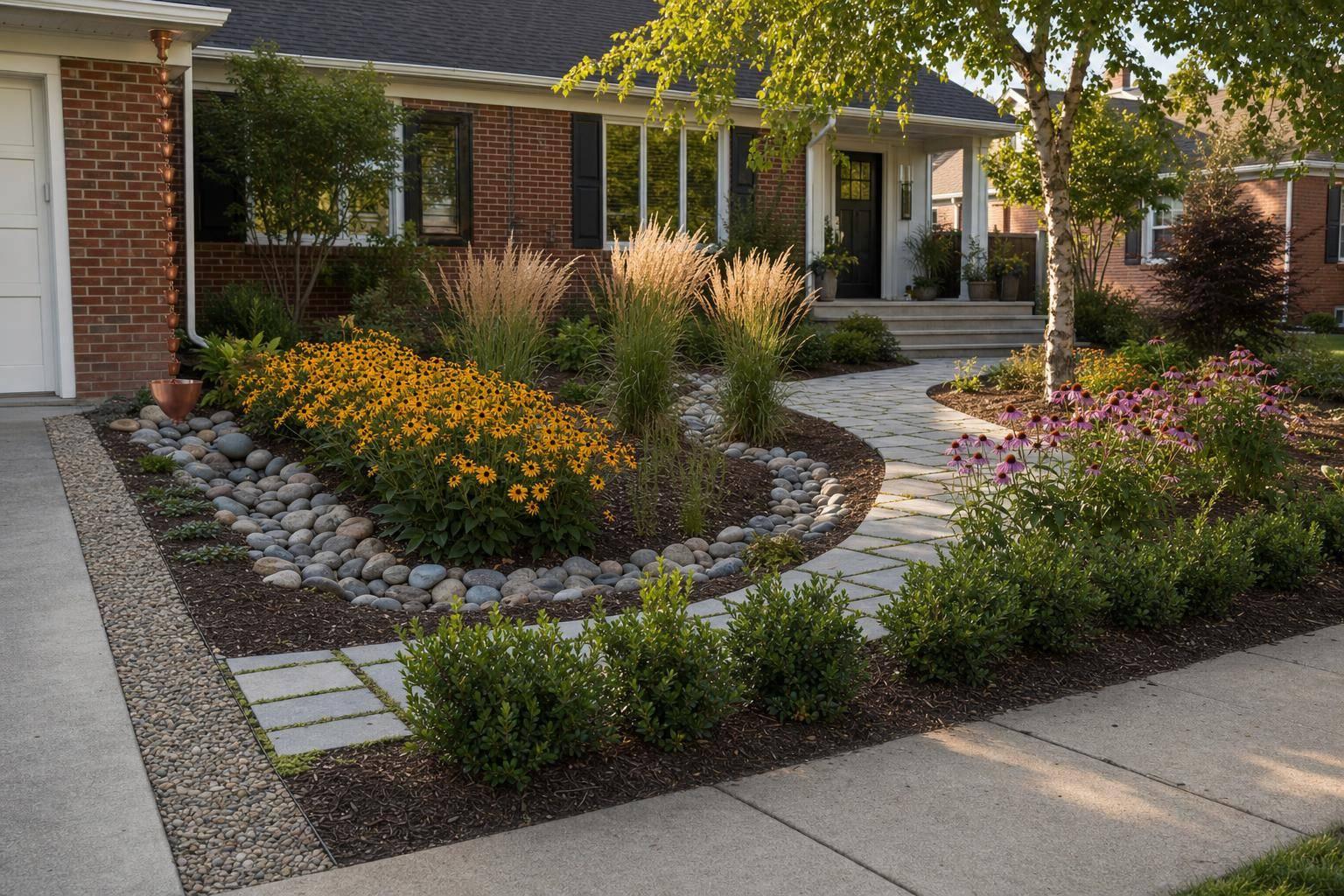
You do not need to remove every blade of grass to have a lawn-free yard. In Maryland, I’d keep lawn only where it serves a purpose, then replace the rest with native plants, groundcovers, rain gardens, and permeable surfaces that fit the site.
Here’s the short version: turf often struggles in Maryland because of clay soil, hot dry stretches in summer, and 35 to 45 inches of yearly rain that does not fall evenly. A 1,000 to 2,000 sq. ft. lawn can use about 20,000 to 40,000 gallons of water per year, and switching much of that space to other landscape types can cut water use by 50% to 75%. Native plantings can also support 10 to 20 times more insect species than a plain grass yard.
If I were planning this kind of yard, I’d focus on four things first:
- Map the site: sun, shade, soil, drainage, and daily use
- Choose the right removal method: sheet mulching, solarization, tarping, or sod removal
- Match the replacement to the spot: sedges and wild ginger for shade, little bluestem for sun, rain gardens for wet areas, and hardscape where people walk or gather
- Plan for the first 1 to 3 growing seasons: that’s when watering and weeding take the most work
A few details matter right away:
- Maryland law says HOAs cannot require turf-only yards or block pollinator gardens, rain gardens, or xeriscaping without reason
- Main paths should usually be 3 to 4 feet wide
- Mulch should stay around 2 to 3 inches deep
- New meadow-style plantings often take about 3 years to fill in
- Before digging, I’d always call 811
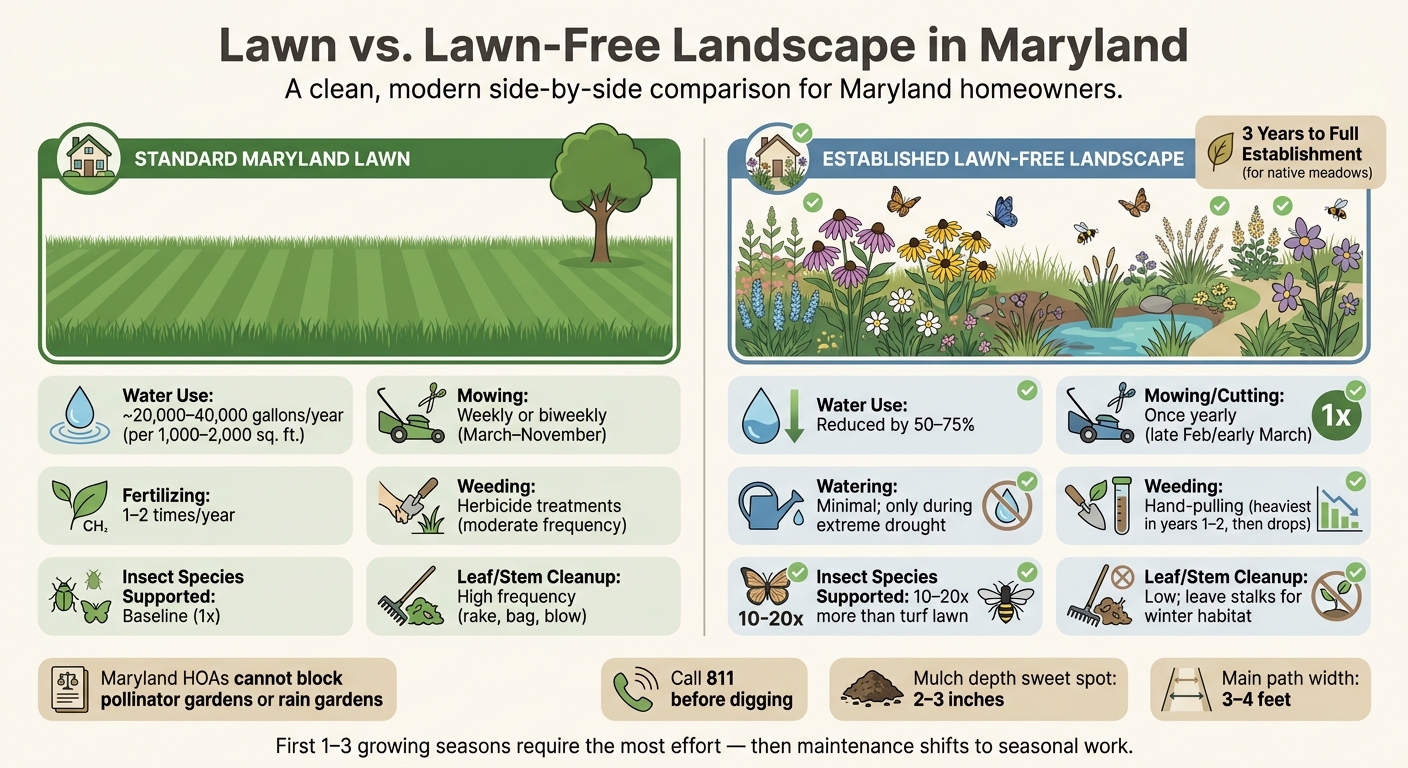
Lawn vs. Lawn-Free Landscape: Maintenance & Impact Comparison
Quick comparison
| Area | Best Lawn Alternative | Best Use |
|---|---|---|
| Shady dry spots | Pennsylvania sedge or wild ginger | Under trees, low-mow groundcover |
| Sunny dry spots | Little bluestem or thyme | Open areas with light foot traffic |
| Wet low spots | Rain garden | Drainage and runoff control |
| Walkways/patios | Permeable pavers or flagstone | Access, seating, daily use |
| Large open yard sections | Native meadow or fine fescue | Less mowing, habitat support |
Bottom line: I’d treat lawn-free landscaping as a site-planning job, not just a grass-removal job. When plant choice, drainage, and layout match the yard, upkeep usually drops from weekly mowing to more seasonal work.
sbb-itb-843f8be
Plan the Yard Before Removing Any Grass
Before you pull up a single piece of sod, take a close look at how your yard behaves. Watch where water sits after rain, which spots stay shady, and which parts of the yard people use most. That small bit of homework makes the rest of the project much easier.
Map Sun, Soil, Drainage, and Daily Use Areas
Walk the yard at a few points during the day for several days. Light changes more than most people think.
Full sun means 6 or more hours of direct light, while full shade means 3 hours or less [5]. Use that map to match plants to the site. Meadow plantings do best in full sun. Ferns, mosses, and sedges fit shady areas better [7].
Pay attention to drainage too. Wet spots can become good places for rain gardens. Dry slopes usually work better with drought-tolerant groundcovers [1][2].
Soil matters just as much. A soil test from your county extension office can help you sort out pH, nutrients, compost needs, and other amendments [2][5].
Then map how the yard gets used every day. Mark spaces for things like:
- children’s play areas
- pet runs
- seating
- food gardens
Do that before locking in a planting plan [1][7].
Once you know the site conditions, turn that rough map into a simple set of zones.
Divide the Yard into a Clear, Organized Layout
After mapping the site, break the yard into clear zones. That might include a seating area, a path from the gate to the door, a planting bed, a food garden, and room for service access.
Size matters here. Main paths should be at least 3 to 4 feet wide so they feel comfortable to walk on [7]. A dining patio needs at least 10 by 12 feet. If you want space for both dining and lounging, 14 by 16 feet works better [7].
Defined edges make naturalized beds look intentional. Stone, brick, or even a neatly mown strip can help native plant beds look cared for instead of ignored, which matters with neighbors and HOA reviewers [1][2].
Plant layering helps too. Put low groundcovers in front, mid-height flowering plants in the middle, and taller plants in back. That simple setup gives the space a planned look instead of a wild one.
With the layout in place, check rules, access, and project size before starting removal work.
Check Rules, Access, and Project Scope Early
Local codes may limit plant height near sidewalks, driveways, and corners [2]. Check those rules before you settle on plant sizes near the street.
Before digging, call Miss Utility at 811 so underground utility lines can be marked [2][4]. That step is not optional.
If the project includes regrading slopes, adding a rain garden, or handling stormwater on a bigger scale, look into local programs. Some Maryland counties offer money back for approved projects. In Prince George’s County, for example, the Rain Check Rebate program helps offset costs for approved stormwater work [1][4].
For grading or drainage problems that go beyond a simple yard update, it makes sense to bring in a pro before turf removal starts.
After the plan is set, choose the turf-removal method that fits the site.
Remove or Reduce Lawn the Right Way
Pick your removal method based on timing, slope, weed pressure, and how much soil disturbance you can tolerate. Each one fits a different situation.
Sheet Mulching, Smothering, and Mechanical Removal: A Side-by-Side Look
Layered sheet mulching puts cardboard or newspaper right over the grass, then adds compost and mulch on top. It works well for Maryland yards with odd corners and curved edges, and it lets you skip digging. The catch is timing. Full breakdown usually takes 6 to 12 months, so it won’t work if you need to plant next month [2].
Solarization uses clear plastic sheeting to trap heat. That heat kills grass and many weed seeds in the top few inches of soil. In Maryland, it usually needs 6 to 8 weeks of full summer sun to do the job [2]. It works, but the plastic isn’t reusable and can be hard on the eyes while it sits in the yard [2].
Mechanical sod removal gives you instant results and a clean area to plant, which makes it a good fit when you need to replant fast or tackle a small space [2][4]. The downside is soil disturbance. Cutting and lifting sod can bring buried weed seeds to the surface, which often leads to a burst of unwanted growth [2][4].
Tarping is a lower-labor option for flat, sunny spots. You cover the area with a reusable woven fabric or black tarp for 2 to 3 months [1]. That saves effort, and the material can be used again. But there’s a tradeoff: it also kills helpful soil life along with the grass [1].
Use groundcovers on steep slopes where turf struggles and mowing becomes risky. Use permeable paving only on gentle slopes.
After removal, the next move is to protect bare soil and make sure drainage fits the new layout.
Prepare the Soil for Planting and Water Management
Once the turf is gone, cover and stabilize the soil right away. Rain, foot traffic, and weeds can undo a lot of work in a hurry.
Protect bare soil immediately. Cover newly seeded areas with weed-free straw or loose mulch at 1/8 to 1/4 inch depth. That helps shield seeds from runoff and birds while they sprout [2]. In established planting beds, keep mulch to no more than 3 inches. Go deeper than that, and roots can suffocate [5].
If the soil is compacted, you may need mechanical aeration or deep ripping before planting [2][5]. Mix organic matter into the planting area before you put anything in the ground [5]. At the same time, don’t overdo fertilizer. Many native meadow species do better in lean soil, and extra fertilizer can push weeds harder than the plants you actually want [2].
If your site gets pooling water or runoff from hard surfaces, sort out drainage before planting. Rain gardens and bioswales help water soak into compacted Maryland soil [1][3]. On slopes, swales, terraces, or dry-laid stone walls can slow water down [7][4]. Plant the areas closest to the house first so you don’t end up compacting freshly prepared soil.
With the site cleared and stabilized, the next step is picking plants, hardscape, and drainage features to replace the turf.
Build a Lawn-Free Landscape with Plants, Hardscapes, and Drainage Features
With bare soil stable and drainage issues handled, the next step is deciding what should take the lawn’s place. That choice comes down to a few plain things: how you use the yard, how much sun or shade it gets, and how much work you want to keep up with over time.
Native Plants, Groundcovers, and Low-Mow Areas
Use the sun, soil, drainage, and use zones you already mapped to match each part of the yard with the right replacement.
Native plants tend to do better with those conditions. They’re suited to Maryland’s clay soils, humid summers, and periodic drought, so once they’re established, they usually need much less hands-on care.
For shady spots under mature trees, Pennsylvania sedge (Carex pensylvanica) and wild ginger (Asarum canadense) are stronger picks than turfgrass. Neither needs mowing. In sunny, dry areas, little bluestem (Schizachyrium scoparium) does well in drought and keeps its color through winter. Use creeping thyme only in full-sun, light-traffic areas.
Try to use mostly native species in each planting bed so the space can better support insects and birds. If you want something that still looks grass-like in shady areas but doesn’t need much mowing, fine fescue blends can be a good in-between option. Hard fescue, creeping red, and Chewings fescue fit that role well, though they won’t stand up to heavy foot traffic [1][6].
| Plant Option | Sun/Shade Needs | Foot-Traffic Tolerance | Mowing Needs | Water Needs | Maryland Suitability |
|---|---|---|---|---|---|
| Creeping Thyme | Full Sun | High | None | Low | Suitable |
| Fine Fescue | Shade/Partial Sun | Low | 1–2 times/year | Low | Highly Suitable |
| Pennsylvania Sedge | Shade to Sun | Low to Moderate | None to Low | Medium | Native |
| Wild Ginger | Full Shade | Low | None | Medium | Native |
| Little Bluestem | Full Sun | Low | None | Low–Medium | Native |
| Moss Phlox | Full Sun | Moderate | None | Low | Native |
For larger open spaces, native meadows take about three years to fill in. During that setup period, weeding matters more than mowing [1].
Rain Gardens, Dry Riverbeds, and Permeable Hardscapes as Turf Replacements
Low spots, downspout discharge zones, and places where water sits after rain usually aren’t good lawn areas. In many yards, they work better as rain gardens or dry riverbeds.
A rain garden catches runoff and lets it soak into the soil over time. Two good native choices for these wetter areas are cardinal flower (Lobelia cardinalis) and golden ragwort [4]. A dry riverbed, by contrast, uses stone and gravel to guide water across the yard where you can see where it’s going.
For high-use spaces like patios, walkways, and driveways, permeable pavers let water pass into the soil below. That can help cut down on pooling and runoff in Maryland’s clay-heavy soils [3][6]. Flagstone with groundcover planted between the joints, along with other permeable hardscape options, can give you more usable space while also helping with runoff. For projects that combine drainage and hardscape work, Pro Landscapes MD installs patios, walkways, retaining walls, dry riverbeds, French drains, and environmental pavers across central Maryland.
Plant-Only, Hardscape-Heavy, and Hybrid Designs Compared
Most Maryland yards do best with a hybrid approach. Put hardscape where people walk, gather, or sit. Use native plantings in the rest of the space. That setup gives you access where you need it without compacting soil or wiping out planting areas. Deep planting borders around a patio or flagstone path can also help manage stormwater, support pollinators, and shrink the part of the yard that needs regular attention.
| Design Type | Maintenance Level | Stormwater Benefits | Habitat Value | Flexibility |
|---|---|---|---|---|
| Plant-Only (Native Beds) | Medium (weeding) | High | High | High |
| Wildlife Meadow | Low (annual mow) | High | Very High | Medium |
| Hybrid (Permeable/Plant) | Low–Medium | High | Medium | Medium |
| Hardscape-Heavy (Patios) | Low | Low (unless permeable) | Low | Low |
For most mixed-use yards, a hybrid layout gives the best balance of access, runoff control, and habitat.
Once the layout is set, maintenance becomes the main deciding factor.
Maintain the Landscape and Plan for Long-Term Success
A lawn-free yard still needs regular yard maintenance. It just usually needs it less often.
After planting and drainage are set, the job changes. At that point, the focus is on helping the space get established. The big drivers of future upkeep are simple: plant fit, drainage, and layout. Get those right early, and the yard is much easier to manage later.
Watering, Weeds, and Seasonal Upkeep
New plantings need steady moisture through the first growing season, especially during hot, dry periods. Once native plants are established, most need no supplemental watering except in extreme drought [2][4].
Mulch should stay 2 to 3 inches deep, but it should never touch stems or trunks. That small gap matters. It helps cut down on rot and stress at the base of the plant.
Weeding is heaviest in the first 1 to 2 years, while plants are still filling in. This is the stretch where a lot of people feel the most upkeep. That’s normal. As the planting thickens, weed pressure usually drops.
Cut back ornamental grasses and perennials in late February or early March. Leave 4 to 8 inches of stems in place for crown protection and winter habitat [2]. Clean, sharp bed edges also help the space look planned instead of overgrown.
How Lawn-Free Maintenance Compares to a Standard Lawn Over Time
The table below shows how long-term care compares with a standard lawn.
| Task | Standard Maryland Lawn | Lawn-Free Landscape (Established) | Typical Tools Needed | Seasonal Frequency |
|---|---|---|---|---|
| Mowing/Cutting | Weekly or biweekly (Mar–Nov) [2] | Once yearly (late Feb./early Mar.) [2] | Mower vs. brush cutter or scythe | High / Very Low |
| Watering | About 1 inch/week during dry spells [6] | Minimal; only during extreme drought [2][4] | Sprinklers vs. soaker hoses | High / Low |
| Fertilizing | 1–2 times/year (fall/spring) [2][6] | Rarely; based on soil test every 3–4 years [2][6] | Spreader vs. hand-applied compost | Moderate / Low |
| Weeding | Herbicide treatments | Hand-pulling or spot-mowing | Sprayer vs. hand tools | Moderate / Low |
| Leaf and stem cleanup | Leaf removal and bagging | Leave stalks for winter habitat [2] | Rake/blower vs. pruners | High / Low |
Even after a garden is established, some hands-on work still comes up. Pruning, dividing crowded plants, and replacing the occasional plant are all part of the rhythm.
Conclusion: Start with Function, Plant Fit, and Drainage
The simplest path to a lawn-free yard comes down to four moves: assess the site, remove turf the right way, choose plants and materials that match the site, and deal with drainage before planting starts. The first 1 to 3 growing seasons usually take the most effort. After that, maintenance shifts from weekly chores to more seasonal work.
Homeowners who want help with design, planting, hardscaping, drainage repair, grading, or landscape restoration can work with Pro Landscapes MD, which serves central Maryland and Washington, DC.
FAQs
How much lawn should I keep?
How much lawn you keep should match the way you live and use your yard. Grass can make sense for kids, pets, get-togethers, or a neat-looking area around the front entry. But plenty of homeowners are maintaining more turf than they ever use.
If part of your lawn just sits there – or turns into a headache because of shade, slopes, or poor soil – it may be worth cutting that area back over time. Garden beds or hardscaping can take the place of grass in spots that don’t earn their keep.
What’s the easiest way to remove grass?
There’s no single easiest way to remove grass. The best choice depends on what you want to do with the space, how big the area is, and how much you want to spend.
Common options include mechanical sod removal, solarization, smothering, and targeted herbicide application.
Here’s the short version:
- Mechanical removal works right away, but it takes hard physical work and can disturb the soil.
- Solarization usually takes 6 to 8 weeks.
- Smothering usually takes 6 to 12 months.
Each method has trade-offs, so the “best” one often comes down to speed, effort, and cost.
How do I make a lawn-free yard look neat?
Focus on clear definition and regular upkeep. Use edging – like metal edging or low fences – to keep clean lines between garden beds and walkways.
Groundcovers can help block weeds. While plants get established, apply 2 to 3 inches of mulch. For paths, use landscape cloth under 4 to 6 inches of wood chips.
Curved planting beds and defined borders also give the space a tidy, structured look.
Chat with Us