









- bhavya gada
- No Comments
Rainwater collection systems help you save water by capturing rain from your roof, filtering out debris, and storing it for outdoor use like irrigation or cleaning. These systems are especially useful in Maryland, where heavy storms and clay-heavy soils can cause runoff and erosion.
Key Takeaways:
- 1 inch of rain on a 1,000 sq. ft. roof = 623 gallons of water. A typical Maryland home can collect nearly 50,000 gallons annually.
- Prevents soil erosion, reduces water bills, and manages stormwater and drainage efficiently.
- Common components: gutters, storage tanks (rain barrels, cisterns), and pumps for distribution.
- Maryland allows rainwater harvesting for non-potable uses, but check local regulations.
Quick Steps to Get Started:
- Start Small: Use a rain barrel (50–100 gallons) for gardens or lawns.
- Filter First: Install screens and diverters to keep debris and mosquitoes out.
- Choose Storage Wisely: Options range from barrels to underground tanks.
- Winterize: Drain and insulate your system before freezing temperatures.
For larger systems or property-specific designs, professional help ensures proper installation and compliance with local codes.
Building a Rainwater Catchment System
sbb-itb-843f8be
Key Components of a Rainwater Collection System
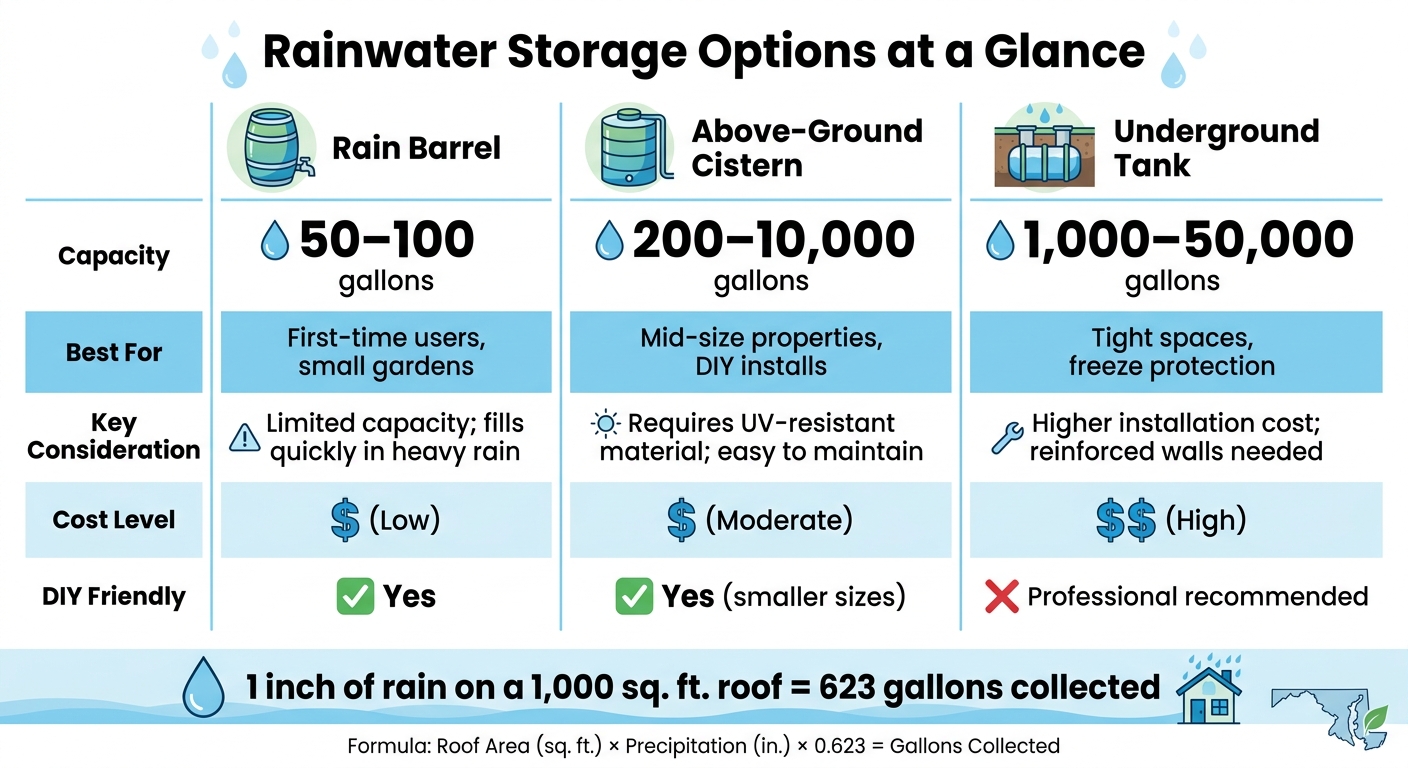
Rainwater Storage Options: Rain Barrel vs. Cistern vs. Underground Tank
A rainwater collection system works in three main stages: collection, storage, and distribution. Each stage includes specific components that must function together for the system to work efficiently. These elements are designed to maximize water collection and ensure smooth operation, laying the groundwork for effective installation.
Catchment Areas and Pre-Filtration
The roof is the most common surface for capturing rainwater, but don’t overlook other hardscapes like driveways and patios – they can contribute a significant amount of runoff. Installing grate and channel drains on paved surfaces helps direct this water into the system [2].
Before water reaches the storage tank, it’s crucial to remove debris, sediment, and pollutants through pre-filtration. Tools like swales slow down runoff and filter out contaminants, while berms help channel water toward your storage area [1]. These measures also reduce erosion and protect your system from heavy sediment loads. Additionally, a first-flush diverter discards the initial 1–2 gallons of runoff per 100 square feet, which typically contains the most sediment and pollutants [4].
Once pre-filtration is in place, you’ll need to decide on the right storage option for your needs.
Storage Options
Filtered rainwater must be stored properly, and there are several storage solutions to choose from. In Maryland, the most common choices are rain barrels, above-ground cisterns, and underground tanks, each suited to different needs.
| Storage Type | Typical Capacity | Best For | Key Consideration |
|---|---|---|---|
| Rain barrel | 50–100 gallons | First-time users, small gardens | Limited capacity; fills quickly in heavy rain |
| Above-ground cistern | 200–10,000 gallons | Mid-size properties, DIY installs | Requires UV-resistant material; easy to maintain [4] |
| Underground tank | 1,000–50,000 gallons | Tight spaces, freeze protection | Higher installation cost; reinforced walls needed [5] |
The material of your storage tank is another important factor. Polyethylene tanks are affordable and widely available, but translucent versions must be painted with exterior-grade paint to block sunlight and prevent algae growth [4]. Concrete tanks are a durable, long-term solution that can also help stabilize water pH. For larger underground setups, fiberglass tanks are a reliable choice [5]. Regardless of the material, your tank should include an inlet that minimizes sediment disturbance, a floating pick-up for clean water, and a screened overflow outlet to keep out mosquitoes [4].
Water Distribution and Use
Once your water is safely stored, the next step is efficient distribution. Water can be delivered using either a gravity-fed system or pump-driven system. Gravity-fed systems are straightforward and don’t require electricity, but they depend on the tank being positioned higher than the area you’re watering. For tasks like running drip irrigation lines or sprinklers, a pump is necessary, typically one that provides a steady 30 psi [4]. If you’re using an underground or low-lying tank, a sump pump is essential to move water where it’s needed [2].
Modern systems often integrate smart irrigation controllers that optimize watering schedules based on factors like soil moisture and weather conditions, ensuring efficient use of harvested water [3]. Common uses for collected rainwater include irrigating garden beds, watering lawns, filling rain barrels for spot-watering, and rinsing outdoor surfaces. If you’re cultivating native Maryland plants like Black-eyed Susans or New England asters, rainwater is an excellent choice – these plants thrive on natural rainfall patterns and don’t require treated tap water [3].
Designing a System for Your Property
Site Assessment and Water Budgeting
Start by conducting a rain audit during a heavy storm to observe how water flows across your property. Look for areas where water pools, spots prone to soil erosion, or places where water might collect near your foundation. These observations will help you identify natural collection points and problem areas, which are crucial for shaping your system’s layout and functionality[2].
To estimate how much water you can collect, use this formula: Roof Area (sq. ft.) × Precipitation (in.) × 0.623 = Gallons collected[9]. For example, 1 inch of rain on a 1,000-square-foot roof can generate about 623 gallons of water. By using the NCEI‘s 30-year Normal Monthly Rainfall data for your Maryland location, you can calculate potential monthly collection and compare it to your actual water needs – whether it’s for drip irrigation, lawn care, or even toilet flushing. These calculations will directly inform your system’s design.
System Layout and Integration
Once you’ve determined your catchment and storage requirements, focus on designing a system that blends into your property. One approach is to use buried cisterns under driveways or lawns. These not only protect the water from temperature changes but also maintain the visual appeal of your landscape[11]. Ensure that downspouts feed directly into the catchment system, and direct any overflow to a rain garden located in a natural low spot on your property[11].
For properties with uneven or sloped terrain, features like swales and berms can help guide runoff toward hidden storage areas efficiently[1]. A great example comes from August 2024, when Pro Landscapes MD installed a rain garden for a home in Silver Spring, MD. The garden not only managed stormwater runoff but also served as a habitat for butterflies[7]. Similarly, at a Columbia, MD property, they used permeable paver technology to allow water to seep through the driveway, reducing pressure on the local storm sewer system[7].
Sizing and Cost Considerations
With your layout in place, the next step is choosing the right tank size. The goal is to balance cost and efficiency. A tank that’s too large may collect more water than you need, leading to higher upfront costs. On the other hand, a tank that’s too small may force you to rely more on municipal water during dry spells[8].
For most systems, aiming for a storage efficiency between 70% and 80% strikes a good balance[8]. Although it’s technically possible to achieve 90% efficiency, doing so often requires a much larger (and more expensive) cistern. The table below highlights the trade-offs between smaller and larger tanks:
| Factor | Smaller Tank (e.g., ~7,000 gal.) | Larger Tank (e.g., ~18,000 gal.) |
|---|---|---|
| Upfront Cost | Lower | Higher |
| Overflow Frequency | Higher; more water lost during storms | Lower; retains more water during heavy rain |
| Municipal Water Reliance | More frequent | Minimal |
| Overall Efficiency | Lower | Higher (up to 80–90%)[8] |
If your property is in a region with stormwater regulations, like Baltimore or Annapolis, you may need to meet specific storage volume requirements set by local authorities[8][10]. In such cases, consulting with a professional is often necessary – and sometimes legally required – before finalizing your design.
Installation and Professional Support
DIY Installation for Simple Systems
A rain barrel, typically holding 40–100 gallons, is a straightforward way to collect rainwater. It connects directly to a downspout using a diverter kit. To set it up, place the barrel on a level, sturdy surface – like cinder blocks – to ensure proper gravity-fed flow through the spigot. Cover the inlet with a mesh screen to keep out debris and mosquitoes since standing water can attract pests [2].
The installation process involves cutting the downspout, attaching the diverter, connecting the overflow hose, and positioning the barrel. Make sure the overflow hose directs water away from your home’s foundation to avoid potential damage. These simple systems can serve as a great starting point if you’re new to rainwater harvesting and plan to expand later.
Professional Installation for Complex Systems
When dealing with larger or more sophisticated systems, professional installation is often the way to go. Systems with higher storage capacities or those integrated into landscaping features require expertise. For example, a 5,000-gallon tank or larger may need an engineered concrete slab or a reinforced gravel base, and the soil’s load capacity must be evaluated before installation.
Professionals can also address uneven terrain by regrading it to direct runoff toward the collection system and away from buildings or neighboring properties [2].
"Drainage problems are complex and require a custom approach for each project." – Pro Landscapes MD [2]
Companies like Pro Landscapes MD handle everything from grading and French drain installation to integrating collection systems into existing hardscapes. For systems that connect rainwater storage to indoor plumbing – like for toilet flushing or laundry – licensed plumbers are required to install backflow prevention devices to safeguard municipal water supplies. If the system is designed for potable use, Maryland law mandates daily water quality testing by a licensed operator [6]. Professionals also take care of the permitting process, a critical step for storage structures or major drainage work [2].
| Feature | DIY (Simple Systems) | Professional (Complex Systems) |
|---|---|---|
| Storage Capacity | 40–100 gallons | 1,000–10,000+ gallons |
| Primary Use | Outdoor gardening, hand watering | Irrigation, toilet flushing, potable use |
| Foundation Needed | Cinder blocks or level ground | Engineered concrete slab or reinforced gravel |
| Maintenance | Basic screen and gutter cleaning | Licensed testing, pump servicing |
Maintaining and Upgrading Your System
Routine Maintenance
Regular upkeep keeps your rainwater collection system running smoothly and extends its lifespan. Thankfully, most tasks are straightforward.
Start with gutters and downspouts. Clean them at least twice a year – once in late spring after pollen and seeds have fallen and again in late fall after the leaves drop. After big storms, do a quick visual inspection for sagging gutters, leaks, or blockages that could interfere with water flow into the system.
Pre-filtration components like leaf screens, first-flush diverters, and inlet strainers need more frequent attention, especially monthly during heavy pollen or leaf seasons. Make sure ball valves, diverter caps, and drain holes operate freely and stay clear. As for storage tanks, check them every few months for cracks, loose fittings, or damage to inlet and vent screens. Plan for an internal cleaning and sediment flush every 1–3 years, or sooner if you notice cloudy water or pump issues.
If your system includes a pump, keep an ear out for unusual sounds, rapid cycling, or vibrations – these could signal a clogged filter, an air leak, or pressure tank trouble. Replace sediment and carbon cartridge filters every six to twelve months, depending on your water quality and usage.
When colder months approach, take steps to protect your system from freezing temperatures.
Winterizing Your System in Maryland
Maryland winters often dip below freezing, so it’s smart to winterize your system in early-to-mid November, before the first hard freeze.
For simple rain barrel setups, switch the downspout diverter to bypass mode, drain the barrel and hoses, and leave valves open to prevent trapped water from freezing. Store lightweight barrels upside down in a sheltered spot. Larger above-ground tanks require draining exposed lines at low-point drains and insulating any pipes that must remain in place with foam sleeves. For particularly vulnerable pipes, consider using UL-rated outdoor heat tape with a thermostat. Disconnect and drain garden hoses, and use frost-free hose bibbs wherever possible.
If your pump is in an unheated area, either move it indoors or place it in an insulated enclosure with a small thermostatically controlled heater. For buried cisterns, tanks installed below Maryland’s frost depth of about 30 inches are generally safe, but you’ll still need to insulate risers, access ports, and above-ground connections to keep cold air out.
Upgrades to Improve Performance
In addition to maintenance and winter prep, upgrades can help your system perform better and improve water quality.
If your tank frequently overflows during heavy rain, consider expanding your storage capacity. You could link additional tanks or upgrade to a larger one. Modular polyethylene cisterns make scaling up relatively simple, and the cost per gallon usually decreases as you add more storage.
Improving water quality is especially important if you’re expanding how you use the water. A multi-stage filtration system – starting with coarse filters (50–100 microns), followed by fine filters (5–20 microns), and optionally a carbon filter – can handle particulates and organic buildup. Adding a UV disinfection unit is a good idea if you’re connecting the system to indoor plumbing for uses like toilet flushing or laundry, or if anyone in your household has a weakened immune system. Research shows that better pre-filtration, including a first-flush diverter, can boost usable storage by 10–30% by reducing sediment accumulation.
You can also connect your stored rainwater to landscape features for efficient use. Drip irrigation, soaker hoses, rain gardens, or dry creek beds help reduce yard runoff while putting your collected water to good use. In central Maryland, companies like Pro Landscapes MD specialize in integrating rainwater storage with features like French drains, dry riverbeds, and eco-pavers, turning your system into a full-scale stormwater management solution for your property.
Conclusion
A well-thought-out rainwater collection system can be a smart choice for homeowners in Maryland. The success of such a system depends heavily on its design and maintenance, making it clear that every property requires a solution tailored to its specific needs.
Each property has unique features – like yard grading, soil type, roof size, and water usage – that determine the best system. Getting these details right from the start can save you from expensive repairs later. While simpler systems might be manageable as DIY projects, more intricate designs often call for professional expertise.
For those in central Maryland, Pro Landscapes MD offers personalized drainage and stormwater management solutions. Their services include French drains, rain gardens, dry riverbeds, and permeable paver systems, all designed to work seamlessly with your landscape while meeting local regulations. They even provide free proposals and estimates for custom projects.
Investing in rainwater collection not only lowers water bills but also protects your home’s foundation and enhances your yard’s health. It’s a practical way to combine eco-conscious practices with smart home improvement.
FAQs
What size tank do I need for my home?
The size of your rainwater collection tank hinges on three key factors: the size of your roof, the amount of rainfall in your area, and how much water you plan to use. A simple way to estimate your collection potential is by using a rainwater calculator. For instance, 1 inch of rain on a 1,000-square-foot roof can produce roughly 623 gallons of water.
Once you know how much water you can collect, compare it to your needs – whether it’s for irrigation, household use, or other purposes. From there, choose a tank size that strikes the right balance between storage capacity, your water usage, and your budget.
Do I need a permit in Maryland?
In Maryland, using simple rainwater harvesting systems like rain barrels usually doesn’t require a permit. However, if you’re considering a more advanced setup, such as cisterns, you may need to get approval from local authorities or consult a professional. Always make sure to review local regulations to stay compliant.
How do I keep my system from freezing?
To keep your rainwater collection system functional during colder months, it’s essential to focus on smart design and regular upkeep. Start by ensuring that drainage pathways are clear and working properly – standing water can freeze and cause damage. Solutions like French drains, berms, or swales can manage runoff effectively. If your system is more complex, it’s a good idea to consult professionals. They can help ensure components like underground pipes and collection boxes are built to withstand your area’s specific climate challenges.
Chat with Us