









- bhavya gada
- No Comments
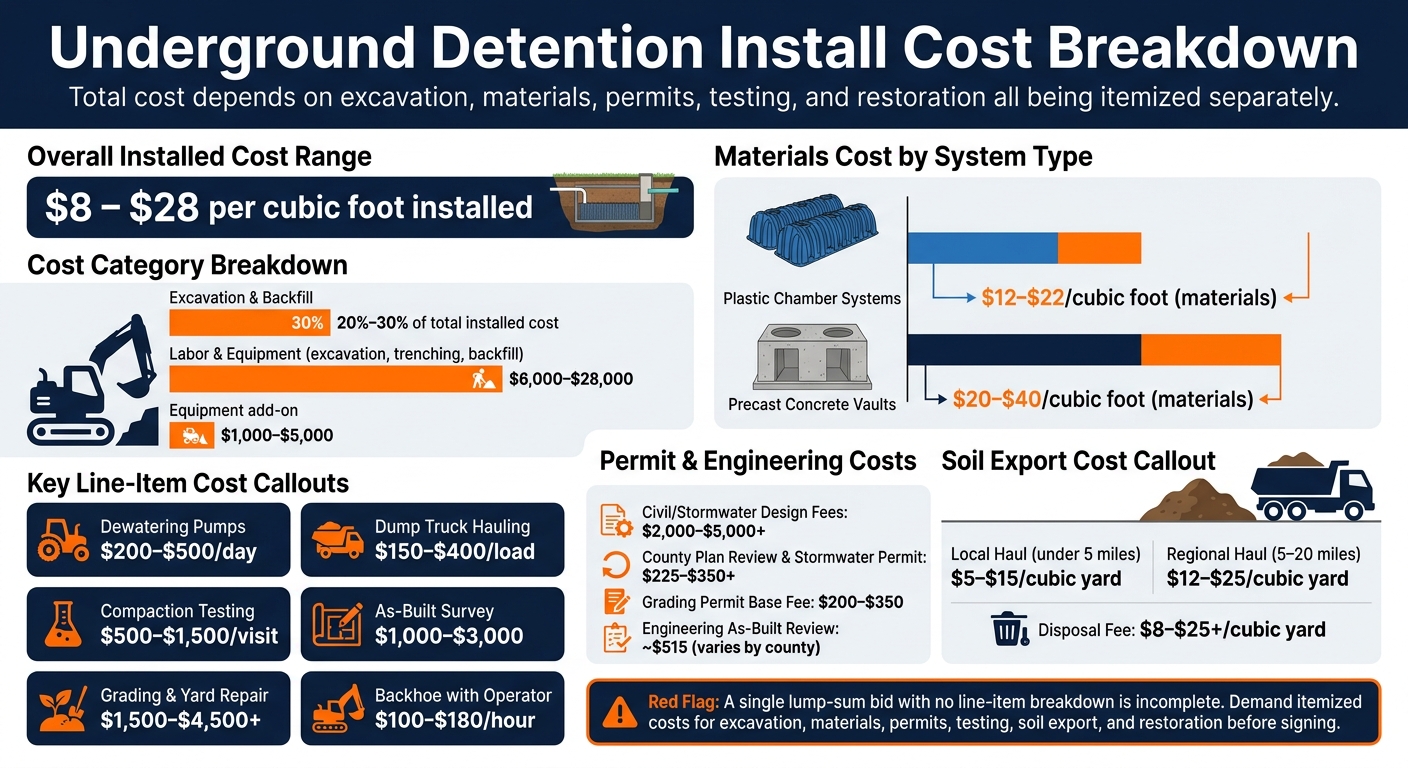
An underground detention job can jump from a clean bid to a much higher final bill if key line items are missing. From what I see in this checklist, installed costs often fall around $8 to $28 per cubic foot, but that number only helps if the proposal also shows excavation, hauling, permits, testing, and restoration.
If I were reviewing a bid today, August 1, 2026, I’d check these items first:
- Site work: access, layout, mobilization, excavation, shoring, dewatering, and backfill
- Materials: chambers, crates, pipes, stone, fabric, risers, cleanouts, and flow-control parts
- Delivery and lifting: freight, fuel charges, crane time, rigging, and standby time
- Permits and inspections: plan review, grading permits, erosion-control approval, compaction testing, and as-built survey
- Soil export: cubic yards, haul rate, dump fee, and stockpile handling
- Restoration: grading, topsoil, seed or sod, and driveway or patio repair
- Change-order risks: rock, wet soil, high groundwater, and poor site access
Here’s the short version: a bid is not clear just because it has one total price. I’d want each cost named, each allowance shown, and each exclusion written down. That matters even more in Maryland, where clay soils, summer rain, and county stormwater rules can add permit steps, pump costs, and extra hauling.
A few numbers stand out:
- Excavation and backfill often make up 20% to 30% of installed cost
- Dewatering pumps can add $200 to $500 per day
- Dump truck hauling can run $150 to $400 per load
- Compaction testing may cost $500 to $1,500 per visit
- As-built surveys can run $1,000 to $3,000
- Grading and yard repair often add $1,500 to $4,500+
| Cost area | What I’d want to see in writing | Red flag |
|---|---|---|
| Excavation | Unit price, depth, soil assumptions | One lump-sum line |
| Materials | Quantities, model, pipe sizes, stone tons, fabric SF | “Materials included” only |
| Freight/crane | Delivery fee, crane hours, rigging | No shipping or lifting line |
| Permits/testing | Permit fees, inspections, closeout costs | No agency or testing allowance |
| Soil export | CY, haul distance, disposal rate | Export buried in excavation |
| Restoration | Lawn, topsoil, hardscape repair scope | “Finished condition” with no detail |
So if I had to sum up the article in one sentence, it would be this: use the checklist to turn a vague detention bid into a line-by-line cost review before you sign.
Underground Detention Install Cost Breakdown: Key Numbers at a Glance
Mastering the Design of Underground Detention & Infiltration Systems
sbb-itb-843f8be
Site Work, Labor, and Equipment Costs
Excavation, access prep, and backfill usually make up 20%–30% of the installed cost for an underground detention system.[2] On a job priced at $8–$28 per cubic foot of storage, that’s a big chunk of the budget.[2] It’s also the part of an estimate where vague pricing and missing line items tend to sneak in.
Access, Mobilization, and Layout
Mobilization and demobilization should show up as their own lump-sum line. That means the cost to move excavators and skid steers in and out of the site, sometimes by lowboy or trailer.
Utility locates, private mark-outs, and survey staking should also be listed as separate lines. That includes the 811 call, plus any private locating work for sprinkler lines, landscape lighting, or private electric or gas lines when needed. Survey, layout, and staking for excavation limits, the system footprint, pipe inverts, and elevations should have a separate allowance too.
On tight-access Maryland lots, side or rear entry can be a headache. When full-size machines can’t get in, contractors often switch to mini-excavators and compact skid steers. That slows production because smaller buckets move less material with each pass. The result? More labor hours, more equipment time, and a higher bill. Those extra hours often get buried inside a broad lump-sum charge, which makes them easy to miss. Once access and layout are nailed down, excavation becomes the biggest cost risk.
Excavation, Shoring, Dewatering, and Backfill
Excavation should never be shown as one catch-all line. Residential excavation often runs $50–$200 per cubic yard by machine, while hand-dug trenches usually run $37.50–$74.50 per cubic yard, based on soil type.[4][6]
Rock removal or removal of bad soil that has to be replaced can cost two to three times the standard excavation rate.[2] That work should be listed with its own unit price per cubic yard. If it isn’t, the estimate leaves too much room for surprise charges later.
High groundwater can also change the math fast. If the water table is high, or if storms hit during construction, dewatering pumps become a daily jobsite expense. Pump rentals for dewatering often add $200–$500 per day to site work costs.[9]
Depth matters too. Any excavation deeper than 5 feet will usually need a trench box or shoring system under OSHA rules. A trench box rents for about $120 per day or $295–$360 per week.[3][5] If a deep trench allowance doesn’t include shoring or trench box rental, that’s a red flag.
Bedding stone, geotextile fabric, and compacted backfill each need their own line items with quantities attached. You want to see:
- tons of No. 57 stone
- square feet of non-woven fabric
- cubic yards of structural backfill placed in compacted lifts
A plate compactor rental runs about $80–$120 per day.[8] If all of this is buried inside a generic “materials” charge, there’s no clean way to check whether it’s actually included. Breaking these costs into task-level items makes missing labor or equipment much easier to spot before the bid gets signed.
Equipment and Labor Breakdown Table
Use this table to cross-check your estimate. Treat missing equipment or crew roles as omitted costs.
| Task | Typical Equipment | Labor Type | Estimate Format | Common Cost Driver |
|---|---|---|---|---|
| Access protection & staging | Skid steer, plywood mats | Laborers, operator | Site protection (lump sum); skid steer hours | Narrow side yards, distance from street |
| Utility locating & layout | Locating tools, survey tripod | Locator, survey tech | Utility locate fee; survey/layout allowance | Number of utilities; need for private locates |
| Excavation | Excavator or mini-excavator | Operator, laborers | Excavation CY rate; excavator hourly | Excavation depth/volume; soil conditions |
| Spoil handling & hauling | Skid steer, dump truck | Operator, driver | Haul per load; dump fees | Haul distance; disposal site fees |
| Bedding stone & geotextile | Skid steer, compactor | Laborers, operator | Stone tons; geotextile SF; compaction hours | Stone quantity; access for stone delivery |
| Backfill & compaction | Skid steer, plate compactor | Laborers, operator | Backfill CY; compactor daily rate | Required compaction level; lift thickness |
| Detention unit installation | Excavator, possible crane/telehandler | Foreman, installers | Structure installation lump sum or per unit | Unit weight/size; crane time |
Excavation, trenching, and backfill labor often runs $6,000 to $28,000, with equipment adding $1,000 to $5,000.[1] A backhoe with operator usually costs $100–$180 per hour, and a dump truck haul runs $150–$400 per load depending on the distance to the disposal site.[8] If those items aren’t broken out, the bid isn’t complete. After reviewing site work, the next step is to check whether materials, freight, and crane time are listed separately.
Materials, Delivery, and Installation Coordination
Once excavation and access are priced, the next place budgets often drift is materials and delivery. The fix is simple: list materials, freight, and crane time as separate costs.
Detention Units, Pipe, and Accessory Materials
Start by confirming the system type. Plastic chamber systems often land around $12–$22 per cubic foot for materials, while precast concrete vaults usually run $20–$40 per cubic foot for materials.[12] Precast units may also need crane picks or rigging, which can push costs up fast.
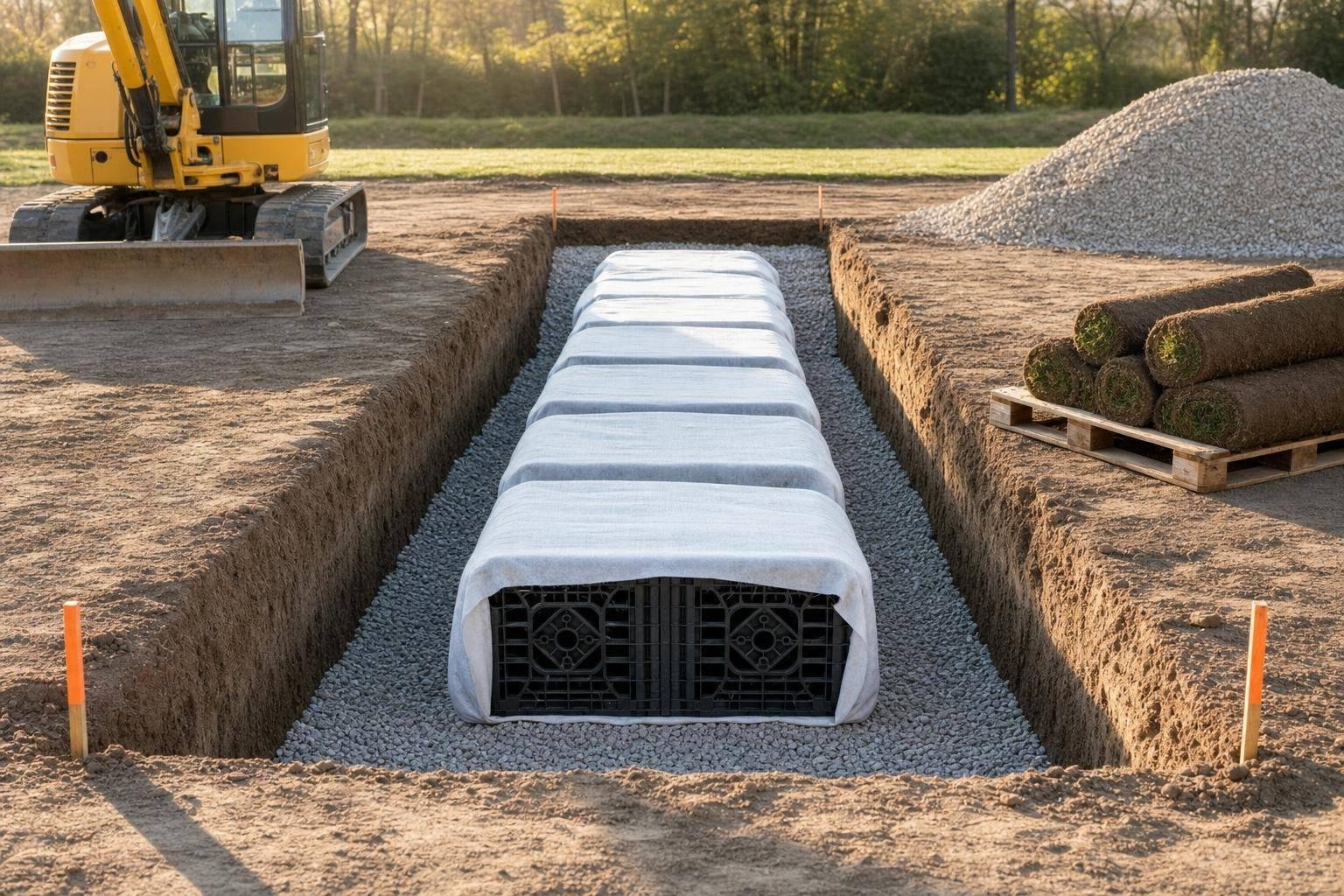
Geocellular modules are also common. But they don’t come alone. They still need geotextile wrapping, and some jobs also call for an impermeable liner. That adds cost on both the material side and the labor side.
The main detention unit is only part of the package. A full materials quote should clearly name inlet and outlet pipes, usually 6-inch or 8-inch PVC or HDPE for residential systems, along with manifolds, fittings, couplings, and any pipe-material transitions. Access risers, inspection ports, and cleanouts should also show up as their own line items. If a quote hides them under “accessories included,” you can’t confirm what’s actually there.
Flow-control devices matter too. Orifice plates and inlet restrictors are often required by local stormwater rules, and they can add hundreds of dollars to the material budget by themselves. If those parts aren’t listed one by one, they shouldn’t be treated as included.
For chamber-style systems, check for foundation stone, embedment stone, geotextile with stated square footage, end caps, and any concrete collars or pads. If the quote just says “stone and fabric included” without tonnage or square footage, it’s not complete.
Freight, Crane Time, and Scheduling Charges
Delivery can quietly bloat a project budget. Freight for a single-home underground detention system can range from a few hundred dollars to more than $1,000, based on system size, distance from the supplier, and site access.[10] Residential jobs often come with extra charges too, like lift-gate fees, smaller truck fees for tight streets, or fuel surcharges. Those costs are easy to miss when freight is buried inside a broad materials line.
System type changes the trucking plan as well. One regional analysis found that a 75,000 CF modular system needed only 8 truckloads, while a similar precast system needed about 73 truckloads.[7] That same pattern shows up on smaller jobs. Precast usually means more trucks, more moving parts, and more chances for delays.
Crane and rigging costs often show up when precast concrete vaults or large tanks are being set. Those charges may include mobilization, setup, hourly hoisting time, standby time if the site isn’t ready when the crane arrives, and rigging hardware. A quote should spell out the estimated crane hours and state whether rigging is included or billed on its own. If crane service is marked “optional” or left out, that’s a gap to clear up before signing.
Precast procurement can take 6 to 8 weeks, so order deadlines and delivery dates should be written into the bid.[11]
Materials and Delivery Checklist Table
Use the table to make sure each part and logistics charge is named.
| Component | Included in Quote | Delivery or Lifting Needed | Notes |
|---|---|---|---|
| Detention units (chambers, vaults, or modular crate systems) | Yes / No | Truck delivery; crane if precast | Confirm exact manufacturer, model, and storage volume |
| Inlet and outlet pipes (PVC or HDPE) | Yes / No | Standard delivery | Verify pipe diameter matches engineered plans |
| Manifolds, fittings, and couplings | Yes / No | Standard delivery | Include transitions between pipe materials |
| Access risers and inspection ports | Yes / No | Standard delivery | Confirm frames and covers are rated for load type |
| Flow-control devices (orifice plates, restrictors) | Yes / No | Standard delivery | Required as shown on the stormwater plan |
| Cleanouts on key pipe runs | Yes / No | Standard delivery | Needed for camera inspection and jetting |
| Geotextile fabric (non-woven) | Yes / No | Standard delivery | Confirm square footage matches system footprint |
| Impermeable liner (if required) | Yes / No | Standard delivery | May be needed for controlled-release or poor-soil sites |
| Foundation and embedment stone | Yes / No | Bulk delivery; confirm site access | Verify tonnage listed, not just stone included |
| End caps and concrete accessories | Yes / No | Standard delivery | Collars, pads, thrust blocks as required |
| Freight and fuel surcharges | Yes / No | N/A | Should be a separate line, not buried in materials |
| Crane mobilization and setup | Yes / No | Crane truck | Required for precast vaults and large tanks |
| Rigging (slings, shackles, rigger labor) | Yes / No | Included with crane | Confirm whether owned or rented by contractor |
| Crane standby time allowance | Yes / No | N/A | Covers delays from late deliveries or site readiness |
| Long-lead item order dates | Yes / No | N/A | Flag any item with a lead time longer than a week |
Treat any No as missing scope unless the plans show the item isn’t needed.
Next, check permit fees, safety controls, inspections, and testing allowances.
Permits, Safety Controls, Inspections, and Testing
After materials and delivery, the next place budgets often slip is permits, safety controls, and inspection timing. These costs are easy to miss with underground detention work. They may not show up in excavation or materials quotes, but they still shape the full price and the project timeline.
Plan Review, Permits, and Agency Fees
In Maryland, underground detention systems usually need a stormwater management review, a grading permit, and sediment and erosion control approval before work starts. In Maryland, stormwater, grading, and erosion control reviews usually run through the county public works or permitting office, with municipal review in some cities.[13][14]
Design and engineering fees are separate from permit fees. Civil engineers and stormwater consultants often charge a flat fee for the first set of plans, then bill hourly for comment responses, revisions, or resubmittals. For a residential stormwater design, that total can run about $2,000 to $5,000 or more depending on complexity. County permit and review fees are set by schedule – often $225 to $350 or more for plan review and stormwater permits, with revision fees often running $50 to $150 per submittal.[17][18][19]
Any land disturbance of 5,000 square feet or more, or 100 cubic yards or more of earth, requires a sediment and erosion control plan in Maryland.[21] That mark is easier to hit than many homeowners expect. Once you factor in excavation, stockpiling, and equipment access, a residential underground detention job can get there fast.
Once the permit path is sorted out, the next step is the temporary controls needed to keep the site in compliance during construction.
Safety Controls and Temporary Protection
Sediment and erosion control is required. Controls can include:
- Silt fence
- Inlet protection
- A stabilized construction entrance
Standard cost estimates show a stabilized construction entrance at $820 for a single-family site, silt fence at $4.00 per linear foot, and super silt fence at $8.00 per linear foot.[22] On a normal residential job, those costs can stack up fast before excavation even starts.
Deeper excavations can also call for trench boxes, shoring, safe access, and confined-space controls, so those items should be listed on their own.[15][16] If they get buried inside a broad excavation number, it becomes much harder to tell what you’re paying for.
Inspection and Testing Allowance Table
Active sites are often inspected every 7 days and within 24 hours after any storm producing 0.5 inches or more of rainfall.[20] That means inspections are part of the working schedule, not a one-and-done box to check. If a control measure fails inspection, work can stop until the issue is fixed and reinspection passes.
Use the table below to make sure each inspection and testing cost is on the budget before work begins.
| Permit or Inspection | Responsible Party | When It Happens | Expected Cost or Allowance |
|---|---|---|---|
| Sediment and erosion control pre-construction inspection | County inspector | Before excavation begins | County fee varies; allow for reinspection if needed |
| Stormwater management plan review | County DPW or permitting agency | Before permit issuance | ~$225–$350+ depending on jurisdiction[17][18] |
| Grading permit | County permitting department | Before grading begins | ~$200–$350 base fee[17] |
| Excavation and subgrade inspection | County inspector or engineer of record | After excavation, before system installation | Included in permit scope; reinspection may apply |
| Detention system installation inspection | County inspector or engineer of record | During placement of chambers or tanks | Included in permit scope; reinspection may apply |
| Compaction testing | Independent geotechnical firm | During backfill operations | ~$500–$1,500 per visit |
| As-built survey | Licensed surveyor | After installation and restoration | ~$1,000–$3,000; surveyor closeout cost |
| Engineering as-built review | County stormwater agency | At project closeout | Varies by jurisdiction; ~$515 in some counties[19] |
| Final stormwater approval | County stormwater inspector | Project closeout | Allow for reinspection if needed |
| Plan revision or resubmittal fee | County permitting agency | If design changes mid-project | ~$50–$150 per revision[17][18] |
Before signing, get it in writing which permit applications, controls, inspections, and closeout documents are included in the contract. A simple included/excluded check can save a lot of back-and-forth once work is underway.
Soil Export, Surface Restoration, and Final Budget Review
Soil Hauling, Disposal, and Stockpile Handling
Once permits, inspections, and testing are covered, one of the biggest budget swing factors is soil export and site restoration. This is where estimates can get slippery. A lot of bids tuck trucking, dumping, and handling into one excavation number, which makes it hard to see what you’re paying for.
A better approach is simple: have the contractor break out the haul rate, disposal fee, and stockpile handling as separate charges. Local hauls under 5 miles often cost $5–$15 per cubic yard, while hauls from 5–20 miles can hit $12–$25 per cubic yard. Disposal adds more, often $8–$25 per cubic yard or higher in urban markets.[27][28][29][30][32]
Some soil costs more to deal with than others. Rock, wet clay, or soil mixed with debris usually gets billed at a higher rate. If there isn’t a clear allowance for that up front, it can turn into a change order later.[28][33]
Before you sign anything, ask for three direct numbers:
- How many cubic yards the contractor expects to export
- What soil density they used to calculate that amount
- What the unit rate is for material that doesn’t qualify as clean fill
If soil is going to stay on site for a while, temporary handling should be priced on its own too. That includes tarping, silt fence, and stockpile stabilization.[31][34]
Final Grading, Lawn Repair, and Hardscape Restoration
After soil export is priced, the next step is checking what it will cost to put the site back together. Backfilling alone doesn’t finish the job. The estimate should list rough grading, topsoil, seed or sod, mulch, and hardscape repair as separate line items.
For residential drainage work, grading often runs $1,500–$4,500. More complex jobs can go past $6,000.[23][26] Screened topsoil commonly costs $20–$50 per cubic yard delivered.[24][25]
Hardscape repair also needs its own line item. If excavation crossed a driveway, walkway, or patio, the estimate should say whether the contractor will rebuild, repair, or only patch those areas. It should also spell out who is responsible for matching the existing materials. Pro Landscapes MD can coordinate grading, drainage, yard repair, and hardscape restoration across central Maryland.
Final Checklist: Missing Cost Red Flags Before Work Starts
A solid estimate breaks each major cost category into its own line item. If everything is bundled together, it’s much easier for costs to drift later. Use the table below as a gut check before accepting any proposal.
| Cost Category | What to Confirm | Common Red Flag |
|---|---|---|
| Labor and equipment | Itemized by task, not bundled | Single lump-sum with no breakdown |
| Materials and delivery | Unit quantities and delivery details | Materials included with no detail |
| Permits and agency fees | Plan review, grading, erosion control | No permit cost detail |
| Stockpile protection | Silt fence, tarps, pile stabilization | No allowance for temporary pile control |
| Inspections and testing | Compaction testing, as-built survey, closeout | No allowance for testing or closeout |
| Soil export | Cubic yards, haul rate, tipping fee | Excavation and export priced as one number |
| Restoration | Grading, topsoil, seed or sod, hardscape repair | Miscellaneous restoration with no scope |
| Allowances for unknowns | Rock, groundwater, unsuitable soil | No unit rates for changed conditions |
| Exclusions | Explicitly listed in writing | Scope described only by what’s included |
Watch out for vague phrases like "finished condition." That kind of wording sounds fine at first glance, but it can hide missing scope. The same goes for proposals that skip allowances for rock or groundwater. Ask for named exclusions and unit rates for rock, groundwater, and unsuitable soil before work starts.[35][36][37][38]
FAQs
What should an itemized detention bid include?
An itemized bid for an underground detention system should spell out the main costs so you’re less likely to get hit with surprise charges later.
It should include:
- Permits and filing fees
- Any required performance bonds
- Labor and equipment for excavation
- Soil export or disposal
- Material delivery coordination
- Safety controls
- Professional inspections
- As-built plans
- Final site restoration
That kind of line-by-line detail makes it much easier to see what’s covered, what isn’t, and where extra costs might show up.
Which hidden costs cause the biggest budget overruns?
The biggest overruns usually come from permit and compliance issues and unexpected site conditions. If erosion control or stormwater permits are missing, the fallout can get expensive fast: daily fines of up to $66,712, stop-work orders, and the cost of fixing work that was done without approval.
A few other costs tend to sneak up on people too. These often include incomplete permit applications, skipped site assessments, tough site access, added electrical or plumbing hookups, and weak record-keeping that later turns into maintenance or cleanup bills.
When should I expect change orders on this work?
Expect change orders when site conditions don’t match the original plan. That can happen with unexpected soil types, tough site access, or hidden infrastructure that forces the crew to change course.
Scope changes can also lead to a change order. For example, drainage design updates or extra materials needed to meet local safety or environmental rules may add work that wasn’t part of the first bid. Clear communication matters here because it helps teams spot issues early and document them before the job moves forward.
Chat with Us