









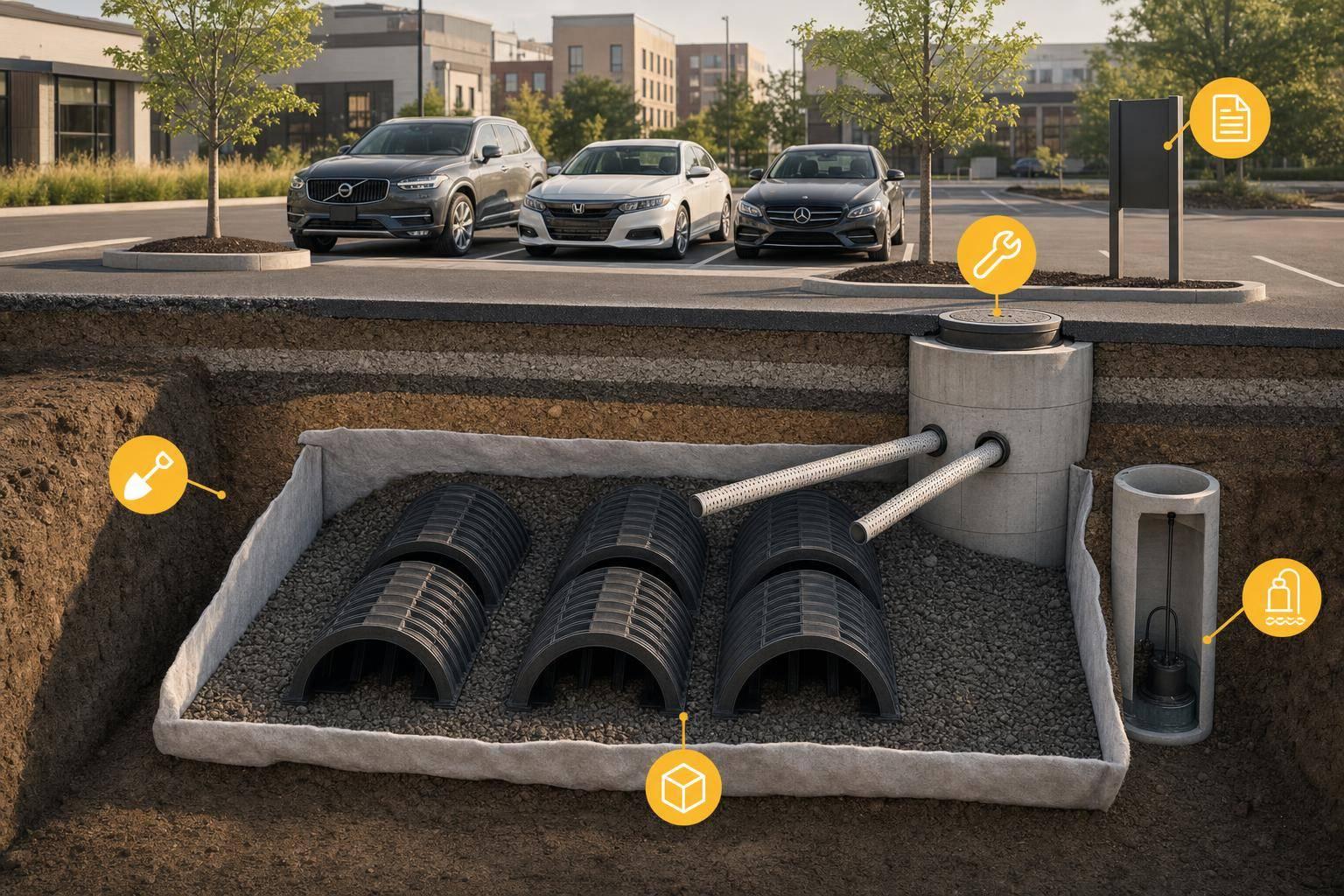
- bhavya gada
- No Comments
Underground detention usually costs more up front because the hard part is the dirt work, not just the tank itself. In most Maryland-area jobs, installed cost is about $8.50 to $17.00 per cubic foot, while more involved residential systems can run $20.00 to $45.00 per cubic foot. For many home projects, total cost often ends up around $40,000 to $90,000.
If I were budgeting one of these projects, I’d focus on four things first:
- Excavation and haul-off: often 40% to 60% of the total cost
- System type: plastic modules, stone, chambers, or concrete all price out differently
- Site problems: groundwater, rock, and utility conflicts can add $5,000 to $30,000+
- Long-term upkeep: plan for 2% to 5% of install cost per year
Here’s the simple takeaway: if surface space is tight, underground detention can make sense. But the final price depends less on storage size alone and more on how much soil must be moved, what’s underground already, and how the system will be maintained over time.
A few numbers stand out:
- A high-water-table site may need dewatering, which can add $5,000 to $25,000
- Engineering and permitting often add $5,500 to $20,000
- Geotechnical work often starts around $3,000 to $10,000
- Maintenance visits can cost $500 to $2,500 per service
| Cost Area | Typical Range |
|---|---|
| Installed cost | $8.50–$17.00/cu. ft. |
| Complex residential install | $20.00–$45.00/cu. ft. |
| Total home project | $40,000–$90,000 |
| Dewatering | $5,000–$25,000 |
| Utility conflict work | $5,000–$30,000+ |
| Annual maintenance budget | 2%–5% of install cost |
Bottom line: I’d build the budget in this order: site testing, design, install, contingency, and yearly maintenance reserve. That gives you a much better read on the full cost before construction starts.
Mastering the Design of Underground Detention & Infiltration Systems
sbb-itb-843f8be
What Drives the Cost of an Underground Detention System
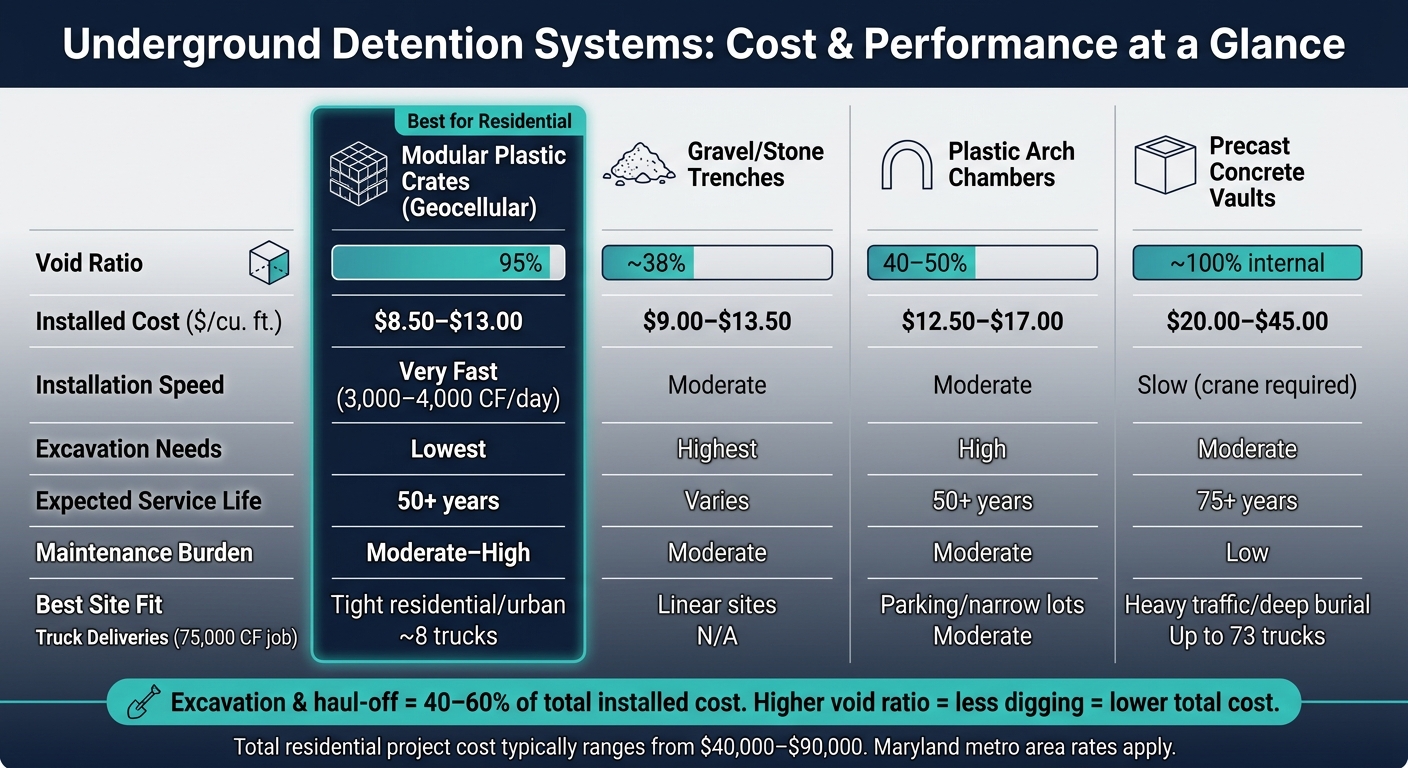
Underground Detention System Types: Cost, Void Ratio & Lifecycle Comparison
On Maryland residential sites, the biggest cost driver usually isn’t the amount of water you need to store. It’s the work needed to get the system in the ground and make it accessible. In plain English: digging, moving soil, dealing with site conditions, and picking the system type tend to shape the budget more than storage volume alone.
Excavation, Haul-Off, Backfill, and Labor
Excavation and haul-off are usually the biggest line items. They often account for 40% to 60% of total installed costs [3]. And the price isn’t just about how deep the crew digs. It depends even more on how much material has to be moved.
That’s where void ratio comes in. Void ratio is the portion of the excavated space that can actually hold water. A gravel trench has a void ratio of about 38%, so only 38% of the dug-out space stores water. A geocellular modular system is around 95%. That gap is huge.
To store the same 10,000 cubic feet of water, gravel needs about 26,316 cubic feet of excavation, while geocellular modules need only about 10,526 cubic feet [3]. More excavation means more machine time, more trucking, and more disposal fees. It adds up fast.
Backfill matters too. Geocellular modules can cut stone backfill needs by 40% to 60% compared with arch chamber systems [6].
In the Maryland and Washington, DC metro area, excavation and disposal rates are high, at about $38–$55 per cubic yard [3]. Soil hauling and disposal by itself can add another $8–$25 per cubic yard [3]. If the site has heavy clay or rocky ground, production can slow by 30% to 40%. In some cases, the contractor may also need specialized rock buckets that rent for about $1,200 per day [3].
Once the excavation volume is known, the storage structure becomes the next big cost factor.
Storage Structure Materials and Piping
Installed cost by system type:
| System Type | Void Ratio | Installed Cost ($/cu. ft.) |
|---|---|---|
| Modular Plastic Crates | 95% | $8.50–$13.00 [3] |
| Gravel/Stone Trenches | ~38% | $9.00–$13.50 [3] |
| Plastic Arch Chambers | 40%–50% | $12.50–$17.00 [3] |
| Precast Concrete Vaults | ~100% (internal) | $20.00–$45.00 [4][2] |
Precast concrete vaults have the highest cost per cubic foot, but they also offer a design life of more than 75 years and work well in heavy traffic areas [5]. On tighter residential lots, modular plastic systems often pencil out better because their high void ratio can trim excavation and hauling costs.
Delivery can shift the budget too. A 75,000-cubic-foot precast concrete system can take up to 73 truckloads, while a similar modular system may need only 8 [6]. Fewer loads can make scheduling easier and reduce headaches on sites with limited access.
Site Constraints, Utility Conflicts, and Regional Pricing
Even a simple design can get more expensive when the site fights back.
If the seasonal high water table is within 24 inches of the excavation bottom, the contractor will usually need to dewater the site. That can add $5,000–$25,000 to the job [3][4]. High groundwater can also mean anti-buoyancy measures, such as concrete anchor pads or hold-down straps, so the system doesn’t float [4][5].
Utility conflicts are another common swing factor. If crews hit existing underground lines during excavation, relocation or bypass work can add $5,000–$30,000+ [4]. On top of that, engineering design usually runs $5,000–$15,000, and geotechnical reports typically cost $3,000–$10,000 [4].
Getting borings done before bidding can help lower the chance of ugly change orders later, especially if the contractor runs into rock or contaminated fill [3].
Installation Cost Breakdown by Project Phase
Looking at costs by phase makes it much easier to spot where jobs start to go off track. It also shows where each dollar is likely to go before construction begins.
Site Preparation, Excavation, and Subgrade Work
Before any system goes into the ground, the site has to be staked out and erosion and sediment controls need to be in place. That early work shapes access, erosion control, and site restoration costs.
After that, excavation usually takes the biggest chunk of the budget. If the site has dense soil or rock, digging takes longer and costs more.
Once excavation is done, the subgrade needs to be compacted – usually to 95% Standard Proctor density – before bedding is placed. A 4- to 12-inch layer of stone or sand bedding is standard to help prevent settlement under the system [5].
| Project Phase | Typical Cost Components | Share of Total Budget |
|---|---|---|
| Site Prep & Excavation | Erosion control, digging, hauling, dewatering | 40–60% [3] |
| System Assembly | Materials, labor, geotextiles, piping | 20–30% [3][4] |
| Backfill & Restoration | Stone bedding, structural fill, pavement or landscaping | 15–25% [3][4] |
| Soft Costs | Engineering, geotech reports, permitting | 10–15% [4] |
System Assembly, Utility Coordination, and Surface Restoration
Once the subgrade is ready, crews install the system, connect the piping, and wrap geotextile. With modular geocellular systems, a two-person crew can usually place 3,000–4,000 cubic feet per day [3].
Shipping and access can change both schedule and cost in a big way. A 75,000 CF precast concrete project may need up to 73 truckloads, while flat-packed modular systems may need only 8 truckloads [6].
Labor and mobilization often take a big share of this phase. Utility conflicts can also hit the budget hard. If a utility has to be moved, that can add $5,000 to $30,000+.
Backfilling comes next, usually in 6- to 12-inch compacted lifts to protect structural integrity [5]. From there, restoration depends on the final surface – lawn, planting beds, or pavement. Our landscape installation services can help restore the site to its original condition.
Installed cost is just one part of the budget. Maintenance starts after construction is done.
Installed Cost Comparison by System Type
The same storage goal can come with very different installed costs once excavation, access, and site conditions are part of the picture.
| System Type | Installation Speed | Excavation Needs | Access Requirements | Typical Site Fit |
|---|---|---|---|---|
| Corrugated Metal Pipe (CMP) | Moderate | High (requires stone) | Moderate | Linear sites, easements [1][5] |
| Plastic Arch Chambers | Moderate | High (requires stone bedding) | Easy (lightweight) | Parking lots, narrow lots [3][2] |
| Geocellular Modules | Very fast (3,000–4,000 CF/day) | Lowest (95% void ratio) | Very easy (hand-carried) | Tight residential, urban sites [3][5] |
| Precast Concrete | Slow (requires crane) | Moderate | Difficult (crane access needed) | Heavy traffic, deep burial [2][5] |
Geocellular modules work well on tight residential lots because crews can hand-carry them into place and install them fast. Precast concrete is often a better fit for heavy traffic areas and deep burial, and it can deliver a 75+ year service life [2][5].
Maintenance and Long-Term Lifecycle Costs
Upfront cost is only one piece of the picture. Once the system is in the ground, maintenance and eventual replacement can shape the total cost just as much as the install itself. That part often gets missed when the main focus is the construction budget.
Recurring Inspection, Cleaning, and Sediment Removal Costs
Sediment builds up over time. When that happens, an underground detention system can lose storage volume and start to clog, which can lead to poor performance or early failure [2][1].
Plan for routine upkeep from the start. Inspect the system once a year, clean it when needed, and set aside 2% to 5% of total installation cost each year for maintenance [1][4]. That routine work usually includes:
After major storm events, the outlet control structure should also be checked for blockages [2]. It helps to design the system with manholes, risers, or removable panels so crews can get in and inspect or clean it without a headache.
Vacuum cleaning and sediment removal usually cost $500 to $2,500 per service, depending on system size and how much sediment has built up [4].
On a $50,000 project, that yearly reserve comes out to about $1,000 to $2,500 per year. In Maryland, homeowners should also check local county rules. Some jurisdictions require maintenance logs or periodic professional reviews to stay in line with stormwater rules [4][5]. Those repeating costs need a place in the annual budget.
Repair Risks, Service Life, and Replacement Planning
Material choice affects both upkeep and replacement timing. Over the long run, three structural issues can push costs up: floating, settlement, and shallow cover.
An empty system can float or shift if it does not have anti-buoyancy protection. Poor backfill compaction can lead to settlement over time. And if there is not enough cover depth under a driveway or parking area, vehicle loads can cause structural failure [5][3].
Skipped maintenance makes things worse. Clogging and structural stress become more likely, which can cut service life short and make repairs cost more [2][5]. If there are signs of structural trouble, a professional site evaluation or geotechnical review can add $3,000 to $10,000 in cost [4].
The key point is simple: budget around service life, not just the install price.
Lifecycle Cost Comparison for Budgeting Decisions
The table below compares service life, maintenance needs, and inspection access [1][2][3][5].
| System Type | Expected Service Life | Maintenance Burden | Inspection Access | Long-Term Cost Considerations |
|---|---|---|---|---|
| Precast Concrete Vault | 75+ years | Low; easy to clean interior | Excellent (manholes) | Long service life and easy internal access |
| HDPE Pipe | 50–100 years | Moderate | Good (via manholes) | Non-corrosive; backfill compaction is critical to avoid settlement |
| Geocellular Modules | 50+ years | Moderate to high | Variable (design-dependent) | Requires quality pre-treatment upstream to prevent clogging |
| Arch Chambers | 50+ years | Moderate | Good (open-bottom access) | Well-understood by regulators; needs significant stone backfill |
| CMP Systems | 25–50 years | Moderate; monitor for corrosion | Good (linear access) | Shorter replacement cycle because of corrosion risk |
Budgeting for a Maryland Residential Stormwater Project
Budgeting starts with site data. Borings show you what’s happening below the surface: soil type, rock, and groundwater. And those factors shape both the design and the price.
For most Maryland residential stormwater projects, two to four soil borings taken to five feet below the planned excavation depth help confirm the conditions that will affect the rest of the design [3]. If you skip geotechnical borings, you can end up paying for it later through change orders [3]. As the AQUA Rainwater Engineering Team puts it:
"Assuming ‘normal soil’ and then hitting rock, perched water, or contaminated fill is the number one source of change orders on detention projects." [3]
After you have soil data, the next step is engineering design and permitting. In Maryland, that usually means civil engineering plans and Land Disturbing Activity (LDA) permitting before construction pricing is locked in [4]. So the order of the budget matters just as much as the total.
Set the Budget in the Right Order: Evaluation, Design, Contingency, and Maintenance Reserve
The table below shows a typical Maryland budgeting sequence [4].
| Budget Phase | Estimated Cost Range | What It Covers |
|---|---|---|
| 1. Evaluation | $3,000 – $10,000 | Geotechnical borings, soil testing, water table check |
| 2. Design & Permits | $5,500 – $20,000 | Civil engineering, LDA permits, drainage compliance |
| 3. Contingency | 15% – 30% of install | Utility conflicts, dewatering, weather delays |
| 4. Maintenance Reserve | $500 – $2,500/year | Annual inspections, sediment removal, vactor cleaning |
One cost can change the budget fast: dewatering. If the seasonal high water table is within 24 inches of the planned excavation bottom, dewatering should be part of the budget. That item alone can add $5,000 to $25,000+ to the project [3][4].
How Coordinated Drainage and Landscape Planning Reduces Rework Costs
Once the system is installed, coordinated grading and restoration help you avoid paying for the same work twice. One of the most common avoidable costs is fixing finished areas after drainage changes are made. It’s the old story: finish the yard, then dig it back up.
When grading, yard repair, and surface restoration are planned with the detention system from the start, the site gets excavated and restored once instead of twice. That keeps rework down and avoids duplicate mobilization costs.
Coordinating drainage, grading, and landscape restoration under one scope can lower those repeat costs. Pro Landscapes MD handles drainage installation, grading, land leveling, stormwater management, and landscape restoration across central Maryland, including Howard County, Montgomery County, and Baltimore County.
Conclusion: Key Costs to Plan for Before Construction Begins
Build the budget from site data, not guesses. Start with borings and evaluation, then add design and permitting, a 15% to 30% contingency, and money for maintenance [4]. A site-specific scope that accounts for lifecycle costs, not just installation, is the number that matters before construction starts.
FAQs
Why does excavation cost so much?
Excavation is often the largest cost in underground detention projects. In many cases, it accounts for 40% to 60% of the total installed price.
That’s why system shape and storage efficiency matter so much. If a system has a lower void ratio, you have to remove more soil to store the same amount of water. More digging usually means a higher bill. It’s that simple.
Site conditions can push costs up even more. Common cost drivers include:
- rock
- high groundwater
- underground utilities
- soil hauling and disposal at $25 to $55 per cubic yard
A clean, easy site is one thing. A site with rock, wet ground, and utility conflicts is a whole different story.
Which detention system is most cost-effective?
It depends on your site limits, how much storage you need, and what excavation costs in your area. On tight sites, modular plastic geocellular crate systems are often the lowest-cost option because their high void ratio can cut down on excavation, hauling, labor, and material use.
For linear or simple layouts, corrugated steel pipe systems can also be a cost-effective pick. Precast concrete vaults are usually the most expensive, at $20.00 to $40.00 per cubic foot.
How much should I budget for maintenance?
Plan to set aside about 2% to 5% of the upfront installation cost each year for maintenance.
That yearly spend helps cover the basics that keep the system working as it should. Regular inspections and cleanouts can stop sediment from piling up and eating into storage volume. If that buildup gets out of hand, it can trigger system failure or even fines.
Professional cleaning and sediment removal usually cost $500 to $2,500 per visit, depending on the site, the scope of work, and local rules.
Chat with Us