









- bhavya gada
- No Comments
If I had to boil it down to one answer, it’s this: in Maryland, walkway costs usually start around $8 per sq. ft. for basic concrete and can go past $55 per sq. ft. for high-end pavers or natural stone. The final price often shifts because of the material, curves, width, steps, slope, drainage, and base prep.
If you’re comparing options, here’s the short version:
- Concrete: about $8–$15 per sq. ft.
- Basic concrete pavers: about $15–$55+ per sq. ft.
- Premium pavers: about $30–$55+ per sq. ft.
- Flagstone/natural stone: about $18–$55+ per sq. ft.
- Curves can add about 10%–20%
- Each extra foot of width can add about 25%–33%
- Steps often cost $80–$200 each
- Permits may add $50–$200
Maryland weather matters too. Freeze-thaw cycles, clay soil, and poor drainage can lead to shifting or cracking if the base work is weak. So when I look at a bid, I don’t just look at the surface material. I look at the prep under it.
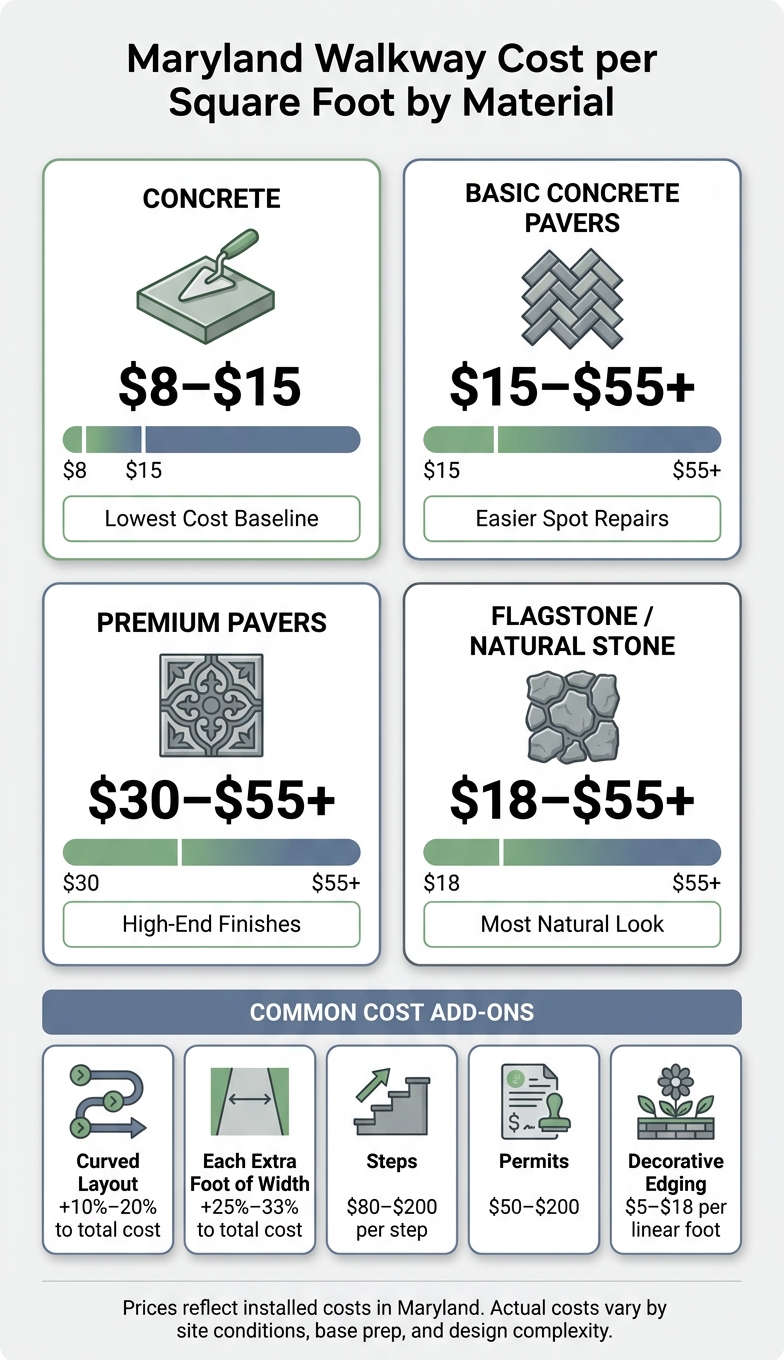
Maryland Walkway Cost per Square Foot by Material (2024)
Front Walkway Cost: Materials and Installation
sbb-itb-843f8be
Quick Comparison
| Walkway type | Typical installed cost | Main cost drivers | Main trade-off |
|---|---|---|---|
| Concrete | $8–$15/sq. ft. | Finish, curves, width, steps | Lower up-front cost, harder patch work |
| Basic concrete pavers | $15–$55+/sq. ft. | Base prep, cuts, slope, edging | Higher cost than concrete, easier spot fixes |
| Premium pavers | $30–$55+/sq. ft. | Custom pattern, curves, access, extras | Higher material and labor cost |
| Flagstone / natural stone | $18–$55+/sq. ft. | Stone type, hand fitting, slope, drainage | More labor, price can swing a lot |
Bottom line: if you want the lowest starting price, concrete is usually the baseline. If you want easier repairs, pavers often win. If you want a more upscale look, premium pavers and natural stone usually sit at the top of the price range.
1. Concrete Walkways
Installed Cost Per Sq. Ft.
Concrete is usually the lowest-cost common option for a walkway, so it’s a solid baseline when you’re comparing materials. Standard poured concrete often costs $8–$15 per sq. ft. [4]
Finish choice can shift that number quite a bit:
- Broom and exposed aggregate: $8–$13 per sq. ft.
- Stamped concrete: $9–$23 per sq. ft.
- Acid-stained finishes: up to $13–$26 per sq. ft. [4]
For a 4-inch-thick walkway in the Baltimore area, average totals look like this:
| Walkway Size (4" Thick) | Average Cost Range (Baltimore, MD) |
|---|---|
| 75 sq. ft. | $625 – $940 |
| 130 sq. ft. | $1,100 – $1,620 |
| 200 sq. ft. | $1,670 – $2,510 |
Layout and Width Impact
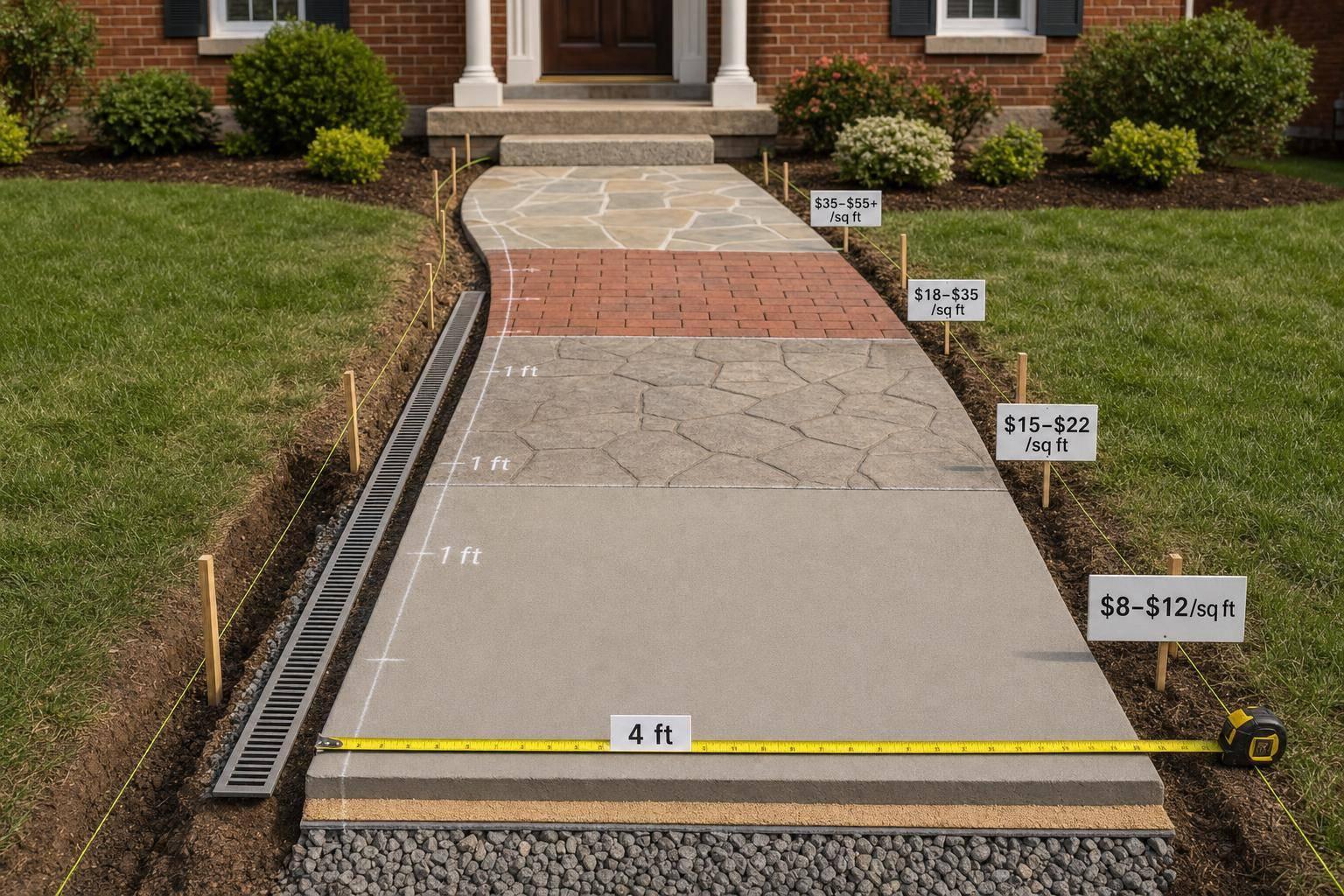
A 3-foot-wide path is fine for single-file walking. If you want two people to walk side by side without doing that awkward shoulder turn, 4 to 5 feet works better [4].
Width affects price in a simple way: more concrete, more labor, more cost. Each added foot of width can increase the total by 25% to 33% [4]. Layout matters too. Straight paths are usually the least expensive, while curved walkways take more form-setting and labor, which can add 10% to 20% [4].
Site Feature Add-Ons
Extra site features can push the total up fast. If your walkway needs steps, expect about $80 to $200 per step [4]. Permits may add another $50 to $200, depending on the local jurisdiction [6][7].
Drainage also matters more than many homeowners think. The walkway should slope slightly to one side – about 1/4 inch per foot – to help limit pooling and ice buildup [4].
Long-Term Value
Edge restraints help the walkway stay in place over time and cut down on shifting. Timing matters too. Concrete work is best done in moderate weather, usually 50°F to 85°F, because those conditions help with curing. In Baltimore, that often makes spring and fall the sweet spot [1][3].
That gives concrete its role as the main cost baseline when comparing basic paver walkways next.
2. Basic Concrete Paver Walkways
Installed Cost Per Sq. Ft.
Basic concrete paver walkways cost more than poured concrete. That said, they’re usually much easier to fix if one section cracks, sinks, or shifts.
The price gap mostly comes down to the install process. Pavers need excavation, a compacted base, and edge restraints, so there’s more labor and more material involved. In Baltimore, standard concrete pavers average $26 per sq. ft. installed [1]. Across Maryland, standard paver walkways usually fall in the $15–$55+ per sq. ft. range, depending on material quality and site conditions [8][2].
That installed price usually includes:
For a sense of project cost, a 120-square-foot paver walkway in Maryland averages about $3,177 statewide [1]. And if you price it by length, a standard 4-foot-wide walkway usually runs $60–$200 per linear foot installed [2].
Layout and Width Impact
Layout matters more than many homeowners expect. Primary walkways are usually 4 feet wide, while secondary paths are often 2 to 3 feet wide. Once you go wider, the price climbs because you’re using more material and adding labor.
Curves also add cost. Straight runs are usually the lowest-cost option because they need fewer cuts and less hands-on work [7][8]. Put simply: a simple path is easier on the budget than one that bends and flares.
Site Feature Add-Ons
Sloped yards can change the price in a hurry. If the walkway needs steps or landings, installed cost goes up [2]. The same goes for retaining edges on sloped ground, since they add both material and labor.
Drainage is another factor. Slopes often need drainage work along with retaining edges, and that can push pricing up fast. Polymeric sand also costs more than standard joint sand, but it can help cut down weed growth over time [5].
A few other details matter too:
- Avoid rock salt on pavers; it can etch the surface [5].
- Permits can add $50–$200 in some Maryland jurisdictions [7][3].
Long-Term Value
One of the big selling points with pavers is repair. If a single paver cracks or shifts, it can usually be lifted and replaced without tearing up the rest of the walkway [8][5]. That’s a big plus compared with poured concrete, where one bad section can turn into a much bigger fix.
In Maryland, base prep makes a huge difference over time. A proper 4–8 inch compacted crushed stone base helps reduce frost heave and long-term shifting caused by freeze-thaw cycles [5].
Premium pavers cost more because of thicker units, more finish choices, and added labor.
3. Premium Paver Walkways
Installed Cost Per Sq. Ft.
In Maryland, premium paver or natural stone walkways usually cost $30–$55+ per sq. ft. [8][7] That higher price comes from thicker materials, natural stone, and the extra labor these jobs often need compared with a standard paver install.
In Baltimore, stone-look paver installations average about $32 per sq. ft. [1] For a professionally installed front walkway in Maryland, total project costs often land between $5,000 and $15,000. [7]
Once you get past the base material, the final number often comes down to the shape of the walkway and what the site is like.
Layout and Width Impact
This is where costs can climb in a hurry. Curves, custom cuts, and wider walkways all add labor and material waste. Premium layouts often include curved lines and detailed cuts, which push pricing higher. [9][10]
Width matters too, both for looks and day-to-day use. Primary front walkways are often built at 4 feet wide, while 5 feet is a common pick for a more balanced, welcoming entry and enough room for two people to walk side by side. [2][9]
A wider walkway means more square footage, so the total cost goes up. Still, on higher-end projects, that extra width is a common add-on because it changes how the entrance feels.
Site conditions can push the budget up just as much as the pattern itself.
Site Feature Add-Ons
Premium walkway projects often include extras like:
- Lighting
- Decorative edging
- Steps
- Tight or hard-to-reach access areas
Each one adds to labor and material costs. [9][7] Limited access can be a big one. If a crew has to hand-carry materials instead of moving them in with equipment, labor costs go up fast. [9]
Long-Term Value
The higher upfront cost can make more sense over time. Granite and bluestone can last 50+ years, while standard concrete pavers usually last around 25–35 years. [9]
The main upkeep cost is sealing. Professional paver sealing usually runs $2–$4 per sq. ft. and is often redone every 2 to 5 years to help preserve color and cut down on staining on natural stone. [9]
The next price jump usually comes from layout, width, and site work.
4. Flagstone and Natural Stone Walkways
Installed Cost Per Sq. Ft.
If you want a walkway with a more natural, upscale look, flagstone is usually at the top end of Maryland pricing.
In Maryland, flagstone and natural stone walkways usually cost $18–$55+ per sq. ft. installed, based on the stone you choose and the site conditions [8]. In Baltimore, standard natural stone installation averages about $32 per sq. ft., while decorative stepping-stone paths are closer to $36 [1].
The type of stone makes a big difference in price:
- Bluestone and limestone: $20–$40 per sq. ft.
- Granite: $22–$40 per sq. ft.
- Cobblestone: $25–$50+ per sq. ft. installed [9]
Layout and Width Impact
Layout can move the price more than many homeowners expect. Curves and irregular patterns take more labor because each stone has to be cut and fit by hand. That often adds 10%–20% or more [4].
And if you go with a custom pattern, labor can climb even more. In many cases, that means 15%–30% more in labor than a simple organic layout [4].
Width matters too. For front entries, a path that’s 4 to 5 feet wide usually feels comfortable for two people walking side by side [4]. Add more width, and the budget grows fast. Each extra foot beyond the standard can add about 25%–33% to the total project cost [4].
Site Feature Add-Ons
On sloped Maryland lots, extras like steps and retaining edges are common [2]. These add-ons can change the budget in a hurry.
- Individual steps: about $80–$200 each [4]
- Decorative edging: $5–$18 per linear foot
- Path lighting: $80–$300 per fixture [9]
Soil can also affect the install. In Maryland’s Piedmont, heavy clay often calls for a stronger crushed-stone base [5].
Those job-site details matter, but design choices can shift the final number just as much.
Long-Term Value
Natural stone can last for decades. But there’s a catch: it needs a well-compacted base and tight joints to help resist movement during freeze-thaw cycles.
How Design Choices Affect Walkway Cost
Once you’ve picked the material, layout and site prep usually have the biggest impact on price.
| Design Condition | Typical Cost Effect |
|---|---|
| Straight run vs. curved layout | Curves add layout time, cutting, fitting, and material waste |
| Standard 3-foot path vs. 5-foot-or-wider walkway | Wider walkways need more material and labor |
Here’s how those cost changes play out on the job.
Straight Runs vs. Curved Layouts
A straight walkway is the baseline. It’s the fastest and simplest layout to install.
Curved walkways take more time to mark out, and pavers or stone often need tighter cutting and fitting to match the arc. That added labor, plus extra waste, pushes up the installed cost per square foot.
Standard Widths vs. Wider Walkways
A standard path, around 3 feet wide, is the baseline.
If you increase that to 5 feet or more, the project needs more material and more labor, so the total cost rises. On bigger jobs, some fixed costs get spread across more square feet, which can bring down the per-square-foot price.
Grading and Drainage Work
Site conditions can hit the budget harder than layout changes.
On properties with heavy clay soil, water drains poorly. Clay swells when it gets wet and shrinks as it dries. In Maryland, freeze-thaw cycles can make that even worse. Some sites need regrading, drain pipe installation, or a French drain to help protect the walkway.
Why Better Base Prep Matters
A compacted crushed-stone base helps the walkway hold up against soil movement and freeze-thaw cycles.
That’s why base prep should be part of every Maryland walkway estimate.
Pros and Cons by Walkway Type
After you compare installed cost per square foot, the next step is simple: figure out which walkway gives you the best mix of price, lifespan, and upkeep.
That matters because walkway value isn’t just about the number on the estimate. You also need to weigh cost, durability, repairability, and maintenance. A lower-priced option can cost more later if repairs are a pain. On the flip side, a pricier material may hold up longer and look better for years.
Here’s how each walkway type stacks up.
Concrete Walkways
Concrete usually comes in as the lowest-cost option upfront. It’s also fairly simple to install on most sites, which helps keep labor more predictable.
The downside shows up when something goes wrong. Repairs are harder to blend cleanly, so one cracked section can turn into a bigger fix. And if you add decorative finishes, expect the price to go up. Those finishes can also show wear over time.
Basic Concrete Paver Walkways
Basic concrete pavers cost more upfront than poured concrete, but they make repairs much easier. If one section gets damaged, individual pavers can be lifted and replaced without tearing up the rest of the walkway.
That said, base prep matters A LOT here. If the base is done poorly, long-term performance can suffer. So while pavers help with repair work, the install quality has a direct effect on how well the walkway holds up.
Premium Paver Walkways
Premium pavers bring more visual punch. You get a broader range of finishes, shapes, and patterns, and they tend to last longer than standard pavers.
The catch is cost. Materials and labor both run higher, and design choices like curves or custom cuts push the price up even more. They also add install time, which can affect the total bid.
Flagstone and Natural Stone Walkways
Flagstone and natural stone sit at the top end for appearance. They’re often the best match for custom designs or a more natural look. And durable stone like granite or bluestone can last 50+ years.
But this option is also the most labor-sensitive. Irregular shapes need hand-fitting, which takes more time and skill. If the base prep or drainage is off, those problems tend to show up faster than they do with other materials.
That tradeoff is usually what decides the best fit for a given property.
Conclusion
The main point is simple: walkway cost depends on more than the material you pick. In Maryland, concrete is usually the starting point for pricing. Basic concrete pavers come in higher, premium pavers cost even more, and flagstone or natural stone are usually at the top end.
Price also goes up when the job gets more involved. Curves, extra width, slopes, steps, retaining edges, and drainage work can all add to the total. That’s why general per-square-foot ranges often don’t tell the whole story.
For central Maryland projects, Pro Landscapes MD can provide a site-specific walkway estimate based on material, layout, and site conditions.
FAQs
What size walkway do I need?
Walkway width should match how people will use it and how much foot traffic it gets.
A main front entrance path should be at least 4 feet wide. That gives two people enough room to walk side by side without feeling squeezed. If you have the space, 5 feet tends to feel more open and better balanced.
For secondary paths, like side-yard routes or backyard garden walkways, 2 to 3 feet is usually enough for single-file use. It also makes sense to add more width if the path needs to handle wheelchairs, strollers, or outdoor furniture being moved through the space.
Why do walkway quotes vary so much?
Walkway quotes vary because every project comes with its own site conditions, material choices, and design needs. Those details shape the labor involved and the logistics behind the job.
The main cost drivers are material type, design complexity, and site issues such as drainage problems, limited access, removal of old materials, and permit requirements.
Which walkway material lasts longest?
Natural flagstone tends to last the longest. In many cases, it holds up for 50 years or more. Concrete and clay pavers also last a long time and often reach 40 years or more when the base is prepared the right way.
In Maryland, the life of a walkway doesn’t come down to material alone. The base, edge restraints, and drainage all play a big part in how long it stays in good shape.
Chat with Us