









- bhavya gada
- No Comments
Managing water pooling on patios is essential for protecting your property and preventing issues like foundation damage, slippery surfaces, and mosquito breeding. In Maryland, clay-heavy soil and freeze-thaw cycles make proper drainage even more critical. Here are five effective solutions:
- French Drains: Underground pipes surrounded by gravel that efficiently redirect water and recharge groundwater.
- Dry Riverbeds: Surface channels with rocks that guide water naturally while adding visual appeal.
- Permeable Pavers: Paving systems that let water seep through, reducing runoff and filtering pollutants.
- Channel Drains: Linear systems that capture surface water and direct it away from patios and foundations.
- Rain Gardens: Planted depressions that collect runoff, filter pollutants, and support local aquifers.
These methods not only solve water issues but also improve your outdoor space’s functionality and appearance. For Maryland homeowners, professional installation ensures proper design tailored to local conditions.
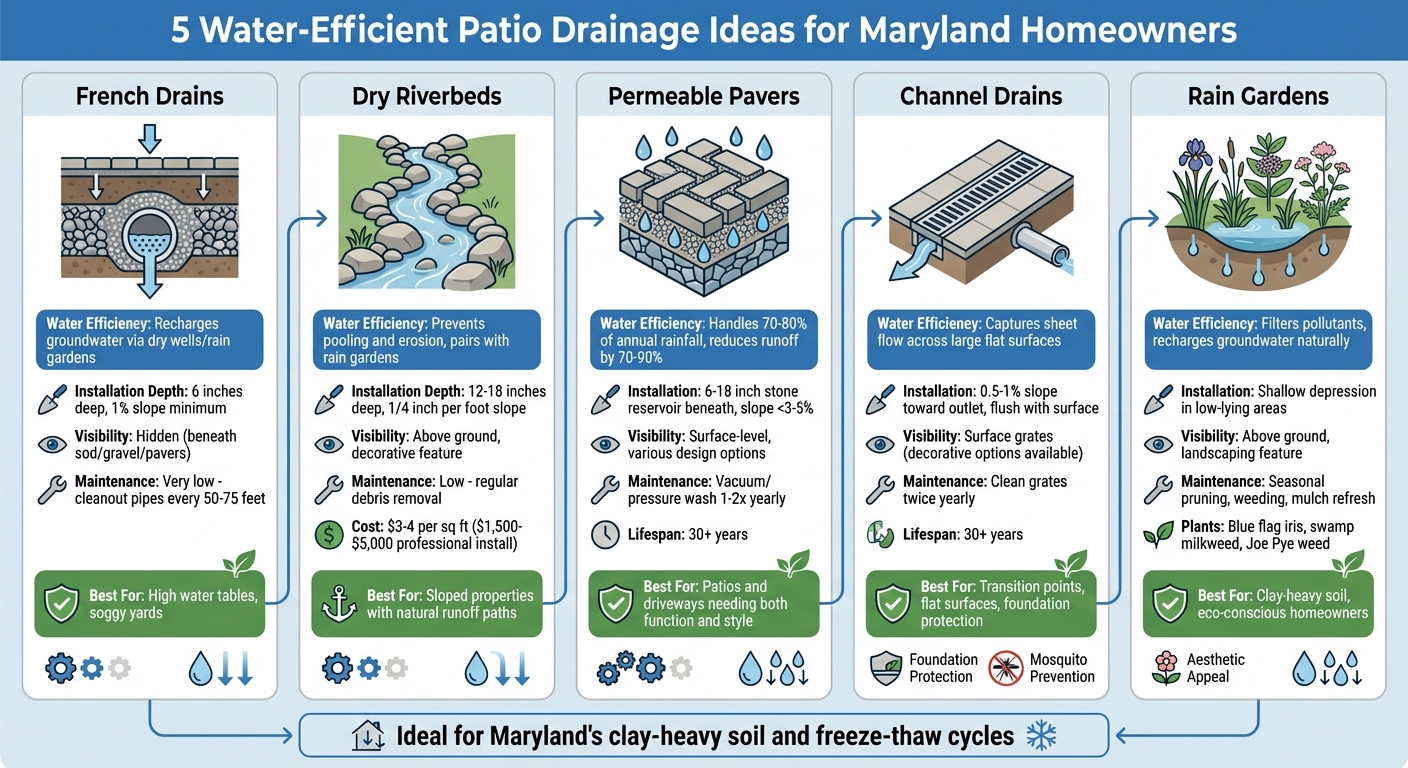
5 Water-Efficient Patio Drainage Solutions Comparison Chart
Building a French Drain around a paver patio
sbb-itb-843f8be
1. French Drains
French drains are a practical solution for managing water around your patio or yard. They work by intercepting surface runoff and groundwater before it can cause issues like patio saturation or concrete damage. Instead of just directing water that’s already collected, these drains use a perforated pipe surrounded by gravel to capture and guide water underground efficiently [4].
Water Efficiency
One of the standout features of French drains is their ability to handle water responsibly. By connecting the outflow to a dry well or rain garden, these systems allow water to seep back into the ground, helping recharge local aquifers instead of overloading storm drains [4]. This is particularly helpful in Maryland, where the clay-heavy soil struggles to absorb water quickly on its own [4].
Ease of Installation
Installing a French drain is relatively straightforward but requires attention to detail, especially in Maryland’s dense clay soils. The process involves digging a trench about 6 inches deep with a slope of at least 1% (1/8 inch per foot, though some experts suggest 1/4 inch per foot for better performance). A 4-inch perforated pipe is placed in the trench with the holes facing downward, wrapped in geotextile fabric to prevent clogging. It’s also essential to check for underground utilities before digging [2][4].
Aesthetic Appeal
One of the great things about French drains is how they integrate seamlessly into your yard. They can be hidden beneath sod, decorative gravel, or patio blocks, allowing them to blend into the landscape while addressing water issues. This prevents problems like standing water, which can stain surfaces, shift pavers, or even attract mosquitoes [1].
"Because they are buried, French drains blend into your landscaping design and do not distract from your yard’s look." – Hawkins Landscaping [1]
Maintenance Requirements
French drains require very little maintenance. Adding vertical cleanout pipes every 50–75 feet makes it easy to flush out sediment if needed. It’s also a good idea to check the system during wet seasons to ensure water flows freely [4].
For Maryland homeowners dealing with soggy yards or high water tables, Pro Landscapes MD offers French drain installations across Howard County, Montgomery County, and nearby areas. Their expertise ensures proper slope and effective water management tailored to your landscape.
2. Dry Riverbeds
Dry riverbeds, also known as dry creek beds, are a practical and attractive way to manage drainage while enhancing your yard’s appearance. Unlike underground systems, these above-ground features rely on gravity and strategically placed rocks to guide water away from patios and foundations [6][7]. They work particularly well on sloped properties where runoff already follows a natural path.
Water Efficiency
Dry riverbeds handle runoff in a way that’s both natural and effective. By channeling water above ground, they help prevent pooling and erosion, safeguarding your landscape and reducing the risk of plant root rot [6][7]. When paired with features like rain gardens or dry wells, excess water can seep back into the ground, replenishing local aquifers instead of overburdening storm drains [4]. This approach not only protects your property but also supports the environment.
Aesthetic Appeal
Beyond their functionality, dry riverbeds add a touch of beauty to your yard. They mimic the look of natural streams, especially when you use a mix of native rocks, boulders, and river stones of varying sizes. Adding water-tolerant plants along the edges introduces color and helps absorb extra runoff [6][7]. Landscaping expert David Beaulieu points out that "A dry creek bed is an effective, low-maintenance drainage solution" [8]. Costs typically range from $3 to $4 per square foot, with professional installations costing anywhere from $1,500 to $5,000, depending on the project’s scale and complexity [8]. This design not only elevates your yard’s appearance but also works seamlessly with other water-efficient systems around your patio.
Ease of Installation
Setting up a dry riverbed is generally less complicated than installing an underground drainage system. The process involves digging a shallow trench about 12 to 18 inches deep with a slope of at least 1/4 inch per foot [2][8][10]. Landscape fabric is then laid down to prevent weeds, followed by layering rocks – small pebbles (1–3 inches) at the bottom, medium cobbles (4–8 inches) along the sides, and larger boulders (12–18 inches) as accents [9]. For DIY enthusiasts, this project usually takes around 16 hours to complete [8]. However, before digging, always check for underground utilities and ensure the bed ends at least 10 feet away from your home’s foundation for safety [2][4].
Maintenance Requirements
Compared to underground systems, dry riverbeds are easier to maintain. To keep water flowing smoothly, clear leaves, twigs, and other debris from between the stones regularly [9]. The landscape fabric beneath the rocks helps suppress weeds, but avoid using wood mulch near the edges, as heavy rains can wash it into the stones and clog the system [8]. Occasionally, check for any shifting rocks or exposed fabric that might need adjustment [9].
Pro Landscapes MD specializes in designing and installing dry riverbeds in Howard County, Montgomery County, and nearby areas, ensuring proper slopes and a natural fit with your existing landscape.
3. Permeable Pavers
Permeable pavers are a smart choice for those seeking drainage solutions that combine functionality with visual appeal. Unlike traditional solid surfaces that repel water, these pavers use aggregate-filled joints to let water seep through into a 6- to 18-inch stone reservoir beneath. This reservoir temporarily stores the water, gradually releasing it into the ground, which mimics natural water cycles and helps recharge local aquifers [11][12].
Water Efficiency
These systems are highly effective at managing rainfall. Permeable pavers can handle 70% to 80% of annual rainfall, significantly reducing runoff – by as much as 70% to 90% compared to traditional paving materials [11][12]. A stone base of 6 to 8 inches can store around 30% to 40% of its volume in water [12].
"Permeable paving allows rainwater to percolate through the paving and into the ground before it runs off."
Beyond infiltration, these systems act as natural filters, removing pollutants like oil, sediment, and heavy metals as water flows through the stone layers. They also reduce winter maintenance needs, requiring only 0% to 25% of the salt typically used on asphalt surfaces [14]. This not only cuts costs but also lessens environmental harm.
Aesthetic Appeal
Permeable pavers aren’t just practical – they’re visually versatile. Available in a variety of colors, shapes, and textures, they can suit a wide range of design preferences. Options range from modern styles like Park Permeare to rustic cobblestone designs like Camino Permeare [12][13]. You can experiment with patterns such as herringbone, basketweave, or staggered layouts, and add borders or inlays for contrast. Some designs even allow for greenery within the joints or curvy edges that blend beautifully with garden elements. Plus, by preventing soil erosion and water pooling, these pavers help maintain the integrity of your landscaping, eliminating messy, soggy areas.
Ease of Installation
Before installation, it’s important to conduct a percolation test to determine the correct base depth [4]. The site should have a slope of less than 3% to 5%; steeper slopes might cause water to run off the surface instead of infiltrating. Avoid using regular sand for jointing, as it can clog the system – engineered jointing materials are a must [4][15]. While the initial installation costs can be about 50% higher than those of asphalt or concrete [11], the system’s efficiency in managing water within 24 to 48 hours prevents standing water and mosquito breeding [4].
Maintenance Requirements
Permeable pavers are low-maintenance but do require some care to stay effective. Vacuum sweeping or pressure washing once or twice a year helps clear fine sediments and organic debris that could block the joints [4][16]. Regularly removing leaves and twigs is also essential to maintain proper water flow. Budgeting 1% to 2% of the total installation cost annually for upkeep is a good rule of thumb [11]. With proper maintenance, these systems can last over 30 years. Pro Landscapes MD offers expert installation services in Howard County, Montgomery County, and nearby areas in Maryland, ensuring a solid foundation and long-term performance. Up next, discover how channel drains can further enhance water management.
4. Channel Drains
Channel drains, also known as trench drains, are an effective solution for managing water over large, flat surfaces. These linear systems sit flush with your patio or driveway, capturing runoff across a broad area. By intercepting "sheet flow" – the thin layer of water that spreads across flat surfaces – they prevent pooling and direct water away from your home’s foundation. Commonly installed at transition points, like between a driveway and patio or in front of sliding doors, they act as a protective barrier against water damage [4][5].
Water Efficiency
Channel drains are particularly effective during heavy rain, handling large volumes of water with ease. By quickly redirecting runoff, they help protect your patio’s sub-base and prevent water from compromising your foundation [4][5]. To ensure proper function, the drains require a slope of 0.5%–1% toward the outlet. This slight incline keeps water flowing smoothly and avoids pooling [4]. For an eco-friendly twist, consider redirecting the collected water to rain gardens or dry wells, allowing it to recharge groundwater naturally [4]. A helpful tip: your gutters should have at least one square inch of cross-section for every 100 square feet of roof area to prevent overflow onto your patio [4].
Aesthetic Appeal
While channel drains are practical, they can also enhance your patio’s look. Decorative grates made from materials like cast iron, stainless steel, or bronze offer a variety of designs, from simple to intricate patterns, turning a functional element into a stylish feature [4]. As Tamura Designs puts it:
"Elevate your patio’s design by choosing decorative grates… turning a functional necessity into a stylish architectural feature" [4]
When selecting a grate, match its load rating to your needs. Pedestrian-rated grates are perfect for standard patios, while vehicle-rated options are a must if the drain crosses a driveway [4].
Ease of Installation
Installing channel drains requires precision, especially when it comes to leveling and sloping. It’s a moderately challenging project that involves choosing the right material for your needs. High-Density Polyethylene (HDPE) is a lightweight, cost-effective option, while polymer concrete offers greater durability and resistance to chemicals [4]. Your choice should factor in your climate and the expected wear and tear. For more complex systems with perforated pipes or integrated site drainage, a professional inspection once a year is a good idea to ensure everything is functioning as it should [5].
Maintenance Requirements
To keep channel drains working efficiently, regular upkeep is essential. Clean the grates twice a year to remove debris and prevent clogs [4]. During dry periods, pour a bucket of water into the channel to confirm the slope is effective and the outlet is clear. Professional services, like those offered by Pro Landscapes MD, can assist with installation and repairs, ensuring your drainage system continues to function properly for years to come. Additionally, consider integrating rain gardens for added beauty and water management benefits.
5. Rain Gardens
Rain gardens are a practical and environmentally friendly way to manage water runoff while adding beauty to your property. They’re designed to catch runoff from surfaces like patios, driveways, and roofs, allowing water to gradually soak into the ground. Along the way, pollutants are naturally filtered out by the soil and plant roots, making rain gardens both functional and eco-conscious [3].
Water Efficiency
Rain gardens are particularly effective at managing runoff before it collects in unwanted areas or causes erosion. By slowing the flow of water, they help recharge groundwater while naturally filtering it [3]. If you live in an area with clay-heavy soil, such as central Maryland, rain gardens can be especially helpful in managing standing water that drains slowly [3]. Placing your rain garden in a low-lying area or at the end of a slope ensures it captures water efficiently and also protects your home’s foundation from potential moisture issues.
Aesthetic Appeal
Beyond their functionality, rain gardens can significantly enhance your outdoor space. Adding paver borders or mulch keeps the garden looking tidy and prevents it from becoming overgrown [3]. Native plants like blue flag iris, swamp milkweed, and Joe Pye weed thrive in the wet conditions typical of rain gardens and are well-suited to Maryland’s soil and climate [3]. Incorporating river rocks, boulders, and a variety of plant sizes creates a natural, visually appealing design that blends well with your existing landscape. Plus, these gardens support local wildlife, adding an extra layer of benefit to their installation.
Ease of Installation
Creating a rain garden involves digging a shallow depression to temporarily hold runoff, choosing the right plants, and ensuring proper grading. Pro Landscapes MD specializes in installing rain gardens that not only manage stormwater effectively but also complement your outdoor design. Their expertise ensures a seamless integration of function and style.
Maintenance Requirements
Once installed, rain gardens are relatively low-maintenance. After heavy rain, it’s a good idea to check that the water is draining properly and not pooling excessively [5]. Regular tasks like clearing leaves and debris help maintain the garden’s capacity to handle runoff [5]. Seasonal upkeep includes pruning plants, pulling weeds, and refreshing mulch to keep the garden both functional and attractive [3]. Paver borders also play a key role in preventing mulch from washing away during storms [3]. For those who prefer professional care, scheduling an annual inspection can help catch and resolve any issues early, ensuring the garden continues to perform effectively [5].
Conclusion
Water-efficient drainage systems do more than just manage water – they protect your home’s foundation, prevent erosion, and eliminate standing water that can attract pests like mosquitoes. When installed correctly, these systems also keep walkways safe from slippery conditions and shield your lawns and garden beds from waterlogging. This is especially crucial in Maryland, where clay-heavy soil naturally drains more slowly. On top of their practicality, features like dry riverbeds and rain gardens can double as eye-catching elements in your yard, using decorative river rocks, boulders, and native plants to enhance your landscape.
Maryland’s frequent storms and unique soil conditions make expert drainage planning essential. Before beginning any project, it’s critical to locate underground utility lines to avoid costly mishaps during excavation. These factors highlight the importance of professional solutions tailored to the area’s specific needs.
Pro Landscapes MD specializes in delivering customized drainage services across central Maryland, including counties like Howard, Montgomery, and Baltimore. Their offerings include French drains, dry riverbeds, drainage system installation and repair, stormwater management, grading, land leveling, and yard restoration. They take a detailed approach, evaluating water flow, slope, and soil conditions to design systems that not only protect your property but also enhance its overall appearance.
Whether you’re looking for a French drain to handle underground water, channel drains to keep patios dry, or a rain garden to naturally filter runoff, professional installation provides the long-term reliability you need. Pro Landscapes MD serves communities throughout Maryland and Washington, DC, transforming water management challenges into durable, visually appealing outdoor spaces. Visit Pro Landscapes MD to schedule a consultation and safeguard your property from water damage today.
FAQs
What is the best patio drainage solution for clay soil?
A French drain works well for clay soil because it effectively channels water away from the area. It consists of a perforated pipe encased in gravel, which helps to reduce water pooling and potential flooding. This design is especially useful for handling excess water in dense, heavy clay soils.
Can I combine multiple drainage solutions?
Yes, using a combination of drainage solutions is a smart way to handle water around your patio. Methods like French drains, dry riverbeds, permeable materials, and grading adjustments can work together to tackle different water challenges while improving the overall effectiveness of your drainage system.
How much does patio drainage typically cost?
Patio drainage installation typically costs between $2,800 and $6,500 for a French drain, with the national average hovering around $5,000. For general yard drainage systems, expenses range from $2,144 to $7,162, depending on the system’s size and type. The final price often depends on the project’s specific requirements and the materials used.
Chat with Us