









- bhavya gada
- No Comments
Windbreaks, rows or clusters of trees and shrubs, provide critical benefits to Maryland’s landscapes. By dedicating just 5% of farmland to windbreaks, wind speed can drop by 30–50%, while soil loss decreases by up to 80%. These plantings also create wildlife corridors, support pollinators, and help restore declining bird populations, like the bobwhite quail. Maryland’s unique geography – Mountain, Piedmont, and Coastal Plain regions – requires tailored windbreak designs to stabilize soil, reduce sediment runoff, and support biodiversity.
Key Highlights:
- Wildlife Support: Windbreaks act as safe corridors for small mammals, reptiles, and migratory birds along the Atlantic Flyway.
- Pollinator Habitats: Native plants like silky dogwood and indigo bush attract pollinators and provide seasonal food sources.
- Design Tips: A mix of trees and shrubs enhances habitat quality. Multi-row or clustered designs offer better wind protection and biodiversity.
- Maintenance: Thinning and mowing every 2–4 years are essential to maintain habitat effectiveness.
- Native Species: Eastern redcedar, American holly, and flowering dogwood are among the top choices for Maryland windbreaks.
Windbreaks are not only practical for reducing energy costs and protecting soil but also play a key role in reversing habitat loss and supporting local ecosystems. Homeowners and land managers can take advantage of native plants and strategic designs to maximize these benefits.
Research Findings on Windbreaks and Wildlife
Wildlife Corridors and Habitat Connectivity
Windbreaks do more than just shield areas from the wind – they act as wildlife corridors, creating safe passageways for animals across fragmented habitats in Maryland. Open spaces like fields and yards can leave small mammals, reptiles, and amphibians exposed to predators, but a well-placed windbreak offers much-needed cover. Maryland’s location along the Atlantic Flyway, a major migratory route in North America, makes these windbreaks even more important. They serve as essential "stopover" spots where migratory songbirds can rest and refuel. Beyond aiding local mammals and reptiles, windbreaks also play a role in supporting migratory species and pollinators, creating vital stepping stones in the broader landscape.
Supporting Pollinators and Songbirds
The species planted in a windbreak can significantly influence the wildlife it attracts. For example, in Worcester County, a landowner planted over 13,000 trees and shrubs, carefully selecting species like silky dogwood for deer and indigo bush for quail. This thoughtful approach helped restore bobwhite quail populations, which had been absent for decades.[2]
"Planting small tree species… can help to increase the amount of early successional habitat in Maryland and support declining populations of native wildlife dependent upon this habitat type." – Daniel F. Pratson, University of Maryland Extension [2]
Using a mix of plants with staggered bloom and fruiting periods can make windbreaks even more beneficial, offering a variety of resources throughout the growing season. However, creating and maintaining an effective windbreak requires careful management to balance its ecological benefits with practical upkeep.
Tradeoffs in Windbreak Design
Windbreaks with a mix of species often support more biodiversity than single-species plantings, but they also demand more maintenance. Without regular actions like mowing, thinning, or coppicing every 2–4 years, windbreaks can grow into closed-canopy forests, which may reduce habitat quality for species such as quail and woodcock.[2]
There are other tradeoffs to consider as well. For instance, Eastern red cedar (Juniperus virginiana) provides excellent year-round cover, but it spreads quickly across Maryland landscapes and can host cedar-apple rust, a disease that threatens nearby apple trees. Similarly, isolated shrub clusters can offer thermal refuge to wildlife, but if they aren’t connected by native ground cover, animals moving between them may face higher risks of predation. To be most effective, windbreaks should enhance connectivity within the broader landscape. These considerations highlight the importance of designing windbreaks that support wildlife while aligning with Maryland’s ecological priorities.
sbb-itb-843f8be
Bay-Wise 2.0: Expanding the Role of Native Plants in Creating Climate-Resilient Maryland Communities

Designing Wildlife-Friendly Windbreaks
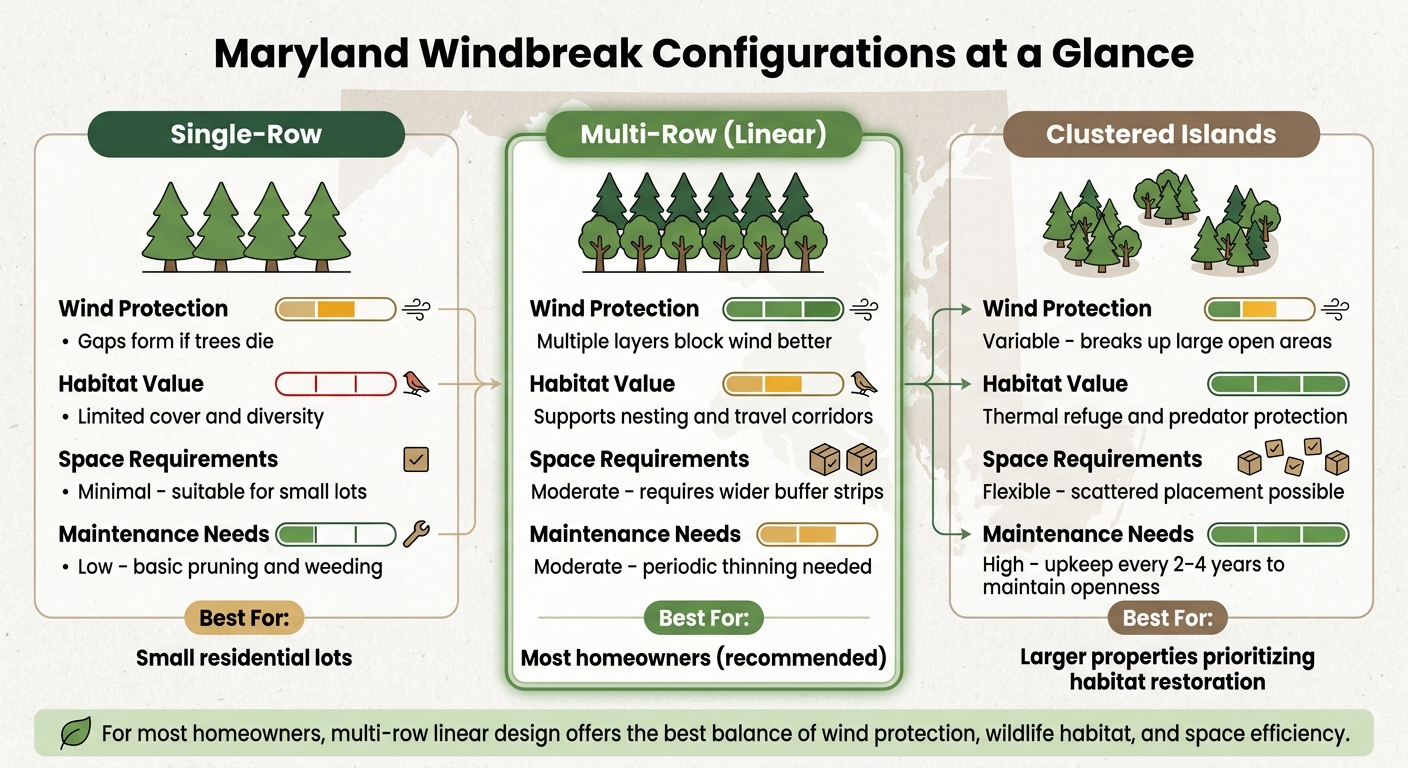
Maryland Windbreak Configurations: Wind Protection, Habitat Value & Maintenance Compared
Key Design Principles
Creating an effective windbreak starts with a layered approach. Using a mix of tree and shrub species is crucial – aim for at least two or more species to enhance both wind protection and habitat value. For example, dedicating about one-third of the cover to smaller trees and shrubs can support species like quail and woodcock, which thrive in early successional habitats. Instead of rigid straight lines, consider grouping shrubs and trees into clusters. This arrangement improves thermal cover and reduces the risk of predation. Ideally, these clusters should be spaced at least 100 yards apart and surrounded by native grasses and forbs to allow safe movement for wildlife. Pairing woody plants with native ground cover further enhances the habitat.
As Kyle Magdziuk from Tall Timbers explains:
"Hedgerows with high structural and species diversity can contribute to the connectivity of habitat islands and provide shelter for wildlife."
To maintain these windbreaks, practices like thinning, coppicing, or mowing should be done in early spring, typically between March and early April. This timing helps avoid disturbing nesting wildlife while preserving winter cover for the next season [2]. These principles can also be scaled down for residential properties without losing their effectiveness.
Adapting Designs to Residential Properties
When applying these principles to residential spaces, opt for smaller trees that stay under 25 feet after 20 years. This ensures the windbreak provides habitat benefits without overwhelming limited areas. Species like serviceberry, American plum, and silky dogwood are excellent choices, offering both food and shelter for local wildlife. A three-tiered design works particularly well:
- Back row: Tall evergreens for year-round wind protection.
- Middle row: Deciduous trees for seasonal diversity.
- Front row: Low-growing shrubs to create vertical structure.
This staggered layout not only boosts habitat value for ground-nesting birds and pollinators but also enhances windbreak performance. Positioning the windbreak perpendicular to prevailing winter winds – often from the north and northwest in Maryland – further increases its effectiveness. During the establishment phase, using tree shelters or tubes can help protect young deciduous seedlings from deer browsing [2].
Comparing Windbreak Configurations
Selecting the right windbreak configuration depends on available space, goals, and the level of upkeep you’re prepared to manage. Here’s a quick comparison of the three most common designs:
| Configuration | Wind Protection | Habitat Value | Space Requirements | Maintenance Needs |
|---|---|---|---|---|
| Single-Row | Moderate; gaps form if trees die | Low; limited cover and diversity | Minimal; suitable for small lots | Low; basic pruning and weeding |
| Multi-Row (Linear) | High; multiple layers block wind better | Moderate; supports nesting and travel corridors | Moderate; requires wider buffer strips | Moderate; periodic thinning needed |
| Clustered "Islands" | Variable; breaks up large open areas | High; thermal refuge and predator protection | Flexible; scattered placement possible | High; upkeep every 2–4 years to maintain openness |
For most homeowners, a multi-row linear design strikes a good balance between wind protection, wildlife benefits, and space efficiency. However, if you have a larger property or aim to prioritize habitat restoration, clustered island setups can offer more ecological advantages over time [2]. These configurations highlight how thoughtful design can meet both ecological and practical needs.
Recommended Plant Species for Maryland Windbreaks
Choosing the right plants for a windbreak can turn it into a haven for wildlife. Maryland boasts over 120 native tree species and more than 80 native shrubs [2]. The real challenge isn’t finding options – it’s narrowing them down to the best fit for your location. Native plants are the go-to choice here. They thrive in local soils and climates, need less water once they’re established, and provide unmatched support for local ecosystems.
"Native plants interact favorably with natural areas beyond your property. If you choose native plants, their dispersal and cross-pollination with plants in natural areas will support local ecosystems and wildlife rather than harm them." – University of Maryland Extension [4]
The following sections highlight some of the top native evergreen, deciduous, and pollinator-friendly plants to help you get the most out of your windbreak.
Evergreens for Year-Round Cover
For consistent coverage throughout the year, Eastern Redcedar (Juniperus virginiana) is a standout. Growing 40–50 feet tall with a 10–20-foot spread, it handles heat, wind, and salt with ease. It also provides nesting spots and winter berries that cedar waxwings rely on. Another excellent option is American Holly (Ilex opaca), which grows 15–30 feet tall, produces winter berries, and thrives in wet soil and shady areas – conditions that challenge many non-native plants. If your property is on the Coastal Plain, Atlantic White Cedar (Chamaecyparis thyoides) offers thick, reliable cover. Just keep Eastern Redcedar away from apple or hawthorn trees to avoid cedar-apple rust [2].
Deciduous Trees and Shrubs
Adding deciduous species to your windbreak introduces seasonal variety and critical food sources. Winterberry Holly (Ilex verticillata) is a standout for its bright red berries, which stick around through winter and provide food when other options are scarce. Blackhaw Viburnum (Viburnum prunifolium) grows 12–15 feet tall, blooms in spring for pollinators, and produces fruit that attracts wildlife well into fall. Flowering Dogwood (Cornus florida) is another must-have. Its high-fat seeds are especially important for migrating birds that need to build energy reserves. For an added bonus, Spicebush (Lindera benzoin) serves as both a food source and a host plant for the Spicebush Swallowtail butterfly.
Pollinator-Friendly Shrubs
The shrub layer is where pollinators truly thrive. Ninebark (Physocarpus opulifolius) grows 5–10 feet tall, offering nectar for bees and nesting cover [3]. Common Elderberry (Sambucus canadensis) is another excellent choice, providing high nectar value and edible berries that attract a wide range of insects and birds. For something unique, Common Witchhazel (Hamamelis virginiana) blooms in late fall, sometimes as late as December. This rare late-season flowering offers a vital resource for pollinators when almost nothing else is in bloom.
"Consider planting multiple varieties of plants as your windbreak, so that should a pest or disease problem crop up in the future, you would not lose all of them at once." – Maryland Certified Professional Horticulturists [3]
Species Comparison Table
| Common Name | Height | Spread | Wildlife Benefits | Best For |
|---|---|---|---|---|
| Eastern Redcedar | 40–50 ft. | 10–20 ft. | Nesting; winter berries for birds | Year-round wind protection |
| American Holly | 15–30 ft. | 10–20 ft. | Winter berries; cover | Wet soils; shade tolerance |
| Atlantic White Cedar | 40–50 ft.+ | 10–20 ft. | Dense cover | Coastal Plain properties |
| Winterberry Holly | 6–12 ft. | ~10 ft. | Winter berries for birds | Mid-layer food source |
| Blackhaw Viburnum | 12–15 ft. | 8–12 ft. | Pollinator flowers; wildlife fruit | Seasonal diversity |
| Flowering Dogwood | 15–30 ft. | 15–20 ft. | High-fat seeds for migrating birds | Mid-layer deciduous cover |
| Spicebush | 6–15 ft. | 6–15 ft. | Host plant; berries | Understory shrub layer |
| Ninebark | 5–10 ft. | 6–10 ft. | Nectar; nesting cover | Front-row pollinator support |
| Common Elderberry | 6–12 ft. | 6–12 ft. | High nectar; edible berries | Biodiversity boost |
| Common Witchhazel | 8–20 ft. | 10–20 ft. | Late-season pollinator blooms | Fall/winter gap coverage |
To ensure your windbreak thrives, keep these care tips in mind: tailor your plant choices to your specific region in Maryland – whether Coastal Plain, Piedmont, or Mountain – since soil and moisture conditions differ widely [4]. Shrubs should generally be spaced 3–6 feet apart within a row, with 6–10 feet between rows. Evergreens need more room, about 20–25 feet, to grow without crowding. For the first two years, consistent watering is key to helping new plants establish. Proper spacing and care will ensure your windbreak supports wildlife corridors and promotes local biodiversity [5].
Practical Applications for Maryland Homeowners
Based on our research, here’s how Maryland homeowners can turn the benefits of windbreaks into real improvements for their properties.
Benefits of Windbreaks in Residential Settings
Windbreaks can reduce heating and cooling costs by anywhere from 3% to 30% while also lowering local temperatures by as much as 16°F [6]. Adding native trees to your property doesn’t just help your wallet – it can increase property values by 2% to 15% [6]. Plus, native plants are crucial for the 27% of Maryland bees that rely on specific plants for survival [6].
For year-round wind protection, evergreens like Eastern Redcedar are a great choice. Meanwhile, deciduous trees like oaks and maples provide shade in the summer but allow sunlight to warm your home in the winter. These dual benefits make a thorough site assessment an essential first step.
"Trees that shade your home in the summer and block cold winds in the winter can help you reduce the costs of air conditioning and heating." – University of Maryland Extension [6]
Site Assessment and Planning
Start by identifying the prevailing wind directions on your property. For maximum winter protection, plant evergreens on the north, northwest, or west sides of your home [6]. Keep in mind that windbreaks are most effective within a zone that extends 10 to 30 times the height of the trees. For example, a row of 20-foot trees can shield an area up to 600 feet deep [7].
Soil type matters, too. Red maple and sweetbay magnolia thrive in wet conditions, while most evergreens need well-drained soil [6]. When planting near your home, keep small trees at least 15 feet away from the foundation, and for species near power lines, choose ones that won’t grow taller than 25 feet [6]. A simple guideline for spacing: the minimum distance from your home should be half the tree’s mature canopy width [6].
To help with costs, Maryland’s Department of Natural Resources offers a $25 rebate per tree through the "Marylanders Plant Trees" program [6]. Careful planning ensures your windbreak not only serves its purpose but also complements your overall landscape.
Combining Windbreaks with Other Landscape Features
Windbreaks are most effective when integrated into a broader landscape design rather than planted as a single row of trees. Pairing them with rain gardens featuring moisture-loving plants like river birch or blackgum can help manage stormwater runoff while protecting the Chesapeake Bay watershed [6]. Adding native grasses and wildflowers at the base of windbreaks creates habitats that are vital for Maryland’s declining bird and pollinator populations [2].
For properties with patios or walkways, a well-placed windbreak can do more than block wind – it can enhance your outdoor living space. By reducing wind chill and attracting songbirds and butterflies, these functional features become enjoyable elements of your yard. Local experts like Pro Landscapes MD specialize in combining windbreaks with drainage solutions, grading, and native plantings, creating designs that benefit both homeowners and the environment across central Maryland.
Conclusion and Key Takeaways
Key Points Recap
From 2013 to 2024, Maryland experienced a 48% decline in early successional habitat, dropping from 224,608 acres to just 118,022 acres [2]. This habitat loss has been accompanied by significant declines in wildlife: grassland bird populations fell by 75%, and scrub-dependent species declined by 58% during the same period [2]. Native windbreaks offer a solution by recreating layered habitats essential for these species. Beyond their ecological importance, windbreaks offer practical benefits: they can lower heating energy use by up to 25%, reduce soil erosion by as much as 80%, and store 27% more organic carbon compared to nearby open land [1]. These statistics highlight the dual ecological and economic advantages of windbreaks and provide a roadmap for action.
Next Steps for Homeowners
You can take steps to improve local wildlife habitats and enjoy practical benefits like reduced energy costs and soil conservation. Start by identifying your goals for a windbreak – whether it’s for wildlife, energy savings, or both. Then, evaluate your property’s soil, vegetation, and planting areas to determine the best approach. Select native species suited to your location and commit to maintenance every 2–4 years to ensure the habitat remains effective.
For tailored advice on windbreak design and plant selection, reach out to Pro Landscapes MD for guidance.
FAQs
How wide should a windbreak be for my yard?
A good windbreak for your yard is typically 20 to 30 feet wide. This width not only helps to slow down wind effectively but also creates a supportive space for wildlife. When designed well, windbreaks serve both practical purposes and contribute to the environment.
Which native plants work best for my part of Maryland?
Native plants that thrive in Maryland include Eastern red cedars, American hollies, Virginia sweetspire, and native viburnums. These species are excellent choices for creating windbreaks and play a crucial role in supporting local wildlife by offering both shelter and food.
How do I keep a windbreak from turning into woods?
To keep a windbreak from turning into a dense forest, regular pruning and thinning are essential. These practices help maintain its primary purpose – reducing wind impact and protecting soil, crops, or livestock. By managing growth, the windbreak stays as a mix of trees and shrubs, offering wind protection while also supporting wildlife habitats without becoming overgrown.
Chat with Us