









- bhavya gada
- No Comments
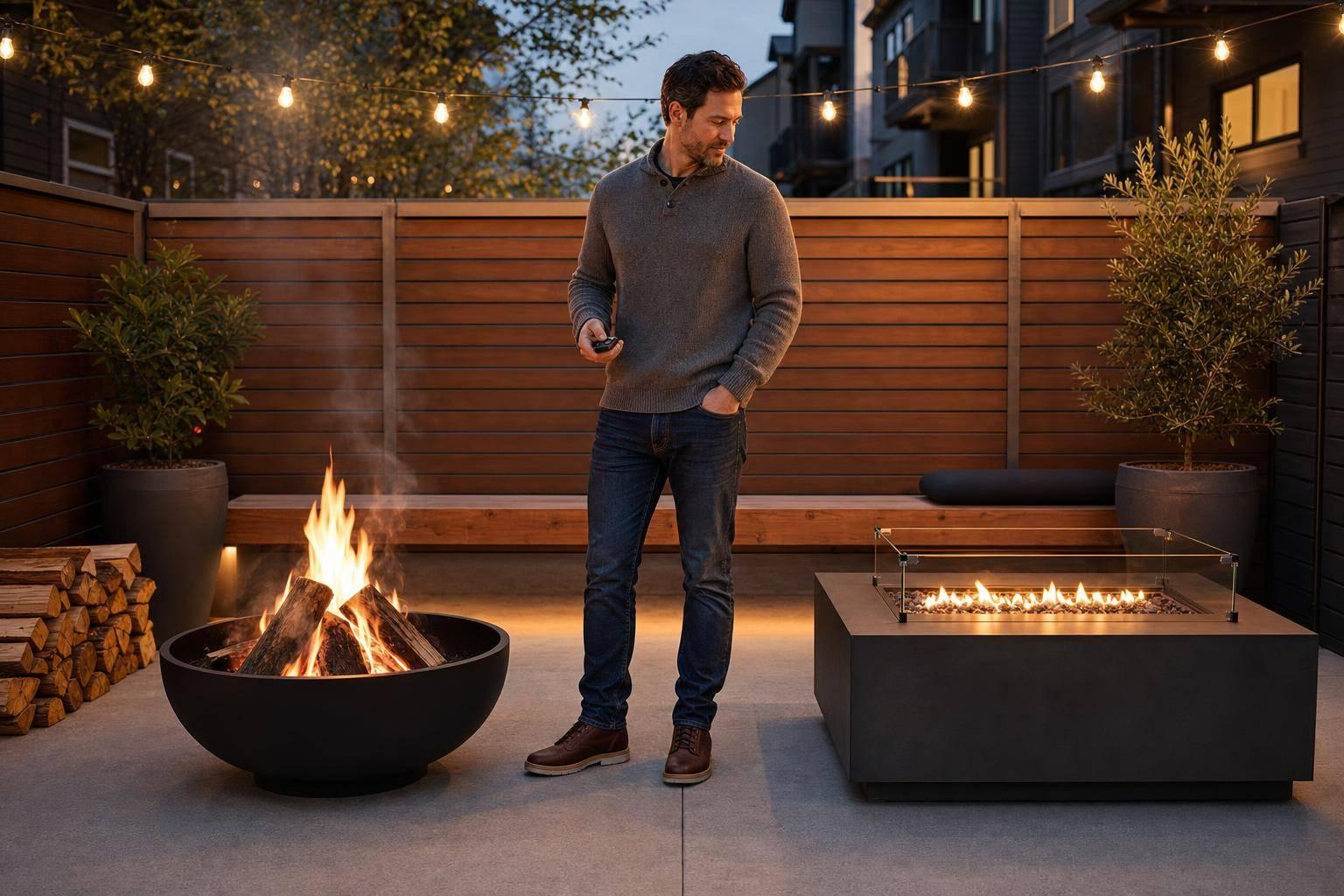
If I want the short answer: wood gives me more heat and that campfire feel, while gas gives me instant fire, less smoke, and less cleanup.
For most Maryland backyards, the choice comes down to 4 things (as seen in our fire pits portfolio):
- Smoke and air: Gas burns far cleaner. Wood can put out 300–400 mg of particulate matter per hour, while gas stays under 5 mg per hour.
- Cost: Wood often costs less to start. Built-in gas units often cost more because of line work. Natural gas, though, can run for about $0.50–$1.50 per hour.
- Heat and feel: Wood can reach 80,000–200,000+ BTUs and gives off crackle, smell, and sparks. Gas usually lands around 40,000–90,000 BTUs with a steady flame.
- Upkeep and rules: Wood needs fuel storage, fire tending, and ash cleanup after each use. Gas starts right away and is often a better fit for HOAs and tighter lots.
If I have a larger yard and want the full fire-building experience, wood may fit better. If I want a fire pit I’ll use often, in a packed neighborhood or finished patio, gas is often the simpler pick.
Maryland weather matters too. Humid summers can make firewood damp, and many neighborhoods have stricter limits on smoke and ember risk.
Quick Comparison
| Factor | Wood Fire Pit | Gas Fire Pit |
|---|---|---|
| Flame style | Bigger, livelier flame | Steady, controlled flame |
| Heat output | 80,000–200,000+ BTUs | 40,000–90,000 BTUs |
| Startup | 15–30 minutes | Instant |
| Smoke | High | Very low |
| Cleanup | Ash after every use | Light cleaning |
| Upfront cost | Lower in many cases | Higher in many cases |
| Fuel handling | Stack and store wood | Gas line or propane tank |
| HOA fit | Often limited | Often easier to approve |
I see this as a lifestyle choice as much as a price choice: wood feels more hands-on, gas feels more convenient.
Don’t Buy a Fire Pit Until You Watch This! Gas vs. Wood Burning?
sbb-itb-843f8be
Wood Fire Pits: Pros and Cons
Wood is a good fit for homeowners who want the classic fire experience and don’t mind a little hands-on work.
Why Homeowners Choose Wood
If you want the full campfire feel, wood is hard to beat. It gives you the biggest flame, that familiar crackle, and the kind of atmosphere gas just can’t match at peak flame intensity.
It also tends to cost less at the start since there’s no gas line to install. Basic steel fire bowls start at under $50, while quality steel or cast-iron models usually range from about $100 to $1,000. If you’re going with a masonry build, professional installation often runs from $500 to $1,300 [2][5][8].
What Makes Wood Harder to Manage
Wood fires ask more from you. They take time to light, time to manage, and a bit of cleanup after every use.
In Maryland’s humidity, damp wood is a common headache. Wet fuel creates more smoke, and ash needs to be removed after each fire. It’s smart to store firewood off the ground and keep it covered so it doesn’t soak up moisture [3][5]. That small step can save you a lot of frustration later.
Ash can also cause its own mess. When it mixes with rainwater, it may stain pavers and wear down masonry joints over time [9].
Where Wood Fire Pits Work Best
Wood fire pits make the most sense in larger, open yards where smoke has room to drift away and embers can stay clear of nearby surfaces. A common rule is to keep the pit 10 to 25 feet from structures, overhanging trees, and combustible furniture, though local rules may set the exact distance [4][5].
They also look right at home in more relaxed outdoor spaces. Think natural stone surrounds, boulder accents, and casual seating like Adirondack chairs [6]. For many people, that’s part of the draw. Building the fire, tending it, and settling in for the evening is part of the experience.
If you like the idea of wood but want less smoke, smokeless inserts can be built into a custom masonry setup. You still get the wood-burning feel, just with less smoke blowing across the patio [3].
Before installing anything, check local fire codes and HOA rules. Many HOAs in master-planned communities ban wood-burning fire pits because of smoke and ember concerns [6][3].
Gas Fire Pits: Pros and Cons
Gas fire pits run on natural gas or propane, so they light right away. No kindling. No waiting. No ash to clean up later. For a lot of homeowners, that ease is the main selling point.
Why Homeowners Choose Gas
Gas fire pits burn much cleaner than wood. They produce less than 5 mg of particulate matter per hour, compared with 300–400 mg per hour for a typical wood fire [5]. In packed Maryland neighborhoods, that can make a big difference. Smoke doesn’t just stay put – it drifts into the next yard, under a pergola, or across the deck.
You also get more control. Want a lower flame for a quiet night outside? Easy. Want to shut it off fast when guests leave or the weather turns? Just turn it off.
What Can Increase Cost or Complexity
The catch is the price. A standard gas fire pit usually costs $300 to $1,500. A built-in setup can land between $5,000 and $15,000 once you factor in the structure, burner kit, and gas line work [5][4].
Propane can skip the trenching, which helps on the install side. But it comes with fuel refills, so the spend doesn’t stop after setup.
And for some people, gas just doesn’t feel the same. You get the flame, but not the crackle or the smell of burning wood.
Where Gas Fire Pits Work Best
Those trade-offs shape where gas makes the most sense. It fits especially well in finished outdoor spaces like patios, fire tables, and pergolas. Since gas fire pits don’t throw embers, they’re often easier to place near decks – as long as clearance rules are followed [2][7].
They’re also a common pick in HOA-run neighborhoods. Many master-planned communities limit or ban wood-burning fires because of smoke and ember risk. In those cases, gas is often the simpler path [3][6].
These differences stand out even more when you look at gas and wood side by side.
Wood vs Gas Fire Pits: Side-by-Side Comparison
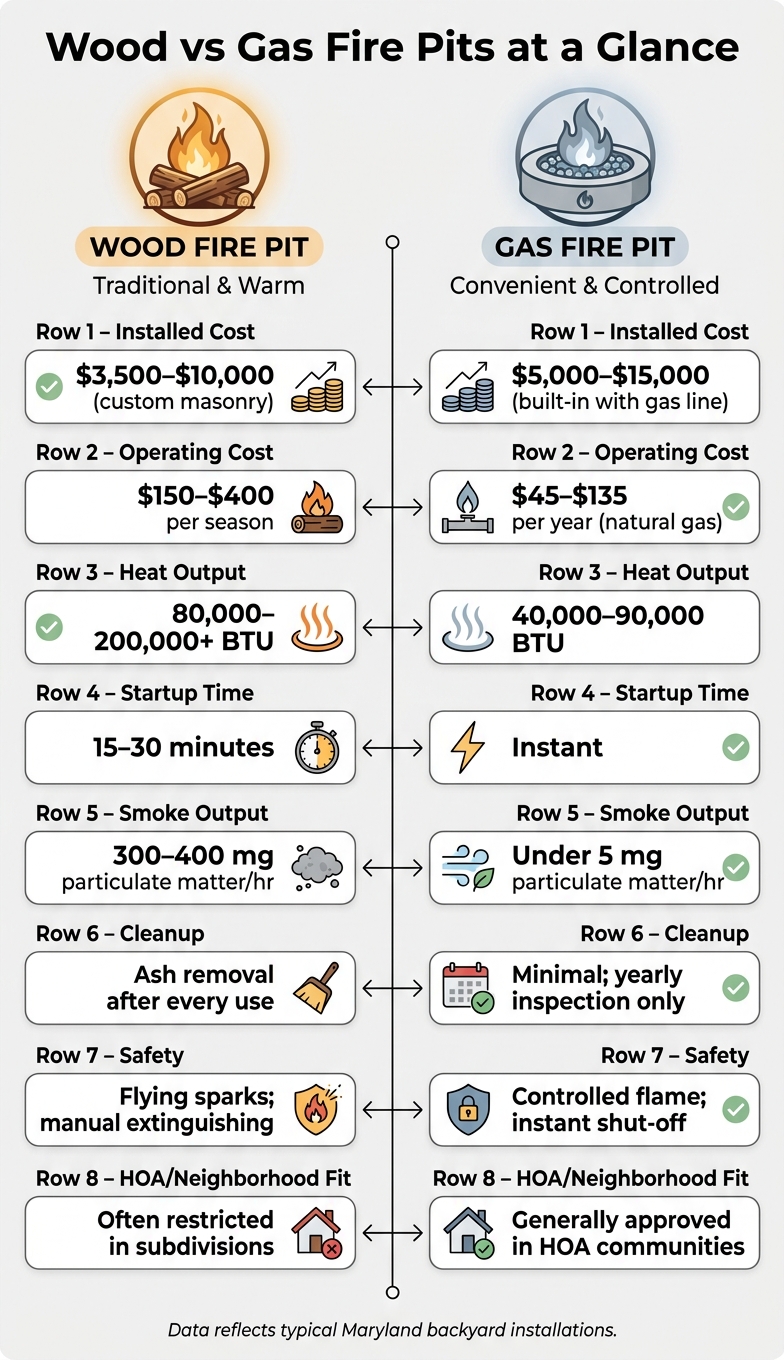
Wood vs Gas Fire Pits: Side-by-Side Comparison
When you put wood and gas next to each other, the main differences come down to cost, heat, upkeep, and where the fire pit needs to fit.
| Feature | Wood Fire Pit | Gas Fire Pit |
|---|---|---|
| Installed Cost | $3,500–$10,000 (custom masonry) [4] | $5,000–$15,000 (built-in with gas line) [4] |
| Operating Cost | $150–$400 per season [4] | $45–$135 per year (natural gas) [4] |
| Heat Output | 80,000–200,000+ BTU [4] | 40,000–90,000 BTU [4] |
| Startup Time | 15–30 minutes [4] | Instant [4] |
| Smoke Output | 300–400 mg of particulate matter per hour [5] | Under 5 mg of particulate matter per hour [5] |
| Cleanup | Ash removal after every use [4] | Minimal upkeep; yearly inspection and light cleaning [1][6] |
| Safety | Flying sparks; manual extinguishing [6] | Controlled flame; instant shut-off [1] |
| HOA/Neighborhood Fit | Often restricted in subdivisions [10] | Generally better for subdivisions and HOAs [10] |
Wood gives you a bigger flame and more heat. Gas gives you easier use, cleaner air, and less day-to-day work. So the choice usually comes down to how you want to live with the fire pit, not just how the flame looks.
Cost, Heat, and Operating Differences
Wood often starts with the lower install price. Gas can cost more up front because of the line and utility work. But once that line is in, natural gas is cheap to run: $0.50–$1.50 per hour [4].
Heat is where wood pulls ahead. Hardwood fires can reach 1,100°F and top 200,000 BTUs [5]. That makes wood a strong pick for long evenings and colder weather. Gas works well when you want fire fast, without the wait.
Maintenance, Safety, and Neighborhood Fit
Gas is simpler to live with. There’s no ash to scoop out, and upkeep usually comes down to a yearly burner inspection plus light cleaning [1][6]. Wood needs cleanup after each use, which sounds minor at first, but it adds up.
There’s also the space around the fire pit to think about. Wood fire pits usually need 10–25 feet of clearance from nearby structures. Gas units can often sit within 5–10 feet. Smoke is another big split: gas stays under 20 µg/m³, while wood can hit 800 µg/m³ [4][5]. In a tighter neighborhood, that difference matters.
How Each Fire Pit Type Fits Into a Patio or Hardscape Project
The build process changes a lot based on fuel type. A wood fire pit needs a deep masonry bowl, a firebrick liner, and proper drainage. What it doesn’t need is a utility hookup.
Gas is a different story. It calls for underground line trenching, a burner kit, and an ignition system. That’s why it makes the most sense to plan a gas fire pit during the first design phase of the patio or hardscape project. If you wait and add the line later, the retrofit can cost $2,500–$5,000 and may mean tearing up existing pavers [4].
That early planning also makes built-in layouts much easier. A gas burner can sit flush in a seat wall, work as part of a fire table, or tie into an outdoor kitchen island. Those details are much easier to sort out before the hardscape is finished.
That leads to the last question: which fuel type fits your property, habits, and layout best?
Choosing the Right Fire Pit for Your Property
Match the Fire Pit to Your Space and Habits
Start with how you’ll use it. If you want frequent fires with less upkeep, gas is usually the better fit. If you’re after that occasional, campfire-style feel, wood often makes more sense.
Space matters too. Wood-burning fire pits need more clearance than gas models, and HOA rules may block open wood burning in some Maryland communities [3][12].
How Maryland Climate and Site Conditions Affect Your Choice
After you’ve figured out how you want to use the fire pit, Maryland weather becomes the next big factor. The state’s humidity means dry firewood storage isn’t optional – it’s part of the plan [5][4]. Gas skips that problem altogether, which is a big plus if you want instant fire without dealing with a woodpile through sticky summers.
Drainage also needs attention from day one. A gravel-filled center or proper drainage beneath the structure helps stop water from pooling after heavy rain [11].
Plan the Project with Pro Landscapes MD

Fuel choice shapes more than the flame. It affects layout, drainage, and utility work, so the fire pit should be planned as part of the full hardscape design.
Pro Landscapes MD designs and builds fire pits as part of complete outdoor living projects across central Maryland, tying them into patios, seat walls, grading, and drainage from the start.
It’s smart to lock in the layout before construction begins, especially when gas lines or drainage are part of the job.
FAQs
Which fire pit is safer for families?
Gas fire pits are often a better fit for families because they don’t send sparks or embers into the air. That lowers the chance of nearby patio furniture, cushions, or landscaping catching fire. They also come with an instant shut-off, which gives you more control when you need to turn the flame off fast.
Wood-burning pits take more hands-on attention. You’ll need to watch the fire closely, use spark screens, and manage the flames with care. Gas models aren’t risk-free, though. They still need regular checks for leaks, and the gas line should be installed by a professional to help keep the setup safe.
Is propane or natural gas better for a gas fire pit?
It comes down to your property setup and how often you plan to use the fire pit.
Natural gas usually costs less over time. It also gives you a steady fuel supply, which makes it a strong choice for permanent setups at homes with utility gas access.
Propane makes more sense for rural properties, homes without gas service, or detached outdoor spaces. It gives you more freedom with installation and doesn’t require trenching.
Do I need permits for a fire pit in Maryland?
It depends on where you live and what kind of fire pit you plan to install. Rules can change from one county or city to the next, and your homeowners association may have its own limits too.
Gas fire pits connected to permanent utility lines often need permits, inspections, and pro installation. Wood-burning fire pits can be limited by local open-burn rules or burn bans. Before you install anything, check with your local fire marshal, zoning office, or building department.
Chat with Us