









- bhavya gada
- No Comments
If your Maryland yard has cracks, leaning walls, wet spots, or bulging soil, the problem may be deeper than erosion. In many cases, I’d look at anchored slope stabilization when a slope is moving, a wall is being pushed out, or water is building up inside clay-heavy ground.
Here’s the short version:
- Anchors, tiebacks, and soil nails help hold moving soil in place by tying it into firmer ground.
- Drainage matters just as much as steel. Water pressure is a main cause of slope failure, especially in clay soils after heavy rain.
- Surface fixes alone – like seed, mulch, or erosion matting – help with washouts, but they do not stop deep slope movement.
- Slopes steeper than about 3:1 often need close review, and slopes around 2H:1V or steeper often need engineering.
- Walls over about 3 to 4 feet, grading over 5,000 square feet, or earthwork over 100 cubic yards may trigger permits or engineered plans in Maryland.
- Permanent anchors are often designed for about 75–100 years.
Bottom line: if I see movement, I think in terms of structure + drainage + site repair, not a surface patch. That usually means checking soil, slope angle, groundwater, nearby patios or foundations, and local permit rules before any work starts.

Anchored Slope Stabilization: Warning Signs, Triggers & System Components
When a Yard May Need Anchored Stabilization
Warning Signs Homeowners Should Not Ignore
Fresh cracks near the top of a slope, bulging at the bottom, leaning fences or posts, and gaps opening in patios or driveways can all signal deep slope movement.[7][8]
A retaining wall that tilts forward, bows outward, cracks, or starts to rotate may be dealing with more soil pressure than it can safely hold back.[4][5][6]
New seeps or ground that stays wet in an area that used to be dry can also be a red flag. In many cases, that means groundwater conditions are shifting and the slope may be losing stability.[7][8]
This isn’t just surface wear and tear. These signs usually point to a problem below the surface, not something a cosmetic patch will fix.
Maryland Yard Conditions That Often Require Engineering Review
Steep cuts behind walkout basements and high fill slopes made during subdivision grading are common cases where anchored stabilization may come into play. These areas can be more at risk when the soil was poorly compacted or when the slope is already moving.[10]
Slopes near stormwater swales or stream corridors also need a close look. Concentrated runoff and changing water tables can weaken the soil over time.[9][12][13] At that point, the work often shifts from basic landscape repair to regulated structural work.
As a general rule, slopes at or steeper than 2H:1V usually need engineering review. Maryland erosion and sediment control guidance does not allow vegetation alone to stabilize slopes that steep.[1][3]
Permits, Grading Rules, and Erosion Control Requirements
In Maryland, engineered plans and permits are often required when a retaining wall holds back more than 3 to 4 feet of soil, supports surcharge loads like a driveway or structure, or involves more than 5,000 square feet or 100 cubic yards of grading.[11][14][15]
Work near stream buffers, drainage easements, or regulated stormwater facilities adds another layer of review. That can include erosion and sediment control rules, along with a need to use the least disruptive design.[12][13][1][16] Once a site crosses those thresholds, the work usually calls for an engineered system with anchors, facing, and drainage.
sbb-itb-843f8be
Fortifying Slope Surfaces Against Erosion with Geocells
How Anchored Slope Stabilization Systems Work
When a slope or wall starts to move, erosion control alone won’t fix it. At that point, the job is to hold the soil in place. Anchors do that by transferring force into deeper, firmer ground. In residential yards, this helps protect patios, driveways, retaining walls, and home foundations from movement happening below the surface. If you’re seeing cracks, bulging, leaning walls, or wet spots, that usually points to a deeper slope issue, not just surface runoff.
Ground Anchors, Tiebacks, and Soil Nails
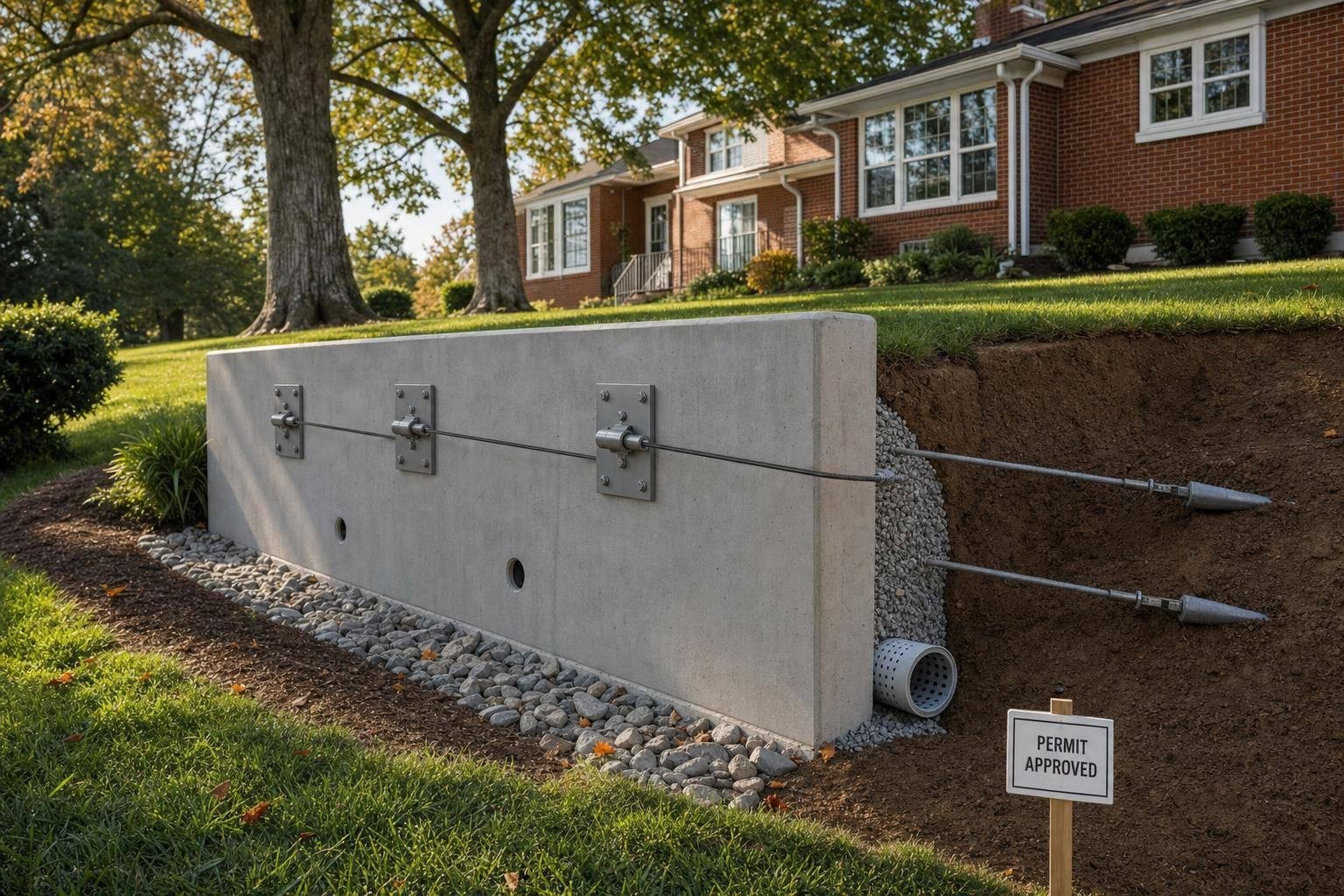
A ground anchor, often called a tieback, is a steel bar or strand placed into a drilled hole that passes through weak or moving soil and extends into firmer ground below. The end section of that hole is filled with cement grout. This creates a bonded length that locks the anchor into place. After the grout cures, a hydraulic jack tensions the anchor against a plate or beam at the face of the slope. That applies preload right away, which helps resist movement from the start.
Soil nails are also steel bars placed in drilled holes and grouted in place, but they are not tensioned after installation. They work passively, which means they only start doing their job after some movement has already happened. That makes soil nails a better fit for slopes that can handle a little movement, and less ideal next to homes, patios, or other hard surfaces where even small shifts can cause damage.
Facing, Retaining Walls, and Load-Bearing Face
Anchors need a solid surface at the slope face to push against. That surface is the load-bearing face. Its job is to spread anchor force over a broader area so the soil isn’t overstressed at one point. In Maryland yards, common facing options include modular block walls, soldier pile walls, and buried reaction blocks.
Drainage as a Required Part of the System
Drainage has to be part of the design because water pressure is often what sets slope failure in motion. Toe drains intercept groundwater at the base of the slope before pressure builds. Backdrains, made with gravel and perforated pipe behind the wall or facing, collect water before it pushes on the structure. Weep holes give trapped water a path out through the wall instead of letting it build up behind it. Surface swales redirect runoff away from the top of the slope. The right setup depends on soil strength, slope shape, and groundwater conditions.
Each system combines reinforcement, a load-bearing face, and drainage sized for the site.
Soil, Slope, and Drainage Conditions Where Anchored Systems Fit Best
The right stabilization method comes down to three things: soil strength, slope shape, and groundwater.
Soils and Slope Shapes Suited to Anchored Solutions
Anchored systems tend to work best in stiff clays, silty clays, sandy clays, and dense sands and gravels that can hold a temporary cut during installation. In central Maryland, over-consolidated clays such as Marlboro Clay, Christiana Clay, and Potomac Group materials need close attention because they can lose strength when wet and creep on slopes. That makes them more likely to become unstable and more likely to cause retaining wall distress.[23]
In this region, anchored designs often come into play after a steep cut slope is created for a walkout basement or a backyard expansion. The same goes for tall fill slopes built for patios, driveways, or elevated outdoor living areas. If a wall is too tall for shallow repairs, or if the failure surface extends deeper than surface fixes can reach, anchors can transfer the load into firm ground below the weak layer.[18][20][21]
Even when the soil looks suitable on paper, high water pressure can still push a slope toward failure.
Drainage Problems That Make Anchors More Important
Persistent seepage in the middle of a slope, groundwater close to the slope surface or behind retaining walls, and wet toes all cut into the soil’s ability to resist movement.[19] Water is often the hidden problem. When runoff from roofs, driveways, or walkways piles up at the top or base of a slope and has no clear way out, pressure builds in the soil. Once that happens, the slope can weaken much faster than it would in dry conditions.[19]
That’s why drainage and reinforcement have to work as a team. Water pressure can trigger failure or make an existing problem worse. One geotechnical guideline recommends assuming the design groundwater level is no lower than one-third of the retained height unless site monitoring shows otherwise.[24] Near homes, hardscapes, and utilities in Maryland, water management and structural stabilization need to be designed together.[2][19]
Anchors hold the structure in place. Surface work helps the slope stay intact.
When Regrading, Terracing, and Planting Are Used Alongside Anchors
In many cases, the fix isn’t just anchors by themselves. It’s a mix of anchors, drainage, and surface restoration. Most projects combine anchored stabilization with regrading, erosion-control matting, and targeted planting to protect exposed soil and cut down surface erosion.
Here’s how that often looks in central Maryland:
- Steep clay cut behind a house: Soil nails or ground anchors tie the slope face to firm ground below. If there’s enough room, the slope is flattened or terraced. Horizontal drains and surface channels carry seepage away. Erosion-control mats and deep-rooted plants help protect the surface over time.[18][20][21]
- Tall fill slope supporting a patio: Tieback anchors are often paired with retaining walls when retained soil height or slope steepness is beyond what surface repairs can handle. Regrading lowers the fill height and slope angle, back-of-wall drains and surface swales deal with runoff, and matting with groundcover helps limit erosion on the fill face.[18][20][2]
- Slope beside a ditch or stream: Anchors or driven pins can reinforce the upper bank when overall slope stability is marginal or when structures sit close to the top. Terracing forms a buffer bench, channel stabilization and controlled drainage outlets reduce erosive flow speeds, and live-stake planting with erosion-control fabrics protects the bank face.[20][21][22]
That mix helps protect the yard’s structure while also giving back usable landscape space.
How Anchored Stabilization Supports Long-Term Site Preservation
Protecting Homes, Hardscapes, Utilities, and Plantings
Once a slope is stabilized, the next step is simple: protect everything around it.
Anchored systems keep weak or shifting soil from moving downhill. That matters because slope movement doesn’t just affect the hillside itself. It can damage nearby foundations, retaining walls, patios, driveways, steps, walkways, fences, underground drainage lines, and plantings. When the soil moves or settles, the rest of the yard often goes with it.
Permanent anchors are often designed for 75–100 years of service[17], which means this isn’t meant to be a short-term patch.
A Maryland case study on failed retaining walls found that groundwater buildup and poor drainage behind walls were the main causes of failure. The fix wasn’t just rebuilding the wall. It required adding anchors and improving drainage[25]. That point matters. Anchors help resist movement, while drainage keeps water pressure from building back up. If drainage is poor, even a strong structural repair can fail.
Coordinating Structural Work with Landscape Restoration
After the structural work is done, the site still needs to be put back together.
A complete project usually pairs stabilization with restoration work like regrading, topsoil, planting, and mulch. That helps the slope work the way it should while also making the area usable again and easier on the eyes. Put another way, the structure does the heavy lifting, and the landscape work helps the site recover.
Deep-rooted vegetation also helps shield the slope face from surface washout between storms. That’s a small detail with a big role, especially on sites that take repeated runoff.
Key Points Maryland Homeowners Should Remember
Anchored slope stabilization is a structural fix for slopes with deeper movement risk. It is not a surface-level patch.
The system works because several parts work together:
- Anchors help limit movement
- Wall or facing elements support the slope surface
- Drainage components reduce water-related pressure
For Maryland homeowners, early review can stop damage from spreading and help avoid larger repair bills later. If walls are leaning, hardscapes are cracking, or drainage issues keep coming back after past fixes, the problem is likely structural and should be checked before more damage occurs.
FAQs
How do I know if my slope problem is structural?
Watch for signs of soil instability and poor drainage. Red flags include erosion that keeps coming back even with vegetation in place, deep cracks in the ground, and any sliding or soil movement. This matters even more in clay-heavy soils, which can shift when they get saturated.
Standing water near the foundation, visible settling, or slopes steeper than a 30% grade can also signal a structural problem. In those cases, planting alone may not fix it. You may need a professional assessment and structural repairs instead.
Will anchors fix water problems too?
No. Anchors are built to keep soil and other materials in place. They help with slope support, but they do not control water flow.
That means they won’t fix pooling, runoff, or water moving below the surface.
If water is the issue, you need drainage work as part of the plan. That can include:
- French drains
- Swales
- Berms
- Dry riverbeds
- Proper surface grading
In most cases, the best approach is to pair drainage with slope stabilization, not treat them as the same thing.
Do I need permits or an engineer in Maryland?
In Maryland, a grading permit is required if your project disturbs more than 5,000 square feet or involves more than 100 cubic yards of fill.
That threshold matters, but it’s not the whole story. If the work takes place in a sensitive area – such as the Chesapeake Bay Critical Area or a historic district – you’ll need a permit no matter the project size.
There’s another rule to watch for on larger home projects. For residential work covering more than 30,000 square feet, the plans must be signed and sealed by a licensed design professional, such as an engineer.
One catch: county requirements can differ, so local rules may add extra steps.
Chat with Us