









- bhavya gada
- No Comments
If you want a Maryland garden that comes back each year, start by matching plants to sun, shade, and drainage with professional landscaping services. That matters more than anything else in a state that spans USDA Zones 5b to 8a and often has heavy clay soil, wet springs, and hot summers.
Here’s the short version: sun-loving plants like Black-eyed Susan, Purple coneflower, Threadleaf bluestar, and Peonies fit bright beds; part-shade picks like Red columbine, Virginia bluebells, Golden Alexanders, Woodland phlox, and Wild geranium fit woodland edges; and Hostas work in deep shade. Most new perennials need about 1 inch of water per week in the first growing season, and many take up to 3 years to fill in.
If I were boiling the article down to the main points, it would be this:
- Pick by light first: full sun, part shade, or shade
- Check drainage before planting: many Maryland beds stay wet in spring
- Mix bloom times: early, mid-, and late-spring plants keep beds from going flat
- Plant at the right time: many spring bloomers do best when planted in late summer or early fall
- Use natives when you can: they often handle local conditions well and help pollinators
The 10 perennials covered are:
- Red Columbine
- Virginia Bluebells
- Golden Alexanders
- Woodland Phlox
- Wild Geranium
- Threadleaf Bluestar
- Black-Eyed Susan
- Purple Coneflower
- Hostas
- Peonies
The Perennial Farm in Baltimore County has tips for your Spring planting | Where’s Alexus?

sbb-itb-843f8be
Quick Comparison
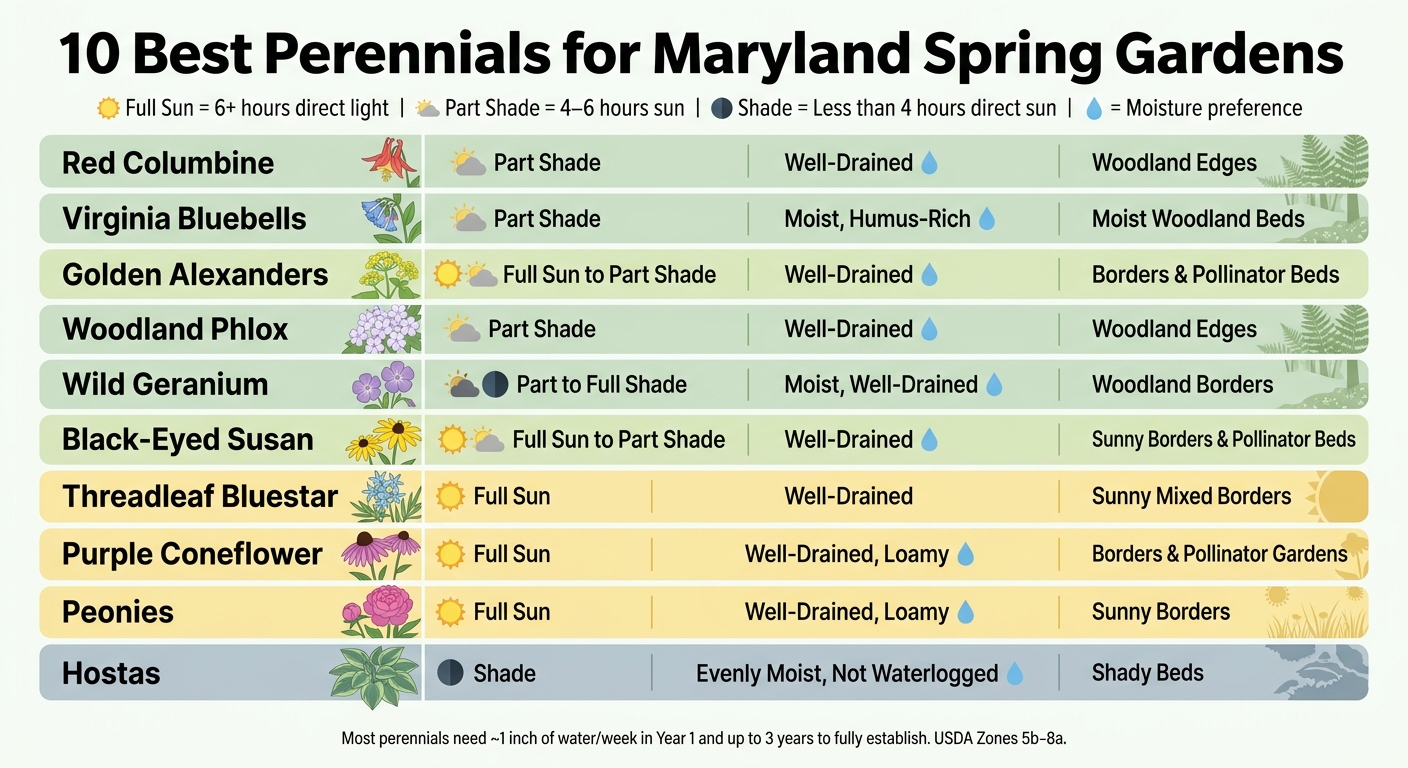
10 Best Perennials for Maryland Spring Gardens: Sun, Shade & Moisture Guide
| Perennial | Light | Soil / Moisture | Main Use |
|---|---|---|---|
| Red Columbine | Part shade | Well-drained | Woodland edges |
| Virginia Bluebells | Part shade | Moist, rich soil | Moist woodland beds |
| Golden Alexanders | Full sun to part shade | Well-drained | Borders, pollinator beds |
| Woodland Phlox | Part shade | Well-drained | Woodland edges |
| Wild Geranium | Part to full shade | Moist, well-drained | Woodland borders |
| Threadleaf Bluestar | Full sun | Well-drained | Sunny mixed borders |
| Black-Eyed Susan | Full sun to part shade | Well-drained | Sunny borders |
| Purple Coneflower | Full sun | Well-drained, loamy soil | Borders, pollinator gardens |
| Hostas | Shade | Evenly moist, not soggy | Shady beds |
| Peonies | Full sun | Well-drained, loamy soil | Sunny borders |
Bottom line: if you choose plants based on your bed’s light and moisture – not just flower color – you give them a much better shot at coming back strong each spring.
What to Look for in Maryland Spring Perennials
Picking the right perennial comes down to four practical things: light, drainage, bloom timing, and planting season. Get those right, and plants settle in faster and return stronger year after year.
Match Light Levels to Each Planting Bed
Before you buy anything, watch how sunlight moves across the bed. That one step can save a lot of trouble later.
Full sun means 6 or more hours of direct light each day. Plants like Black-eyed Susan and Purple coneflower do best in those spots.
Part shade means 4 to 6 hours of sun. That works well for Red columbine, Woodland phlox, and Wild geranium.
Full shade means less than 4 hours of direct sun. If you have a spot like that, Hostas are a solid fit.
Check Soil Drainage and Spring Moisture
Maryland clay tends to drain slowly, so it helps to test each bed before planting. A simple way to do that: dig a hole, fill it with water, and see how long it takes to drain.
If the water is still sitting there after a few hours, that area is too wet for most standard perennials. In low or soggy spots, it’s better to plant moisture-tolerant perennials instead of trying to force dry-soil plants to survive there [3][4].
Plan for Early-, Mid-, and Late-Spring Bloom
One of the most common mistakes is filling a bed with perennials that bloom all at once. It looks good for a short stretch, then fades fast.
A better approach is to mix plants with different bloom windows. Threadleaf bluestar opens in May, Golden Alexanders bloom into early June, and Black-eyed Susans carry color into summer [4]. That timing helps spread color across the 10 plants below instead of stacking it into one brief burst.
Choose the Right Planting Season for Each Type
The University of Maryland Extension puts it plainly:
"Plant late summer or fall-flowering perennials in the spring and spring-flowering perennials in late summer or early fall." – University of Maryland Extension [2]
So for spring planting, focus on summer- and fall-blooming perennials. Save spring bloomers for late summer or early fall. For summer and fall bloomers like Black-eyed Susans, late April to early May is a safe planting window after Maryland’s final frost [6].
Most perennials need up to three years to fully establish.
Use these checks to match each plant below to the right Maryland bed.
1. Red Columbine
Red Columbine (Aquilegia canadensis) does well in part-shade Maryland beds, especially where it gets light shade and soil that drains well. It’s a good fit for woodland edges and lightly shaded garden areas, and its red and yellow blooms show up in mid-spring. That gives it one of the earliest bloom periods on this list.
2. Virginia Bluebells
Virginia Bluebells (Mertensia virginica) are a great fit for moist, part-shade garden beds in Maryland. They do best in humus-rich soil and bloom in early spring.
After they flower, they fade back and leave space for later perennials as the season moves along.
3. Golden Alexanders
As Virginia bluebells start to fade, Golden Alexanders (Zizia aurea) step in and keep the bed going through late spring. Their bright yellow flowers add a cheerful pop of color, and the plants stay a neat 18 to 24 inches tall, so they’re easy to tuck into borders [3].
This native perennial grows well in Zones 4 through 9. It handles full sun to partial shade and does well in Maryland’s well-drained garden soils.
Golden Alexanders also earn their keep in pollinator gardens. They attract butterflies and hummingbirds [3]. The plant’s loose shape fits right into cottage-style and naturalistic beds, where it helps connect spring bloom with the first wave of summer color.
4. Woodland Phlox
As Golden Alexanders start to fade, Woodland Phlox (Phlox divaricata) takes over and keeps the bed looking alive through late spring. It brings soft, star-shaped flowers in loose clusters to part-shade beds and woodland edges, and it prefers part shade.
This plant grows well across Maryland’s USDA hardiness zones 5b to 8a [6]. It does best in well-drained soil with a slightly acidic to neutral pH of 6.0–7.0 [6].
Maryland’s humid spring weather can set the stage for mildew, so airflow matters. Thin a few stems at the base each year to improve air movement and lower mildew risk [2].
Plant Woodland Phlox in late summer or early fall so it has time to settle in before spring bloom [2][6].
5. Wild Geranium
Wild Geranium (Geranium maculatum) is another strong native pick for part-shade gardens. In Maryland, it does especially well in part to full shade, which makes it a good fit for woodland borders and naturalized plantings.
It grows across Maryland’s Zones 5b to 8a [6] and tends to do best under deciduous trees, where it gets partial to full shade.
This plant likes moist, well-drained soil. If the ground stays soggy, it usually won’t do well.
Its spring flowers help support pollinators, and once established, Wild Geranium is pretty low-maintenance in shaded beds.
6. Threadleaf Bluestar
Threadleaf Bluestar adds a soft, airy look to sunny Maryland beds, along with May flowers and strong fall color. Threadleaf Bluestar (Amsonia hubrichtii) fits nicely into sunny mixed borders in Maryland. It comes up early in spring and blooms in May with small clusters of blue flowers. Its feathery foliage looks good through summer, then turns gold in late fall [4].
Once mature, it reaches about 4 feet tall and 4 feet wide, though it usually needs 4 to 5 years to fill in [4]. For the best shape and bloom, plant it in full sun with well-drained soil. Leave the stems standing through winter. Even after they turn brown, they tend to stay upright and can serve as nesting sites for non-stinging native bees [2].
7. Black-Eyed Susan
If you want color to carry from spring into summer, Black-Eyed Susan is a smart pick. It’s a dependable Maryland perennial for sunny beds.
Black-Eyed Susans bloom from July into fall, so it helps to plant them in late April or early May. That gives the roots time to settle in before the summer heat hits [6]. They usually grow to about 3 feet tall, and their bright yellow flowers draw bees and butterflies [1][6].
They grow best in full sun and well-drained soil, though they can handle partial shade too [5][6]. After they’re established, they can handle dry spells. During the first season, aim for about 1 inch of water per week [6].
One thing to watch: they spread fast. Divide clumps every few years in early spring or fall to keep them in check [1][2]. You can also leave the seed heads in place for winter interest and bird food [2]. Their long bloom period helps connect spring planting with summer color.
8. Purple Coneflower
Purple coneflower (Echinacea purpurea) is another sun-loving perennial that lines up well with Maryland’s spring planting window. It’s a hardy pick for sunny beds and works especially well in borders and pollinator gardens, since the flowers attract bees and butterflies. It usually grows up to 3 feet tall, with purple petals and orange-brown centers that stand out nicely in mixed plantings [1].
Plant it after the last frost, which in Maryland is often late April through early May. It grows best in full sun and well-drained, loamy soil with plenty of organic matter. During the first season, give it about 1 inch of water per week, and don’t let the soil stay soggy [6].
Once the plant settles in, it handles dry spells well. In fall, leave the seed heads standing through winter. They feed birds and also give helpful insects a place to overwinter [6].
9. Hostas
For the darkest Maryland beds, it makes sense to swap sun-loving perennials for hostas. They bring steady foliage, shape, and contrast to shady spots, and they grow well across Maryland’s zones 5b to 8a. Each spring, they come back from the crown [2][6].
Hostas are grown mostly for their leaves, not their flowers. Foliage color can range from light green to blue. If flower stalks start to look tired, cut them back so the plant can put more energy into leaf growth [2][7].
Good soil makes a big difference. Plant hostas in well-drained soil mixed with compost, and aim for a slightly acidic to neutral pH of 6.0 to 7.0 [6]. Keep the soil evenly moist but not waterlogged, since soggy soil can lead to root rot [6].
A thin layer of mulch helps the soil stay moist, but don’t pile it against the crowns [2].
10. Peonies
If you want a standout perennial for a sunny border, peonies are tough to top. They grow well across Maryland’s zones 5b to 8a [6], and in late spring they put on a big show with large, eye-catching flowers. Because of that, site choice and drainage matter most.
Peonies do best in full sun. Plant them in well-drained, loamy soil that’s rich in organic matter, with a pH between 6.0 and 7.0 [6]. That drainage piece matters a lot in Maryland, especially if you’re dealing with heavy clay. Skip soggy areas, since peonies need soil that drains well.
They also take their time. Peonies establish slowly and may need up to three years to reach full size [2].
If you want bigger blooms, remove the side buds and leave the center bud in place. That pushes the plant to produce a larger flower on a longer stem [2].
Spring is the right time to pick the planting spot. Then set new peonies in the ground in late summer or early fall [2]. After frost, add 1 inch of mulch, but keep it away from the crown [2].
Use the comparison table below to match each perennial to the right Maryland bed.
Quick Comparison Table for Maryland Garden Conditions
Use this table to match each perennial to the right light and moisture conditions at a glance.
| Perennial | Sun Exposure | Moisture Preference | Best Garden Use |
|---|---|---|---|
| Red Columbine | Part shade | Well-drained soil | Woodland edges and lightly shaded beds |
| Virginia Bluebells | Part shade | Moist, humus-rich soil | Moist woodland beds |
| Golden Alexanders | Full sun to part shade | Well-drained soil | Borders and pollinator beds |
| Woodland Phlox | Part shade | Well-drained soil | Woodland edges |
| Wild Geranium | Part to full shade | Moist, well-drained soil | Woodland borders and naturalized plantings |
| Threadleaf Bluestar | Full sun | Well-drained soil | Sunny mixed borders |
| Black-Eyed Susan | Full sun to part shade | Well-drained soil | Sunny borders and pollinator beds |
| Purple Coneflower | Full sun | Well-drained, loamy soil | Borders and pollinator gardens |
| Hostas | Shade | Evenly moist, not waterlogged soil | Shady beds |
| Peonies | Full sun | Well-drained, loamy soil | Sunny borders |
Start with the site, then pick the plant. The care tips below will help each one settle in well.
Planting and Care Tips for Long-Term Success
Once you’ve matched the right perennial to the right bed, planting and aftercare make a big difference. These steps help Maryland perennials settle in faster, especially in clay soil, wet spring conditions, and hot summer weather.
Improve Clay Soil Before Planting
Work compost into heavy soil to improve drainage and loosen the structure. Dig a wide, shallow hole instead of a deep one, since deep holes in clay can trap water around the roots.
Set the crown at soil level or slightly above it. If the roots are circling, loosen them before planting. In Maryland, where spring clay can stay dense and wet, this prep work does a lot of the heavy lifting.
Water Deeply During the First Growing Season
New perennials need steady moisture while they get established. Plan on about 1 inch of water per week during the first growing season [6].
A simple approach works well:
- Pre-water the planting hole
- Let the water drain
- Then plant
That helps roots settle into evenly moist soil instead of dry pockets.
Use Mulch Without Burying Plant Crowns
Add about 1 inch of organic mulch, like shredded leaves, to help the soil hold moisture between waterings. Just don’t pile mulch against the crown. Keep it pulled back a bit so the plant doesn’t sit in damp material, which can lead to rot.
Divide Clump-Forming Perennials at the Right Time
Clump-forming perennials should usually be divided every three years, or sooner if the center starts to thin out [2]. Timing matters here.
- Divide spring and summer bloomers after flowering, in late summer or fall [2]
- Divide fall bloomers in early spring [2]
If a plant looks tired in the middle but still grows around the edges, that’s often your cue.
Fix Drainage Problems in Low Areas
Take care of wet spots before you plant. If water still sits in the area after rain, regrade the space or add drainage first. Roots won’t do well if the soil stays soggy.
For persistent drainage problems, Pro Landscapes MD offers grading, yard leveling, and French drain installation across central Maryland.
Conclusion
The best Maryland spring gardens rely on a smart mix of perennials that match the site. When you pair the right plants with the right levels of sun, shade, and moisture, a Maryland garden bed can stay active through the season.
Native and well-suited perennials usually need less upkeep once they’re established, and they help support local pollinators. Plants like Black-Eyed Susans, Golden Alexanders, and Purple Coneflowers tend to spread in a natural way and handle Maryland conditions with less hands-on work over time.
Start small with two or three plants that suit your bed. Then add more as the garden starts to settle in.
FAQs
How do I know if my garden bed drains well enough?
Check whether the soil stays moist without becoming waterlogged. Proper drainage helps prevent problems like root rot and soil erosion.
If you’re not sure what your soil is doing – or you want help getting garden beds ready for spring – Pro Landscapes MD offers professional landscaping and site evaluation services across central Maryland.
Which of these perennials do best in clay soil?
Several of these perennials grow well in Maryland’s clay soils. Liatris and Golden Alexander are strong picks because they handle many soil types without much fuss. Penstemon also works well, especially if your yard shifts between dry and moist conditions.
If you want help with soil prep, drainage, or the layout of your landscape, Pro Landscapes MD offers professional services across central Maryland.
What should I plant together for longer spring color?
For spring color that sticks around longer, pair perennials with overlapping bloom times. That way, one plant starts to flower just as another begins to fade.
You can also add spring-blooming bulbs like daffodils, or tuck in annuals to fill bare spots. Mixing textures, heights, and flower shapes helps the garden stay lively all season.
Chat with Us