









- bhavya gada
- No Comments
If I had to pick one stone for a Maryland patio, I’d start with granite. It usually absorbs under 0.5% water, so it handles Maryland’s roughly 30 to 50 freeze-thaw cycles per year better than most other options. Dense bluestone is close behind, while slate and flagstone depend a lot on grade and quarry source. Limestone can work, but only in dense grades with strong drainage.
Here’s the short version:
- Best overall: Granite
- Strong second choice: Dense bluestone
- Can work if you check test data: Slate and flagstone
- Most risky in winter: Limestone
- Main thing to check: Water absorption
- Main install detail: A slope of about 1/8 to 1/4 inch per foot helps move water off the patio
The big point is simple: stone fails when water gets in and freezes. That means you need to look at absorption rate, crack risk, surface wear, and Maryland climate fit. And even the best stone can still crack or shift if the base holds water.
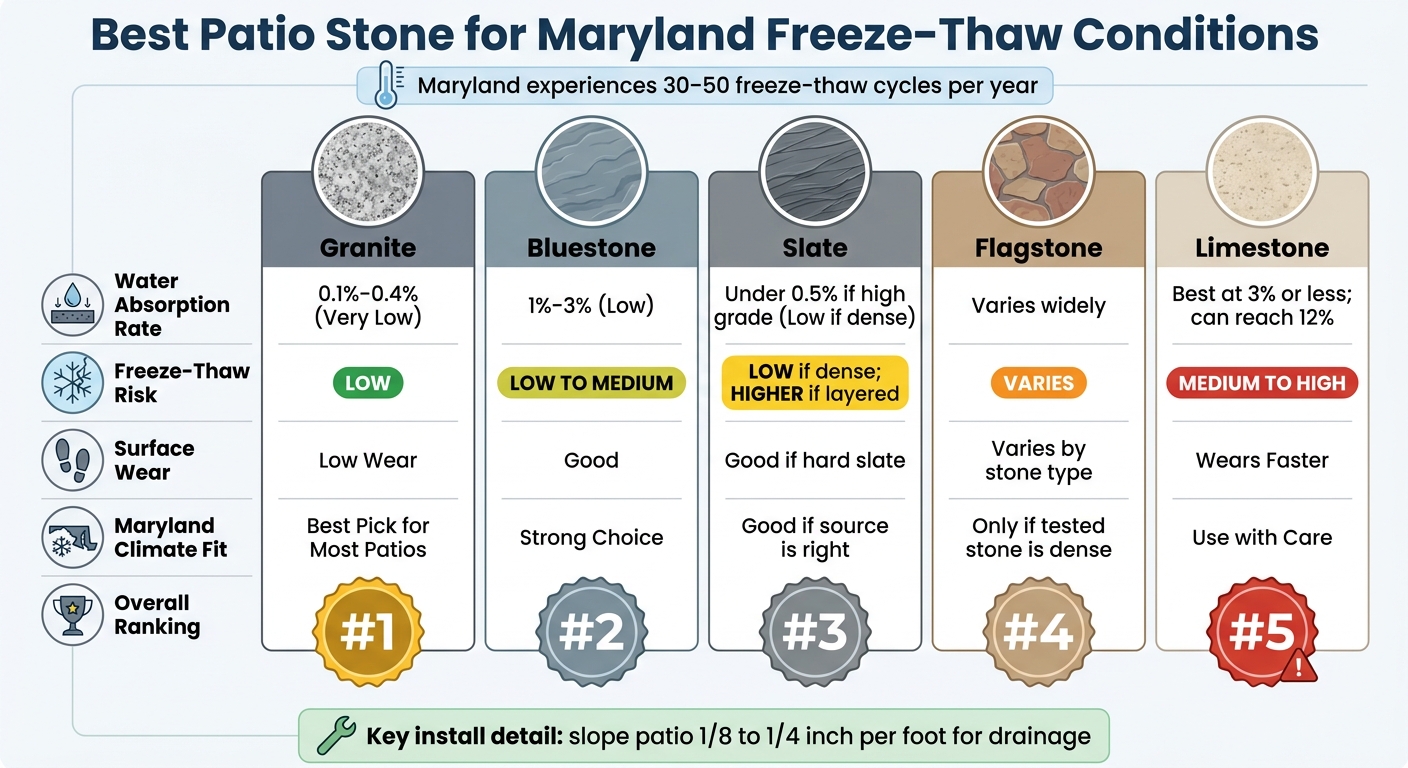
Best Patio Stone for Maryland Freeze-Thaw: Side-by-Side Comparison
Stop Patio Frost Heaving Fast with These Easy Tips
sbb-itb-843f8be
Quick Comparison
| Stone | Water Absorption | Freeze-Thaw Risk | Surface Wear | Maryland Fit |
|---|---|---|---|---|
| Granite | Very low: often 0.1%–0.4% | Low | Low wear | Best pick for most patios |
| Bluestone | Low: often 1%–3% | Low to medium | Good | Strong choice |
| Slate | Low if high grade: often under 0.5% | Low if dense; higher if layered | Good if hard slate | Good if source is right |
| Flagstone | Varies a lot | Varies a lot | Varies by stone type | Only if tested stone is dense |
| Limestone | Varies; best at 3% or less | Medium to high | Wears faster | Use with care |
So if you want the short answer, I’d rank them like this for Maryland winters: granite first, dense bluestone next, then quality slate, then tested flagstone, and limestone last. The rest of the article breaks down why.
1. Bluestone
Bluestone sets the bar because it pairs low water absorption with solid cold-weather performance. It’s a dense, fine-grained sandstone that’s often used for patios in Maryland. Its water absorption usually falls between 1% and 3% by weight, and some premium stone tests at under 1%.[4][8] That matters when temperatures drop below 32°F. Less water gets into the stone, which means less internal pressure when that water freezes.
Central Maryland gets about 30 to 50 freeze-thaw cycles each year.[6] That’s a lot of stress on patio materials. Bluestone’s tight grain helps limit moisture entry, which lowers the risk of spalling and cracking.[1][9] Its dense structure also holds up well against surface wear from foot traffic and snow shovels.
For traction, finish matters. Natural cleft bluestone gives you good grip when the surface is wet. Thermal finishes can reach 0.65 to 0.80 wet DCOF.[18][19] On the other hand, honed or polished bluestone is too slick for a winter patio.
Installation is where a lot of patios either hold up or fall apart. A properly installed bluestone patio can last 50+ years.[20][13] But that kind of lifespan depends on the base and drainage. Using 2-inch-thick bluestone over a well-compacted aggregate base helps the patio stand up to heaving and cracking in freeze-thaw areas.[16]
The main trouble spot is trapped moisture under the stone. Once that water freezes, even a low-absorption material can shift, rock, and put stress on the joints. Good pitch, drainage, and a stable base are what keep bluestone in place through Maryland winters.
That’s why bluestone is the benchmark when you compare it with less uniform stones like flagstone.
2. Flagstone
Compared with bluestone, flagstone is less predictable. That’s because flagstone is a shape, not one single stone type. Its freeze-thaw performance depends on the stone itself, especially its density and porosity. So yes, flagstone can make an excellent patio material, but only if the stone you choose has low absorption and strong density.
Here’s where the difference shows up fast. Dense quartzite and slate flagstone absorb less than 1% by weight. Some sandstone can perform well at around 3% if drainage is strong. But softer sandstone and limestone can absorb 8% to 12% or more, which makes them much more likely to spall and crack.[21][24][10][5]
Before you buy, ask for the ASTM C97 water absorption percentage. For exposed Maryland patios, aim for 3% or lower. Treat anything above 5% with caution unless freeze-thaw test data backs it up.[21][22][24][5][26]
Traction matters too. Most cleft flagstone has decent grip when wet, and textured finishes can help even more. Softer sandstone, though, wears down faster under foot traffic and freeze-thaw cycling. Over time, that wear can smooth the surface and make it less safe to walk on.[21][23][25][5]
Installation also plays a big role. Dry-laid flagstone over a compacted, draining gravel base tends to handle seasonal movement better than mortared installs, since water is less likely to collect underneath.[18][22] Either way, pair the patio with a 1.5% to 2% slope away from the house and solid sub-base drainage.[22][23]
Granite is the next test case because it is far more uniform.
3. Granite
Granite is the most predictable natural stone in this comparison. Its water absorption rate is usually under 0.5% by weight, and many dense commercial paving granites test in the 0.1% to 0.4% range.[29][22][30] ASTM C615, the standard for granite dimension stone, sets a maximum absorption of 0.40% and a minimum density of 160 lb/ft³.[37][34][35]
That low absorption matters in Maryland winters. Less water gets into the stone, which means less trouble when temperatures swing below freezing. In this group, granite stands out for absorption, crack resistance, and surface wear.
High-grade granites can handle more than 240 to 300 freeze-thaw cycles under EN 12371 without major loss of strength or surface condition.[31][32][33] It also does well under wear. Granite’s compressive strength often falls between 19,000 and 25,000 psi, which helps it resist abrasion, edge chipping, and other damage from heavy use.[22][28] That makes it a smart pick for patios with regular foot traffic, moved furniture, and careful use of de-icing salts.
Traction is a different story. It depends a lot on the finish. Polished granite is a poor fit for an exposed Maryland patio because it can get slick when wet or frosty.[5][28] Go with flamed, sandblasted, or bush-hammered finishes instead. These finishes create a rough microtexture, and textured granite surfaces can reach about 0.60 wet DCOF, which is above the 0.5 outdoor threshold.[38][17]
Before you buy, check the quarry data. Absorption can change by quarry and source, sometimes running from about 0.1% to 0.8%.[31][29] Ask the supplier for ASTM C97 test data that shows absorption and density for the exact product you’re considering. For a fully exposed Maryland patio, aim for 0.4% absorption or less, and pair it with a well-compacted base and proper drainage.[10][22][39]
Slate shifts the comparison from uniform density to layered stone structure and split risk.
4. Slate
Granite tends to be uniform. Slate is a different story. Its outdoor performance depends a lot more on grade and internal structure.
Slate can work very well on a Maryland patio if it’s dense and low in absorption. But weaker slate has a nasty habit: after enough freeze-thaw cycles, it can start splitting into layers. That’s why the first number to check is water absorption.
High-quality exterior slate tests at under 0.4% water absorption by weight, and some premium products reach as low as 0.19% with a stated maximum of 0.25%.[40][45] For exposed Maryland patios, aim for slate below 0.5% absorption. Once you get above 0.6%, freeze-thaw risk climbs fast.[10][41][42][21] ASTM C121 is the standard test method for slate water absorption, so it makes sense to ask the supplier for lab results before you buy.[46][48]
S1-grade slate is the best exterior choice because it usually has the lowest absorption.[40] Lower-grade slate often contains more clay, which means it takes in more water and is much more likely to split along its bedding planes after repeated Maryland winters.[21][47] Put simply: when absorption goes up, durability goes down.[47]
Natural cleft slate also has a practical upside. It offers good grip when wet, which matters on a Maryland patio that deals with rain, snowmelt, and the odd frost.[42][21] Softer slate can flake under foot traffic and freeze-thaw stress, leaving rough, uneven spots.[21][43] Hard, dense slate holds its surface texture longer and stays safer to walk on.
Installation matters too. Set slate over a free-draining base, build in a 1% to 2% slope, and keep joints tightly filled so less water gets under the slabs.[5][14] If you use de-icing salts in winter, pick slate and joint materials that are documented as resistant to salt-related scaling, and use sealing where it makes sense.[44][5]
Dense slate can do well in Maryland. Limestone, on the other hand, is much less forgiving.
5. Limestone
Limestone is the most variable option in this group. So for winter performance, absorption matters more than looks.
On Maryland patios, the big issues are water absorption, crack risk, and how well the surface holds up over time. ASTM C568 sorts limestone by absorption:
For a Maryland patio that has to deal with freeze-thaw cycles, high-density limestone with 3% absorption or less is usually the safest pick [27][50]. Once absorption goes above 5%, the risk of spalling and cracking climbs fast [21][56].
Because limestone can vary a lot from one quarry to another, ask for ASTM C97 test results for the exact stone being sold [36][55]. If a supplier can’t show lab data, that’s a red flag for exterior use in a cold climate.
Limestone is also softer and less abrasion-resistant than granite or dense bluestone. That makes it a better fit for low-traffic patios than for busy walkways [53][54]. A honed or lightly textured finish works best, since polished limestone can get slick when it’s wet [51].
De-icing salts can also cause trouble. Rock salt may etch and scale limestone, so it’s better to use stone-safe, calcium-based ice melt products [51][10].
Installation details matter here too. A compacted, well-drained base, proper slope, and solid edge restraints help cut down freeze-thaw stress on the slabs [52]. A breathable penetrating sealer can also help limit staining and water uptake while still letting vapor escape, but it should only go on a fully dry slab [49][51][8][52].
Pro Landscapes MD can build these drainage and base details into a limestone patio installation across central Maryland. That range in performance is exactly why limestone lands as a conditional option before comparing each stone side by side.
Pros and Cons of Each Stone for Freeze-Thaw Conditions
The table below sums up the main freeze-thaw trade-offs at a glance.
| Stone | Key Pros | Key Cons | Maintenance Concerns |
|---|---|---|---|
| Bluestone | Dense, low-absorption stone that handles freeze-thaw well | Not all grades are equally dense; thinner pieces are more likely to crack on poorly drained bases [57][1][7] | Seal every 3–5 years; use non-corrosive ice melt [15][1] |
| Flagstone | Dense flagstone types do well in cold climates and give you flexible patterns and finishes [12][62] | Porous flagstone takes in much more water, which increases the risk of spalling and cracking [12][60][61] | Porous types need sealing more often; the base and drainage need to stop water from sitting under the stone [12][60][61][22] |
| Granite | Low absorption and high strength [58][59][22] | Higher cost; tougher to cut and install; harder underfoot [14][22] | Needs little sealing; holds up well against salt staining [58][22] |
| Slate | Low-absorption slate with good freeze-thaw resistance and natural traction [12][60][61] | Softer or layered types can delaminate or chip if the stone quality varies [60][61] | Avoid harsh acids; periodic sealing helps reduce surface flaking and staining [60][61] |
| Limestone | Warm, classic appearance; can work in dense grades with strong drainage and regular sealing [27][22] | Water absorption varies more than granite or slate, which increases freeze-thaw and surface-wear risk [58][59][22][61] | Seal often, use pH-neutral cleaners, avoid aggressive de-icers, and install on a well-drained base [58][59][22][61] |
That pattern leads straight into the ranking: granite and quality slate are the safest picks, dense bluestone sits in the middle, flagstone depends heavily on the exact stone you buy, and limestone needs the most care and the right site conditions.
Which Stone Works Best for Maryland Patios?
The side-by-side comparison leads to a pretty clear pecking order for Maryland patios. In most cases, granite is the top pick for freeze-thaw conditions, with dense bluestone right behind it. Both hold up well because they resist water intrusion, cracking, and surface wear. [2][22][3]
Flagstone and slate can work too, but only when the stone itself is dense and has low water absorption. Limestone is still the biggest gamble of the five. Many limestone types soak up too much water, which makes them far more likely to run into trouble during freeze-thaw exposure. [22][7]
There’s also a hard truth here: even great stone can fail if water sits under it. Stone choice matters, but freeze-thaw damage usually begins with trapped water. That’s why proper grading and a draining base are just as important as the stone on top. [5][63][64][11]
That’s the reason both stone selection and installation matter in Maryland. Pro Landscapes MD designs, installs, and repairs stone patios across central Maryland with drainage and grading built for freeze-thaw conditions.
FAQs
How do I verify a stone’s absorption rate?
Check the stone supplier’s or manufacturer’s technical specs. You’ll usually find the water absorption rate in the product data sheet or in a test report from standard lab testing.
There’s no at-home test method in the source material. If you’re choosing stone for a specific job, ask your supplier for those documents so you can confirm the material is a good fit for outdoor use.
Is a dry-laid patio better than a mortared patio in Maryland?
It comes down to what you want, but dry-laid patios are often a better fit for Maryland’s freeze-thaw weather. Because they can move a bit on their own, they’re less likely to crack or shift when the ground expands and contracts.
Mortared patios can give you a more formal look. But there’s a trade-off: rigid joints are more likely to crack when water gets trapped, freezes, and expands. No matter which option you choose, proper installation, grading, and drainage matter a lot.
Do sealers make porous stone safe for freeze-thaw patios?
Sealers add a layer of protection against moisture and weather damage, which matters for natural stone in Maryland’s climate. But sealers alone are not enough.
You still need proper drainage. Gravel backfill, weep holes, and correct grading help keep water from pooling and weakening the patio during freeze-thaw cycles.
Chat with Us